
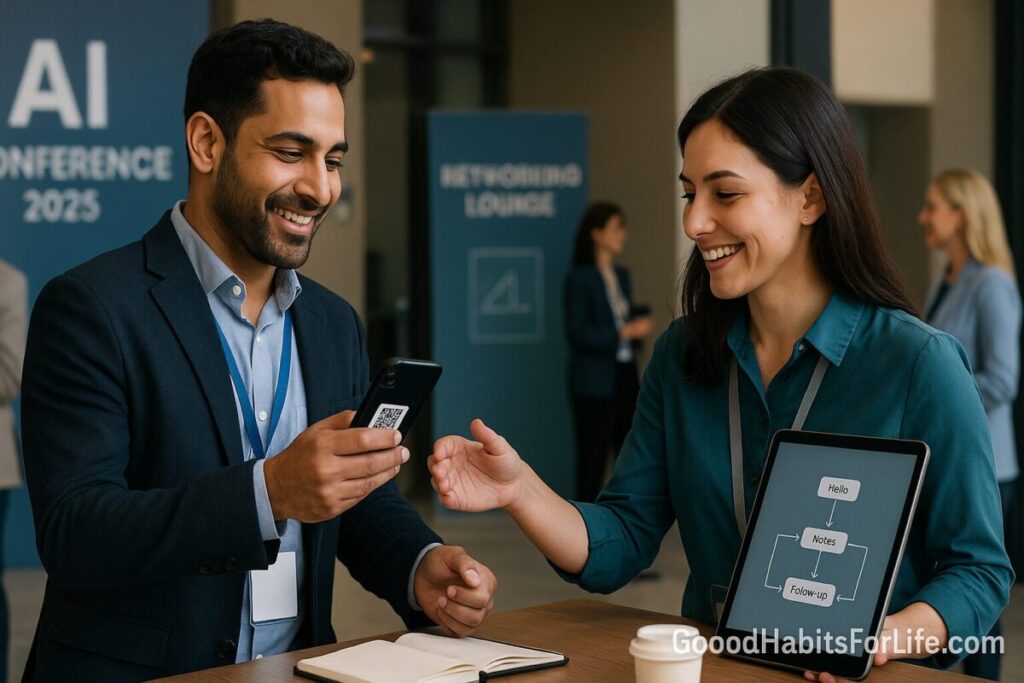
Conference Confidence: From Hello to FollowUp: AI workflows (2025)
Conference Confidence: AI Workflows from Hello to Follow-Up (2025)
Table of Contents
🧠 What & Why (clear definition + evidence)
“Conference confidence” is the skill of turning brief in-person moments into durable, mutually helpful relationships—without feeling salesy or awkward. Two research-backed truths anchor this guide:
-
Weak ties are powerful. Career opportunities often flow through acquaintances, not close friends. That’s the “strength of weak ties.” SNAPChicago Journals
-
Memory needs spacing and retrieval. People (including you) remember names and details best when you review them over spaced intervals and actively recall them—crucial for follow-ups. PubMedBates College
Also helpful:
-
Self-disclosure & asking questions. Thoughtful, reciprocal sharing and genuine questions increase liking and connection. PubMedHarvard Business School
-
Face-name association is hard—but trainable. Linking faces to names is an associative memory task; a little structure improves recall. PMC
Finally, if anxiety spikes before a talk or icebreaker, evidence-based speaking tips can help. APA+1
✅ Quick Start: Do-This-Today Checklist
-
Define 3 outcomes: e.g., meet 5 peers, schedule 2 debrief calls, learn 1 tool.
-
Create a one-page Brief: “My intro, target sessions, top 10 people, 3 questions.”
-
Prep 3 openers + 1 closer: e.g., “What drew you to this session?” → closer: “Would a 15-min debrief next week help?”
-
Capture fast: Use your phone’s voice notes post-chat; tag name + topic.
-
Follow-up rhythm: 24 hours (thank-you), 7 days (value add), 30 days (light check-in).
-
Stay human-first: Curiosity > pitch; consent > scraping; help > ask.
🧭 Pre-Event: AI Planning Workflow
Goal: Walk in with clarity, conversation starters, and a map of who matters (to them and to you).
Step-by-step
-
Define intent: 3 outcomes, constraints (time/energy), and audience types.
-
Pull the program: Export sessions + speakers into a sheet (Title, Time, Track, Speaker).
-
Build a “Priority 20” list: Speakers, panelists, and attendees aligned to your outcomes.
-
Generate smart openers (with AI):
-
Prompt idea: “Give me 3 respectful, specific conversation starters for <Person>, based on these topics: <X, Y, Z>. Avoid flattery; prioritize curiosity and usefulness.”
-
-
Craft your 30-second story: Problem you care about → how you help → proof → next step.
-
Pre-introduce yourself (selectively): Short note to 3–5 key people with a crisp ask (coffee, sit together at session). Pre-intro boosts conference ROI. Harvard Business Review
-
Ethics & privacy check: If you handle personal data (emails from badges, QR scans), ensure lawful basis (e.g., legitimate interests), transparency, and data minimization—especially for EU contacts. European Union
Deliverables you carry in:
-
One-page Brief (printed or phone-pinned), Priority 20 sheet, 3 openers per person, calendar slots for quick meets.
🗣️ On-Site: Hello Scripts, Name Memory & Small-Talk Moves
Human-first hello (3-step)
-
Context: “Hey, I’m Dheeraj—also here for the <track/topic>.”
-
Curiosity: “What were you hoping to get from this session?”
-
Bridge: “I’ve been working on <X>; if useful, happy to share a template after.”
Name-locking mini-routine (15 seconds)
-
Echo the name, tag a detail, write/record after the chat. Spaced mini-reviews later help you remember. PubMedBates College
-
Remember: face-name linking is associative; repetition + context wins. PMC
Small-talk that scales
-
Ask > tell. People like you more when you ask genuine follow-ups. Harvard Business School
-
Use turn-taking self-disclosure: share a short, relevant nugget and invite theirs. ScienceDirect
If you’re speaking or hosting
-
Short interactive moments every ~10 minutes keep energy up. APA
📬 Follow-Up: 24-7-30 Cadence (with AI)
Why this cadence? It piggybacks on spacing and retrieval practice, which strengthen memory and learning—helpful for both sides of the relationship. PubMedBates College
-
T+24 hours: “Great to meet you” + 1 useful link, note, or intro.
-
T+7 days: Summarize a shared interest; propose a 15-min call or swap a template.
-
T+30 days: Light check-in + micro-ask (or a relevant invite).
-
AI assist: Paste your voice notes; ask AI to generate a 3-sentence recap and a tailored follow-up email.
-
Process time matters. Block time to sort cards/notes right after the event. Harvard Business Review
🧠 Techniques & Frameworks (Evidence-Backed)
A. Weak-Tie Flywheel
Micro-connections → occasional, spaced touchpoints → serendipitous opportunities. (Classic network science.) SNAP
B. 24-7-30 Spaced Loop
Space reviews of names/notes and practice retrieval (e.g., quiz yourself before you email). Expect better long-term recall. PubMedBates College
C. ASK-LISTEN-LINK
-
Ask a targeted, open question.
-
Listen and reflect back one insight.
-
Link them to a resource or person (give before you ask). Asking itself increases liking. Harvard Business School
D. Reciprocal Self-Disclosure (RSD)
Small, genuine self-disclosure—then invite theirs—builds liking and trust. PubMed
E. Name Association Tiles
Pair the name with a feature or fact (“Neha—neuroscience notes”). Associative learning supports face-name recall. PMC
F. Nerves to Narrative
Use brief, evidence-based anxiety tactics (reframe, questions early, chunk your story). APA+1
👥 Audience Variations
Students: Use Priority 10; ask for advice or examples, not jobs. Keep your 30-second story crisp and impact-based.
Professionals: Bring 1–2 case snippets (before/after metric). Offer a small audit, checklist, or template.
Founders: Focus on customer learning; ask problem-finding questions.
Introverts: Limit to 2 sessions/day + 3 deliberate conversations. Schedule quiet recharge blocks. Harvard Business Review
Seniors/Teens: Adjust energy and goals; pair up (buddy system) to reduce friction and boost accountability.
⚠️ Mistakes & Myths to Avoid
-
Myth: “You must talk to everyone.”
Truth: Depth with a few beats breadth with many. -
Mistake: Data grab without consent.
Fix: Be transparent, minimize data, and follow regional laws (e.g., GDPR). European Union -
Myth: “If I don’t pitch fast, I’ll be forgotten.”
Truth: Asking good questions and adding value is more memorable. Harvard Business School -
Mistake: One-and-done follow-up.
Fix: Use 24-7-30 spacing; it’s how memory works. PubMed
💬 Real-Life Examples & Copy-Paste Scripts
Pre-intro (3 lines):
“Hi <Name>—I’m attending <Conference>. I loved your post on <topic>. I’m exploring <X> and have a small dataset/template you might find useful. Could we grab 10 minutes after your session?”
Hello opener (hallway):
“Hey <Name>, I’m <You>. That point you made about <X> clicked—how are you seeing <Y> handled in the wild?”
Value-first follow-up (T+24h):
“Great meeting you, <Name>. Here’s that checklist we mentioned (3 steps I use for <topic>). No action needed—if helpful, happy to jam for 15 minutes next week.”
7-day nudge:
“Circling back on <topic>. Two examples attached + 1 question I’d love your take on. Would a brief co-review help you decide next steps?”
30-day light check-in:
“Quick hello—saw <new development/resource> that maps to your <goal>. If timing’s off, no worries; cheering you on.”
🛠️ Tools, Apps & Resources (brief pros/cons)
-
Notes & Capture: Voice Memos/Otter → fast capture; may need cleanup later.
-
Organization: Notion/Obsidian → flexible; requires setup.
-
Contacts/CRM: Google Contacts, Airtable, Clay → centralized; watch privacy settings.
-
Automation: Zapier/Make → reduces admin; can break if fields change.
-
Calendars & Links: Calendly/Google Calendar → frictionless; be mindful of tone (offer choices).
-
AI Helpers: ChatGPT, email draft features → speed + personalization; always human-edit.
✅ Key Takeaways
-
Focus on outcomes, not volume; curate a Priority list.
-
Lead with curiosity, questions, and small, specific help. Harvard Business School
-
Use 24-7-30 spacing with short, value-led follow-ups. PubMed
-
Treat data respectfully; comply with privacy principles (e.g., GDPR). European Union
-
Build a simple AI workflow: prep prompts → capture → summarize → follow-up.
❓ FAQs
1) How many people should I aim to meet each day?
Quality > quantity. Target 3–5 substantive chats daily and nurture them with spaced follow-ups. PubMed
2) I forget names instantly—what works?
Echo the name, link it to a detail, record a note, and review at 24h/7d. Associative learning + spacing helps. PMCPubMed
3) I feel “icky” networking. Any fix?
Reframe toward service and shared curiosity; instrumental networking can feel morally off, which is why giving value first helps. SAGE JournalsHarvard Business Review
4) I’m shy/introverted. How do I conserve energy?
Pre-intro a few people, batch meetings, protect recharge blocks, and pick sessions you genuinely care about. Harvard Business Review
5) What if a talk is boring but I want to meet people there?
Stay for Q&A, ask one thoughtful question, then greet speakers/attendees briefly outside; follow up later with a useful link. Harvard Business Review
6) Email or LinkedIn DM for first follow-up?
Either is fine; choose the channel they used. Keep it short, specific, and helpful.
7) Is it okay to scan badges and add people to my list?
Only with consent and lawful basis; be transparent about how you’ll use their info. European Union
8) How do I make my talk more engaging?
Insert interaction every ~10 minutes and start with a question to lower anxiety and raise attention. APA+1
9) Do weak ties really help careers?
Yes—classic social science shows many opportunities flow through acquaintances. SNAP
10) What if I miss the 7-day window?
No problem—send a human-first note with value, then resume the 30-day rhythm.
📚 References
-
Granovetter, M. S. (1973). The Strength of Weak Ties. American Journal of Sociology. (PDF). SNAP
-
Cepeda, N. J., et al. (2006). Distributed practice in verbal recall tasks: A review and quantitative synthesis. (Meta-analysis). PubMed. PubMed
-
Karpicke, J. D., & Roediger, H. L. (2008). Retrieval Practice Produces More Learning than Elaborative Studying. Science (PDF). Bates College
-
Collins, N. L., & Miller, L. C. (1994). Self-disclosure and liking: A meta-analytic review. PubMed. PubMed
-
Huang, K., et al. (2017). It Doesn’t Hurt to Ask: Question-Asking Increases Liking. (PDF, HBS). Harvard Business School
-
Uslu, Ö., et al. (2023). The Effect of Aging on Face-Name Recognition: An fMRI Study. (PMC). PMC
-
American Psychological Association (2017). Tips for keeping fear of public speaking at bay. APA
-
American Psychological Association (2017). 10 tips for speaking like a TED-style pro. APA
-
Harvard Business Review (2018). How to Follow Up with People After a Conference. Harvard Business Review
-
Harvard Business Review (2015). How to Get the Most Out of a Conference. Harvard Business Review
-
EU “Your Europe” (GDPR overview): Data protection under GDPR. European Union
Disclaimer
This guide offers general information for professional development and communication. It is not mental-health, legal, or compliance advice.