
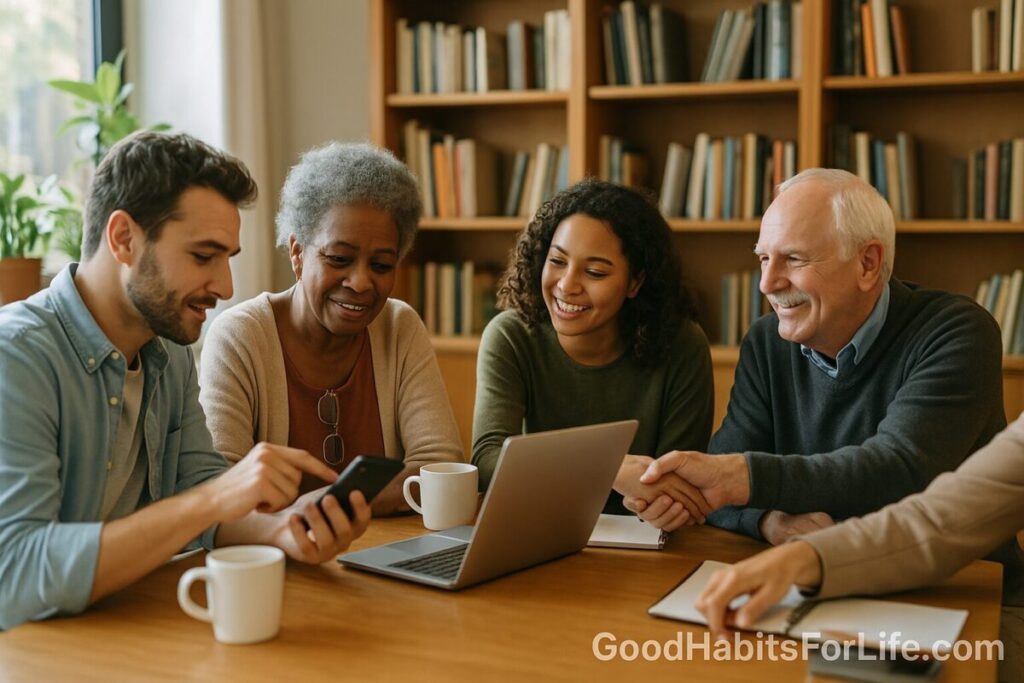
InterAge Friendships: Mentors, Mentees, Peers
InterAge Friendships: Mentors, Mentees, Peers
Table of Contents
🧭 What & Why
What are InterAge friendships?
Age-diverse friendships connect people with a spread of years between them—sometimes as mentor–mentee, other times as equals (“peers”) who simply bring different decades of experience. These ties deliver big upside for learning, perspective, and belonging.
Why they matter (evidence):
-
Strong social connection is a health protective factor; lack of it can raise premature mortality risk on par with smoking ~15 cigarettes/day. InterAge ties expand our social graph and buffers. HHS.gov
-
Intergenerational contact (planned or organic) reduces ageism and anxiety about aging for younger and older groups. PMC+1SAGE Journals
-
Older adults with younger friends often feel younger and more satisfied with aging—shaping healthful behaviors. Harvard Health
-
Programs that bring generations together show improvements in well-being, mood, social inclusion, and community cohesion. PMCScienceDirect
-
Workplace “reverse mentoring” (junior to senior knowledge flow) and age-diverse teams report learning gains and stereotype reduction. Harvard Business ReviewMDPI
-
On a population level, older adults face persistent loneliness—InterAge friendships are part of the solution. AARPData Stories
-
The WHO’s global guidance: intergenerational strategies are proven ways to combat ageism and build healthier, age-inclusive communities. World Health Organization
✅ Quick Start (Do This Today)
-
Map your age range (5 minutes): List 10 non-family contacts; mark each person’s approximate age bracket (±5–10 years). Circle gaps.
-
Pick one low-stakes curiosity (2 minutes): e.g., “Short-form video tips,” “mid-career plateau,” “applying to uni,” “healthy aging mobility.”
-
Send one invitation (3 minutes): “Could we do a 20-minute learning swap this week? I’ll share X; I’d love your perspective on Y.”
-
Design a two-way agenda (15 minutes): 10 minutes each to teach/ask; 5 minutes to plan a follow-up; write 1 takeaway each.
-
Calendar a follow-up now (1 minute): Book a 30-minute check-in within 10–14 days.
-
Micro-ritual: End with “one gratitude, one experiment” to keep it practical and positive.
🛠️ 30-60-90 Habit Plan
Goal: Build two enduring InterAge friendships (one where you mentor, one where you’re mentored) plus one age-diverse peer bond.
Days 1–30 (Start & Sample):
-
Identify 6 candidates across age brackets (2 younger, 2 older, 2 lateral but different decade).
-
Run three “learning swaps” (20–30 mins).
-
Agree on norms: punctuality, confidentiality, “two-way value,” no unsolicited fixing.
-
Checkpoint (Day 30): Which conversations energized you? Book 2 deeper sessions.
Days 31–60 (Structure & Stretch):
-
Formalize one mentoring dyad (you mentor) and one reverse-mentoring dyad (you learn).
-
Add a peer trio: three people from different decades co-learning monthly.
-
Introduce light artifacts: shared notes, 1-page goals, and a monthly experiment.
-
Checkpoint (Day 60): Are benefits mutual? Adjust cadence/format if lopsided. PMC
Days 61–90 (Sustain & Scale):
-
Establish a monthly theme (e.g., creativity systems, financial basics, digital literacy, mobility/health).
-
Do a mini-project together (co-host an event, write a joint post, volunteer day).
-
Invite one new voice (different age) each month to your trio.
-
Checkpoint (Day 90): Capture outcomes (skills gained, perspectives shifted, opportunities created).
🧠 Techniques & Frameworks
1) The “3 Roles” Portfolio
-
Mentor: You offer experience/context.
-
Mentee: You seek skills/perspective (e.g., emerging tech, culture, study/work hacks).
-
Peer: You collaborate as equals across decades.
2) Reverse Mentoring Loop
-
Pair junior ↔ senior; swap domains (e.g., AI tools ↔ stakeholder strategy).
-
Cadence: 45 min monthly; rotating mini-topics; 1 action each side. Evidence from workplaces suggests innovation and learning gains when structured well. MDPIHarvard Business Review
3) Intergenerational Contact Design (IGC)
-
Equal status activities, shared goals, and cooperation—principles that help reduce prejudice in intergroup contact research and applied in intergenerational settings. PMC
4) “Two-Way Value Canvas” (10 minutes)
-
Column A: What I can give (skills, stories, networks).
-
Column B: What I want to learn (be specific).
-
Column C: Shared experiment (small, time-boxed).
5) Rituals that stick
-
Open with a check-in (“Green/Yellow/Red”), close with “one gratitude, one experiment.”
-
Rotate facilitation and note-taking to keep power balanced.
🧑🎓 Audience Variations
Students: Join campus intergenerational clubs, service-learning, or alumni circles; practice “career curiosity interviews.”
Parents: Co-host family-friendly meetups with retirees/college students (storytime, bike repairs, coding hour).
Professionals: Build an age-diverse “Personal Board” (5–7 people from different decades) with quarterly meetings. Harvard Business Review
Seniors: Offer micro-mentoring (30-minute slots) on life admin, craft, or career wisdom; request tech help via reverse mentoring. Benefits include mood and cognition gains in many intergenerational programs. PMC
Teens: Seek skill trades (editing shorts for career advice); ensure safe, moderated spaces via schools, libraries, nonprofits.
⚠️ Mistakes & Myths to Avoid
-
Myth: “Mentoring is one-way.” Best results come from mutual exchange. Harvard Business Review
-
Mistake: Tokenism. Don’t invite someone just to “represent a generation.” Design shared goals and equal voice. PMC
-
Myth: “Only family counts.” Non-kin ties are powerful health buffers too. HHS.gov
-
Mistake: Over-generalizing generations. Treat people as individuals, not stereotypes. World Health Organization
-
Myth: “It’s awkward online.” Virtual reverse mentoring works when structured. PMC
📚 Real-Life Examples & Scripts
Cold outreach (email/DM):
Hi [Name], I admire how you [specific]. I’m exploring [topic] and could share [your skill]. Would you be up for a 20-minute learning swap next week—10 mins each, plus 5 to plan a next step?
Mentor ask (younger → older):
I’m navigating [decision]. Could we do a monthly 30-minute check-in for 3 months? I’ll send a 3-bullet agenda and one action I’ll try after each session.
Reverse mentoring ask (older → younger):
I’m updating my workflow with [tool/platform]. In return for your guidance, I can offer [career mapping/network intros]. Interested in a 45-minute swap next month?
Peer trio charter (3 different decades):
-
Purpose: cross-decade idea lab for [theme].
-
Cadence: 60 mins monthly, rotating host.
-
Agenda: Wins → Topic deep dive → Experiments → Next actions.
🧰 Tools, Apps & Resources (quick take)
-
CoGenerate (Encore.org) – Programs & stories for age-bridging civic projects (great inspiration; availability varies).
-
MENTOR / Big Brothers Big Sisters – Formal mentoring with vetting (strong structure; time commitment).
-
AARP Community Connections / Ethel groups – Local meetups for older adults (U.S.-centric). MarketWatch
-
Libraries, universities, faith/community centers – Safe, moderated intergenerational events (consistent cadence; local scope).
-
Meetup / Nextdoor – Find hobby or service groups across ages (quality varies by area).
-
Workplace ERGs / Alumni networks – Ready-made pools for reverse mentoring (requires policy buy-in). Harvard Business Review
🔑 Key Takeaways
-
InterAge friendships are a health, learning, and inclusion multiplier. HHS.govPMC
-
Treat relationships as mutual: trade skills, stories, and experiments. Harvard Business Review
-
Use simple rituals (shared agendas, monthly themes, gratitude/experiment) to sustain momentum.
-
Build a 3-role portfolio: mentor, mentee, and peer across decades.
-
Normalize intergenerational contact in your week to reduce stereotypes and widen empathy. PMC
❓ FAQs
1) What’s the difference between intergenerational and InterAge friendships?
Intergenerational is the umbrella; InterAge emphasizes everyday friendship across decades—mentor/mentee or peer.
2) Do these friendships really affect health?
Yes. Broader, stronger social connection is linked with lower mortality risk and better mental/physical outcomes. HHS.gov
3) How do I avoid power imbalances?
Set two-way goals, rotate facilitation, and agree on norms (time, confidentiality, “no fixing without asking”). PMC
4) Can online InterAge friendships work?
Yes—virtual reverse mentoring pilots show social and learning benefits when structured. PMC
5) What if I’m shy or new in town?
Start with one low-stakes learning swap and join moderated community spaces (libraries, alumni, volunteer groups).
6) Is this only for careers?
No. Evidence shows benefits for mood, inclusion, and well-being beyond work. PMC
7) How many friendships should I aim for?
Quality beats quantity. Our plan targets two deep dyads plus one trio to keep it sustainable.
8) How do these friendships reduce ageism?
Regular, cooperative contact with equal status reduces stereotypes and aging anxiety across groups. PMC
References
-
U.S. Surgeon General. Our Epidemic of Loneliness and Isolation (2023). HHS.gov
-
Drury L. et al. Direct and Extended Intergenerational Contact and Young People’s Attitudes Toward Older Adults (2016). PMC
-
Burnes D. et al. Interventions to Reduce Ageism Against Older Adults: A Systematic Review and Meta-analysis (2019). PMC
-
Apriceno M. et al. Effective Programs for Reducing Ageism Toward Older Adults: Systematic Review & Meta-analyses (2023). SAGE Journals
-
Whear R. et al. What is the effect of intergenerational activities on the wellbeing and mental health of older people? (2023). PMC
-
Harvard Health Publishing. Bonds that transcend age (2023). Harvard Health
-
WHO. Global report on ageism (2021, updated page). World Health Organization
-
Harvard Business Review. Harnessing the Power of Age Diversity (2022). Harvard Business Review
-
Li M. et al. Reverse Mentoring and Employees’ Innovative Behaviors (2024). MDPI
-
Generations United. Intergenerational Programs Benefit Everyone (2021). Generations United
-
AARP. Loneliness and Social Connections Among Adults 45+ (2018). AARP
-
AARP Data Stories. The Lived Experience of Adults 50+—Connections (accessed 2025). Data Stories
Disclaimer: This article is educational and not a substitute for professional medical or mental-health advice.