
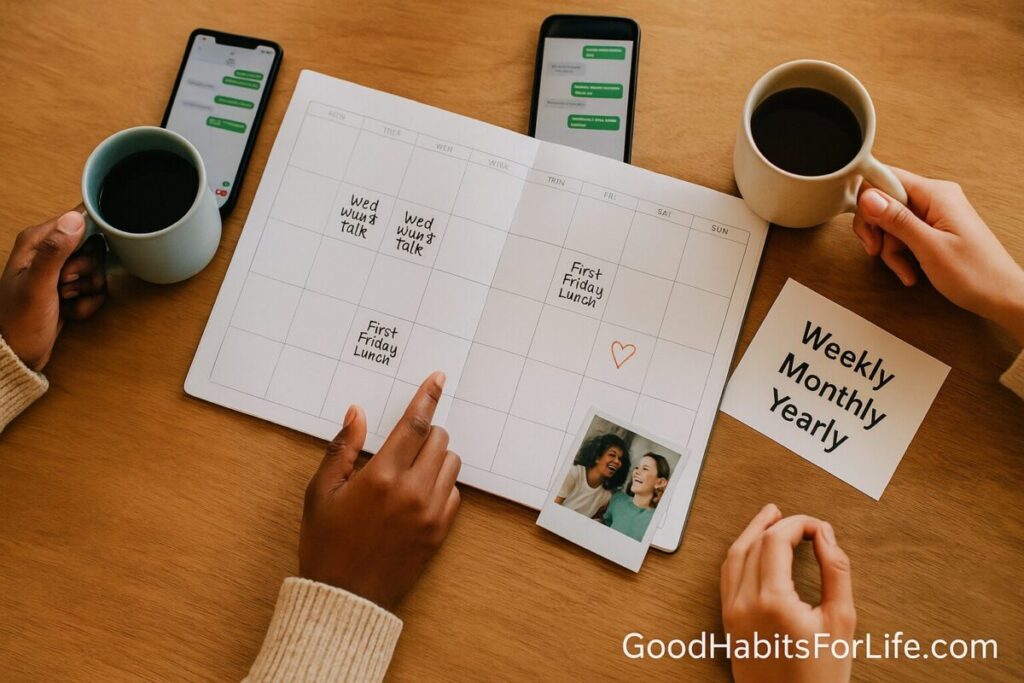
Friendship Rituals: Weekly, Monthly, Yearly
Friendship Rituals: Weekly, Monthly, Yearly (Guide)
🧭 What & Why
What are friendship rituals?
Small, repeated, meaningful acts you share—at a predictable cadence (weekly, monthly, yearly). Think “Wednesday walk-and-talk,” “first-Friday lunch,” or a “friendiversary” call. Rituals are not chores; they’re simple moments that carry symbolic meaning and reliably produce connection.
Why they work (evidence-based):
-
Connection = health: Strong social ties are associated with lower mortality risk; a landmark meta-analysis found about a 50% increased likelihood of survival for people with stronger relationships. PMC
-
A public-health priority: Social connection is recognized as vital by the U.S. Surgeon General and the WHO’s Commission on Social Connection. HHS.govWorld Health Organization
-
Rituals regulate and bond: Psychological research shows rituals help regulate emotions and strengthen social connection, especially under stress or uncertainty. faculty.haas.berkeley.edu
-
Shared arousal & laughter: Activities that trigger shared laughter can upregulate the brain’s endogenous opioids, reinforcing social bonds—why even silly micro-rituals matter. PMC
-
Lifelong payoff: Long-running research (Harvard Study of Adult Development) consistently ties quality relationships to better health and happiness. Harvard Gazette
✅ Quick Start (Do This Today)
-
Pick your “anchor friend.” Choose one person you’d love to feel closer to this month.
-
Choose one tiny weekly ritual (≤10 min). Examples:
-
Monday voice note: 60–120-second update + one appreciation.
-
Wednesday walk-and-talk: 10-minute call while you walk.
-
Friday meme swap: 3 funniest screenshots of the week.
-
-
Schedule it now. Recurring calendar invite with a short title (“Wed Walk-Talk — 10 min”).
-
Decide your monthly & yearly.
-
Monthly (60–90 min): Coffee, co-cooking, a museum hour, or a co-working session.
-
Yearly (2–6 hrs): Day trip, “friendiversary” dinner, photo-album review.
-
-
Set a “minimum viable ritual (MVR).” If busy, do the 2-minute version (e.g., a quick voice note).
-
Use the script: “I value our friendship. Can we try a 10-minute Wednesday walk-call? I’ll send a recurring invite.”
🛠️ 30-60-90 Habit Plan
Goal: Lock in a friction-light cadence you’ll actually keep.
At a glance
| Timeframe | Weekly (micro) | Monthly (memory) | Yearly (tradition) |
|---|---|---|---|
| Days 1–30 | One 5–10 min ritual (e.g., Wed walk-call) | Plan one 60–90 min meet (co-cook, coffee, co-work) | Pick date + theme (day trip, hike, photo album) |
| Days 31–60 | Add a second micro-ritual (Fri meme swap or Sun check-in) | Do the meetup; capture a photo/story | Book reservations/route for the annual |
| Days 61–90 | Upgrade one micro-ritual to 15–20 min | Add a rotating activity (volunteer, class) | Run the annual; name it (e.g., “Third-Saturday Trail Day”) |
Weekly micro-ritual ideas (choose 1–2):
-
Walk-and-talk (10–20 min)
-
Co-read one article and swap 3 takeaways
-
Two-win Tuesday: send 2 small wins, ask 1 question
-
Playlist Friday: share one song with a memory
-
Gratitude note: one specific “thank you” (see scripts)
Monthly memory-makers:
-
Skill swap (teach each other something in 60 minutes)
-
Try-a-thing (new coffee spot, board game, trail)
-
Co-create (cook, craft, playlist, photo walk)
-
Volunteer hour (local cleanup, sorting donations)
Yearly traditions:
-
Friendiversary dinner or day trip
-
Annual “Highlights & Hopes” (reflect on last year; set 3 shared micro-goals)
-
Photo yearbook (shared album; caption your top 12 pics)
🧠 Techniques & Frameworks
1) Minimum Viable Ritual (MVR): Define the 2-minute fallback that “counts.” Consistency beats intensity.
2) Habit Stacking: Attach the ritual to an existing routine (“After my Wednesday lunch, I send a 90-sec voice note.”)
3) Implementation Intentions: “If it’s raining during our walk-call, then we switch to voice notes.”
4) Cadence Design using Layers: Focus most energy on your closest circle, then lightly maintain wider circles (e.g., a monthly group dinner). Friendship networks have natural “layers,” so designing cadence by closeness makes maintenance realistic. ScienceDirect
5) Meaning over mechanics: What makes a ritual “work” is the shared meaning, not the extravagance. Small, repeated, symbolic acts are potent. faculty.haas.berkeley.edu
6) Bonding science in practice:
-
Laughter ritual (e.g., “two funnies & a fail”): shared laughter strengthens bonding pathways. PMC
-
Gratitude ritual: A quick “other-praising” thank-you boosts closeness (see script). compass.onlinelibrary.wiley.comPMC
7) “Trigger-Tool-Token” loop:
-
Trigger = recurring calendar ping
-
Tool = prepared prompts/scripts
-
Token = small souvenir (shared photo, inside-joke emoji) to mark the moment
👥 Audience Variations
Students: Cheap & cheerful—library co-study + coffee; monthly “potluck & playlist.” Expect higher turnover of close ties at life transitions; rituals help you re-anchor. PMC
Professionals: Protect time: 10-min walking 1:1s, monthly co-working. Use commute-length calls.
Parents: “Piggyback” rituals onto kid activities (sideline strolls, park coffee). Monthly family-friend meetups.
Seniors: Prioritize mobility-friendly rituals: tea & puzzles, gentle walks, photo-album projects; add video calls for long-distance.
Teens: Short cadence works best: gaming co-ops, weekly playlist swaps, group study timers.
Long-distance: Async voice notes, shared photo albums, monthly video “cook-along.”
Big friend groups: Rotate hosts/themes; use a shared board (Notion/Sheets) for dates & ideas.
⚠️ Mistakes & Myths to Avoid
-
Myth: “Real friends don’t need scheduling.”
Reality: Scheduling protects what matters—especially across time zones and busy lives. (Major health bodies now treat connection as a public-health priority.) HHS.govWorld Health Organization -
Mistake: Over-engineering elaborate rituals.
Fix: Start with MVRs (2–10 min). Level up later. -
Mistake: Letting one cancel kill the habit.
Fix: Always have a fallback (voice note/text) so the chain stays unbroken. -
Myth: “Only big adventures create memories.”
Reality: Small, repeated, meaningful acts—like a weekly walk—compound.
💬 Real-Life Examples & Scripts
Weekly 10-Minute Check-In (copy/paste questions):
-
What energized you this week?
-
What felt heavy?
-
One tiny win you’re proud of?
-
How can I support you next week?
“Other-praising” gratitude (research-aligned):
“Hey, I’m grateful for how you [specific action]. When you did that, it made me feel [emotion] and helped me [impact].” PMC
Invite a ritual (text):
“I value us and I miss our regular catch-ups. Want to try a 10-min Wed walk-call for the next month? I’ll send a recurring invite and we can keep it super light.”
MVR fallback:
“Running late—sending a 90-sec voice note so we still get our Wednesday touchpoint.”
Name the yearly tradition:
“How about we declare the first Saturday of March Friend Day—brunch + a mini-adventure every year?”
🧰 Tools, Apps & Resources
-
Calendar (Google/Apple/Outlook): Recurring events + reminders. Pros: reliable. Cons: easy to snooze.
-
Messaging with voice notes (WhatsApp/Telegram/Signal): Async “micro-rituals.” Pros: friction-low; rich tone. Cons: hard to search later.
-
Shared Albums (Google Photos/Apple Photos): “12-pics-a-year” album. Pros: auto-organized; nostalgia hits. Cons: privacy settings matter.
-
Notes/Boards (Notion, Google Docs/Sheets): Idea bank + dates. Pros: collaborative. Cons: setup time.
-
Habit trackers (Loop/Done/Streaks): Keep the chain alive. Pros: visual momentum. Cons: can feel gamified.
Pro tip: Pre-save your check-in prompts and gratitude script in Text Shortcuts/Keyboard templates.
📌 Key Takeaways
-
A tiny ritual done weekly beats a grand plan done rarely.
-
Design cadence by closeness: more for inner circle, lighter for wider circles. ScienceDirect
-
Schedule, stack, and set a 2-minute fallback to keep momentum.
-
Use laughter and gratitude intentionally—fast, science-supported bonding tools. PMC+1
-
Lock the system with a 30-60-90 plan (micro weekly, memory monthly, tradition yearly).
❓FAQs
1) How many rituals should I have?
Start with one weekly micro-ritual and one monthly memory-maker. Add only when it’s effortless.
2) What if our schedules never align?
Use async voice notes + a monthly video call. Keep the “minimum viable ritual” alive.
3) Do rituals really help mental health?
Connection is a protective factor; major health leaders highlight its importance. Rituals make connection automatic. HHS.govWorld Health Organization
4) Isn’t this just habit formation?
Yes, but with shared meaning. Rituals are habits with symbolism, which is why they’re powerful for bonding. faculty.haas.berkeley.edu
5) We fell off—how do we restart without awkwardness?
Send: “I miss our Wednesdays. Can we reboot with a 5-min version this week?” Then schedule the next one immediately.
6) What about big friend groups?
Rotate hosts, lock a standard slot (e.g., first Friday), and keep themes simple (cards, potluck, movie).
7) Can rituals feel fake?
If they lack meaning, yes. Co-design a ritual you both want and name what it stands for.
8) How do I keep it fresh?
Use a 3-month rotation: month A = walk-call; month B = article swap; month C = playlist share.
9) Any science on “why small talk helps”?
Brief, frequent contact builds familiarity and closeness over time; laughter and shared micro-moments are efficient bonding routes. PMC
10) How do rituals evolve across life stages?
Expect shifts (new jobs, moves, parenting); adjust cadence, not commitment. PMC
📚 References
-
Holt-Lunstad J., et al. Social Relationships and Mortality Risk: A Meta-analytic Review, PLOS Medicine (2010). PMC
-
U.S. Surgeon General. Our Epidemic of Loneliness and Isolation (2023). HHS.gov
-
WHO. Commission on Social Connection (2024–2026) & flagship report launch (2025). World Health Organization+1
-
Hobson N.M., et al. The Psychology of Rituals (2017). faculty.haas.berkeley.edu
-
Xygalatas D., et al. Extreme Rituals Promote Prosociality, Psychological Science (2013). Pure
-
Manninen S., et al. Social Laughter Triggers Endogenous Opioid Release in Humans (2017). PMC
-
Harvard Gazette. How “Social Fitness” Shapes Health (2023). Harvard Gazette
-
Dunbar R.I.M. The Anatomy of Friendship (2018). ScienceDirect
-
Roy C., et al. Turnover in Close Friendships (2022). PMC
-
Algoe S.B. Find, Remind, and Bind: The Functions of Gratitude in Everyday Relationships (2012). compass.onlinelibrary.wiley.com
Disclaimer: This article is for general education and is not a substitute for professional mental-health advice.