
Online Community Guides: From Lurker to Leader: Dopamine Detox (2025)
Dopamine Detox (2025): From Lurker to Leader
Table of Contents
🧭 What This Guide Is (and Isn’t)
“Dopamine detox” is a catchy phrase—not a literal biochemical cleanse. You can’t “purge” dopamine; instead, you can take structured breaks from high-stimulation digital rewards (infinite feeds, alerts) to regain attention and intention. Think of it as a reset of habits, not hormones. Harvard HealthNCBI
In online communities, attention is your main currency. A short detox clarifies why you’re there and helps you move along the proven Reader → Contributor → Collaborator → Leader path. cs.umd.edu
Benefits (evidence-aligned):
-
Less anxiety and improved well-being when you reduce or pause social media—effects are small to moderate and vary by person. Liebert Publishingguilfordjournals.comPMC
-
More time for active participation versus passive scrolling (most communities are dominated by readers—intentional steps matter). Nielsen Norman Group
✅ Quick Start: Do This Today (15–30 minutes)
-
Name your community purpose (2 min): e.g., “Learn and share one evidence-based productivity tip weekly.”
-
Silence bait loops (5 min): Turn off non-human push alerts (likes, “someone posted,” trending). Keep DMs/mentions only.
-
Time box (2 min): Cap each app at 30–45 minutes/day with one evening session for deep engagement. guilfordjournals.com
-
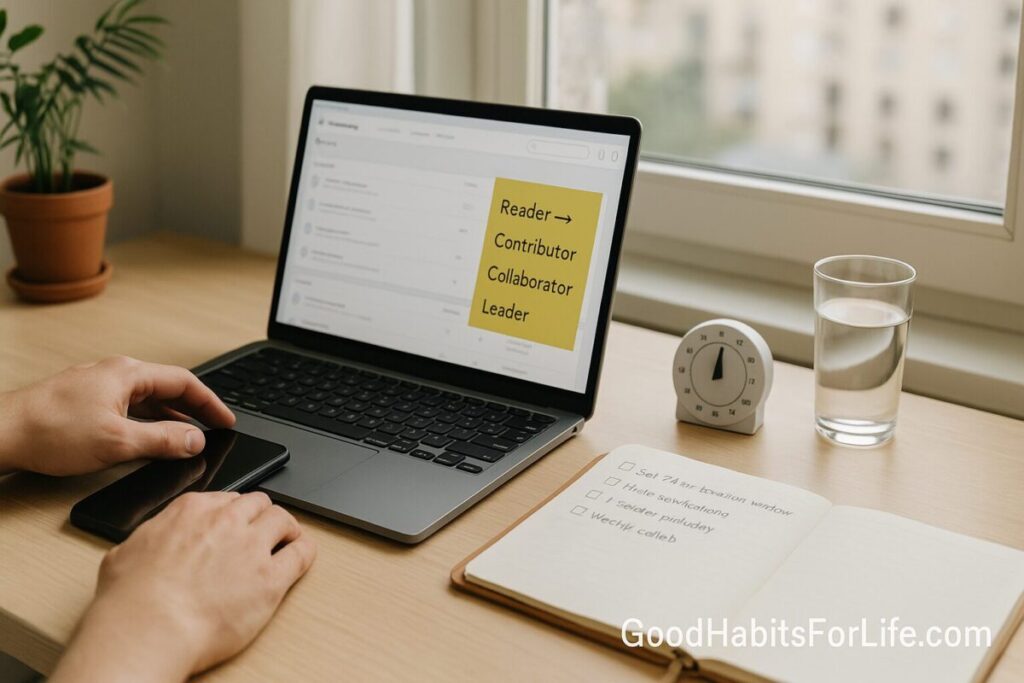
Cue a micro-habit (3 min): Place a sticky note prompt: “Post one helpful reply before any scrolling.” (Prompt + ability + motivation). Fogg Behavior Model
-
First value post (10–15 min): Share a short summary, link to a credible source, and a question inviting replies.
-
Reflect (3 min): Did posting feel harder or easier than expected? Adjust tomorrow’s prompt/ability.
🛠️ 30-60-90 Roadmap: From Lurker to Leader
Goal: Move deliberately from passive to pro-social leader while staying mentally healthy.
Days 1–30: Calm & Contribute (Reader → Contributor)
-
Detox cadence: Take two 24-hour social-media breaks per week (e.g., Sat + Wed). Track mood/energy before and after. Evidence suggests short breaks can boost well-being for many, though not all. Liebert PublishingPMC
-
Daily cap: 30–45 min. Post one helpful comment before any feed. guilfordjournals.com
-
Weekly ritual: Summarize “3 sparks” you learned, tag sources, ask one question that invites replies.
Days 31–60: Collaborate (Contributor → Collaborator)
-
Start a micro-project: e.g., compile a community FAQ or “resource thread” with 5–10 vetted links.
-
Co-create: Pair with one member to host a weekly themed thread (Q&A hour).
-
Measure engagement: Track replies, saves, and follow-ups—optimize post timing and clarity.
-
One longer detox: 3–7 days once this month to assess habits and reset. Results vary across individuals; treat as an experiment. Nature
Days 61–90: Lead & Mentor (Collaborator → Leader)
-
Launch a recurring series: e.g., “Monday Habit Lab”—a templated discussion that runs the same time each week.
-
Mentor 2–3 newcomers: Create a welcome script and a “first reply” checklist.
-
Document: Publish a community “Starter Kit” and nominate moderators.
-
Protect attention: Keep your caps and weekly breaks to sustain well-being. PMC
🧠 Techniques & Frameworks That Work
-
Reader-to-Leader framework: Advance via reading → contributing → collaborating → leading. Design your week to practice each stage. cs.umd.edu
-
90-9-1 rule: Expect participation inequality; leadership grows when you reliably add value where 90% only read. Nielsen Norman Group
-
Fogg Behavior Model (B=MAP): Use small prompts, make the action easy (e.g., a 2-sentence reply), and connect to your motivation (e.g., learning, helping). Fogg Behavior Model
-
Self-Determination Theory (SDT): Design your community work to satisfy autonomy (choose topics), competence (show wins), and relatedness (build bonds). This sustains participation. Self Determination Theory
-
Evidence-based detoxing: RCTs show short-term improvements for some when limiting or pausing social media; meta-analyses show small, mixed effects. Personalize. Liebert Publishingguilfordjournals.comPMCScienceDirect
👥 Audience Variations
-
Students: Time box study breaks; post one summary of a reading per week; join study-buddy threads.
-
Professionals: Batch notifications; share one “how-to” or template weekly; host office-hours thread monthly.
-
Parents: Follow topic-specific groups; share resource roundups; avoid doomscrolling after 22:00.
-
Seniors: Prioritize small, trusted groups; schedule weekly “Ask Me Anything” about your expertise.
-
Teens (with guardians): Co-create rules (bedtime off screens, private accounts); focus on supportive communities; seek adult help as needed. (Public health guidelines emphasize balanced, safe use.) HHS.govAPA
⚠️ Mistakes & Myths to Avoid
-
Myth: “Detox resets dopamine levels.” Reality: It resets habits/contexts, not neurotransmitters. Harvard Health
-
Mistake: All-or-nothing quitting without a plan—often rebounds. Use caps + prompts + scheduled breaks. Fogg Behavior Model
-
Mistake: Posting without listening. Spend the first 10 minutes reading thread norms and recent FAQs. cs.umd.edu
-
Myth: “Lurkers don’t belong.” Many readers are legitimate members; aim to invite micro-contributions. دانشیاری | دانستنیهای جذاب برای زندگی
💬 Real-Life Examples & Copy-Paste Scripts
-
First post (value-add):
“Just read the week’s thread on time-blocking. Here’s a 3-step mini-plan that worked for me (15-min blocks, 1 priority, 1 review). Does anyone pair this with calendar holds?” -
Invite collaboration:
“I’m compiling a ‘starter toolkit’ for new members. Reply with one resource you wish you had on day one—will credit everyone.” -
Mentor outreach (DM):
“Saw your question on habit trackers. Happy to share a simple spreadsheet and walk you through it in the thread—keen?” -
Boundary setting:
“I’m logging off till tomorrow’s Q&A. Tag me if you want feedback and I’ll reply during my 19:00 window.”
🧰 Tools, Apps & Resources
-
Attention guards: iOS Screen Time, Android Digital Wellbeing, Focus modes—set per-app caps and silence non-human alerts.
-
Friction helpers: Freedom, One Sec, Forest—add a pause before opening feeds; block dopamine-loop triggers.
-
Workflow: Notion/Obsidian for “Weekly Sparks,” Google Sheets for contribution logs, Trello for community projects.
-
Well-being check-ins: Simple 1–5 mood score pre/post sessions to see if your detox cadence is helping (evidence shows benefits vary—track yours). PMCNature
📌 Key Takeaways
-
A dopamine detox is habit design, not brain chemistry. Use it to redirect attention toward active participation. Harvard Health
-
Follow the Reader → Contributor → Collaborator → Leader ladder with tiny, repeatable actions. cs.umd.edu
-
Combine time caps, notification hygiene, and prompted micro-posts for dependable progress. Fogg Behavior Model
-
Expect modest, person-dependent well-being gains from breaks/limits—treat it like an experiment. Liebert Publishingguilfordjournals.comPMC
❓ FAQs
1) How long should a dopamine detox last?
Start with 24 hours weekly or a 7-day trial once per quarter; many studies use 1-week breaks. Adjust by mood and goals. Liebert Publishing
2) Will a detox fix anxiety or depression?
It can help some people; evidence is mixed and effects are usually small to moderate. Seek professional care for persistent symptoms. PMCNature
3) How do I post if I’m shy?
Use copy-paste templates; start with one resource share or clarifying question. The ladder framework supports gradual escalation. cs.umd.edu
4) Is lurking bad?
No. Reading is legitimate participation and often the first step toward contribution. Communities thrive when leaders invite micro-contributions. دانشیاری | دانستنیهای جذاب برای زندگی
5) What’s the best daily time cap?
RCTs suggest ~30 minutes/day limits can improve well-being in young adults; your optimal cap may differ. guilfordjournals.com
6) Do participation inequalities mean leadership is hopeless?
No—awareness of the 90-9-1 distribution helps you design targeted contributions where they matter most. Nielsen Norman Group
7) How do I avoid sliding back after 90 days?
Keep caps, schedule recurring value threads, and mentor newcomers—leadership sustains motivation via autonomy/competence/relatedness. Self Determination Theory
📚 References
-
Harvard Health. Dopamine fasting: Misunderstanding science spawns a maladaptive fad. Harvard Health
-
National Library of Medicine “Behind the Headlines.” Debunking the Dopamine Detox Trend. NCBI
-
Preece J., Shneiderman B. The Reader-to-Leader Framework: Motivating Technology-Mediated Social Participation. AIS THCI (2009). cs.umd.edu
-
Nielsen J. Participation Inequality: The 90-9-1 Rule. Nielsen Norman Group. Nielsen Norman Group
-
Fogg B.J. Fogg Behavior Model (B=MAP). Behavior Design Lab, Stanford. Fogg Behavior ModelBehavior Design Lab
-
Lambert J. et al. Taking a One-Week Break from Social Media Improves Well-Being… Cyberpsychology, Behavior, and Social Networking (2022). Liebert Publishing
-
Hunt M.G. et al. Limiting Social Media Decreases Loneliness and Depression. Journal of Social and Clinical Psychology (2018). guilfordjournals.com
-
Plackett R. et al. Impact of Social Media Use Interventions on Mental Well-Being: Systematic Review (2023). PMC
-
Burnell K. et al. The Effects of Social Media Restriction: Meta-analysis of RCTs (2025). ScienceDirect
-
Lemahieu L. et al. Effects of Social Media Abstinence on Affective Well-Being: Meta-Analysis (2025). Nature
-
Ryan R.M., Deci E.L. Self-Determination Theory (Encyclopedia entry, 2022). Self Determination Theory
Disclaimer: This guide is educational and does not replace professional mental-health advice. If symptoms persist or worsen, consult a qualified clinician.