
MicroConnections: 60Second Habits that Compound
MicroConnections: 60-Second Habits that Compound
Table of Contents
🧭 What Are “Micro-Connections”? Why They Work
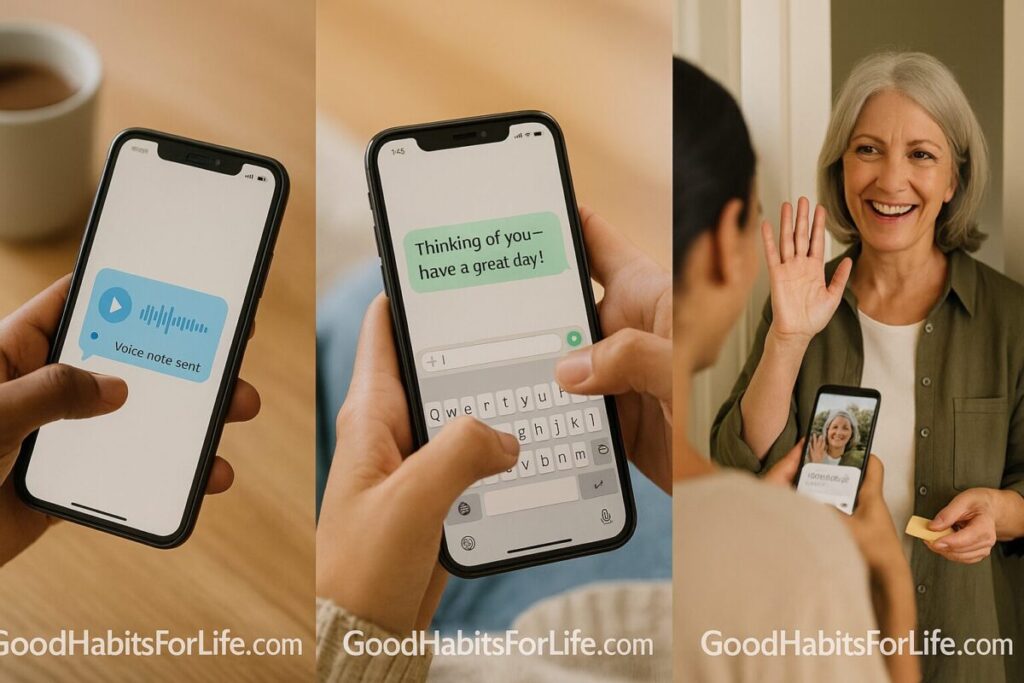
Micro-connections are tiny, intentional social touches that take about a minute—sending a short voice note, replying to a story with a genuine comment, or texting “thinking of you.” Though small, they build consistency, visibility, and trust over time (like adding daily drops into a relationship “bucket”).
Why it works (research, briefly):
-
Connection safeguards health. Large meta-analyses show strong social relationships are associated with ~50% greater survival—on par with other major risk factors. PMC
-
Small talk & weak ties matter. Short, everyday chats with acquaintances (“weak ties”) increase happiness and belonging; even talking to a stranger on your commute boosts mood. PubMedfaculty.haas.berkeley.edu
-
Public-health relevance. The U.S. Surgeon General highlights social connection as foundational for well-being and community health. Micro-connections are a practical, daily lever. HHS.gov
-
Habits need cues + repetition. Repeating a simple behavior in a stable context strengthens automaticity over weeks; pairing connection with an existing routine turns it into “set-and-forget.” Wiley Online Library
Definition you can use: A micro-connection is a ≤60-second social action you can repeat daily in the same context that signals care, attention, or appreciation to someone in your network.
✅ Quick Start: 60-Second Moves You Can Do Today
Pick two and do them now:
-
3-line Gratitude Text
“Line 1: Specific thank you. Line 2: Why it mattered. Line 3: One-line wish.” (People underestimate how much gratitude is appreciated—send it anyway.) SAGE Journals -
Active-Constructive Reply to Good News
When someone shares a win, respond with energy + a follow-up question (“That’s fantastic! What part was most exciting?”). This response style deepens bonds. PubMed -
Story/Status Reply With Substance
Skip “Nice!” and instead add one sentence of resonance (“I tried that café too—the cardamom latte is unreal.”) -
Micro Voice Note (20–40s)
Say their name, a sincere “how you’ve been on my mind,” and one question they can answer in one line. -
Forward + Why
Share an article/podcast and include why it reminded you of them (one sentence). -
Weak-Tie Wave
Ping a classmate, colleague from a prior project, or a neighbor: “Hey! It’s been a while—how are things on your end this week?” (Weak ties lift well-being more than we expect.) PubMed
🛠️ 30-60-90 Friendship-Fitness Plan
Goal: Build automatic, scalable connection habits without feeling spammy or performative.
Days 1–30: Spark (1 touch/day)
-
Daily cue: After breakfast, send one micro-connection (text/DM/voice).
-
Rotation: 2 strong ties, 3 weak ties each week.
-
Checkpoint (Day 30): Note mood and energy. Which touch felt easiest? Double down there.
Days 31–60: Stabilize (3 touches/day, Mon–Fri)
-
Stacking:
-
Morning: Gratitude text.
-
Midday: Active-constructive reply to someone’s good news. PubMed
-
Evening: 30-second check-in to one person you haven’t spoken to in 30+ days.
-
-
Boundary rule: No back-to-back days to the same person unless it’s a live thread.
Days 61–90: Compound (5 touches/day, 5 days/week)
-
List: Keep a running “Connections” note with 30 names (A/B/C tiers).
-
Theme days:
-
Mon: Mentors/Peers
-
Tue: Old friends
-
Wed: Family
-
Thu: Community (neighbors, clubs)
-
Fri: Serendipity (a stranger/super-weak tie—barista, regular vendor). Talking to strangers boosts mood. faculty.haas.berkeley.edu
-
-
Checkpoint (Day 90): Compare feelings of belonging + energy vs. Day 1; prune tactics that feel forced.
🧠 Techniques & Frameworks That Make It Stick
1) If-Then Planning (Implementation Intentions)
-
If I sit for tea at 16:00, then I send one gratitude text.
-
If I park my laptop at lunch, then I voice-note a friend.
This links a stable cue to a micro-action and automates follow-through. kops.uni-konstanz.de
2) Habit Stacking
Attach a connection to something you already do daily (after brushing teeth; after gym check-out). Over weeks, the context does the remembering. Wiley Online LibraryAnnual Reviews
3) Active-Constructive Responding
When others share wins, respond with enthusiasm + specifics + a question. Relationships grow when good news is received well. PubMed
4) The “2-Question” Check-In
-
Q1: “How’s your week going, 1–10?”
-
Q2: “What would make next week a +1?”
Short, supportive, and forward-looking.
5) Weak-Tie Loop
Keep a 5-person weekly loop (local shop owner, old classmate, gym buddy, co-commuter, neighbor). One ping each weekday. Weak ties add novelty and belonging. PubMed
6) Gratitude Micro-Bursts
Send three thank-yous/week. We undervalue how good they make others feel—do them anyway. SAGE Journals
🧩 Variations by Audience
Students:
-
Use class changeovers or lunch lines for a 20-second “Hey, how did your lab go?”
-
Form a study micro-pod (3 people, 2 check-ins/week).
Professionals:
-
60-second Slack/Teams “👏 + concrete praise” after meetings.
-
Maintain a 5-warm-contact CRM note; one ping/day.
Parents & Caregivers:
-
School pickup = cue for a two-parent hello; share one resource and ask one question.
-
Leave lunchbox notes (one sentence: “Thanks for emptying the sink yesterday!”).
Seniors/Teens:
-
Seniors: Daily WhatsApp audio greeting to family; ask one memory question.
-
Teens: One positive comment/day on a friend’s post + one DM check-in about something not online.
⚠️ Mistakes & Myths to Avoid
-
Myth: “It’s awkward or won’t matter.” People chronically underestimate how appreciated gratitude and small kindnesses are. SAGE Journals
-
Spammy blasts. Mass forwards without context feel transactional. Always add why you thought of them.
-
One-sided venting. Balance support with celebration and curiosity.
-
Over-optimizing. A spreadsheet isn’t a friendship. Use lists to prompt, not to perform.
-
Ignoring boundaries. If someone replies late or briefly, reduce frequency and switch channels.
💬 Real-Life Examples & Copy-Paste Scripts
Gratitude (to a peer):
“Thanks for your feedback on my draft yesterday. Your point about the intro saved me time this morning. Appreciate you.”
Active-Constructive to Good News:
“Big congrats on your internship! What part of the role are you most excited to dive into first?”
After a Gap:
“I was thinking about our old project today and realized I hadn’t checked in. How’s Q3 treating you lately?”
Weak-Tie Hello (neighbor/vendor/parent at school):
“Hi! I see you at pickup often—how’s your week going so far?”
Support Without Fixing:
“That sounds heavy. Want a listening ear, or are you looking for ideas?”
No-Reply Follow-Up (after 7–10 days):
“Just bumping this with zero pressure. Hope your week’s smooth—thought of you when I saw [short thing].”
Declining Gracefully (keep the bridge):
“I’m heads-down this week, but I’d love to catch up later. Could we revisit after the 20th?”
📚 Tools, Apps & Resources (pros/cons in brief)
-
Phone “Favorites” & Pinned Chats – Free, frictionless; add 7–10 people you want to hear from. Con: Easy to ignore when busy.
-
Reminders/Shortcuts (iOS/Android) – Auto-prompt “Send 1 gratitude text at 16:00.” Con: Can feel robotic—rotate recipients thoughtfully.
-
Contact Notes (Google Contacts / Apple Contacts) – Add “last met,” topics, and next check-in date. Con: Light manual upkeep.
-
Habit Trackers (Loop, Streaks, Habitica) – Visual streak for “1 micro-connection/day.” Con: Streak loss can demotivate.
-
Calendar Blocks (5×1-minute slots) – 09:00/12:30/16:00/18:30/21:00 micro-pings. Con: Needs discipline to protect.
-
Group Threads/Communities – Low-effort presence (drop a photo, ask a Q). Con: Not a substitute for 1:1.
🧾 Key Takeaways
-
Small > Seldom Big. Short, consistent touchpoints compound trust and belonging.
-
Automate with context. Tie micro-connections to daily cues (tea, commute, gym). Wiley Online Library
-
Respond to good news well. Active-constructive replies deepen bonds quickly. PubMed
-
Don’t overthink gratitude. Send it; it lands better than you predict. SAGE Journals
-
Scale thoughtfully. Use the 30-60-90 plan, rotate strong + weak ties, and respect boundaries.
❓ FAQs
1) How many micro-connections per day is “enough”?
Start with one/day for 30 days, then build toward 3–5 on weekdays. Quality>quantity—aim for sincerity and specificity.
2) Do weak-tie interactions really matter?
Yes. Studies link frequent weak-tie chats (classmates, baristas, neighbors) with higher happiness and belonging. PubMed
3) I’m introverted. What’s the least-effort version?
Use asynchronous channels (texts/voice notes). Keep scripts handy and set a single, daily cue (e.g., after lunch).
4) Is social media “enough”?
It helps for light ambient presence, but depth usually comes from 1:1 messages or voice notes that show you noticed something specific.
5) What if someone never replies?
Switch to lighter frequency and change channels once. After two unanswered touches, pause and keep goodwill.
6) How long until it feels natural?
Habit research suggests weeks of repetition in the same context build automaticity; expect variability by person and behavior. Wiley Online Library
7) Any fast way to reconnect after months?
Name the gap without drama, add one warm memory, and ask a single easy question about now.
8) How do I avoid seeming transactional?
Give more than you ask: gratitude, celebration, and curiosity. Keep a 2:1 ratio of giving:asking.
9) Does this really impact health, or just feelings?
Strong social ties are linked to lower mortality risk and better well-being; connection is a serious health behavior. PMC
10) Is talking to strangers safe?
Use common-sense boundaries and public settings. Even brief, appropriate chats (commutes, queues) can lift mood. faculty.haas.berkeley.edu
📚 References
-
Holt-Lunstad, J., Smith, T. B., & Layton, J. B. (2010). Social relationships and mortality risk: A meta-analytic review. PLOS Medicine. https://pmc.ncbi.nlm.nih.gov/articles/PMC2910600/ PMC
-
U.S. Surgeon General (2023). Our Epidemic of Loneliness and Isolation. HHS Advisory. https://www.hhs.gov/sites/default/files/surgeon-general-social-connection-advisory.pdf HHS.gov
-
Sandstrom, G. M., & Dunn, E. W. (2014). Social interactions and well-being: The surprising power of weak ties. Personality and Social Psychology Bulletin. https://pubmed.ncbi.nlm.nih.gov/24769739/ PubMed
-
Epley, N., & Schroeder, J. (2014). Mistakenly seeking solitude. Journal of Experimental Psychology: General. https://faculty.haas.berkeley.edu/jschroeder/Publications/Epley%26Schroeder2014.pdf faculty.haas.berkeley.edu
-
Lally, P., van Jaarsveld, C. H. M., Potts, H. W. W., & Wardle, J. (2010). How are habits formed? Modelling habit formation in the real world. European Journal of Social Psychology. https://onlinelibrary.wiley.com/doi/abs/10.1002/ejsp.674 Wiley Online Library
-
Wood, W., & Rünger, D. (2016). Psychology of Habit. Annual Review of Psychology. https://www.annualreviews.org/docserver/fulltext/psych/67/1/annurev-psych-122414-033417.pdf Annual Reviews
-
Gable, S. L., Reis, H. T., Impett, E. A., & Asher, E. (2004). What do you do when things go right? The intrapersonal and interpersonal benefits of sharing positive events. Journal of Personality and Social Psychology. https://pubmed.ncbi.nlm.nih.gov/15301629/ PubMed
-
Kumar, A., & Epley, N. (2018). Undervaluing gratitude: Expressers misunderstand the consequences of showing appreciation. Psychological Science. https://journals.sagepub.com/doi/abs/10.1177/0956797618772506 SAGE Journals
-
Algoe, S. B., Dwyer, P. C., Younge, A., & Oveis, C. (2015). Effects of expressing gratitude in ongoing relationships on perceived responsiveness, positive emotions, and relationship connection. Emotion. https://pmc.ncbi.nlm.nih.gov/articles/PMC5085264/ PMC
Disclaimer: This article is for general information only and is not a substitute for professional mental-health advice.