
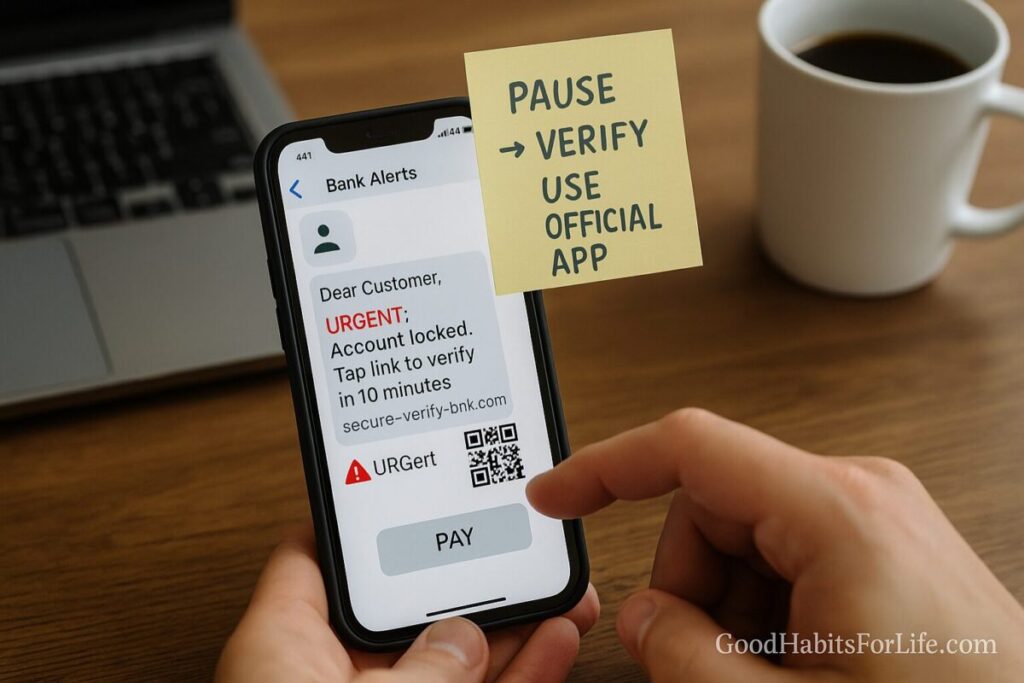
ScamProofing 2025: Red Flags & Safe Defaults
ScamProofing (2025): Red Flags & Safe Defaults
Table of Contents
🧭 What “ScamProofing” Means in 2025 (and Why It Matters)
“ScamProofing” is the habit of defaulting to a few protective behaviors—before you click, reply, or transfer. It matters because losses keep rising and tactics are evolving: the FBI’s IC3 logged $16.6B in reported internet-crime losses in 2024, up 33% year-on-year, with 859,532 complaints. Federal Bureau of Investigation In the U.S., the FTC separately reports $12.5B in consumer fraud losses for 2024, +25% vs. 2023, with older adults increasingly targeted by business/government imposters. Federal Trade CommissionConsumer Advice
Globally, deepfakes and AI-assisted impersonation are lowering the barrier for fraudsters and powering more convincing “boss,” “bank,” and “family emergency” scams. Law-enforcement bulletins and threat assessments highlight AI-enabled voice/video clones and BEC (business email compromise) as growing risks. Internet Crime Complaint CenterEuropol
In India, digital-arrest and fake e-challan APK scams show how sideloaded apps and pressure tactics drain accounts fast; prompt reporting to 1930 has helped authorities freeze funds in time. The Times of India+1
✅ Safe Defaults — The 12 Rules
-
Inbound → Outbound rule
If money or sensitive info is requested on any inbound contact (call, text, DM, email), hang up / stop and re-contact via an official number or app you look up yourself (bank app, card back-of-card, org’s .gov/.bank/.org site). In the UK, you can dial 159 to reach your bank safely. Stop Scams UK+1 -
Two-channel identity check
Before paying or sharing codes, verify identity on a second channel (e.g., call your boss on their known number; video call a family member; DM inside the corporate chat tool). AI voice/video clones demand this upgrade. Internet Crime Complaint Center -
Cooling-off + micro-test
For new payees, wait (at least 2–24 hours), then send a tiny test amount and confirm receipt by voice/video before larger transfers. (For UPI, also review your daily limits and disable “collect” requests you don’t expect.) -
App-store only
Never sideload/APK. Install only from official app stores and confirm the publisher (bank, card network, government). Fake mParivahan/e-challan APKs are stealing OTPs and reading SMS. The Times of India -
No screen-sharing during payments
Refuse all remote-access apps and screen shares while banking. (NPCI warns that fraudsters use these to see OTPs/PINs.) NPCI -
OTP/PIN/2FA hygiene
Never share OTPs, UPI PINs, or authenticator codes—no bank or RBI/ED/CBI officer will ask. Use app-based authenticators or hardware keys for email/finance logins to block account takeovers. Reserve Bank of India -
Search-proof your support
Don’t “Google the helpline” (fake listings exist). Use the bank’s own app support, official website, or country schemes (UK 159). In India, use RBI/NPCI and government pages for official contacts. Stop Scams UK -
Report fast when money moves
Time is everything. In India, call 1930 or file at cybercrime.gov.in immediately to trigger fund-freezing workflows; in the U.S., report to IC3 and FTC; in the UK, forward scam texts to 7726 and contact your bank (159). i4cInternet Crime Complaint CenterFederal Trade Commissionwww.ofcom.org.uk -
Email & domain due-diligence
For invoices and vendor payment changes, call to confirm on a known number; be wary of last-minute account changes (classic BEC tactic referenced in EU threat reports). Europol -
Payment method caution
Prefer reversible rails (card with chargeback) over irreversible ones (crypto, wire to new accounts). If using UPI, know the in-app dispute flow. NPCI -
Allowlist & limits
Enable spend caps, geofences, and payee allowlists where available. Keep high-value accounts at banks with robust fraud controls and 24/7 hotlines. -
Family “safe-word”
Set a pre-agreed code phrase for emergencies to defeat AI voice “kidnapping” scams.
🛠️ Quick Start (Do This Today)
-
Lock down accounts: Turn on 2FA (app/hardware key) for email, banking, brokerage, and cloud storage.
-
Bank contact shortcut: Save your bank’s in-app support and verified phone numbers; UK users bookmark 159. Stop Scams UK
-
UPI hardening (India): Review daily limits, disable unknown “collect” requests, and learn dispute steps inside your PSP app. NPCI
-
Device hygiene: Uninstall any remote-access or unknown APKs; set SIM lock and port-out PIN with your carrier.
-
Practice the script: “I don’t act on inbound money requests. I’ll call back on the official number.”
-
Report pipeline ready: India—1930 / cybercrime.gov.in; U.S.—IC3 + reportfraud.ftc.gov; UK—7726 for texts + 159 for bank contact. i4cInternet Crime Complaint Centerwww.ofcom.org.uk
📅 30-60-90 Habit Plan
Days 1–30 (Foundation)
-
Build a payee allowlist and caps on risky rails.
-
Train your team/family on the Inbound → Outbound rule and a shared safe-word.
-
Enable alerts for new payees, logins, and high-value transfers.
Days 31–60 (Drills & Hardening)
-
Run a BEC drill: fake invoice with changed account—did anyone pay?
-
Add hardware keys to email/admins; rotate passwords; review who has payment authority.
-
UK: practice the 159 callback flow; India: test your familiarity with 1930 escalation. Stop Scams UKi4c
Days 61–90 (Audit & Iterate)
-
Quarterly vendor verification (bank details, contacts).
-
Review fraud logs, near-misses, and update training.
-
Formalize an incident runbook (who calls the bank, who files IC3/FTC/NCRP reports). Internet Crime Complaint CenterFederal Trade Commission
🧠 Techniques & Frameworks
-
STOP-PAUSE-VERIFY (inspired by UK “Take Five”): Stop the interaction, Pause 60–120s, Verify through an independent channel. Take Five
-
Two-Person Rule for payments ≥ your threshold (e.g., ₹50,000 or $1,000).
-
Reverse-auth: You authenticate the caller, not the other way round (call back on known numbers).
-
Context traps awareness: Urgency, secrecy, authority (police/tax/regulator), and rewards (“refund,” “lottery,” “investment tip”). RBI cautions the public against such fictitious offers. Reserve Bank of India
👥 Audience Variations
-
Students & Early-career: Beware “work-from-home” recruitment scams and money mule offers; verify internships and “task” jobs. (Australian data shows job scams spiked recently.) News.com.au
-
Parents & Seniors: Pre-agree family safe-words; no payments on calls/texts. Older adults are heavily targeted by imposters; coach them on the callback habit. Consumer Advice
-
Professionals/SMBs: Secure email with strong 2FA and admin controls; require voice verification for any bank-detail change; train staff on BEC patterns flagged in EU threat reporting. Europol
⚠️ Mistakes & Myths to Avoid
-
“They knew my details, so it must be real.” Data leaks and OSINT make impersonation easy; deepfakes add realism. Internet Crime Complaint Center
-
“A QR scan automatically takes my money.” In standard UPI/card flows, funds move only if you authorize with your PIN/biometric—fraudsters try to watch you enter it or trick you into a collect request/remote access. NPCI
-
“The regulator/bank/police can hold my funds in a ‘safe account’.” That’s a classic imposter scam. RBI and other authorities do not ask for transfers or OTPs by phone. Reserve Bank of India
-
“Nothing to do after a mistake.” Rapid reporting can freeze funds; in India, 1930 and the NCRP portal improve recovery odds. i4c
💬 Real-Life Examples & Scripts (Copy-Paste)
-
Unknown “bank” call:
“I don’t act on inbound requests. I’ll call my bank using the number in my app. Goodbye.” -
Boss DM asking for urgent payment:
“Per policy we need voice confirmation on your known number and a small test transfer before new payees. Calling you now.” -
Family emergency voice clone:
“Tell me our safe-word. If you can’t, I’ll call back on the number I already have for you.” -
Vendor bank-detail change:
“We only update payment accounts after a scheduled verification call to the registered number on file.” -
Fake e-challan/parcel text:
“We don’t open links. We’ll check the official site/app. Your message will be reported.”
🧰 Tools, Apps & Resources (Pros/Cons)
-
Bank’s official app & secure messages — Pro: verified support & notifications; Con: still need strong device security.
-
UK: Dial 159 — Pro: safe, non-spoofable path to your bank; Con: UK-only. Stop Scams UK
-
India: 1930 + cybercrime.gov.in — Pro: rapid escalation & fund-freezing; Con: speed and full details matter. i4c
-
U.S.: IC3 + FTC ReportFraud — Pro: supports investigations & recovery steps; Con: not an instant refund. Internet Crime Complaint CenterFederal Trade Commission
-
NCSC/Ofcom 7726 (UK) — Pro: forward scam texts for carrier blocking; Con: post-event control, not prevention. www.ofcom.org.uk
-
NPCI fraud awareness (India) — Pro: clear UPI dos/don’ts; Con: you must still enforce them. NPCI
-
DigiSaathi (India) — Pro: official 24×7 guidance on digital payments; Con: info/help line, not a recovery hotline. NPCI
📚 Key Takeaways
-
Default to Outbound verification and Two-channel identity checks.
-
Strengthen rails: limits, allowlists, 2FA, and no sideloading.
-
Use country helplines & portals immediately after any loss.
-
Train family/teams with scripts; rehearse quarterly drills.
-
Expect AI-boosted imposters—habits beat heuristics.
❓ FAQs
1) What are the biggest scams by losses right now?
Investment, business/government imposter, romance, payment redirection, and online shopping scams consistently top loss charts across recent years. kansascityfed.org
2) How do I handle a “digital arrest” or police/CBI/ED threat call?
Hang up. No Indian authority demands transfers or OTPs by phone. Call your local police on known numbers and report via 1930/cybercrime.gov.in. Reserve Bank of Indiai4c
3) I clicked a fake e-challan link and installed an app—what now?
Disconnect data, remove the app, change banking passwords on a clean device, alert your bank, and file a report. Expect OTP theft if the app had SMS permissions. The Times of India
4) Does scanning a QR code take money automatically?
No—debits require your authorization (e.g., UPI PIN). The risk is being tricked into authorizing or being watched via screen-share. NPCI
5) If I was pressured to wire/UPI money for an “urgent” invoice, can I get it back?
Sometimes. Speed is crucial; immediately contact your bank and the appropriate national channels (India 1930; U.S. IC3/FTC). i4cInternet Crime Complaint CenterFederal Trade Commission
6) Are seniors really targeted more?
Yes. Data spotlights show older adults reporting larger losses to impersonation scams. Consumer Advice
7) What’s a simple family plan against AI kidnapping voice scams?
Create a safe-word + a rule: “No transfers on inbound calls. We call back on our known numbers.” Consumer Advice
8) For UK scams via SMS, what should I do?
Forward the text to 7726 (free), and if it involves your bank, hang up and call 159. www.ofcom.org.uk
9) Where can I learn UPI dispute steps?
In your PSP/TPAP app—there’s a built-in dispute flow for transfers and merchant payments. NPCI
References
-
FBI IC3 — 2024 Internet Crime Report (losses $16.6B). Federal Bureau of Investigation
-
FTC — Fraud losses hit $12.5B in 2024 (press release, Mar 10, 2025). Federal Trade Commission
-
FTC — Older adults & imposter scams data spotlight (Aug 7, 2025). Consumer Advice
-
FBI — PSA: Criminals use generative AI to facilitate fraud (Dec 3, 2024). Internet Crime Complaint Center
-
Europol — SOCTA/IOCTA 2025–AI & fraud trends. Europol
-
NPCI — Fraud Awareness guidance (UPI do’s/don’ts). NPCI
-
NPCI — UPI Dispute Redressal Mechanism. NPCI
-
RBI — Cautions public against fictitious offers (imposter warnings). Reserve Bank of India
-
India — National Cybercrime Reporting Portal / Helpline 1930. i4c
-
UK — Stop Scams UK: Dial 159 (safe route to your bank). Stop Scams UK
-
UK — Ofcom: report scam texts to 7726 (guide). www.ofcom.org.uk
-
Kansas City Fed — Top five scam categories, 2020–2024. kansascityfed.org
Disclaimer
This guide provides general educational information on fraud prevention and is not financial, legal, or law-enforcement advice; follow your bank’s and your country’s official guidance.