
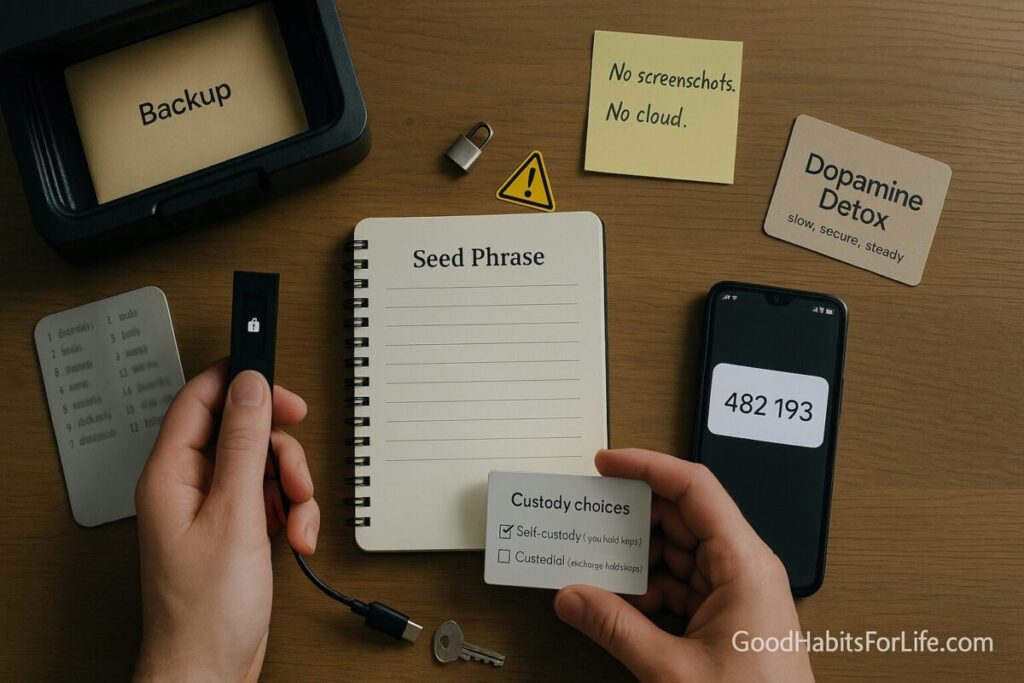
Crypto Basics: Custody, Keys & Caution: Dopamine Detox (2025)
Crypto Basics: Custody, Keys & Caution — Dopamine Detox
Table of Contents
🧭 What “Custody” and “Keys” Really Mean
Custody = who controls the private keys to your crypto.
-
Self-custody: you control the keys (e.g., hardware wallet, multisig).
-
Custodial/hosted: an exchange or custodian controls the keys on your behalf.
Private key / seed phrase: the master secret that proves ownership of your assets. If anyone sees it, they can move your funds. There’s no “forgot password” for a lost seed.
Why this matters now: regulators and watchdogs continue to warn about crypto scams, misleading claims, and weak security practices—especially around custody, authentication, and “proof of reserves.” Treat custody as a risk decision, not a convenience toggle. SECIOSCODefault
✅ Quick Start: Do This Today
-
Decide custody path (for each asset):
-
Small, spendable holdings → self-custody (single-sig hardware wallet).
-
Larger/long-term holdings → self-custody with 2-of-3 multisig or an insured, regulated custodian.
-
-
Set up secure authentication:
-
Prefer passkeys/FIDO2 (hardware keys like YubiKey) → phishing-resistant.
-
If not available, use an authenticator app; disable SMS fallback on every account. cisa.govpages.nist.gov
-
-
Harden your exchange account:
-
Withdrawal allow-listing, login alerts, device approvals, and cool-down timers for new addresses.
-
Treat proof-of-reserves marketing cautiously; it is not an audit. Default
-
-
Protect your seed phrase: write it by hand on paper or steel; store in two separate, secret places. Never in photos, email, notes, or cloud.
-
Test a restore on a spare device (without internet) before you fund the wallet.
-
Scam shields: never move coins because of urgent DMs/calls, celebrity offers, or “support” chats; verify through official sites you navigate to yourself. Track scam patterns in FTC alerts. Consumer AdviceFederal Trade Commission
🧰 Custody Options Compared (Pros/Cons)
| Option | Who holds keys? | Pros | Cons | Best for |
|---|---|---|---|---|
| Self-custody (single-sig HW wallet) | You | Full control; no counterparty risk; offline storage | User error risk; seed loss = total loss | Hands-on users; small–medium stacks |
| Self-custody (2-of-3 multisig) | You (shared) | Strong theft/loss resilience; granular policies | More setup; small fees/coordination | Larger stacks; teams/families |
| Custodial exchange/wallet | Platform | Easy; recovery support | Platform risk; hacks; off-chain rehypothecation risk; PoR not an audit | Beginners; small trading balances |
| Qualified/regulated custodian | Custodian | Governance, segregation policies, audits; insurance possible | Fees; jurisdiction limits | Institutions; high-net-worth |
Note: Regulations are evolving (e.g., IOSCO/FSB recommendations; EU MiCA rules for custody/disclosures). Check local rules for protections and complaints channels. IOSCOFinancial Stability BoardESMA
🧠 A Sane “Dopamine Detox” for Crypto
“Dopamine detox” is a catchy phrase, not a literal neuro reset. Still, reducing variable-reward triggers (price pings, social hype) can lower impulsive trades. Evidence links compulsive crypto trading with gambling-like behaviors; use behavioral guardrails, not willpower alone. Harvard HealthPMC
Do this:
-
Silence push alerts for prices/news; check on a schedule (e.g., 12:30 & 18:30).
-
Batch decisions: write a plan; act only during pre-set windows.
-
Pre-commit: use limit orders; set cooling-off periods (e.g., 24 hours) for big moves.
-
Block cues: unfollow hype accounts; hide watchlists on rest days.
-
Track impulses (urge log): trigger → thought → action → result; review weekly.
-
Replace the hit: 10-minute walk/call a friend before any discretionary trade.
Why it works: reduces exposure to intermittent rewards that drive compulsive use; aligns with research on trading/gambling overlaps. ScienceDirect+1
🗺️ 30-60-90 Habit Plan
Days 1–30 (Stabilize)
-
Choose custody per asset; buy a hardware wallet; record seed phrase (2 locations).
-
Turn off SMS 2FA; add passkeys/FIDO or authenticator; enable withdrawal allow-listing. cisa.govpages.nist.gov
-
Define two daily check-in times; log urges; no trading outside windows.
Days 31–60 (Fortify)
-
Migrate long-term funds to multisig or a regulated custodian (if appropriate).
-
Run a disaster drill: device loss scenario; test restore; verify address book.
-
Create a fraud playbook (see scripts below); share with family.
Days 61–90 (Scale & Sustain)
-
Quarterly security review: rotate exchange API keys; audit allow-list; firmware updates.
-
Portfolio policy: % per asset, rebalance bands, max position sizes, “stop-loss of attention” (e.g., if you check prices >4×/day, take a week off).
-
Annual custody review against new rules (MiCA/IOSCO local updates). ESMAIOSCO
🛠️ Techniques & Safety Frameworks
-
2-of-3 Multisig: any two keys move funds; keep keys in different places (e.g., hardware key, mobile key, and a trusted recovery provider).
-
Address allow-listing: lock withdrawals to pre-approved addresses; add a 24–72h cool-down for changes.
-
Cold storage + small hot wallet: hold most value offline; keep a small trading float online.
-
Beware Proof-of-Reserves claims: not standardized, not a full balance-sheet audit; treat as marketing. Default
-
Authentication hierarchy: Passkeys/FIDO2 → authenticator app → (last resort) SMS; remove SMS fallbacks. cisa.gov
-
Scam triggers to learn: “guaranteed returns,” romance/pig-butchering, fake support chats, crypto ATM payments. Track FTC data trends. Federal Trade Commission+1
👥 Audience Variations
-
Students/teens: lowest balances; use custodial exchange + strict limits or a read-only wallet; parents co-sign policies.
-
Professionals: automate buys; consolidate to cold storage; quarterly reviews; FIDO keys for every finance/login.
-
Parents/caregivers: add an “in case of emergency” envelope (wallet type, where seed is stored, how to access).
-
Seniors: prefer regulated custodians; enable account lockdowns; whitelist a family helper for support calls (never seed access).
-
Active traders: create a written Trading Charter: entries, size, risk per trade, and a two-strike rule (two impulse trades → mandatory week off).
⚠️ Mistakes & Myths to Avoid
-
Myth: “PoR = audit.” Reality: PoR is limited; don’t rely on it for solvency assurance. Default
-
Mistake: Storing seed in screenshots/cloud/email.
-
Mistake: Keeping large balances on exchanges “for convenience.”
-
Mistake: SMS 2FA (SIM-swap risk) or leaving SMS as a fallback. cisa.gov
-
Mistake: Paying anyone who says “send crypto to fix/freeze/unlock.” Crypto ATMs are a common scam conduit. Federal Trade Commission
-
Myth: “Dopamine detox resets your brain chemistry.” Use limits and cue-control instead; that’s what evidence supports. Harvard Health
💬 Real-Life Scripts (Copy-Paste)
-
Support imposter DM: “Thanks—what’s the ticket number? I will open a fresh ticket at the official site. I don’t share codes or click links in DMs.”
-
Urgent transfer ask: “I never move funds based on calls/DMs. I will contact the company via the website I type myself.”
-
Family policy: “If anything crypto-related seems urgent, we pause 24 hours and verify with me + one trusted person.”
-
Broker/exchange sales pitch: “Please send your regulatory license, custody model, insurance details, and audit standards—PoR alone is insufficient.” IOSCO
🧩 Tools, Apps & Resources (quick takes)
-
Hardware wallets (Ledger, Trezor, Coldcard): durable self-custody; keep firmware updated; buy direct.
-
Multisig services (Casa, Unchained): simpler policies/recovery; monthly fees.
-
FIDO security keys (YubiKey, Titan): phishing-resistant login; carry a spare. cisa.gov
-
Authenticator apps (Microsoft/Google/Aegis): better than SMS; still phishable—watch for fake prompts. cisa.gov
-
Password managers (1Password, Bitwarden): unique passwords; enable secret-key protection.
-
Portfolio trackers (Zerion, CoinStats): read-only; avoid granting trading permissions.
📌 Key Takeaways
-
Decide custody per asset; document and test your setup.
-
Passkeys/FIDO > authenticator > SMS—and remove SMS fallback. cisa.gov
-
Treat PoR as marketing, not assurance. Default
-
Use a scheduled-check routine and cue control to reduce impulsivity; evidence links compulsive trading with gambling-like behavior. PMC
-
Keep learning—rules and threats evolve (MiCA/IOSCO/FTC updates). ESMAIOSCOFederal Trade Commission
❓ FAQs
1) Should beginners use self-custody right away?
Start with what you can operate safely. Many begin on an exchange with strict security, then migrate long-term funds to hardware wallet or multisig once comfortable.
2) Is proof-of-reserves enough to trust an exchange?
No. It’s not a full audit and isn’t standardized. Look for governance, audits, segregation, and your own risk limits. Default
3) Are passkeys really better than SMS 2FA?
Yes. Passkeys/FIDO are phishing-resistant; authenticator apps are better than SMS; disable SMS fallback everywhere. cisa.govpages.nist.gov
4) What if I lose my seed phrase?
If you didn’t set up a safe recovery (e.g., multisig with redundant keys), the funds may be unrecoverable. Build redundancy before funding.
5) How do I protect family members from scams?
Use a household rule: no crypto payments on calls/DMs, ever. Verify on official sites; watch FTC alerts on new scam patterns (e.g., Bitcoin ATMs). Federal Trade Commission
6) Is “dopamine detox” real?
It’s a misnomer; you can’t reset dopamine like a battery. But reducing cues (alerts, hype feeds) and batching checks can cut impulsivity. Harvard Health
7) Are stablecoins safer?
They reduce price volatility but add issuer, reserve, and regulatory risks. Check disclosures and jurisdictional rules (e.g., MiCA in the EU). ESMA
8) What’s a practical split between hot and cold storage?
Keep only what you need for the next few weeks of trades/spending in a hot wallet or exchange; move the rest to cold storage with tested recovery.
9) Do regulators actually act on crypto scams?
Yes—see SEC investor alerts and FTC loss data. You still must self-protect: once funds move on-chain, recovery is hard. SECFederal Trade Commission
10) Is multisig overkill for individuals?
Not if you hold meaningful sums. It reduces single-point failure and can include a “break-glass” recovery key with a trusted service or vault.
📚 References
-
SEC Office of Investor Education & Advocacy. Investor Alert: Scams Involving Crypto Asset Securities (May 29, 2024). SEC
-
CISA. Mobile Communications Best Practice Guidance (Dec 18, 2024) — phishing-resistant MFA; avoid SMS fallback. cisa.gov
-
NIST SP 800-63B. Digital Identity Guidelines: Authentication & Authenticator Management (2024/2020 editions). nvlpubs.nist.govpages.nist.govNIST Computer Security Resource Center
-
PCAOB. Investor Advisory: Exercise Caution with Proof-of-Reserve Reports (Mar 8, 2023). Default
-
FTC. Top Scams of 2024 / Consumer Sentinel Data (Mar 10, 2025). Consumer AdviceFederal Trade Commission
-
FATF. Targeted Update on Implementation for Virtual Assets & VASPs (2024/2025). FATF+1
-
IOSCO. Policy Recommendations for Crypto & Digital Asset Markets (Nov 16, 2023). IOSCO+1
-
ESMA (MiCA). Markets in Crypto-Assets Regulation overview & guidelines (2024–2025). ESMA+1
-
Harvard Health. Dopamine fasting: misunderstanding science spawns a maladaptive fad; Dopamine: The pathway to pleasure. Harvard Health+1
-
Peer-reviewed evidence on trading/gambling overlap: scoping reviews and studies (2025–2021). PMC+1ScienceDirect+1
Disclaimer: This article is educational and not financial advice; crypto assets are volatile and risky—do your own due diligence and follow local laws.