
Payment App Hygiene: PIN, QR, Phishing: Dopamine Detox (2025)
Payment App Hygiene 2025: PIN, QR & Phishing Detox
Table of Contents
🧭 What “Payment App Hygiene” Means (and Why It Matters)
Payment app hygiene is the set of daily habits that keep your money safe when you pay with UPI/wallets/cards—plus behavioral guardrails that reduce impulsive spending. Think: PIN discipline, QR verification, phishing resistance, device security, and a light dopamine detox to cut impulse buys.
Why it matters in 2025: instant payments lower the “pain of paying,” which nudges higher spend unless you add friction by design. Lab and field research shows frictionless methods can reduce perceived cost and increase outlay compared with cash. ScienceDirect
On safety, regulators and networks repeat the golden rule: never share your PIN/OTP/CVV/UPI-PIN with anyone—banks won’t ask, and screen-sharing during payments is dangerous. Reserve Bank of IndiaNPCI+1
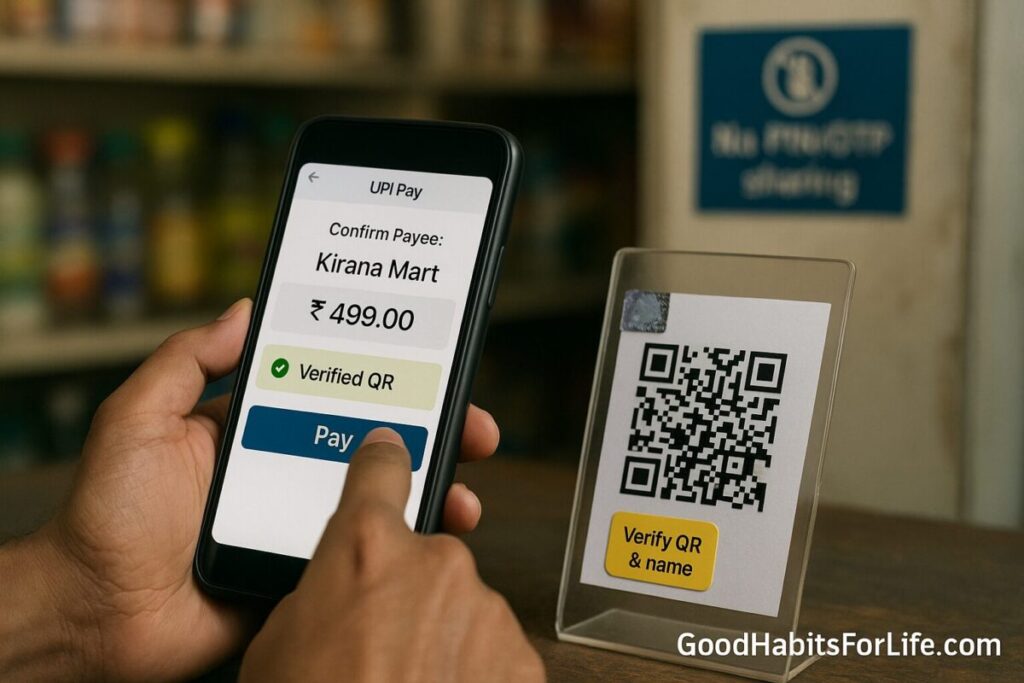
QR code fraud has matured: scammers paste their QR on shops or DM a “refund” QR that actually pulls money when you enter your PIN. Verify the payee name and guard against printed overlays. The Times of India+1
Phishing remains the most common initial vector—via SMS, email, search-ad impersonation, and malicious APKs (e-challan scams, fake helpdesks). The Times of Indiacisa.gov
✅ Quick Start: 12 Moves to Do Today
-
Reset UPI-PINs you haven’t changed in 6–12 months; use unique PINs across apps. NPCI
-
Set per-transaction and daily limits in your bank/payment app.
-
Turn on instant SMS/app alerts for every debit.
-
Add a device screen lock + SIM PIN; disable lock-screen preview of OTPs.
-
Disable screen-sharing while paying; uninstall remote-access apps you don’t need. NPCI
-
QR safety check: confirm merchant name in the app before entering your PIN; inspect the physical QR for overlays or mismatched names. The Times of India
-
Update apps from official stores only; never sideload APKs from links/DMs. The Times of India
-
Phishing filter: don’t click payment links from chats/SMS; search the official site yourself. cisa.gov
-
Spending friction: remove saved cards from shopping apps; require biometric/PIN for every purchase.
-
Notification diet: mute shopping/flash-sale pings; batch notifications twice daily. PLOS
-
Export statements monthly; reconcile and categorize spends.
-
If scammed, act within minutes: call 1930 and file at cybercrime.gov.in; then escalate via RBI’s grievance channels if a regulated entity fails to resolve. i4cCyber Crime IndiaReserve Bank of India
🛠️ 7-Day Starter Plan (with checkpoints)
Goal: lock down security + install healthy spending friction.
Day 1 — PIN & Limits
-
Rotate UPI-PINs; set daily/txn caps; enable alerts. NPCI
Day 2 — QR Hardening
-
Re-label printed QRs (merchants): tamper-evident cover; place indoors; verify name on every payment. (Consumers: confirm name, avoid “refund” QR.) The Times of India
Day 3 — Phishing Firewall
-
Create a rule: never act on links/attachments in unsolicited messages; uninstall unknown APKs; add spam filters. The Times of Indiacisa.gov
Day 4 — Device Hygiene
-
Update OS/apps; remove screen-sharing tools; set SIM PIN; backup authenticator codes.
Day 5 — Dopamine Detox Lite
-
Silence shopping notifications; delete one “temptation app”; set a 24-hour cooling-off rule for non-essentials. (Lower alerts = fewer impulsive taps.) PLOS
Day 6 — Spending Review
-
Export last 30 days; tag “needs vs wants”; add an impulse ledger (note triggers and context).
Day 7 — Drill & Escalation
-
Practice the 1930 call flow and portal filing; save account/UPI IDs you commonly pay so you can spot imposters. i4c
🧠 Techniques & Frameworks (practical, research-aligned)
1) PIN Discipline (3-Layer Rule) 🔒
-
Layer A—Knowledge: unique UPI-PIN per app; change quarterly.
-
Layer B—Channel: never share PIN/OTP/CVV on calls/chats; banks won’t ask. Reserve Bank of IndiaNPCI
-
Layer C—Context: if someone is on a call while you’re paying, hang up and finish the transaction privately. NPCI
2) QR Code Safety (V-M-O Check) 🧾
-
V—Verify name shown in your app matches the merchant you’re facing.
-
M—Match medium: inspect physical QRs for stickers over stickers; prefer in-app VPA selection from your saved list. The Times of India
-
O—Own device: never scan and then accept a “refund” request; incoming refunds don’t require your PIN. NPCI
3) Phishing Defense (3-Qs) 🕵️
-
Who sent it (handle/domain spelled right, verified)?
-
What are they asking (urgent, new number, secret link)?
-
Where should you act (go to the official site/app yourself). cisa.gov
4) Device & Network Hygiene (M-F-U) 📱
-
M—Minimal permissions: revoke SMS/contacts access for apps that don’t need them.
-
F—Fresh software: keep OS and wallet apps updated.
-
U—Untrusted networks: avoid payments on public Wi-Fi; use mobile data. Reserve Bank of India
5) “Dopamine Detox” for Digital Spending 🧯
Not a medical protocol—just reducing cues and delays to curb impulses. Research links notifications and always-on prompts with attention capture and reward-seeking; adding friction (delays, approvals) counters the effect. Try:
-
Mute/Batch notifications (twice daily). PLOS
-
24-hour cooling-off for non-essentials; buy only in scheduled “purchase windows.”
-
Unsave cards; require biometric/PIN every time.
-
Wishlist rule: if it’s still needed in 7 days, then consider.
-
Cash switch for discretionary categories to restore the “pain of paying.” InvestopediaScienceDirect
👥 Audience Variations
Students
-
Use prepaid wallets with low caps; disable BNPL; blacklist shopping hours during exams.
Parents
-
Set child UPI limits; keep biometrics to the parent’s device; teach kids to check payee names out loud.
Professionals
-
Separate phones or profiles for work/payments; export expenses weekly; watch for QR phishing in office cafes. Security Boulevard
Seniors
-
Use whitelists of trusted payees; large-amount “dual approval” with a family member; practice the 1930 call flow. The Times of India
Teens
-
Educational wallet with spending caps; monthly “receipt review” with a parent.
⚠️ Mistakes & Myths to Avoid
-
“Scanning a QR means I’m receiving money.” False. A QR can initiate collect or trick you into entering your PIN to send money. Always confirm the payee name and type. NPCI
-
“Bank staff asked for my OTP/KYC over WhatsApp.” Banks/regulators don’t do this; report and block. Reserve Bank of India
-
“Refund QR/verification fee.” Classic pull scam—don’t enter your PIN. The Times of India
-
“More apps = more convenience.” More apps = larger attack surface; keep only what you use.
-
“Dopamine detox is pseudoscience.” The term is pop-culture, but cue reduction and friction are evidence-aligned ways to cut impulsive taps and spending. PLOSScienceDirect
💬 Real-Life Scripts You Can Copy-Paste
-
Caller wants your PIN/OTP:
“I don’t share PINs or OTPs. I’ll call my bank on the official number.” -
Suspicious QR at a shop:
“Before I pay, can you show me the name that should appear in my app?” -
Friend asks you to scan a refund QR:
“Refunds don’t need my PIN. Send to my UPI ID; I’ll confirm the name before I approve.” -
Unknown ‘e-challan’ message:
“I’ll verify only on the official website/app—won’t install files from links.” The Times of India -
If money is debited fraudulently:
“I’m calling 1930 now and filing at cybercrime.gov.in. Here are the UTR, time, and amount.” i4cCyber Crime India
📚 Tools, Settings & Resources (quick picks)
-
Regulator guidance: RBI’s safety do’s/don’ts; NPCI UPI FAQs (PIN privacy; banks never ask). Reserve Bank of IndiaNPCI
-
Fraud advisories: CERT-In alerts; CISA phishing basics. CERT-INcisa.gov
-
Report & recover: National helpline 1930; National Cybercrime Reporting Portal (NCRP). i4cCyber Crime India
-
Grievance escalation: RBI Integrated Ombudsman Scheme (RB-IOS, 2021; FAQs updated 2025). Reserve Bank of India
-
Behavior change: Batch notifications; remove saved cards; enable spend-alerts; use spending caps and approval workflows. PLOSScienceDirect
🔑 Key Takeaways
-
PIN privacy is non-negotiable; no one legitimate needs your PIN/OTP—ever. Reserve Bank of IndiaNPCI
-
Treat QR codes like URLs—verify the recipient name and watch for overlays/tampering. The Times of India
-
Phishing beats tech: slow down, verify sources, and use official apps/sites only. cisa.gov
-
Add friction to fight impulse: mute promos, cooling-off windows, unsaved cards. ScienceDirect
-
If hit, act fast: call 1930, file at cybercrime.gov.in, and escalate to RBI Ombudsman if needed. i4cCyber Crime IndiaReserve Bank of India
❓ FAQs
1) Why do some QR scams drain money instead of paying me?
Because the flow is send, not receive. Scammers make you authorize a debit with your PIN. Always check the payee name and never enter a PIN to “receive” money. NPCI
2) How often should I change my UPI-PIN?
Every 3–6 months is a practical cadence; change immediately if you suspect compromise. NPCI
3) A message says I must update KYC via a link—should I?
No. Go to the official bank app/site yourself. Don’t share PIN/OTP, and never install APKs from links. Reserve Bank of IndiaThe Times of India
4) Are public Wi-Fi payments safe?
Avoid them. Use mobile data or a trusted network; never transmit sensitive info on open Wi-Fi. Reserve Bank of India
5) What’s the fastest way to respond after a fraudulent debit?
Call 1930 (financial cyber-fraud helpline) and file on cybercrime.gov.in with UTR, time, amount; then contact your bank and, if unresolved, RBI Ombudsman. i4cCyber Crime IndiaReserve Bank of India
6) Does muting shopping notifications really help me spend less?
Reducing prompts improves attention control and reinstates spending “friction,” which research links to lower impulsivity. PLOSScienceDirect
7) Are QR code overlays actually common?
Police and media reports in 2024–25 show pasted overlays at shops diverting payments; always inspect the code and verify the name in-app. The Times of India
8) Can banks ask for my OTP or PIN to “verify” a transaction?
No. Legitimate staff never ask for OTP/PIN/UPI-PIN/CVV. Hang up and call the official number. Reserve Bank of India
📚 References
-
Reserve Bank of India — Financial Awareness Messages (FAME) (PIN/OTP do’s & don’ts). https://www.rbi.org.in/commonman/images/FAME202426022024.pdf
-
RBI — Public cautions on sharing passwords/PIN/OTP. https://www.rbi.org.in/commonman/english/scripts/PressReleases.aspx?Id=3232
-
NPCI — UPI FAQs (never share UPI-PIN; banks won’t ask). https://www.npci.org.in/what-we-do/upi/faqs
-
CERT-In — Advisory CIAD-2024-0050 (verify sender, QR/loan scams). https://www.cert-in.org.in/s2cMainServlet?VLCODE=CIAD-2024-0050&pageid=PUBVLNOTES02
-
CISA — Phishing (general guidance, 2024). https://www.cisa.gov/sites/default/files/2024-02/Update%20to%20Phishing%20General%20Security%20Postcard_01.01.2024.pdf
-
RB-IOS FAQs (Integrated Ombudsman Scheme; updated Jan 7, 2025). https://www.rbi.org.in/commonman/English/Scripts/FAQs.aspx?Id=3407
-
National Cybercrime Reporting Portal (helpline 1930, portal). https://cybercrime.gov.in/ and https://i4c.mha.gov.in/ncrp.aspx
-
Upshaw JD et al. PLOS ONE (2022). Smartphone notifications and cognitive control. https://journals.plos.org/plosone/article?id=10.1371/journal.pone.0277220
-
Broekhoff MC et al. (2024). Pain of paying and frictionless transactions. https://www.sciencedirect.com/science/article/pii/S0167268124001100
-
Veissière SPL & Stendel M (2018). Dopamine & smartphone notifications. https://www.frontiersin.org/journals/psychology/articles/10.3389/fpsyg.2018.00141/full
-
KnowBe4 Q3-2024 report (QR phishing trend coverage). https://www.securitymagazine.com/articles/101232-a-new-report-shows-qr-code-phishing-is-on-the-rise
-
NPCI — UPI circulars (product standards & safeguards). https://www.npci.org.in/what-we-do/upi/circular
⚖️ Disclaimer
This article offers general education on digital payments and behavioral finance. It is not financial, legal, or cybersecurity advice; follow guidance from your bank, regulator, and local authorities.