
Kids & Money Mindset: Earn Save Give: No-Spend Challenge (2025)
Kids No-Spend Challenge (2025): Earn, Save, Give Mindset
Table of Contents
🧭 What & Why
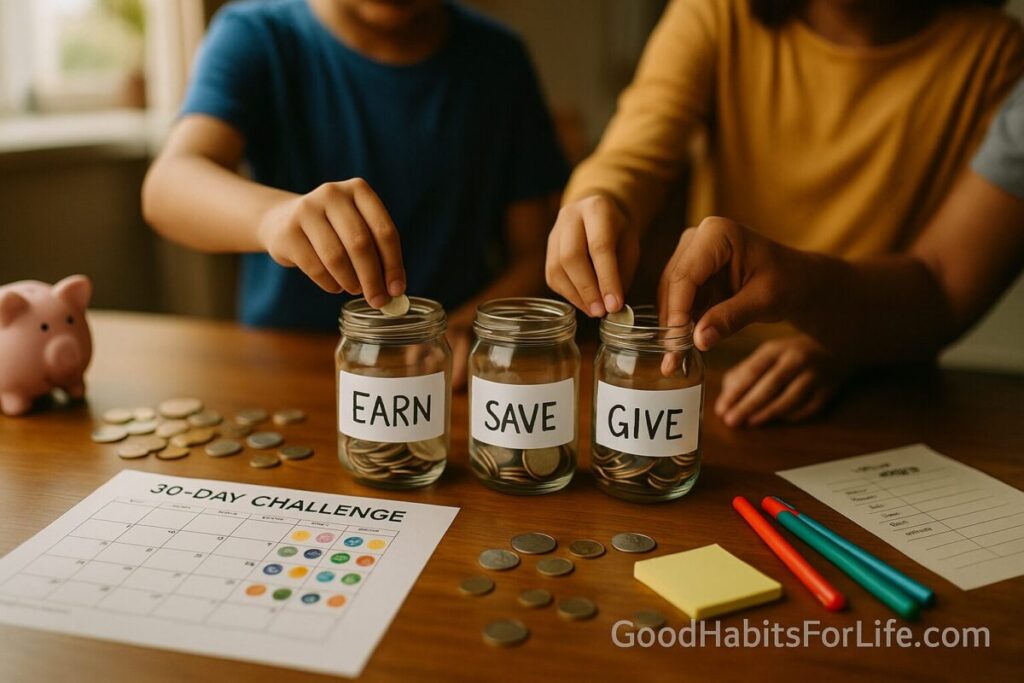
What this is: A family-friendly no-spend challenge designed for kids (and tweens/teens). For 30 days, children avoid impulse buys and instead earn, save, and give with intention.
Why it matters: Money skills grow over time, not overnight. Evidence-based youth education emphasises three “building blocks”: executive function (self-control, planning), habits & norms, and financial knowledge & decision-making—best developed through age-appropriate, hands-on practice. Consumer Financial Protection Bureau
Global assessments (e.g., PISA 2022 Financial Literacy) show many 15-year-olds struggle with everyday money tasks, underlining the value of consistent learning at home and school. Family conversations and real experiences—earning, saving toward a goal, giving to a cause—make literacy stick. OECD
Bottom line: Treat money like a habit (repeated behaviours in context) rather than a one-time lecture—then make the habit visible, trackable, and rewarding.
✅ Quick Start (Do This Today)
-
Set the rules (10 minutes).
-
No-spend list: Snacks, in-app buys, toys, non-essentials.
-
Allowed: Essentials (school supplies), pre-planned purchases, earning via chores/mini-jobs, saving, giving.
-
-
Create three “pots.”
-
Earn Jar (income placeholder), Save Jar, Give Jar. Use jars, envelopes, or a digital wallet with separate “pots.”
-
-
Choose split ratios.
-
Start simple: 50% Save / 40% Give / 10% Fun (adjust by age; see variations).
-
-
Pick a goal.
-
A specific, priced goal (e.g., ₹1,200/US$15 sketchbook set in 4 weeks). Post a progress chart on the fridge.
-
-
Plan how to earn.
-
Age-fit mini-jobs (sorting books, watering plants, simple baking). List tasks with payment amounts.
-
-
Schedule a weekly Money Huddle (15 min).
-
Review earnings, splits, progress, and one giving action (e.g., donate ₹100/US$1.25 to a local cause).
-
-
Make it fun.
-
Add No-Spend Bingo (free activities), streak stickers, and a small family reward at day 30.
-
🛠️ 30-60-90 Day Habit Plan
Days 1–30 (Foundations):
-
Week 1: Set rules, make jars, pick goal & cause, design an earning board (task → amount).
-
Week 2: Track daily; introduce “cooling-off” rule (wait 48 hours before any new wish-list item).
-
Week 3: Add price-per-use thinking (e.g., a ₹600/US$7 toy used 20 times = ₹30/US$0.35 per use).
-
Week 4: Celebrate progress; kids present their “money story” (what they earned, saved, gave, learned).
Days 31–60 (Confidence):
-
Move to automatic splits (kids can do the math).
-
Introduce mini-budgets for categories (snacks, hobbies).
-
Add a stretch goal (e.g., 10% extra savings) and a giving project (e.g., school library books).
Days 61–90 (Mastery):
-
Kids set their own ratios (with a minimum 30% save).
-
Practice cost comparison and unit pricing at the store.
-
Try a “value audit”: list last 10 purchases and rate joy/usefulness (keep 8–10s; avoid 3–5s).
🧠 Techniques & Frameworks (Earn-Save-Give in Practice)
1) Three-Jar System (classic, visible):
-
Label Earn, Save, Give. Every rupee/dollar flows through Earn first, then is split.
-
Younger kids: use images (piggy, shield, heart) and coloured lids.
2) “Pay Yourself First” for Kids:
-
As soon as money arrives, allocate to Save before discretionary spending.
3) Needs vs Wants Ladder:
-
Draw a ladder from Needs→Nice-to-have→Impulse. Place wish items on the ladder; only items at or above a set rung are considered after a 48-hour wait.
4) Sinking Funds for Kids:
-
Create micro-funds for Big Goal, Hobby, Gifts. Helps with planning and reduces “surprise spends.”
5) Weekly Money Huddle (family ritual):
-
Review the tracker, praise effort, troubleshoot barriers, pick a give action (time, stuff, or money).
6) Real-World Earning Board:
-
Examples:
-
Primary: Match socks (₹10/US$0.10), water plants (₹15/US$0.15).
-
Tweens: Wash bicycle (₹60/US$0.70), organize shelf (₹50/US$0.60).
-
Teens: Babysit, simple tutoring, pet-sitting (market rates).
-
7) Decision Scripts (Implementation Intentions):
-
“If I see a new snack I want, then I’ll put it on my 48-hour list and check my goal chart first.”
8) Learning Alignment:
-
Align with competency frameworks (planning, saving, giving, comparing). See OECD/INFE & Jump$tart standards; use FDIC Money Smart modules for practice. OECDJump$tart CoalitionFDIC
👨👩👧 Audience Variations (By Age & Role)
Ages 4–7 (Foundations):
-
Use clear jars and stickers for goals.
-
Practice counting coins, simple price comparisons (“Which costs less?”).
-
1–2 mini-jobs/week; heavy adult scaffolding.
Ages 8–12 (Skills):
-
Introduce split ratios kids can calculate; small budget envelopes.
-
Add price-per-use and the cooling-off rule.
-
Encourage giving choices kids care about (animals, trees, books).
Ages 13–17 (Ownership):
-
Shift to self-set ratios with minimum save %, category budgets, and comparison shopping.
-
Consider a supervised debit/prepaid tool if legal/available; review statements together monthly (focus on trends, not shame).
Parents/Caregivers:
-
Model behaviour (lists, price checks), narrate decisions (“We’re saving 40% for a trip”).
-
Keep weekly huddles short, positive, and kid-led.
Teachers/Youth Leaders:
-
Run a classroom no-spend week; integrate quick Money Smart lessons; map to standards and reflect in journals. FDICJump$tart Coalition
Grandparents & Mentors:
-
Sponsor matching saves (e.g., match up to ₹200/US$2 per week).
-
Co-design a give project related to family history or community.
⚠️ Mistakes & Myths to Avoid
-
Myth: “Money habits are fixed by age 7.”
Early experiences matter, but habits continue to form with ongoing practice and support. The widely cited “age 7” comes from a UK report on early habit formation; treat it as motivation to start early, not a deadline. MaPS -
Over-relying on willpower.
Make the environment do the work (jars, trackers, pre-commitments) rather than lectures. -
Shaming mistakes.
Reframe slips as data: “What got in the way? What’s the next tweak?” -
Assuming delay of gratification is destiny.
Newer research shows context (like family and resources) affects a child’s ability to “wait”—so build supportive structures, not tests. PMC -
No fun allowed.
A strict “no anything” month backfires. Keep planned fun (library day, park picnic) to sustain motivation.
📋 Real-Life Examples & Scripts
Split ratio menu (pick one to start):
-
Saver Start: 50% Save / 40% Give / 10% Fun
-
Balanced: 40% Save / 30% Give / 30% Fun
-
Teen Flex: 30% Save / 20% Give / 50% Discretionary (with a written mini-budget)
Family script (store impulse):
-
Kid: “I want this ₹300 fidget toy!”
-
Parent: “Cool—add it to your 48-hour list. Check your goal chart—how would this change your finish date?”
Weekly Money Huddle agenda (15 min):
-
Wins (what we earned, saved, gave).
-
Goal check (how close, what’s next).
-
One improvement (e.g., adjust ratio for a week).
-
Plan a give action (money, time, or item).
No-Spend Bingo (free fun ideas):
-
Backyard picnic 🧺, library treasure hunt 📚, DIY comic 🎨, board-game night 🎲, neighbourhood photo walk 📷.
Giving projects (kid-led):
-
Animal shelter wishlist, classroom book drive, park clean-up, seedlings for a community garden.
📚 Tools, Apps & Resources (Pros/Cons)
-
FDIC Money Smart (free curricula, K-12).
Pros: Free, lesson-based, with caregiver guides. Cons: Educator-style PDFs (parents may skim). FDIC -
Jump$tart National Standards (2021).
Pros: Clear competency map; helpful for planning. Cons: Framework (not plug-and-play activities). Jump$tart Coalition -
CFPB Youth “Building Blocks.”
Pros: Research-based model of skills across ages; simple concepts for parents. Cons: US-centric examples. Consumer Financial Protection Bureau -
OECD/INFE Guides & Toolkits.
Pros: Internationally validated competencies and measurement; policy-neutral. Cons: Dense reading. OECD -
Talk, Learn, Do (parents of 3–11).
Pros: Evidence-tested parent sessions; practical conversation prompts. Cons: UK focus (adapt ideas locally). MaPS+1 -
Low-tech essentials.
Clear jars, coloured envelopes, fridge chart, simple calculator, pencil + ruler (for price-per-use tables).
🔑 Key Takeaways
-
Make money visible. Clear jars and weekly huddles beat abstract talks.
-
Habits over lectures. Repetition with feedback builds skills and confidence.
-
Early matters, but it’s never “too late.” Support and structure drive growth. Consumer Financial Protection BureauPMC
-
Tie actions to outcomes. Earn mini-jobs, save toward a goal, give to a cause.
-
Celebrate streaks. Fun, low-cost rewards maintain momentum.
❓ FAQs
1) How long should a kids’ no-spend challenge last?
Start with 30 days. Extend to 60–90 as kids internalise the routine.
2) What split ratio is “best”?
There’s no single right answer. Begin with 50/40/10 (Save/Give/Fun) and adjust by age and goals.
3) Should kids be paid for every chore?
Not necessarily. Keep family responsibilities unpaid; pay for extra tasks or mini-jobs that teach value.
4) How do we handle birthdays or festivals?
Pre-plan. Allow a one-day pause or allocate part of cash gifts into Save/Give before spending.
5) What if my child resists?
Shrink the challenge (one week), add choice (kids pick ratios/jobs), and track visible wins.
6) Is it OK to use prepaid or debit cards for teens?
If permitted in your country and with supervision. Review statements monthly and set category budgets.
7) How does this align with school learning?
Use FDIC Money Smart lessons and Jump$tart standards to map activities to competencies. FDICJump$tart Coalition
8) Is delaying gratification the goal?
It’s a tool—not a trait you either “have” or “don’t.” Context matters; build supports, not tests. PMC
📚 References
-
Consumer Financial Protection Bureau. Understanding youth financial capability & the “building blocks” model. https://www.consumerfinance.gov/consumer-tools/educator-tools/youth-financial-education/learn/ Consumer Financial Protection Bureau
-
OECD. PISA 2022 Results (Vol. IV): Students’ Financial Literacy. (2024). https://www.oecd.org/content/dam/oecd/en/publications/reports/2024/06/pisa-2022-results-volume-iv_125a58b3/5a849c2a-en.pdf OECD
-
Jump$tart Coalition. National Standards for Personal Financial Education (2021). https://www.jumpstart.org/education/national-standards/ Jump$tart Coalition
-
FDIC. Money Smart (K–12 & beyond) – Educator & Parent Resources. https://www.fdic.gov/consumer-resource-center/money-smart FDIC
-
Money and Pensions Service (UK). Talk, Learn, Do—Parents & Money. https://maps.org.uk/en/our-work/talk-learn-do MaPS
-
Watts, T. W., Duncan, G. J., & Quan, H. (2018). Revisiting the Marshmallow Test: A Conceptual Replication. Psychological Science. https://pmc.ncbi.nlm.nih.gov/articles/PMC6050075/ PMC
-
Whitebread, D., & Bingham, S. (2013). Habit Formation and Learning in Young Children. (Money Advice Service/University of Cambridge). https://maps.org.uk/content/dam/maps-corporate/en/our-work/mas-habit-formation-and-learning-in-young-children-may-2013.pdf MaPS
-
OECD/INFE. Overview & Recommendation on Financial Literacy; international toolkits and measures. https://www.oecd.org/content/dam/oecd/en/topics/policy-sub-issues/financial-education/oecd-infe-overview.pdf OECD
-
FDIC. Money Smart for Young People (K-12). https://www.fdic.gov/consumer-resource-center/money-smart-young-people FDIC
-
Money and Pensions Service. NatWest Talk, Learn, Do Evaluation (2022). https://maps.org.uk/content/dam/maps-corporate/en/our-work/talk-learn-do/natwest-talk-learn-do-evaluation-july-2022.pdf MaPS
⚖️ Disclaimer
This article provides general educational information about money habits for families and does not constitute financial advice.