
Money Dates: Monthly CheckIns that Stick: No-Spend Challenge (2025)
No-Spend Challenge (2025): Money Dates & Monthly Check-ins
Table of Contents
🧭 What & Why
What is a “money date”?
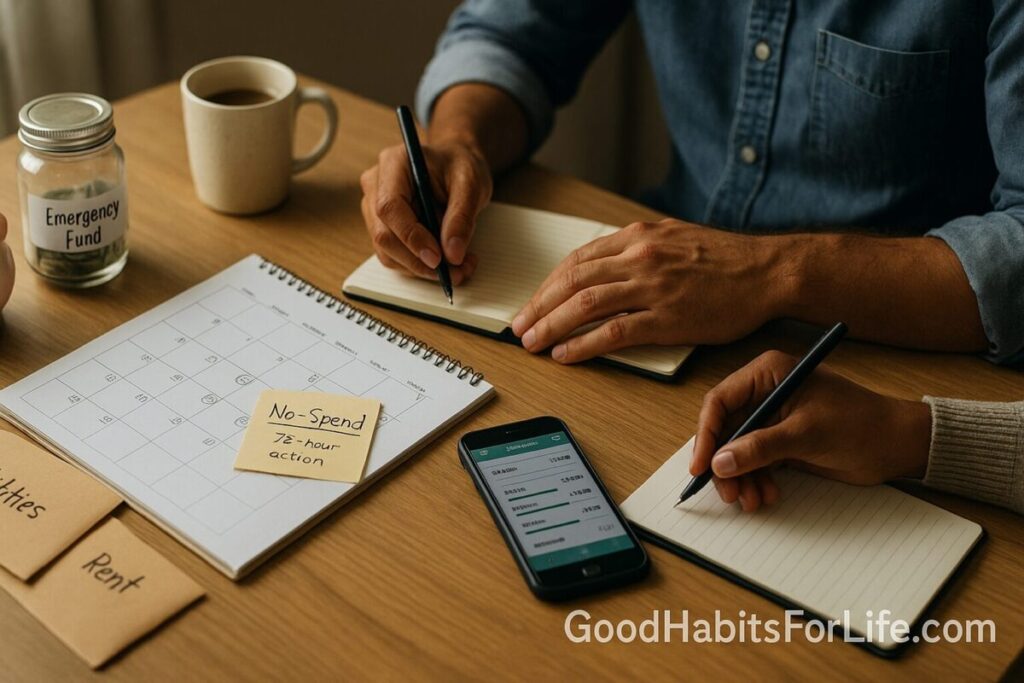
A short, scheduled check-in (solo or with a partner) to review last month’s spending, make two or three decisions for the next month, and set one action you’ll finish in the next 72 hours. Stack a no-spend challenge (a defined period with no discretionary purchases) onto that cadence to compress gains.
Why it works:
-
Regularity reduces stress. Money pressure is widespread, and periodic reviews help regain control. In APA’s Stress in America 2024, the economy was a significant source of stress for most adults, underscoring the need for simple routines that restore agency. APA
-
Measure what matters. A brief monthly baseline using the CFPB Financial Well-Being Scale helps you see whether habits translate into real financial well-being over time. Consumer Financial Protection Bureau
-
Behavior science backs the method. Implementation intentions (if-then plans), pre-commitment, and payment friction reliably improve follow-through (details below). kops.uni-konstanz.de
Outcomes you can expect (8–12 weeks):
-
Fewer impulse buys and “leaks.”
-
Clearer rules for discretionary spending.
-
A documented path toward savings goals (emergency fund, debt payoff, or investments).
✅ Quick Start: Your First 30-Minute Money Date (this month)
Before you begin (5 min):
-
Open last month’s statements (bank + credit).
-
Write your one-month goal (e.g., “Save ₹10,000 (≈$120) by cutting food delivery and subscriptions”).
-
Decide your no-spend window (7, 14, or 30 days). Choose start date now.
During the money date (20 min):
-
Review (8 min):
-
Top 3 categories by spend.
-
Any annual/quarterly bills due soon.
-
Recurring subscriptions—circle candidates to cancel or downgrade.
-
-
Decide (8 min):
-
Pick one category to cap (e.g., eating out ≤ ₹3,000 this month).
-
Pick one subscription to cancel or pause.
-
Set one no-spend rule (e.g., “No apparel purchases until next money date”).
-
-
Plan (4 min):
-
Add two “if-then” prompts (e.g., “If I get a food-delivery urge after 7 p.m., then I’ll make eggs or dal and set a 10-min timer.”)
-
Schedule next month’s money date.
-
After (5 min):
-
Do the 72-hour action: cancel a subscription, move cash to savings, or set a card-level spend alert.
Track only 3 metrics this month:
-
Savings added, 2) Subscription spend, 3) Impulse buys prevented (count).
🗓️ 30-60-90 Roadmap (Monthly Check-ins + No-Spend)
Days 0–30 (Month 1): The Starter Sprint
-
No-spend: 7–14 days, with a written exceptions list (e.g., medicines, commute, fresh produce).
-
Cap one category (the biggest “leak”).
-
Audit subscriptions and kill at least one.
-
Checkpoint: Savings rate improves by 2–3 percentage points; 1–2 impulse purchases a week avoided.
Days 31–60 (Month 2): Systems & Automation
-
No-spend: 14–21 days (or two weekend sprints).
-
Add automations: account alerts (per-category), round-ups to savings, bill-due reminders.
-
Envelope a tempt category (e.g., prepaid card with ₹2,000 for coffee/snacks).
-
Checkpoint: 50–70% reduction in “regret buys”; two automations live.
Days 61–90 (Month 3): Optimization & Growth
-
No-spend: 30-day “soft” challenge (allowed exceptions + planned “spend days” for essentials).
-
Commitment device: schedule an automatic transfer to savings the day after payday.
-
Invest learning: note three triggers and the counter-moves that worked.
-
Checkpoint: +5–10% savings rate vs. Month 0; steady monthly routine.
🧠 Techniques & Frameworks That Work
1) Implementation intentions (If-Then planning).
Pre-plan the cue and the response: “If I’m scrolling shopping apps after 10 p.m., then I’ll plug in my phone in the living room and read for 10 minutes.” A large meta-analysis shows this simple technique meaningfully increases goal achievement. kops.uni-konstanz.de
2) “Pain of paying” and payment friction.
Spending feels different depending on method. Paying with cards or frictionless apps can reduce the “pain of paying,” nudging higher spend; adding small frictions (cash envelopes for a trouble category, 24-hour waitlists, or app locks) counteracts over-spending. Massachusetts Institute of TechnologyAPA
3) Commitment devices.
Pre-commit to a future behavior (e.g., auto-increase savings after a raise). The Save More Tomorrow™ model shows how pre-commitment boosts saving without daily willpower battles. Chicago Journals
4) Financial check-ins with a scale.
Use the CFPB Financial Well-Being Scale (10 questions) quarterly to see if your money dates are moving overall well-being, not just cutting costs. Consumer Financial Protection Bureau
5) Focused no-spend windows—not forever.
Short sprints (7–30 days) reset habits without rebound. Pair them with pre-approved exceptions and planned “spend days” to avoid deprivation backlash.
👥 Audience Variations
Students
-
Do 7-day no-spend sprints during exam weeks (built-in focus).
-
Cap delivery/coffee; set campus-friendly meal prep.
-
Use shared spreadsheets to split rent/utilities.
Couples / Parents
-
Rotate agenda ownership monthly (each partner brings one decision).
-
Use “mine-yours-ours” accounts: fixed amounts to a joint “ours” for shared bills; personal “mine/yours” for guilt-free spending.
-
Close every money date with a 2-minute “What went well?” ritual.
Professionals
-
Add subscription audits quarterly (software, streaming, SaaS).
-
Use card-level category alerts (e.g., dining > ₹4,000 triggers a text).
-
Block “shopless hours” (9 p.m.–9 a.m.) with device limits.
Seniors / Fixed Income
-
Prefer cash or debit for discretionary categories to increase salience.
-
Add a trusted person to your “money date” once a quarter to discuss big bills and benefits. (Government resources on day-to-day money support can help.) MaPS
⚠️ Mistakes & Myths to Avoid
-
Myth: “No-spend means buy nothing.” Reality: define clear exceptions (healthcare, essentials), or you’ll rebound.
-
Mistake: Tracking everything. Track only 3 numbers; spend energy deciding, not logging.
-
Myth: “If I budget once, I’m done.” Money dates are recurring, not one-off events.
-
Mistake: Going solo when you share bills. If you live with someone, invite them—silence breeds surprises.
-
Myth: Apps solve behavior. Apps support; the calendar appointment + decisions change behavior.
💬 Real-Life Examples & Scripts
Script: Starting the money date (couples)
“Let’s spend 30 minutes on our money date. I’ll bring last month’s top 3 spends; you bring one rule we can try for the next 30 days. We’ll decide two things and set one action today.”
Script: Saying no during a no-spend
“I’m on a 14-day no-spend. If I still want this after the 24-hour wait, I’ll add it to next month’s list.”
Script: Cancelling a subscription
“I’m pruning subscriptions this month. Please confirm cancellation effective today and send a confirmation email.”
Example: Exceptions list (copy-paste)
-
Allowed: medicines, groceries (fresh produce only), transport, essential school/work supplies.
-
Not allowed: apparel, electronics, eating out (except one pre-planned meal), impulse décor, digital add-ons.
Example: 24-Hour Waitlist (notes app)
-
Item | Price | Why I want it | Still want after 24h? | When to revisit
🛠️ Tools, Apps & Resources (pros/cons)
-
Rocket Money — Finds and helps cancel subscriptions; useful for the 72-hour action. Pros: quick wins; Cons: some features paid. rocketmoney.com
-
Monarch Money / YNAB / Tiller — Category caps, rollovers, and granular budgets. Pros: excellent visibility; Cons: subscription cost.
-
Google Sheets “Money Date” Template — Shared calendar + sheet for agenda, decisions, metrics. Pros: free, flexible; Cons: manual setup.
-
Splitwise / Honeydue (couples) — Shared expenses and chats about bills. Pros: transparency; Cons: needs consistent logging. Honeydue
-
Banking apps — Enable per-category alerts, merchant-level blocks, and spending limits. Pros: built-in; Cons: varies by bank.
-
Government/Nonprofit guides — Budgeting basics and support if you’re helping a family member manage money. Pros: impartial; Cons: general advice. MaPS
📌 Key Takeaways
-
The combination of monthly money dates + short no-spend challenges creates a repeatable habit loop: review → decide → act.
-
Use if-then plans, commitment devices, and payment friction to make the right choice easier than the impulse. kops.uni-konstanz.deChicago JournalsMassachusetts Institute of Technology
-
Track fewer numbers, make more decisions, and lock in automations within 72 hours of each money date.
-
Keep it friendly and brief; progress beats perfection.
❓ FAQs
1) How long should a no-spend challenge be?
Start with 7–14 days. Extend to 30 days once you’ve tested exceptions and a waitlist.
2) What if I “break” the challenge?
Log it, learn the trigger, and restart the clock. The goal is behavior learning, not purity.
3) Do I need to track every expense?
No. For this system, track just three metrics (savings added, subscription spend, impulse-buy count). If you love detail, add category caps.
4) Should I use cash only?
Not necessarily. Use cash or prepaid for a problem category to add friction; keep digital for bills and travel. The point is salience, not inconvenience. Massachusetts Institute of Technology
5) How do couples avoid arguments on money dates?
Use a fixed 30-minute agenda, rotate who leads, and close with one 72-hour action you both support.
6) What if income is irregular?
Base caps on percentages, not rupees/dollars. Run money dates after each payout, not by month-end.
7) How do I know it’s working?
Re-take the CFPB Financial Well-Being Scale quarterly and compare your score; also check your savings rate trend. Consumer Financial Protection Bureau
8) Is this just budgeting with a new name?
No. This is behavior-first budgeting—short meetings, small rules, and rapid actions that compound.
📚 References
-
American Psychological Association. Stress in America™ 2024: A Nation in Political Turmoil (Oct 2024). https://www.apa.org/pubs/reports/stress-in-america/2024/2024-stress-in-america-full-report.pdf APA
-
Consumer Financial Protection Bureau. Measure and Score Financial Well-Being (Dec 2024). https://www.consumerfinance.gov/consumer-tools/educator-tools/financial-well-being-resources/measure-and-score/ Consumer Financial Protection Bureau
-
Gollwitzer, P. M., & Sheeran, P. (2006). Implementation Intentions and Goal Achievement: A Meta-analysis of Effects and Processes. Advances in Experimental Social Psychology, 38, 69–119. (Open copy via University of Konstanz.) https://kops.uni-konstanz.de/bitstreams/d4f710b4-a505-49ef-a831-5b8d7675100b/download kops.uni-konstanz.de
-
Prelec, D., & Simester, D. (2001). Always Leave Home Without It: A Further Investigation of the Credit-Card Effect on Willingness to Pay. Marketing Letters, 12(1), 5–12. (MIT working paper copy.) https://web.mit.edu/simester/Public/Papers/Alwaysleavehome.pdf Massachusetts Institute of Technology
-
Raghubir, P., & Srivastava, J. (2008). The Effect of Payment Coupling and Form on Spending Behavior. Journal of Experimental Psychology: Applied, 14(3), 213–225. https://www.apa.org/pubs/journals/releases/xap143213.pdf APA
-
Thaler, R. H., & Benartzi, S. (2004). Save More Tomorrow™: Using Behavioral Economics to Increase Employee Saving. Journal of Political Economy. https://www.journals.uchicago.edu/doi/10.1086/380085 Chicago Journals
-
MoneyHelper (UK). Beginner’s Guide to Managing Your Money. https://www.moneyhelper.org.uk/en/everyday-money/budgeting/beginners-guide-to-managing-your-money MaPS
-
Consumer app site. Rocket Money—Find & Cancel Subscriptions. https://www.rocketmoney.com/ rocketmoney.com
-
Honeydue. Finance App for Couples—How it Works. https://www.honeydue.com/how-it-works Honeydue
-
OECD/INFE. 2023 International Survey of Adult Financial Literacy (overview). https://www.oecd.org/en/publications/oecd-infe-2023-international-survey-of-adult-financial-literacy_56003a32-en.html OECD
⚖️ Disclaimer
This article is for education only and is not financial advice; please consider your circumstances and consult a licensed professional where appropriate.