
Dopamine & Purchases: The 24Hour Rule: No-Spend Challenge (2025)
Dopamine & Purchases: 24-Hour Rule No-Spend (2025)
Table of Contents
🧭 What Is the 24-Hour Rule & Why It Works
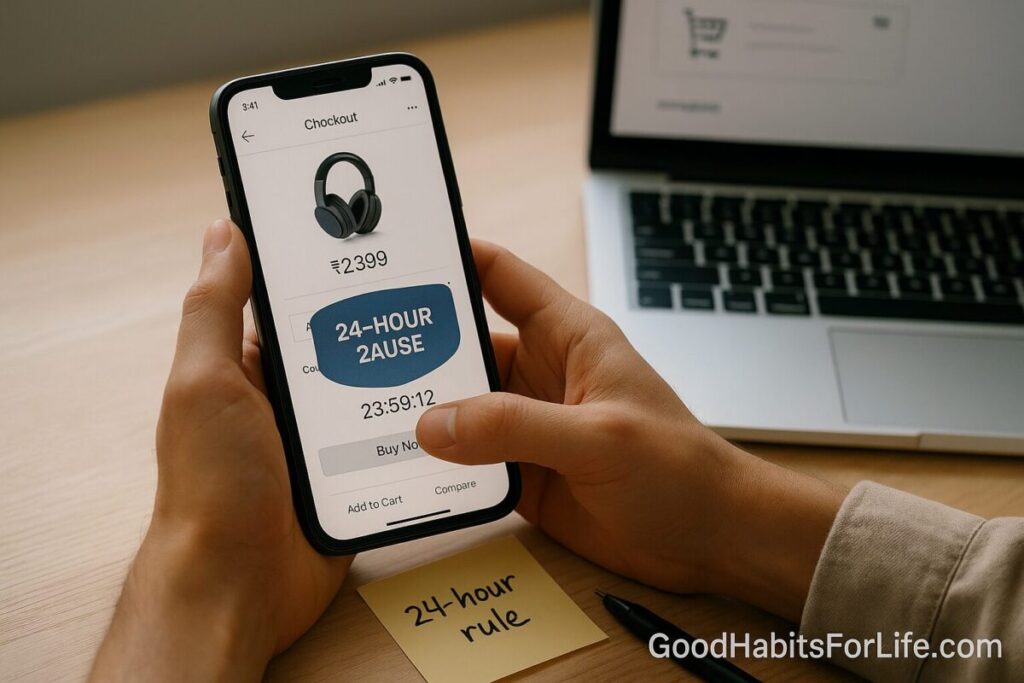
The 24-hour rule is a simple pause: for any non-essential purchase above a threshold you choose (e.g., ₹2,000/$25), wait at least 24 hours before buying. In that window, you reassess need, compare options, or abandon the cart—often with no regret.
Why it works:
-
Your brain’s reward system (dopamine) encodes “prediction errors”—bursts when a potential reward looks better than expected—driving urges to click “Buy.” A short delay lets that spike normalize, so cooler reasoning can weigh in. PMC
-
fMRI studies show desire and price “pain” compete: nucleus accumbens (wanting) vs. insula (cost aversion). Creating delay increases the chance the “cost” network overrides impulse. PMC
-
Present bias (overvaluing “now” vs. “later”) is a core driver of impulse spending; a 24-hour pause weakens it. Dash Harvard
✅ Quick Start: Do This Today
-
Pick your threshold: “I’ll wait 24 hours on anything over ₹2,000 ($25).”
-
Set a capture tool: Create a “Parking Lot” list in Notes/Trello. Add item, price, date.
-
Defuse checkout traps: Remove saved cards; disable 1-click; turn off autofill for payment. Massachusetts Institute of Technology
-
BNPL off by default: Opt-out where possible; treat BNPL like short-term debt. Consumer Financial Protection Bureau
-
Add a question: “What problem does this solve? What’s the cheaper fix?”
-
Decision review next day: If still needed, buy—ideally after price-checking and sleeping on it.
🧠 The Brain & Biases Behind Impulse Buys
-
Dopamine & “surprise value”: When a product feels new, scarce, or discounted, dopamine neurons fire to signal a mismatch between expected and received reward—pushing you toward approach behaviors. Pausing dulls this “surprise.” PMC
-
Neural tug-of-war: The nucleus accumbens lights up with desire; the insula responds to pain/cost—better activating when you see total cost, shipping, or fees. Time helps your prefrontal cortex compute value calmly. PMC
-
Cards vs. cash: Classic experiments show people are willing to pay more with credit than cash—the “pain of paying” is softened, encouraging overspend; layering the 24-hour rule offsets that effect. Massachusetts Institute of Technology
-
BNPL risk: Buy-Now-Pay-Later expands purchasing power and can lead to multiple overlapping loans among borrowers—another reason to insert a waiting period. Consumer Financial Protection Bureau
🛠️ Techniques & Frameworks That Work
1) MCII (“WOOP”) — Wish, Outcome, Obstacle, Plan
-
Example: Wish: Cut impulse buys. Outcome: Save ₹15,000 ($180)/month. Obstacle: Late-night scrolling. Plan (if-then): “If I add to cart after 9 pm, then I’ll park it and set a 24-h reminder.”
-
Meta-analysis: MCII/implementation intentions yield small-to-moderate improvements in goal attainment across domains. PMC
2) Choice bundling / commitment
-
Treat repeated small purchases as a bundle affecting monthly cash flow; decide once per week. Use public commitments (accountability buddy), prepaid spending envelopes, or self-imposed blocks. Evidence shows reducing delay discounting improves self-control. PMC
3) Friction design
-
Remove stored cards, require two-step logins on shops, and force a “compare prices” step. These add milliseconds of friction that meaningfully cut impulsive checkouts. Massachusetts Institute of Technology
4) Price-per-use rule
-
Estimate “cost per use” (e.g., ₹4,000 shoes with 100 wears = ₹40/use [$0.48]); if still compelling after 24 h, proceed.
5) BNPL guardrails
-
If you must use BNPL, limit to one active plan, track payoff dates, and still apply the 24-hour rule on each order to avoid stacking loans. (Regulators are moving to align BNPL with credit-card-like protections.) Reuters
📅 30-60-90 No-Spend Roadmap
Goal: Build the habit of pausing and prioritizing. Research suggests habit strength typically grows over weeks (median ~66 days, range 18–254). Plan for ~90 days to cement it. Wiley Online Library
Days 1–30 (Install the pause):
-
Set thresholds and install blockers (remove saved cards; disable BNPL). Massachusetts Institute of TechnologyConsumer Financial Protection Bureau
-
Track every non-essential desire in your Parking Lot.
-
Weekly review: Count deferrals, regrets prevented, ₹ saved.
Days 31–60 (Upgrade decisions):
-
Add compare-before-buy (3 quotes); apply price-per-use.
-
Introduce “72-hour on items >₹10,000/$120.”
-
Start sinking funds for big goals (travel, laptop).
Days 61–90 (Automate & scale):
-
Formalize categories: Immediate needs, 24-h wants, Wishlist.
-
Lower your threshold by 10–20% (e.g., ₹2,000→₹1,600) to capture more wins.
-
Celebrate with a planned purchase from your Wishlist—paid in full, not BNPL.
Monthly scorecard:
-
Deferrals completed; % abandoned; average cooling-off time; savings redirected to goals; number of BNPL/credit “temptations” avoided.
👥 Audience Variations
-
Students/Teens: Use prepaid wallets with weekly caps; remove shopping apps from the phone Monday–Friday. Parents can co-create thresholds.
-
Professionals: Add a “workday window”: no discretionary buys 10:00–18:00. Park items; decide on weekends.
-
Parents: Batch kid-related purchases into a weekly “family cart” and decide together.
-
Seniors: Prefer debit/cash for non-essentials to keep spending salient; set SMS alerts per transaction.
-
Side-hustlers/Creators: Treat gear purchases as projects—write a mini-brief (problem, ROI, alternatives) before the 24-h review.
⚠️ Mistakes & Myths to Avoid
-
“I’ll miss the deal.” Most discounts repeat. If it’s truly rare, ask: Will this strain cash flow? Scarcity cues can exaggerate dopamine responses; pausing helps. PMC
-
“Only big purchases need a pause.” Small daily swipes accumulate; apply the rule to low-stakes, too.
-
“BNPL isn’t debt.” It is staggered debt and often stacks—use sparingly with full visibility. Consumer Financial Protection Bureau
-
“Habits form in 21 days.” Evidence suggests a median nearer 66 days—plan for longer, be consistent. Wiley Online Library
💬 Real-Life Examples & Scripts
Personal script:
-
“If a non-essential costs >₹2,000 ($25), then I add it to my Parking Lot and set a 24-h reminder.”
-
“If I see ‘Only 2 left!’, then I screenshot, park the item, and close the tab.”
Partner script:
-
“I’m trying a 24-hour pause this month. If I send a screenshot, can you hold me to it until tomorrow at 7 pm?”
Team challenge:
-
“No-Spend 14”: Each day, share one deferral and what you did instead (walk, library, repair). Small rewards from a pre-agreed pot at the end.
🧰 Tools, Apps & Resources (pros/cons)
-
Budgeting apps (envelope/zero-based): Pro—clarity and intentionality; Con—setup time.
-
Price-tracking extensions: Pro—auto alerts support waiting; Con—can rekindle desire.
-
Website blockers / focus apps: Pro—reduce late-night scrolling; Con—needs willpower to keep enabled.
-
Payment friction tactics: Remove saved cards; use virtual cards with caps; disable autofill. Pro—instant results; Con—minor checkout hassle. Massachusetts Institute of Technology
-
BNPL visibility: Maintain a simple tracker; limit to one plan max—or opt-out entirely. Pro—prevents stacking; Con—less “flex.” Consumer Financial Protection Bureau
📌 Key Takeaways
-
A 24-hour pause counters dopamine-driven “wanting” and present bias. PMCDash Harvard
-
Add friction (no stored cards/1-click) and visibility (Parking Lot, price-checks). Massachusetts Institute of Technology
-
Use MCII if-then plans; build the habit over 60–90 days. PMCWiley Online Library
-
Treat BNPL as debt; apply the same pause to it. Consumer Financial Protection Bureau
❓ FAQs
1) Does the 24-hour rule actually save money?
Yes—by reducing present-biased choices and letting price “pain” surface before purchase; card-based buying often increases willingness to pay, so a pause plus friction helps. Dash HarvardMassachusetts Institute of Technology
2) What if a deal expires?
If the purchase is truly essential, it should withstand a day’s scrutiny. Genuine once-a-year buys can be exceptions—note them in your rules.
3) Should I use cash only?
Not necessary, but making payment more salient (debit, alerts, spending caps) restores the insula’s “cost” signal that cards can mute. PMCMassachusetts Institute of Technology
4) Is BNPL okay for small things?
Use caution. Many BNPL users juggle multiple plans; if you use it, keep a single plan and crystal-clear payoff dates (and still wait 24 hours). Consumer Financial Protection Bureau
5) How long until the pause becomes automatic?
Habit strength typically builds over weeks (median ~66 days across behaviors). Plan for 60–90 days. Wiley Online Library
6) Does science really link dopamine to shopping urges?
Indirectly: dopamine neurons encode reward prediction errors (surprise/reward learning), and fMRI ties purchase decisions to reward and cost networks—consistent with why pauses help. PMC+1
7) What threshold should I pick?
Choose an amount that captures most non-essentials without creating friction fatigue (e.g., 0.5–1% of monthly take-home per purchase).
8) Can I extend the pause?
Yes: try 72 hours for >₹10,000/$120 or a “month-end buy day” for big discretionary items.
9) Is the 24-hour rule good for groceries?
Use it for impulse extras (snacks, novelty items). Essentials can bypass the rule—use a list and stick to it.
10) How do I keep it fun?
Gamify deferrals, track savings toward a named goal, and reward yourself periodically—with planned purchases.
References
-
Schultz, W. (2016). Dopamine reward prediction-error signalling. Nature Reviews Neuroscience. Nature
-
Knutson, B., et al. (2007). Neural predictors of purchases. Neuron. PMC
-
Prelec, D., & Simester, D. (2001). Always Leave Home Without It: The Credit-Card Effect on Willingness to Pay. MIT working paper/PDF. Massachusetts Institute of Technology
-
Consumer Financial Protection Bureau (2025). Consumer Use of BNPL and Other Unsecured Credit. Report. Consumer Financial Protection Bureau
-
CFPB (2025). Newsroom: Heavy BNPL Use Among Borrowers with High Balances. Consumer Financial Protection Bureau
-
Reuters (2024). US consumer watchdog to apply credit-card rules to BNPL. Reuters
-
Gollwitzer, P. M., & Sheeran, P. (2006). Implementation intentions and goal achievement: A meta-analysis. Advances in Experimental Social Psychology. cancercontrol.cancer.gov
-
Wang, G., et al. (2021). Meta-analysis of MCII for goal attainment. Frontiers in Psychology. PMC
-
Lally, P., et al. (2010). How are habits formed? European Journal of Social Psychology. Wiley Online Library
-
Rung, J. M., & Madden, G. J. (2018). Reducing delay discounting & impulsive choice: Systematic review/meta-analysis. Journal of Experimental Psychology: General. PMC
Disclaimer: This article is educational and not financial advice; consider your situation or consult a licensed advisor before making money decisions.