
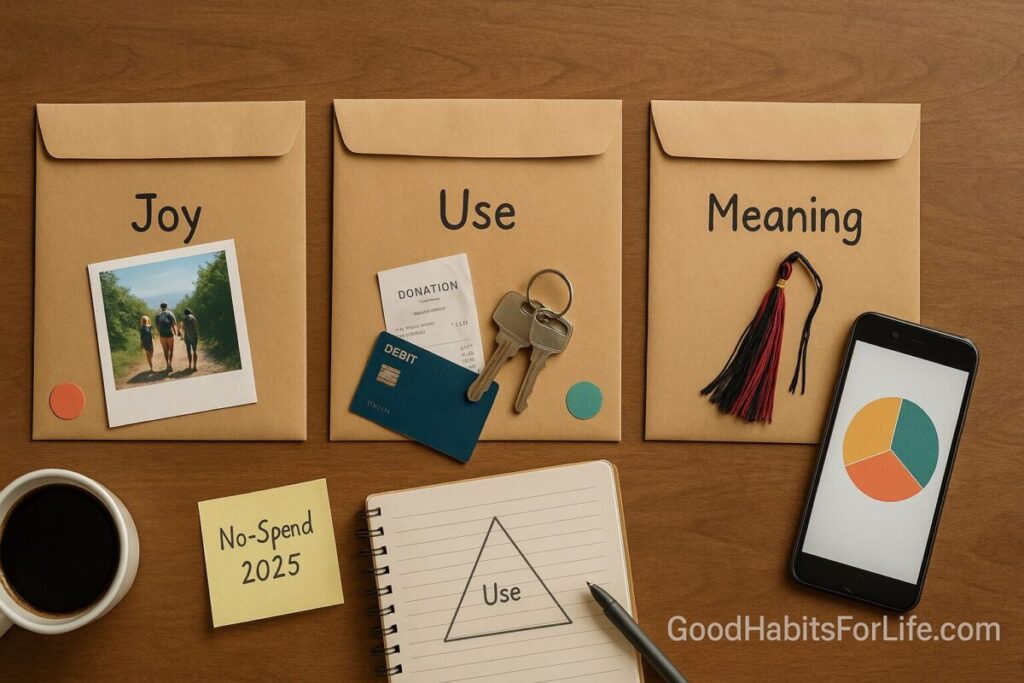
ValuesBased Spending Map: Joy, Use, Meaning: No-Spend Challenge (2025)
Values-Based Spending Map: Joy–Use–Meaning (No-Spend 2025)
Table of Contents
🧭 What Is a Values-Based Spending Map?
A Values-Based Spending Map is a simple lens for every expense you make. Label each line item as:
-
Joy — experiences or things that reliably make you feel good (e.g., a monthly hike, family outing).
-
Use — essentials and high-utility purchases (housing, groceries, transport, tools you use daily).
-
Meaning — spending tied to purpose and values (education, charity, family support, community).
This map turns vague “budgeting” into clear, value-aligned decisions. It also meshes with modern measures of financial well-being (control over day-to-day finances, capacity for shocks, and financial freedom to enjoy life). Consumer Financial Protection Bureau
✅ Why It Works (the Science)
-
Experiences often beat things for happiness. Research repeatedly shows experiential purchases provide more enduring satisfaction than material ones, and prosocial spending (on others) boosts happiness. Aligning spend to Joy and Meaning leverages this effect. ScienceDirectcpb-us-e1.wpmucdn.comScience
-
Financial well-being improves when behavior matches goals and values. National and international bodies (CFPB, OECD/INFE, FINRA Foundation) emphasize behaviors—making ends meet, avoiding hardship, and planning—as core to well-being. A values map focuses behavior where it matters. Consumer Financial Protection BureauOECDfinrafoundation.org
-
Behavioral pitfalls derail budgets. Mental accounting and the sunk-cost effect make us keep paying for low-value items (subscriptions, unused memberships). Surfacing Use vs. Joy prevents overpaying for “dead” categories. JSTORScienceDirect
-
Implementation intentions (IF-THEN plans) and commitment devices (pre-commitment rules) dramatically raise follow-through—perfect for a No-Spend sprint. PMCProfessor Nava Ashraf
-
Eudaimonic (meaning-driven) choices last. Distinguishing hedonic (pleasure) from eudaimonic (meaning/purpose) well-being helps you invest more in “Meaning.” PubMed
🛠️ Quick Start: Do This Today (30–60 minutes)
-
Export last 30–60 days of transactions. Tag each line: J (Joy), U (Use), M (Meaning). Grey-flag “?.”
-
Highlight low-J/low-U culprits. Think unused subscriptions, impulse food delivery, fees.
-
Launch a 14-day No-Spend Sprint.
-
Allowed: Use, pre-planned Meaning, and pre-budgeted Joy.
-
Paused: all grey-flag items + any Joy that isn’t planned (create a wishlist instead).
-
-
Write two IF–THEN rules (implementation intentions):
-
IF I feel like ordering in after 7 pm, THEN I’ll heat the freezer meal.
-
IF I pass the coffee cart, THEN I’ll use the office beans and put ₹150 to “Trip Fund.” PMC
-
-
Add friction & defaults:
-
Remove saved cards from browsers, delete one food app, and put a 24-hour rule on non-essential buys.
-
Auto-transfer savings on payday to a goal account (commitment device). Professor Nava Ashraf
-
-
Reallocate now: 50% of freed cash to emergency buffer, 30% to priority goal, 20% to “Meaning” (giving/learning).
-
Log it. Use a simple monthly budget worksheet weekly. Consumer Financial Protection Bureau
🧱 30-60-90 No-Spend Roadmap
Days 1–30 (Reset)
-
Sprint: 14 days No-Spend on grey-flags; continue to day 30 with a “3/7 rhythm” (3 No-Spend days per week).
-
Checkpoints (Day 7 & 14): Review Joy items—keep the top 3 that truly lift you; cut or cap the rest.
-
Quick wins: Cancel/pare subscriptions; renegotiate one bill; batch-cook 4 meals.
-
Track: Weekly “J-U-M” pie chart in your tracker; note mood changes.
Days 31–60 (Rebuild)
-
Upgrade Use: Replace two “cheap but bad” Use items with higher-utility options (e.g., better water filter).
-
Add Meaning: Schedule one volunteer session or course module; automate a monthly micro-donation.
-
Commitment device: Lock savings with a rule (e.g., 60-day no-withdrawal). Harvard Business School
Days 61–90 (Stabilize)
-
Joy cap: Set a monthly Joy envelope (e.g., ₹X / month).
-
Meaning milestone: Complete one 6-hour learning block or family project.
-
Review: Move any recurring low-Joy expense to “trial cancel” for 30 days; reinstate only if missed.
🧠 Techniques & Frameworks That Actually Work
-
Implementation Intentions (IF–THEN). Automate your best self with written cues: If ad pops up → add to 24-hour list. Robust across domains. PMC
-
Commitment Devices. Pre-commit with rules (no card on food apps; savings auto-transfer on payday). Field evidence shows large savings effects from commitment accounts. Professor Nava AshrafHarvard Business School
-
Temptation Bundling. Pair a “want” with a “should” (podcast only when doing accounts). Boosts adherence in field studies. PubsOnlineScienceDirect
-
Mental Accounting—used for good. Separate “Joy,” “Use,” and “Meaning” envelopes; consolidate tiny low-value categories that invite leakage. JSTOR
-
Sunk-Cost Guardrails. Add a rule: “Past spend doesn’t justify future spend”—use a monthly “kill list” for poor-value renewals. ScienceDirect
-
Measure What Matters. Track well-being markers (stress, control, goal progress), not just rupees. Use the CFPB Financial Well-Being items as inspiration. Consumer Financial Protection Bureau
👥 Audience Variations
Students
-
Use campus resources; bundle “study café” visits with coursework; 24-hour pause before any tech/gadget purchase.
-
Keep Joy micro and frequent (low cost).
Parents
-
Build a shared “family Joy list” under ₹X; rotate choices weekly.
-
Meaning: education fund auto-transfer on payday.
Professionals
-
Upgrade high-Use tools (ergonomic chair, water bottle) to avoid false economy.
-
Batch social Joy to one or two calendar slots.
Seniors
-
Audit subscriptions; prioritize health-related Use (vision, mobility) and Meaning (grandkids, community).
-
Add bill-pay automation; review for scams quarterly (with a trusted contact).
Teens
-
Pocket-money envelopes: Joy 50% / Use 30% / Meaning 20%.
-
If-Then: If I want a game skin → wait 72 hours and check wishlist first.
⚠️ Mistakes & Myths to Avoid
-
All-or-nothing No-Spend. Short, repeatable sprints beat perfection.
-
Shame-based budgeting. Replace “guilty pleasures” with capped Joy line items.
-
“Experiences always beat things.” Not always—high-Use items can outperform low-quality experiences. The key is alignment with your values. ScienceDirect
-
Ignoring sunk costs. Don’t “keep” a subscription just because you’ve paid for it. ScienceDirect
-
Over-tracking. Five core categories (J-U-M + Savings + Debt) are enough for most people.
💬 Real-Life Examples & Scripts
1) Decline Script (Friend Outing):
“Looks fun! I’m on a 14-day No-Spend sprint—can we do a home movie/game night this week instead?”
2) Refund/Cancel Script (Subscription):
“Hi, I’ve decided to cancel as I’m reducing recurring costs. Please confirm cancellation effective today and any prorated refund.”
3) Family Money Check-In (10 minutes):
-
What one Joy we loved this week?
-
One Use we can optimize?
-
One Meaning we’ll schedule next week?
4) Wishlist Rule:
Add non-essential wants to a shared list; buy only after 7 days if it still scores high on Joy or Meaning.
🧰 Tools, Apps & Resources (quick picks)
-
Budget & Tracking:
-
CFPB Monthly Budget worksheet (printable, simple). Consumer Financial Protection Bureau
-
Any app that supports custom envelopes/labels (create Joy/Use/Meaning).
-
-
Automation & Friction:
-
Bank/UPI auto-sweeps to savings; remove saved cards from browsers.
-
-
Planning Aids:
-
CFPB Your Money, Your Goals toolkit: goal-setting, spending trackers, and conversation guides. Consumer Financial Protection Bureau
-
-
Learning & Benchmarks:
-
OECD/INFE and FINRA NFCS for research-backed insights and national benchmarks. OECDfinrafoundation.org
-
📌 Key Takeaways
-
Money feels better when it mirrors your values—that’s the point of Joy–Use–Meaning. PubMed
-
A No-Spend sprint creates space to reset; repeat short cycles rather than chasing perfection.
-
Small, scientific habits—IF–THEN plans, commitment, friction—do the heavy lifting. PMCProfessor Nava Ashraf
-
Track well-being and progress toward goals, not just expenses. Consumer Financial Protection Bureau
❓ FAQs
1) Is a No-Spend challenge safe if I have kids or medical needs?
Yes—Use (essentials) always stays funded. The sprint targets low-value, non-essential items only. Use a bill-prioritizer mindset if money is tight. MaPS
2) How long should a No-Spend last?
Start with 14 days, then shift to a “3/7 rhythm” (three No-Spend days weekly). Most people sustain this better than month-long austerity.
3) What if experiences aren’t my thing?
Experiences often yield more lasting happiness, but a high-Use item you rely on daily can outperform fleeting events. Choose by Joy/Use/Meaning, not trends. cpb-us-e1.wpmucdn.com
4) How do I keep myself honest?
Write IF–THEN rules and add friction (delete one shopping app, remove saved cards). Pre-commit a savings auto-transfer on payday. PMCProfessor Nava Ashraf
5) What should I measure besides rupees?
Track stress, sense of control, and goal progress; the CFPB Financial Well-Being framework is a good model. Consumer Financial Protection Bureau
6) Does giving really make me happier?
Prosocial spending has been linked with higher happiness across multiple samples; even small gifts count. Science
7) Is this different from “zero-based budgeting”?
Yes. Zero-based budgets allocate every rupee; the Values-Based Map adds a why (Joy/Use/Meaning) layer so you cut waste and increase fulfillment.
📚 References
-
Consumer Financial Protection Bureau. Financial Well-Being Scale (overview & guide). Consumer Financial Protection Bureau
-
Consumer Financial Protection Bureau. Data Spotlight: Financial Well-Being in America (2017–2020). Consumer Financial Protection Bureau
-
FINRA Investor Education Foundation. National Financial Capability Study — Sixth Edition (2025). finrafoundation.org
-
OECD/INFE. International Survey of Adult Financial Literacy (2023). OECD
-
Dunn, Gilbert, & Wilson (2011). If Money Doesn’t Make You Happy, Then You Probably Aren’t Spending It Right. Journal of Consumer Psychology. ScienceDirect
-
Dunn, Aknin, & Norton (2008). Spending Money on Others Promotes Happiness. Science. Science
-
Thaler (1985). Mental Accounting and Consumer Choice. Marketing Science. JSTOR
-
Arkes & Blumer (1985). The Psychology of Sunk Cost. Organizational Behavior and Human Decision Processes. ScienceDirect
-
Wieber, Gollwitzer, & Oettingen (2015). Promoting the Translation of Intentions into Action by Implementation Intentions. PMC
-
Milkman, Minson, & Volpp (2014). Holding the Hunger Games Hostage at the Gym: An Evaluation of Temptation Bundling. Management Science. PubsOnline
-
Ryan & Deci (2001). On Happiness and Human Potentials: Hedonic and Eudaimonic Well-Being. Annual Review of Psychology. PubMed
-
CFPB. Monthly Budget Worksheet (PDF). Consumer Financial Protection Bureau
Disclaimer: This article is for general education, not financial advice; consider your situation or consult a qualified advisor.