
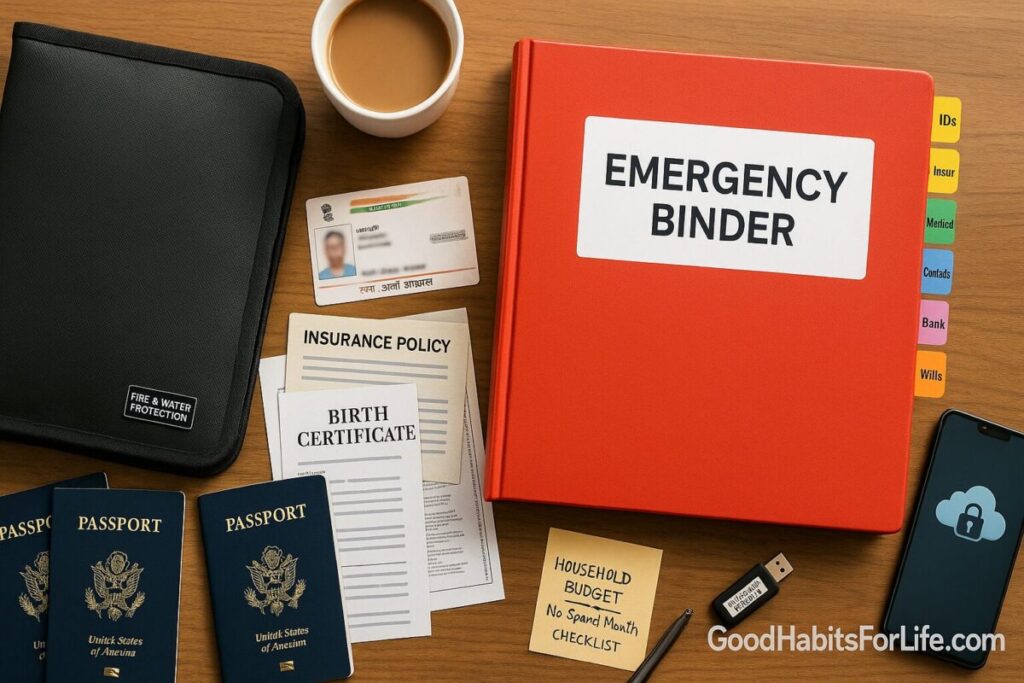
Emergency Binder: Documents Your Family Needs: No-Spend Challenge (2025)
Emergency Binder: Family Documents (2025 No-Spend)
Table of Contents
🧭 What Is an Emergency Binder & Why It Matters
An emergency binder is a single, grab-and-go place—physical and digital—containing the critical documents and instructions your family would need after a disaster, hospitalization, theft, or death. FEMA’s Emergency Financial First Aid Kit (EFFAK) provides a government-backed structure for the financial and legal pieces, including checklists for identification, insurance, medical info, and household contacts. Ready.gov
Best practice is to keep paper copies in a fire- and water-resistant container and store encrypted digital copies (cloud or drive) as a backup—guidance echoed by Ready.gov. Ready.gov
If you’re in India, official preparedness checklists specifically call out core IDs like Aadhaar, ration and voter cards—so include those too. NCDC
Finally, preparedness doesn’t have to be expensive: Ready.gov lists many low- and no-cost actions you can do right now, which this guide turns into a no-spend plan. Ready.gov
✅ Quick Start: Today’s 60-Minute Setup
-
Create a working folder (physical file + a mirrored digital folder).
-
Print or copy a trusted checklist (EFFAK) and highlight what you already have. Ready.gov
-
Collect “Tier-1” IDs: passports, national IDs (e.g., Aadhaar), PAN, birth certificates, one recent utility bill. NCDC
-
Scan with your phone (PDF). Name files consistently:
YYYY-MM-DD_DocType_Name.pdf. -
Secure storage: put paper in a water/fire-resistant folder or box; add an external drive with encrypted copies; upload to a secure cloud. Ready.gov
-
Digital vaults: Indians can add official digital documents to DigiLocker (free). DigiLocker
-
Password hygiene: move credentials into a password manager and turn on 2FA. ncsc.gov.uk
🧠 The No-Spend 30-60-90 Day Plan (2025)
Goal: Complete a comprehensive binder with zero new spending by using free checklists, government e-vaults, and your phone.
Days 1–30 (Foundation)
-
IDs & Family Basics: Aadhaar, PAN, passports, birth/marriage certificates, recent photos, school IDs. Use DigiLocker for issued digital copies when supported. DigiLocker
-
Medical Essentials: medications list, allergies, blood group, immunisations, recent test results, and ABHA (Ayushman Bharat Health Account) links to digital health records. National Health Authority
-
Contacts: ICE numbers, physicians, insurer, bank manager, lawyer, emergency neighbors; use EFFAK contact sheets. Ready.gov
-
Storage: fire/water protection + encrypted digital copies as per Ready.gov. Ready.gov
Days 31–60 (Money & Protection)
-
Insurance (life, health, motor, home): policy pages, e-cards, claim helplines, coverage summaries; confirm nomination/beneficiary details per IRDAI norms. IRDAI
-
Banking: account list, IFSC, lockers, EMI schedule, UPI IDs; verify RBI nomination on all deposit accounts to ease settlement. Reserve Bank of India
-
Investments: demat, mutual funds, PPF/EPF; update nomination to avoid account freezes (SEBI). SEBI Investor
-
Bills & Subscriptions: maintain a monthly obligations sheet (EFFAK forms help). Ready.gov
Days 61–90 (Risk Hardening & Rehearsal)
-
Password Manager & 2FA: store account keys and recovery codes; give your emergency contact access instructions. (NCSC guidance endorses using a password manager for unique passwords.) ncsc.gov.uk
-
Aadhaar Security: lock biometrics to prevent misuse; store steps to unlock for legitimate use. UIDAI
-
Drill: run a 10-minute family “find it & go” test; iterate storage and labels.
-
No-Spend habit: redirect any recovered “leaks” (unused subscriptions) into your emergency fund, following CFPB’s savings guidance. consumerfinance.gov
🛠️ Master Checklist: Documents Your Family Needs
Identity & Civil Status
-
Passports; national IDs (Aadhaar), PAN; voter & ration cards; birth/adoption/marriage certificates; recent passport photos. NCDC
Health & Medical
-
Medications/prescriptions; allergies; blood group; vaccination records; insurance e-cards; ABHA/PHR details; recent reports, discharge summaries. National Health Authority
Insurance
-
Life, term, health, personal accident, motor, home/renter’s policies; premium receipts; claim forms; nominees/beneficiaries confirmed per IRDAI rules. IRDAI
Money & Banking
-
Bank accounts (branch, IFSC), fixed/recurring deposits, cards; RBI nomination confirmation; locker details; UPI IDs; recent statements. Reserve Bank of India
Investments
-
Demat, mutual funds, NPS/EPF/PPF, bonds; latest KYC; SEBI nomination status printouts. SEBI Investor
Property & Vehicles
-
Title deeds, sale deeds, tax receipts; lease agreements; vehicle RC, insurance, PUC, permits.
Legal & End-of-Life
-
Will & codicils; powers of attorney; guardianship letters; letter of instruction (how to access accounts, manager of passwords).
Household & Work
-
Employment letters; pay slips; professional licenses; school records; pet vaccination & microchip info.
Proofs & Photos
-
Utility bills; inventory photos/video of home (to support claims); scans backed up per Ready.gov guidance. Ready.gov
Where to Store
-
Paper originals/copies in water/fire-resistant storage; electronic copies encrypted in multiple locations; government e-vault (e.g., DigiLocker). Ready.govDigiLocker
📚 Techniques & Frameworks That Make It Stick
-
EFFAK method: Use the FEMA/Ready.gov EFFAK forms to structure accounts, obligations, and contacts—free, printable, standardised. Ready.gov+1
-
Low/No-Cost Preparedness: Batch tasks during bill-pay time; store documents in resealable water-tight bags on a high shelf (flood safety). Ready.gov
-
Security by default: Adopt a password manager; use unique passwords + 2FA to reduce risk. ncsc.gov.uk
-
Health record portability: Link ABHA to your providers to fetch and share records when needed. National Health Authority
🧩 Audience Variations
Students: Add academic records, scholarship letters, exam IDs; store guardian consent letters.
Parents: Include child immunisation charts, school contacts, allergies, consent-to-treat letters.
Professionals: Back up certifications, work contracts, PF/NPS statements, key client contacts.
Seniors: Keep will/POA upfront, medication list in large font, caregiver contacts; add PM-JAY details if eligible. National Health Authority
Teens: School ID, essential medical info, ICE card, minimal wallet.
⚠️ Mistakes & Myths to Avoid
-
Myth: “Photos on my phone are enough.”
Reality: Maintain organised PDFs plus a secure cloud/drive and government e-vault where available. Ready.govDigiLocker -
Myth: “Nomination can wait.”
Reality: Missing nominees can freeze or delay access to funds (bank, demat/mutual funds). Update them now. Reserve Bank of IndiaSEBI Investor -
Myth: “This costs money.”
Reality: FEMA/Ready.gov checklists, DigiLocker, ABHA, and password-manager basics are free or no-cost. Ready.gov+1DigiLockerNational Health Authorityncsc.gov.uk -
Myth: “Aadhaar is set-and-forget.”
Reality: Lock biometrics and know how to temporarily unlock when needed. UIDAI
🗣️ Real-Life Examples & Scripts
Script—Bank Nomination Update (branch visit/email)
“Hello, I’d like to confirm and, if needed, update the nomination for my savings account [account number/branch] as per RBI guidelines. Please confirm current nominee details and share the required form to update. Thank you.” Reserve Bank of India
Script—Demat/Mutual Fund Nomination
“I’m updating nomination for my [demat/mutual fund folio] per SEBI’s mandate. Please confirm my current status and send the e-nomination/opt-out link.” SEBI Investor
Checklist-to-Binder Workflow (Weekly, 30 min)
-
Pick a category (IDs/Health/Money/Property).
-
Gather → Scan → Rename → File (paper + digital) using EFFAK sheets. Ready.gov
-
Log nominees/beneficiaries and claim phone numbers.
-
Rehearse retrieval with a 2-minute “find & show” drill.
🧩 Tools, Apps & Resources (Free & Low-Cost)
-
EFFAK (FEMA/Ready.gov) — forms & checklists for financial/medical/contacts; printable. Ready.gov+1
-
Ready.gov guidance — storage, kit building, and low/no-cost ideas. Ready.gov+2Ready.gov+2
-
DigiLocker (India) — official digital document wallet; issue & store government-verified copies. DigiLocker
-
ABHA / ABDM (India) — digital health records linkage and sharing. National Health Authority
-
Password Manager — centralise and secure credentials; recommended approach by NCSC. ncsc.gov.uk
-
Savings Starter (CFPB) — practical steps to seed an emergency fund alongside your binder. consumerfinance.gov
📌 Key Takeaways
-
Put everything critical in one place—paper + encrypted digital; follow government checklists. Ready.gov+1
-
Use no-spend tools: DigiLocker for documents, ABHA for health records, free EFFAK forms. DigiLockerNational Health Authority
-
Nominees/beneficiaries across bank, investments, and insurance prevent painful delays. Reserve Bank of IndiaSEBI InvestorIRDAI
-
Security first: password manager, 2FA, and Aadhaar biometric lock. ncsc.gov.ukUIDAI
-
Maintain: review every 6 months; run a 10-minute drill.
❓ FAQs
1) What documents are absolutely essential to start with?
Passports/national IDs (Aadhaar), PAN, birth certificates, core insurance policies, a current utility bill, and emergency contacts. Use EFFAK to prioritise. Ready.gov
2) Where should I store the binder at home?
In a water- and fire-resistant portable container; keep encrypted digital copies on a drive and in secure cloud storage. Ready.gov
3) Are scanned copies valid?
Scans help access info quickly; originals may still be required for legal actions, but official e-documents issued via DigiLocker are widely accepted across government workflows. DigiLocker
4) How often should I update the binder?
After major life events and at least twice a year; run a 10-minute retrieval drill with family.
5) What if I’m on a tight budget?
Follow Ready.gov’s low/no-cost steps; use free checklists and government e-vaults; scan with your phone; prioritise nominees over paid tools. Ready.gov
6) Do I really need to update nominees?
Yes—RBI/SEBI/IRDAI frameworks exist so funds/claims can be settled smoothly. Missing nominees can cause freezes or delays. Reserve Bank of IndiaSEBI InvestorIRDAI
7) How do I protect against identity theft if my wallet is lost?
Lock Aadhaar biometrics; keep a password manager with 2FA and a recovery plan. UIDAIncsc.gov.uk
8) What health info should I include?
Medication list, allergies, key reports, and your ABHA details so you can fetch/share digital records when needed. National Health Authority
9) Should kids/teens have a mini-binder?
Yes—a simple pouch with school ID, emergency contacts, allergy card, and recent photo.
10) How does this connect to my emergency savings?
Organising documents reduces claim delays and helps you spot money “leaks” to redirect into an emergency fund (CFPB has step-by-steps). consumerfinance.gov
📚 References
-
FEMA/Ready.gov — Emergency Financial First Aid Kit (EFFAK) (checklists & forms).
https://www.ready.gov/sites/default/files/2020-03/ready_emergency-financial-first-aid-toolkit.pdf Ready.gov -
FEMA/Ready.gov — Safeguard Critical Documents & Valuables (storage guidance).
https://www.ready.gov/sites/default/files/2020-03/fema_safeguard-critical-documents-and-valuables.pdf Ready.gov -
Ready.gov — Low and No-Cost Preparedness.
https://www.ready.gov/low-and-no-cost Ready.gov -
National Centre for Disease Control (India) — Emergency Preparedness Checklist (Aadhaar, voter card, ration card).
https://ncdc.mohfw.gov.in/wp-content/uploads/2024/07/Emergency-Preparedness-Checklist.pdf NCDC -
DigiLocker (MeitY, Govt. of India) — Official Overview.
https://www.digilocker.gov.in/ DigiLocker -
UIDAI — Biometric Lock/Unlock FAQs.
https://uidai.gov.in/en/contact-support/have-any-question/925-english-uk/faqs/aadhaar-online-services/biometric-lock-unlock.html UIDAI -
Reserve Bank of India — Nomination facility: guidance for deposit accounts.
https://www.rbi.org.in/commonman/english/scripts/Notification.aspx?Id=47 Reserve Bank of India -
SEBI — Nomination for Demat/MF units (timeline & implications).
https://investor.sebi.gov.in/market-nomination.html SEBI Investor -
IRDAI — Standard Term Life (Saral Jeevan Bima): nomination under Insurance Act, 1938.
https://irdai.gov.in/documents/37343/365525/Guidelines%2Bon%2BStandard%2BIndividual%2BTerm%2BLife%2BInsurance%2BProduct%2C%2B%E2%80%9CSaral%2BJeeva.pdf IRDAI -
NCSC (UK) — Managing Your Passwords / Password Managers.
https://www.ncsc.gov.uk/collection/top-tips-for-staying-secure-online/password-managers ncsc.gov.uk -
National Health Authority — About ABDM (ABHA & digital health records).
https://nha.gov.in/NDHM National Health Authority -
CFPB — An essential guide to building an emergency fund.
https://www.consumerfinance.gov/an-essential-guide-to-building-an-emergency-fund/ consumerfinance.gov
Disclaimer: This guide is for general information and education, not legal, tax, or financial advice.