
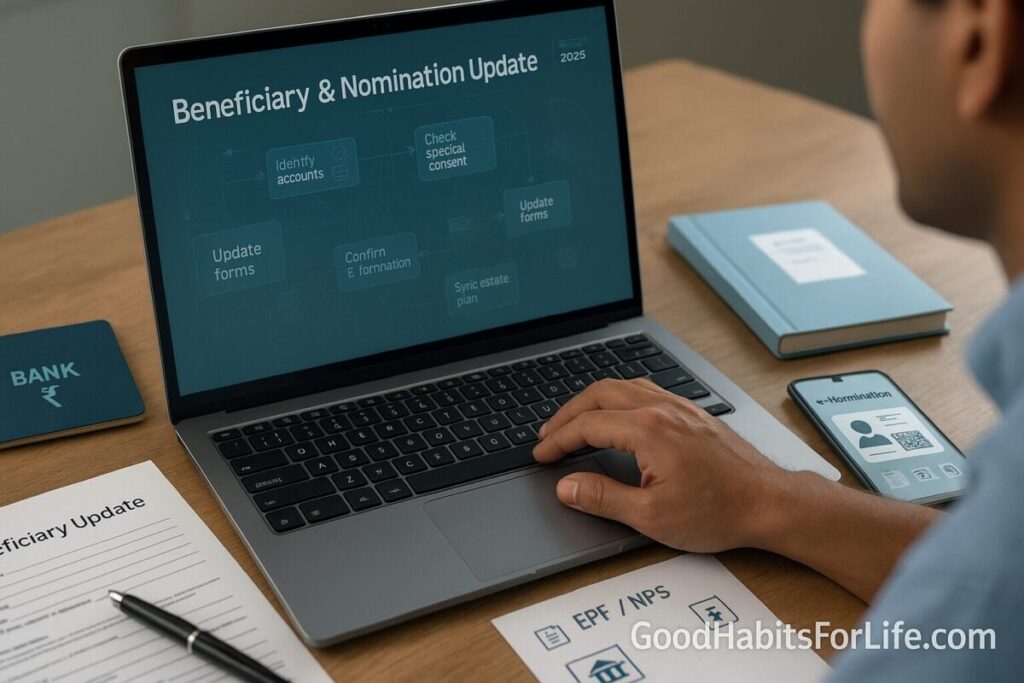
Beneficiaries & Nominations: Keep Them Updated: AI workflows (2025)
Update Beneficiaries & Nominations: AI Workflows 2025
Table of Contents
🧭 What & Why
Beneficiaries/nominees direct who receives assets that transfer outside probate—bank accounts with POD (payable on death), brokerage accounts with TOD, retirement plans (401(k)/IRA), pensions, life insurance, HSAs, education accounts (529/Coverdell), and (in India) EPF/PPF/NPS/bank deposits. Proper forms mean faster access and fewer disputes; missing or outdated forms can push assets to an estate, delay distribution, or conflict with your intentions.
Key rules you should know (high-level, jurisdiction-aware):
-
Beneficiary designations generally govern over wills for ERISA/plan assets; courts require administrators to follow the plan documents/beneficiary form. Justia Law+1
-
401(k) & many employer plans: Spouses are typically protected; naming a non-spouse often needs notarized spousal consent. DOL
-
IRAs & the SECURE Act: Most non-spouse beneficiaries must empty inherited IRAs within 10 years (exceptions for “eligible designated beneficiaries”). IRS+1
-
Bank accounts (POD) & trust/“Totten trust” coverage: FDIC rules require beneficiaries be recorded in the bank’s records for trust/POD insurance coverage. FDIC
-
Brokerage accounts (TOD): Check and align with your estate plan. FINRA
-
HSA on death: Spouse-as-beneficiary becomes owner; a non-spouse generally recognizes the HSA’s fair market value as income (with limited relief for last-year medical bills). IRS+1
-
529 plans: You can change beneficiaries within family without tax consequences. IRS
-
India: EPF e-nomination, NPS nominee limits/splits, and RBI nomination rules for deposits are formalized and increasingly online-first. EPF IndiaNational Pension System TrustReserve Bank of India
✅ Quick Start: Fix It Today (60–90 minutes)
-
Make a master list of accounts that support beneficiaries/nominees:
-
Bank/POD; Brokerage/TOD; 401(k)/403(b)/Pension; IRA/Roth IRA; Life insurance; HSA; 529/Coverdell; (India) EPF/PPF/NPS/Banks.
-
-
Pull current forms: Log in to each provider → “Profile/Beneficiaries/Nomination.” Download or screenshot each designation.
-
Spot red flags: Missing beneficiaries; no contingent; percentages ≠ 100%; minors named without guardianship/trust; ex-spouse still listed; outdated addresses/emails; conflicts with community-property/spousal rights (401(k)/pension). DOL
-
Decide per account: Primary vs. contingent; per stirpes option (if available) to route through bloodlines when a beneficiary predeceases you.
-
Update forms (online e-sign or PDF). For 401(k)/pensions, collect spousal consent if naming a non-spouse. DOL
-
Confirm receipt: Save confirmations to a secure folder; note the date and a support ticket/reference number.
-
Tell your people: Share location of records with a trusted person; for life insurance, ensure the policy and carrier details are findable. insurance.utah.gov
-
Calendar it: Set a recurring “Beneficiary Day” (see Habit Plan).
🗓️ 30-60-90 Habit Plan
Goal: A complete, conflict-free set of beneficiary/nominee records with annual maintenance and life-event triggers.
Days 1–30 (Inventory & Triage)
-
Build the master spreadsheet (account, type, primary/contingent, percentages, last updated, form link).
-
Update high-risk items first: life insurance, retirement plans, and any account with no contingent.
-
If in India: complete EPF e-nomination, check NPS nominee shares, and confirm bank nomination per RBI rules. EPF IndiaNational Pension System TrustReserve Bank of India
Days 31–60 (Close Gaps & Align Plan)
-
Align designations with your will/trust and marital regime (community-property states; ERISA plans).
-
Add per stirpes where helpful; avoid minors as direct beneficiaries (consider a trust/guardian).
-
Centralize confirmations in a secure vault (password manager/drive).
Days 61–90 (Automation & Proofing)
-
Turn on the AI audit (below).
-
Add life-event triggers: marriage/divorce, birth/adoption, death of a beneficiary, moving countries, starting a new job/plan.
-
Schedule annual review (your birthday, new year, or tax time).
🛠️ AI Workflows that Make This Easy (Privacy-first)
Golden rule: Never paste account numbers, SSNs/Aadhaar, or security answers into AI tools. Redact before sharing.
1) Account Audit Bot (30 min set-up)
-
Input: Your spreadsheet (names redacted), screenshots/PDF confirmations with PII blurred.
-
Prompt idea: “You are a compliance checker. For each account, identify if primary and contingent beneficiaries are present, if percentages total 100, whether any beneficiary is a minor, and any mismatches with spousal-consent rules (flag ‘possible ERISA spousal consent’ for employer plans). Output a table with ‘Issue’ and ‘Fix’.”
-
Output: A prioritized fix list with gaps and suggested next actions.
2) Life-Event Watcher
-
Maintain a lightweight Notion/Google Docs “Life Events” log.
-
Use an automation tool (e.g., calendar + email filter) to push a reminder to revisit beneficiaries when it sees keywords like “married,” “divorce,” “new job/401(k),” “birth certificate,” “policy issue.”
3) Form-Finder & Request Drafter
-
Give AI a redacted provider list; ask it to generate:
-
Exact search queries (“site:[provider].com beneficiary form PDF”),
-
Short emails to HR/plan administrators requesting forms,
-
A checklist of expected confirmations.
-
-
For India, generate step-by-steps for EPFO e-nomination and NPS nominee changes; paste only public instructions or your non-sensitive details. EPF IndiaNational Pension System Trust
4) Consistency Checker
-
Prompt: “Compare these designations to my estate plan summary. List any conflicts (e.g., will vs. 401(k) form).”
-
Note: Beneficiary forms often control plan assets over wills; courts require plan admins to follow plan documents. Use this to catch conflicts early. Justia Law
5) Annual Review Pack
-
Auto-generate a 1-page summary with current beneficiaries, contingents, and last-updated dates; attach confirmation PDFs and store in your vault.
🧠 Techniques & Frameworks
The 5-Point Check per Account
-
Primary + Contingent present?
-
Percentages = 100%?
-
Per stirpes vs. per capita option understood?
-
Spousal consent needed (401(k)/pension)? DOL
-
Special rules: IRA 10-year rule, HSA spousal vs non-spouse, 529 family change allowed, POD/TOD recorded at institution. IRS+2IRS+2FDIC
Jurisdiction Notes (selected)
-
United States: SECURE Act 10-year rule for most IRA non-spouse heirs; ERISA plans prioritize plan documents; POD/TOD are common; FDIC insurance has specific beneficiary-recording rules. IRSJustia LawFDIC
-
India: EPF e-nomination is mandatory online; NPS allows up to 3 nominees with percentage shares; RBI prescribes nomination mechanics for deposits and updates. unifiedportal-mem.epfindia.gov.inNational Pension System TrustReserve Bank of India
👥 Audience Variations
-
Students/Young Professionals: Start with bank, brokerage/TOD, and any employer plan; name a trusted contingent (parent/guardian/trust).
-
Parents: Avoid listing minors directly without a guardian/trust; review 529 beneficiaries annually. IRS
-
Professionals with Multiple Plans: Consolidate old 401(k)s or at least align all beneficiary forms; secure spousal consents where required. DOL
-
Seniors: Reconfirm life insurance, IRA/RMD rules, and contingents; document where policies/accounts live for your executor. IRS
⚠️ Mistakes & Myths to Avoid
-
“My will covers it.” Not always—plan documents/beneficiary forms typically control. Justia Law
-
No contingent beneficiary. If your primary predeceases you, assets may flow in unintended ways.
-
Minors as direct beneficiaries. Consider trusts/guardianship arrangements.
-
Ignoring spousal rights (401(k)/pensions). Many plans default to a spouse; non-spouse choices often require notarized consent. DOL
-
Assuming POD/TOD is “automatic” without records. Banks must have beneficiaries recorded to apply trust/POD insurance rules. FDIC
-
HSA/IRA misunderstandings. HSA tax treatment differs for non-spouse heirs; IRAs typically have a 10-year depletion rule for non-spouses. IRS+1
📝 Real-Life Examples & Scripts
Email to HR/Plan Admin (401(k))
Subject: Beneficiary Update & Spousal Consent
Hello [Plan Admin],
Please send the latest beneficiary designation form and spousal consent procedure for our 401(k) plan. I intend to update my primary/contingent beneficiaries and will arrange notarized spousal consent if required. Thank you.
Bank/Brokerage Request (POD/TOD)
Subject: POD/TOD Beneficiary Confirmation
Hi [Institution],
Please confirm the POD/TOD beneficiaries and percentages on account ending …1234 and provide the form link if updates are needed. I will return signed forms promptly. Thanks.
Family Message (to a trusted person)
“I’ve updated beneficiary/nominee forms. If anything happens, the folder ‘Beneficiary Kit’ in my password manager/drive has confirmations and contacts.”
🧰 Tools, Apps & Resources
-
Password Manager (1Password/Bitwarden/Keychain): Store confirmations, policy numbers, and the Beneficiary Kit (Pros: secure sharing; Cons: learning curve).
-
Spreadsheet/Notion/Airtable: Single source of truth; attach PDFs (Pros: searchable; Cons: needs discipline).
-
Calendar/Reminders: Annual Beneficiary Day + life-event triggers.
-
Automation helpers (Zapier/Make/IFTTT): Nudge emails to self (“It’s time to review beneficiaries”).
-
Provider Portals: Use built-in e-signature where available (fastest, creates a dated receipt).
📌 Key Takeaways
-
Keep a complete, verified list of beneficiaries/nominees with contingents and percentages.
-
Understand special rules: spousal consent (employer plans), IRA 10-year rule, HSA treatment, 529 family changes, POD/TOD registration. DOLIRS+2IRS+2
-
Use AI checklists and scripts—but redact PII and store originals securely.
-
Revisit annually and at life events.
-
In India, complete EPF/NPS/bank e-nominations online and save receipts. EPF IndiaNational Pension System TrustReserve Bank of India
❓ FAQs
1) Do beneficiary designations override my will?
Often for plan assets, yes. Courts require ERISA plan administrators to follow plan documents/beneficiary forms—even if a will suggests otherwise. Align your will/trust to match your forms. Justia Law
2) How often should I review?
Annually plus after life events: marriage/divorce, birth/adoption, death, moves, new jobs/plans.
3) Do I need my spouse’s consent to name someone else on a 401(k)?
Typically yes—spousal consent (notarized/witnessed) is often required for employer plans. IRAs generally don’t require spousal consent. DOL
4) What is POD/TOD and why use it?
POD (bank) and TOD (brokerage) pass assets directly to named beneficiaries and can avoid probate delays—ensure beneficiaries are on file with the institution. FDICFINRA
5) My beneficiary is a minor—what should I do?
Avoid naming minors directly; consider a trust/guardian per local law. Your institution may not release funds to a minor without court processes.
6) What changed for inherited IRAs?
For deaths in 2020+, most non-spouse heirs must empty the account within 10 years (exceptions apply); additional annual RMDs may be required depending on the decedent’s status. IRS
7) What happens to my HSA when I die?
If your spouse is the beneficiary, it becomes your spouse’s HSA; otherwise, the HSA typically becomes taxable to the beneficiary that year (with limited relief for final medical bills). IRS
8) Can I change a 529 plan’s beneficiary?
Yes—changing to another family member is generally tax-free; document the change with your plan. IRS
9) I’m in India—what should I update first?
Complete EPF e-nomination, check NPS nominee shares (up to three with percentages), and verify bank nominations under RBI rules. Save PDF acknowledgments. EPF IndiaNational Pension System TrustReserve Bank of India
10) How do I keep AI safe here?
Redact PII before using AI, avoid uploading full statements/policies, and store originals in a password manager or encrypted drive.
📚 References
-
IRS — Publication 590-B: Beneficiaries & the SECURE Act 10-year rule. IRS
-
IRS — RMD FAQs for retirement plans & IRAs (10-year rule & exceptions). IRS
-
DOL/EBSA — FAQs about Retirement Plans & ERISA (spousal consent/beneficiary basics). DOL
-
FDIC — Your Insured Deposits / Trust Accounts (POD beneficiaries must be in bank records). FDIC+1
-
FINRA — Transfer on Death & beneficiary coordination for brokerage accounts. FINRA
-
IRS — Publication 969 (HSA: spouse vs non-spouse beneficiary). IRS
-
IRS — 529 Plans Q&A (changing designated beneficiary within family). IRS
-
Supreme Court of the United States — Kennedy v. Plan Administrator for DuPont (plan must follow beneficiary form). Justia Law
-
Supreme Court of the United States — Egelhoff v. Egelhoff (ERISA pre-empts conflicting state revocation statutes). Justia Law
-
EPFO (India) — e-Nomination process & portal. EPF Indiaunifiedportal-mem.epfindia.gov.in
-
NPS Trust / PFRDA (India) — Nominee rules & e-nomination circular. National Pension System TrustPFRDA PROD
-
RBI (India) — Nomination rules/circulars for bank deposits. Reserve Bank of India+1PDICAI
Disclaimer: This guide is educational only and not financial, tax, or legal advice; rules vary by jurisdiction—consult a qualified professional for your situation.