
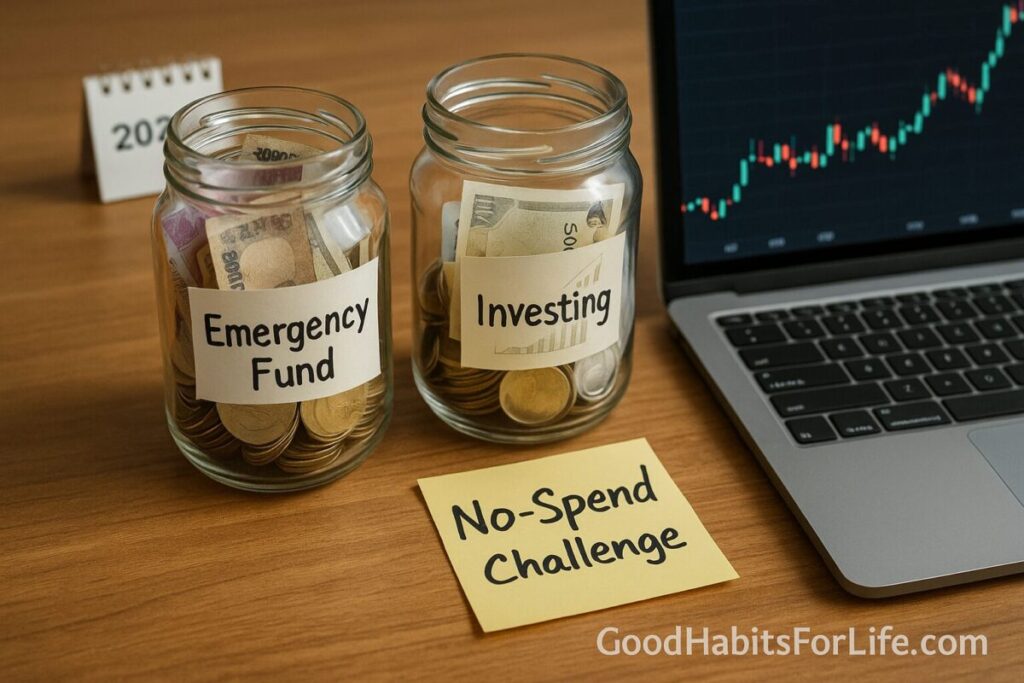
Emergency Fund vs Investing: Draw the Line: No-Spend Challenge (2025)
Emergency Fund vs Investing (2025): No-Spend Challenge
Table of Contents
🧭 What & Why
Emergency fund = cash you can reach quickly (no market risk) for life’s surprises—job loss, medical bills, car/phone breakdowns. A widely used rule of thumb is three to six months of essential outgoings held in an instant-access account. MaPS
Investing = putting money into assets (stocks/bonds/funds) that can grow but fluctuate. Your time horizon and risk tolerance determine the right mix—short-term needs belong in low-risk cash; longer horizons can take more risk. Investor+1
Why separate them?
-
Volatility vs liquidity: Markets can drop right when you need money; an emergency fund prevents forced selling. Over the long run, equities have beaten cash and bonds on average, but with big swings along the way—another reason to firewall emergencies. pages.stern.nyu.edu
-
Financial resilience: Households with buffers cope better with shocks and avoid high-cost debt. OECD
-
India-specific safety: Bank deposits in India are insured up to ₹5 lakh (principal + interest) per depositor per bank under DICGC—use this knowledge when allocating cash across institutions. DICGC
✅ Where to Draw the Line (Decision Rule)
Use this quick rule to decide when to prioritize emergency fund vs investing:
-
No or tiny buffer (<1 month of essentials):
-
Prioritize building cash in a safe, instant-access account. If you carry high-priority/expensive debt, prioritize those obligations alongside or ahead of extra savings. MaPS
-
-
Basic buffer (1–3 months) + stable job:
-
Full buffer (3–6 months) and insured:
-
Invest incremental rupees according to your horizon and risk capacity (e.g., equity for 10+ years, more bonds/cash for nearer goals). Investor+1
-
-
Unstable income/self-employed/caregiver/one-income household:
-
Target the upper end (6+ months) for resilience. OECD
-
-
India tip:
-
If your emergency fund > ₹5 lakh, consider spreading across banks so each chunk stays under the DICGC insurance limit per bank. DICGC+1
-
🛠️ Quick Start: Do This Today
-
Compute your “bare-bones” monthly essentials (rent, food, utilities, transport, insurance). Target = 3–6 × essentials. MaPS
-
Open/confirm a dedicated, instant-access account (separate from spending).
-
Automate a weekly or payday transfer. Use a simple Savings Plan worksheet to set a weekly target and timeline. Consumer Financial Protection Bureau
-
Freeze non-essentials for 30 days (details below) and redirect all savings. Track daily with a one-page Spending Tracker. Consumer Financial Protection Bureau
-
Check deposit insurance (India): keep each bank balance within ₹5 lakh insured limit. DICGC
-
When you hit 3–6 months, continue auto-transfers into your investment plan according to risk and horizon. Investor+1
🧠 30-Day No-Spend Challenge (Habit Plan)
Goal: Rapidly seed or top up your emergency fund—without derailing essential bills.
Set-up (Day 0):
-
List allowed categories (rent, basic groceries, utilities, transport, meds). Everything else = pause for 30 days.
-
Create a separate “EF” account; set daily micro-transfers (e.g., ₹200–₹500/day) + one weekly sweep of leftover checking balance.
-
Download/print a one-page tracker to log wins (₹) each day. Consumer Financial Protection Bureau
Weekly rhythm:
-
Week 1 – Audit: Track every rupee; cancel/park subscriptions; meal-prep; plan zero-cost fun. Consumer Financial Protection Bureau
-
Week 2 – Replace: Swap paid habits for free/cheaper alternatives; negotiate one bill.
-
Week 3 – Sell/Free up: Declutter 10 items; sell 3; bank proceeds to EF same day.
-
Week 4 – Future-proof: Build a “friction plan” (e.g., 24-hour rule before any non-essential purchase).
Daily checklist (5 mins): Record spend, transfer the day’s saving, and tick off NSD (no-spend day). Consumer Financial Protection Bureau
Finish line: If you saved ₹30,000 in 30 days, you just secured ~half a month of essentials (example). Keep momentum until you hit 3–6 months. MaPS
📚 Techniques & Frameworks
-
50/30/20 (adapted): While building the fund, temporarily shift to 50/10/40 (needs/wants/saving-debt) to accelerate. After reaching target, revert or allocate more to investing. (Framework aligns with budgeting best practices emphasized in CFPB materials.) Consumer Financial Protection Bureau
-
Buckets, not one pot:
-
Immediate (1 month): primary bank, instant access.
-
Near-term (2–5 months): second bank or cash-equivalent instrument with quick access.
-
Long-term goals: diversified portfolio (e.g., equity/debt funds) per horizon & risk. Investor
-
-
Evidence-based investing mindset: Markets pay for risk over decades—don’t expect equity-like returns from emergency cash, and don’t park long-term money in cash. pages.stern.nyu.edu
👥 Audience Variations
-
Students/early-career: Start with 1–2 months, then climb to 3 months; focus on building the saving habit. Consumer Financial Protection Bureau
-
Professionals (salaried): Target 3–6 months; max your emergency fund before increasing risk. MaPS
-
Self-employed/freelancers: Income variability → aim for 6–12 months. OECD
-
Parents/single-income households: Favor the upper range to cushion child-related and caregiver shocks. OECD
-
Seniors/retirees: Keep a larger cash runway to avoid selling investments in downturns. pages.stern.nyu.edu
⚠️ Mistakes & Myths to Avoid
-
Myth: “Cash is wasted; invest everything.”
Reality: Cash = insurance. Equities have higher long-run returns but can be down sharply when you need money. pages.stern.nyu.edu -
Mistake: Ignoring deposit insurance limits.
Fix: In India, keep each bank’s balance ≤ ₹5 lakh for full DICGC cover (per depositor, per bank). DICGC -
Myth: “I’ll build an emergency fund after I start investing.”
Reality: Build a base first; even a small buffer reduces stress and reliance on high-cost credit. MaPSFederal Reserve -
Mistake: No-spend without tracking.
Fix: Use a one-page spending tracker; measure daily wins. Consumer Financial Protection Bureau
💬 Real-Life Examples & Scripts
-
Pay-yourself-first text to self:
“Every payday, ₹3,000 auto-moves to EF. I only move it back for true emergencies.” (Use CFPB savings-plan math to set amounts.) Consumer Financial Protection Bureau -
No-spend announcement to friends:
“I’m on a 30-day no-spend—down for park walks, potlucks, and game nights. I’ll be back for cafes next month.” -
Bill-negotiation opener:
“I value your service, but my budget’s tight. Are there promotional rates or plan downgrades to lower my monthly cost?” -
DICGC reminder (India):
“I’m keeping ≤ ₹5 lakh per bank for insurance; if my balance grows past that, I’ll open at another bank.” DICGC
🧰 Tools, Apps & Resources (quick picks)
-
CFPB Spending Tracker & Savings Plan (free printables): simple, low-friction habit aids. Consumer Financial Protection Bureau+1
-
Investor.gov Calculators: compound interest (see growth trade-offs once EF is set). Investor
-
MoneyHelper (UK, gov-backed): clear guidance on how much to hold and budgeting tools. MaPS
-
DICGC (India): official deposit-insurance details & FAQs to check coverage. DICGC+1
-
SEBI Investor Education: micro-videos incl. Importance of Emergency Fund and basics of mutual funds/risk. SEBI Investor
-
RBI Financial Literacy: campaigns and materials on planning, saving, and risk. Reserve Bank of India
🔑 Key Takeaways
-
Build 3–6 months of essentials in liquid, insured accounts before taking significant market risk. MaPSDICGC
-
Use a 30-day No-Spend Challenge + automation to reach the target fast. Consumer Financial Protection Bureau+1
-
After funding the buffer, invest based on time horizon and risk tolerance; equities historically beat cash over long periods but can be volatile year-to-year. Investor+1pages.stern.nyu.edu
❓ FAQs
1) Can I invest while building my emergency fund?
Yes—after covering essentials and priority debts, you can split new money (e.g., 60/40) between savings and diversified investing until you reach 3–6 months. MaPSInvestor
2) How big should my fund be if I’m self-employed?
Aim for 6–12 months because income shocks are more likely. OECD
3) Where should I keep my emergency fund in India?
Use a regulated bank’s instant-access account(s) and remember ₹5 lakh per-bank DICGC coverage (principal + interest). Spread across banks if needed. DICGC
4) Is a fixed deposit okay for emergencies?
Only if you can break it quickly with minimal penalty. Liquidity first; consider a mix (instant-access + breakable FD) so cash is reachable. (Principle aligns with liquidity guidance for emergencies.) MaPS
5) What if inflation erodes my cash?
That’s expected; emergency cash is insurance, not an investment. Once funded, invest the excess for long-term growth. Long-run equity returns have historically exceeded cash. pages.stern.nyu.edu
6) Do I pause investing during a No-Spend month?
Keep automated contributions if they don’t jeopardize essentials; the No-Spend is to trim wants, not halt good habits. Use trackers to stay on plan. Consumer Financial Protection Bureau
7) What’s a simple way to decide my investment mix?
Match time horizon and risk tolerance (longer horizon → more risk capacity). Revisit yearly or after life changes. Investor+1
8) How do I know if my emergency fund is “enough”?
Re-check when expenses, job stability, household size, or geography change. Many households use 3–6 months as a baseline. MaPS
📚 References
-
Consumer Financial Protection Bureau — An essential guide to building an emergency fund. Consumer Financial Protection Bureau
-
MoneyHelper (UK, gov-backed) — Emergency savings – how much is enough? (3–6 months rule, instant access). MaPS
-
DICGC (RBI subsidiary) — Information Booklet: Are my deposits in banks safe? (₹5 lakh coverage). DICGC
-
Investor.gov (U.S. SEC) — Assessing Your Risk Tolerance and Time Horizon (risk/horizon basics). Investor+1
-
NYU Stern (Aswath Damodaran) — Historical Returns on Stocks, Bonds, and Bills (long-run comparative returns). pages.stern.nyu.edu
-
OECD — Inequalities in household wealth and financial insecurity of households (resilience, lack of buffers). OECD
-
Federal Reserve — Economic Well-Being of U.S. Households in 2024 (May 2025) (emergency-expense capability). Federal Reserve
-
CFPB — Your Money, Your Goals: Spending Tracker and Savings Plan Tool (practical worksheets). Consumer Financial Protection Bureau+1
-
SEBI Investor Education — Video modules incl. Importance of Emergency Fund. SEBI Investor
-
RBI — Financial Education (Financial Literacy Week materials). Reserve Bank of India
Disclaimer: This guide is educational, not financial advice. Consider your personal circumstances or consult a licensed advisor before making decisions.