
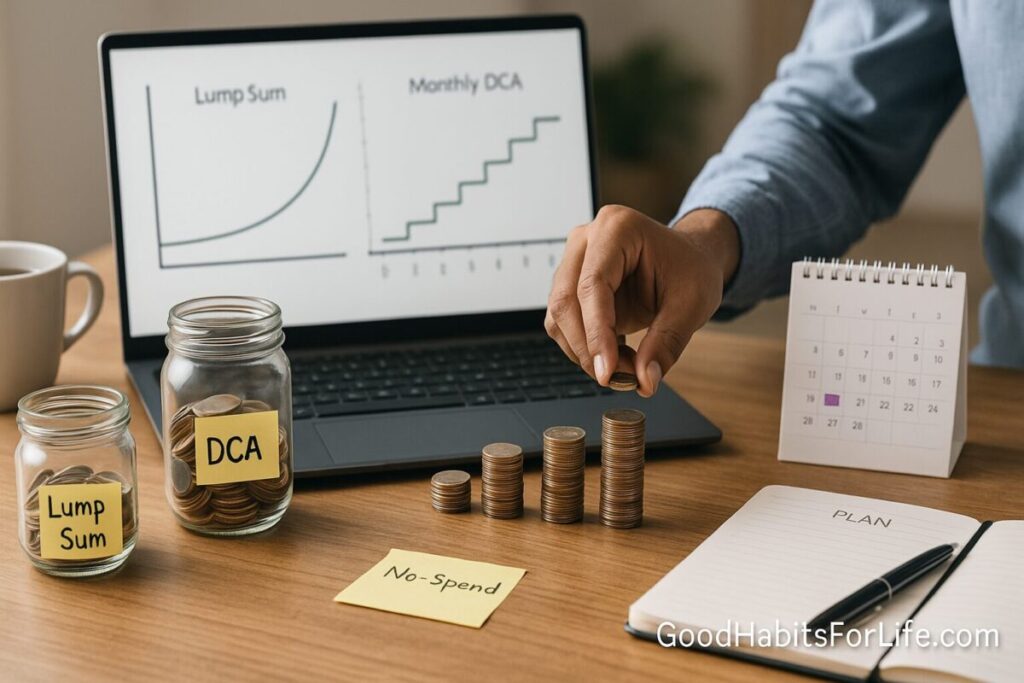
Lump Sum vs Monthly: Timing Without Guessing: No-Spend Challenge (2025)
Lump Sum vs Monthly: No-Guess Timing + No-Spend (2025)
Table of Contents
🧭 What & Why: Lump Sum vs Monthly
The decision.
-
Lump sum (LS): invest all available cash at once.
-
Monthly/Dollar-Cost Averaging (DCA): spread a lump sum into equal parts over a set period (e.g., 3–6 months), or invest as you earn.
Evidence in one line: Over many markets and decades, lump sum beats DCA in the majority of one-year scenarios (e.g., ~68% globally 1976–2022) because markets tend to rise and cash sitting idle drags returns. investor.vanguard.comVanguard
But there’s a trade-off: DCA reduces short-term downside and regret risk, helping some investors stick with the plan—useful if you’re loss-averse or worried about buying right before a drop. CFA Institute Daily Browse
Practical rule of thumb:
-
Want maximum expected growth and can tolerate near-term swings? Lump sum.
-
Want smoother entry and better sleep? Short DCA ramp (e.g., 3 months)—still better than staying in cash. Vanguard
✅ Quick Start: Decide in 7 Steps (Today)
-
Define the pot: How much cash is investable after your emergency fund (3–6 months expenses) and upcoming bills.
-
Pick your mix: e.g., 60/40 equity/bonds or a global equity index + high-quality bonds.
-
Choose your entry method:
-
If you’re comfortable with swings: one-shot lump sum.
-
If you’re loss-averse: DCA over 3 months (monthly or bi-weekly tranches). Vanguard
-
-
Automate it: Set standing orders on fixed dates. Avoid manual tinkering. Schwab Brokerage
-
Pre-commit rules: No market-timing; rebalance if drift >5%.
-
Fund the plan: Kick off a 7–30 day no-spend challenge to free extra cash; then “pay yourself first” via automatic transfers. Consumer Financial Protection Bureau
-
Review in 90 days: Check completion of tranches (if DCA) and rebalance to target.
🛠️ 30-60-90 Day Habit Plan
Day 0 Setup (1 hour):
-
Write your Investment Policy Mini-Statement (IPMS): goal, time horizon, asset mix, entry method, rules (e.g., “If market falls 10% during DCA, continue as scheduled”).
-
Create automation: recurring buys or a three-date DCA schedule.
Days 1–30 (30-Day Sprint):
-
If Lump Sum: execute now, then monitor only on rebalance dates.
-
If DCA: invest tranche 1 today; schedule tranches 2 and 3 for Days 15 and 30 (or monthly).
-
Run a No-Spend sprint (7–30 days) to top up investments; redirect savings automatically. FidelitySchwab Brokerage
Days 31–60:
-
Complete remaining DCA tranches.
-
Rebalance if allocation drifts >5 percentage points.
Days 61–90:
-
Confirm you’re fully invested per plan.
-
Add a standing monthly contribution (from ongoing income)—this is DCA by design and avoids timing guesses. Schwab Brokerage
🧠 Techniques & Frameworks (No Guesswork)
1) Short DCA Ramp (3 months max)
-
Minimizes cash drag while still reducing “bad-timing” anxiety. Evidence suggests longer DCA ramps increase opportunity cost. investor.vanguard.com
2) Pre-commit & Automate
-
People stick to plans when the default is “on.” Automate transfers/investments so you don’t have to decide each time. Consumer Financial Protection Bureau
3) Regret-proofing
-
If you fear a drop right after investing, split into 3 tranches (e.g., now/Day 15/Day 30) and execute regardless of headlines. This targets emotion management, not market prediction. CFA Institute Daily Browse
4) “Pay Yourself First” + No-Spend Sprints
-
Use short no-spend periods as a commitment device to redirect cash to investments; pair with automatic transfers the day you get paid. Financial Health NetworkConsumer Financial Protection Bureau
5) Simple Rebalance Rule
-
Quarterly glance; rebalance only if drift >5%. This avoids tinkering while keeping risk on target.
👥 Audience Variations
Students/Young Professionals
-
Usually invest as you earn (built-in DCA). Keep fees low; automate day-after-payday buys.
Parents
-
Lump sums from bonuses/tax refunds: consider LS or a 3-month DCA if loss-averse. Keep college funds and emergency cash separate.
Seniors/Retirees
-
Focus on sequence-of-returns risk. For investing fresh cash, a short DCA can reduce worst-case drawdowns; for withdrawals, reverse-DCA (monthly distributions) can smooth risk. CFA Institute Daily BrowseVanguard
Entrepreneurs/Variable Income
-
Use a profit-first sweep (fixed % of monthly profits) to investment accounts; when a windfall arrives, apply your preset LS/DCA rule.
⚠️ Mistakes & Myths to Avoid
-
Myth: “DCA always outperforms.” Historically false; it often underperforms LS over long horizons due to cash drag. Schwab Brokerage
-
Mistake: Long, year-long DCA ramps. The longer you wait, the higher the opportunity cost. Keep it short. investor.vanguard.com
-
Myth: “I’ll just wait for a dip.” That’s market timing in disguise; data show it’s unreliable. Schwab Brokerage
-
Mistake: Mixing goals/cash. Never invest money needed within 3 years or emergency funds.
-
Myth: “No-spend means zero spending.” It targets non-essentials for a defined period, not essentials like rent, groceries, utilities, healthcare. Fidelity
💬 Real-Life Examples & Copy-Paste Scripts
Example A — Growth-focused investor (LS):
-
“I have ₹5,00,000 earmarked for a 70/30 portfolio. I’ll invest 100% today into my chosen index funds/ETFs and review in 90 days for rebalance. I will not react to headlines.”
Example B — Loss-averse investor (Short DCA):
-
“I’ll split ₹5,00,000 into 3 tranches (Today/Day 15/Day 30). I’ll execute on calendar dates regardless of market moves. If the market falls >10% during the ramp, I will still stick to the dates.”
No-Spend Sprint (7–30 Days) Script:
-
“From [start date] to [end date], I buy essentials only. I’ll cancel food delivery, pause apparel/impulse buys, and redirect the saved amount via automatic transfer to my investment account every Friday.” FidelityConsumer Financial Protection Bureau
🧰 Tools, Apps & Resources
-
Brokers/Robo-advisors with automation: set automatic purchases on fixed dates (helps DCA and discipline). Schwab Brokerage
-
Budgeting & tracking: any app that supports rules-based autosave and spend categories (e.g., YNAB, PocketGuard, Revolut/Monzo “pots,” ET Money, Groww).
-
Government/Nonprofit guides: MoneyHelper budget planner (UK), CFPB “Start Small, Save Up,” and emergency-fund guides (US). MaPSConsumer Financial Protection Bureau+1
📌 Key Takeaways
-
Lump sum generally wins on expected return; DCA wins on emotional fit by cutting regret and smoothing downside. investor.vanguard.comCFA Institute Daily Browse
-
If you DCA, keep it short (≈3 months) to limit cash drag. investor.vanguard.com
-
Automate everything—contributions, buys, and rebalancing rules—to avoid timing guesses. Schwab Brokerage
-
Fund your plan with targeted no-spend sprints and automatic transfers. FidelityConsumer Financial Protection Bureau
❓FAQs
1) Is DCA better in bear markets?
Sometimes. In falling markets, DCA can reduce losses vs. buying all at a high, but over most periods—and especially rising markets—lump sum tends to finish ahead. Morningstar
2) How long should I DCA a lump sum?
Evidence favors short ramps (about 3 months). Longer ramps increase cash drag without much extra risk reduction. Vanguard
3) What if I only invest from my paycheck?
That’s classic DCA and a great habit—set it and forget it with automatic purchases. Schwab Brokerage
4) Should I wait for “the right time” to invest?
No. Market timing is unreliable; rules-based LS or DCA beats waiting. Schwab Brokerage
5) How do I start a no-spend challenge safely?
Define essentials (rent, utilities, basic groceries, healthcare), pick a timeframe (7–30 days), and automate transfers of the savings. Fidelity
6) Is lump sum too risky for retirees?
If a sharp drawdown right away would derail your plan, use a short DCA ramp to reduce regret and sequence risk, then rebalance. CFA Institute Daily Browse
7) Does DCA guarantee profit or loss protection?
No guarantees either way—DCA reduces timing risk, not market risk. Schwab Brokerage
8) What about fees?
Fewer transactions (LS) can mean slightly lower costs; frequent small trades can add up. Balance this with your platform’s fee structure. Morningstar
9) Can I combine LS and DCA?
Yes—invest a core lump sum now and schedule a few tranches over the next 1–2 months for the remainder—emotionally easier, financially efficient. Vanguard
10) How do I stop myself from overriding the plan?
Use automation plus a written rule like: “I will not cancel scheduled buys due to headlines.” Accountability helps.
📚 References
-
Vanguard (2023). Lump-sum investing versus cost averaging: Which is better? (Article summarizing 1976–2022 results; LS beat DCA ~68% after one year.) investor.vanguard.com
-
Vanguard Research (2023). Cost averaging: Invest now or temporarily hold your cash? (Paper; global evidence; short DCA to limit opportunity cost.) Vanguard
-
Charles Schwab (2024). What Is Dollar-Cost Averaging? (Explains DCA benefits/limits; notes DCA tends to lag LS over long periods.) Schwab Brokerage
-
CFA Institute — Enterprising Investor (2020). Dollar-Cost Averaging (DCA): A Reappraisal (Downside/volatility reduction and regret management.) CFA Institute Daily Browse
-
Morningstar AU (2024). Dollar Cost Averaging vs Lump Sum Investing (Finds LS wins in most scenarios; DCA shines in downturns.) Morningstar
-
CFPB (2020). Evidence-Based Strategies to Build Emergency Savings (Start Small, Save Up—automation/commitment strategies.) Consumer Financial Protection Bureau
-
CFPB (2024). An Essential Guide to Building an Emergency Fund (Make saving automatic.) Consumer Financial Protection Bureau
-
Fidelity (2025). No-Spend Challenge: How to do it (Defines essentials-only periods for freeing cash.) Fidelity
-
Charles Schwab (2025). Are You Up for the No-Spend Challenge? (Practical guidance; timeframe options.) Schwab Brokerage
-
GOV.UK / Money & Pensions Service (2025). Budget Planner (Official budgeting tool reference.) GOV.UK
Disclaimer: This article is educational information, not financial advice; investing involves risk, including possible loss of principal.