
Index Funds vs Active Funds: What to Know: No-Spend Challenge (2025)
Index Funds vs Active Funds: What to Know (2025)
Table of Contents
🧭 What Are Index vs Active Funds?
Index funds (mutual funds or ETFs) follow a market index to deliver the market’s return minus costs. They trade less, keep costs down, and don’t try to pick winners. Active funds employ managers and research to select securities with the goal of beating a benchmark. Investor+1
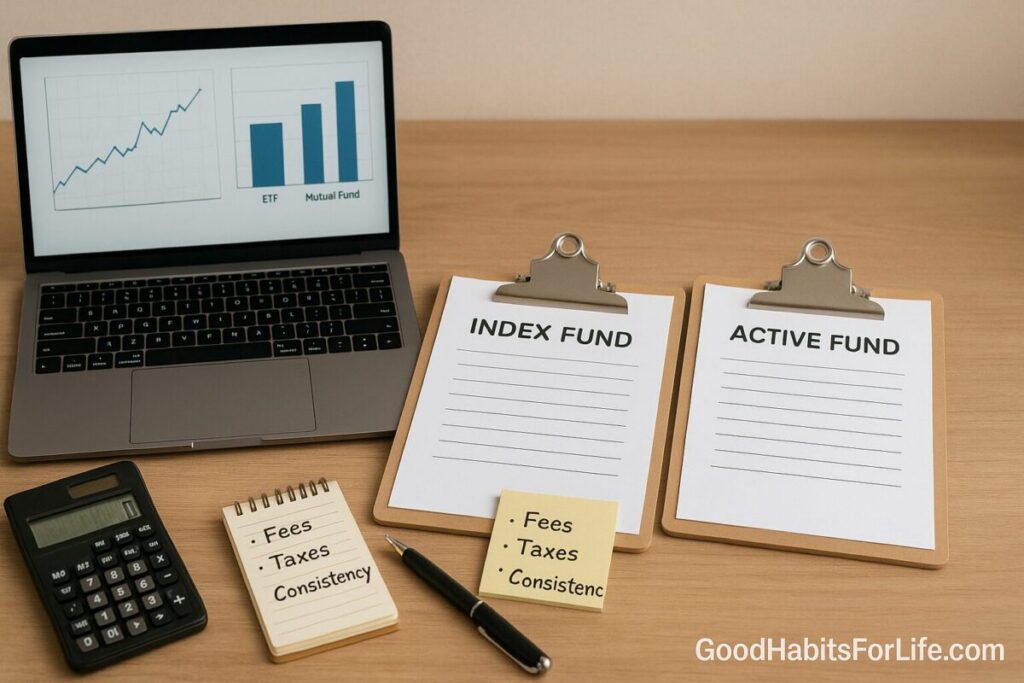
Why this matters: Costs, taxes, and consistency. Where index funds keep costs predictable and typically low, active funds add a layer of manager skill/risk that can help in specific niches but often doesn’t persist.
A quick comparison
| Feature | Index Funds | Active Funds |
|---|---|---|
| Goal | Match index | Beat index |
| Fees (expense ratios) | Typically lower | Typically higher |
| Taxes in taxable accounts | ETFs often more tax-efficient via in-kind redemptions | Mutual funds can pass out capital-gain distributions |
| Transparency | High (published index) | Varies (strategy discretion) |
| When they shine | Broad markets, large caps, core bond exposure | Inefficient niches, concentrated bets, specialized mandates |
ETFs’ in-kind creation/redemption mechanism can help minimize taxable capital-gains distributions relative to mutual funds—useful if you invest in a taxable brokerage account. SECInvestor
✅ Evidence: Performance, Costs & Taxes
Performance: Independent scorecards repeatedly show that most active funds underperform their passive peers over long windows once fees are included. Morningstar’s U.S. Active/Passive Barometer found only 42% of active strategies beat comparable passive options in 2024, with lower long-term success rates in large-cap equity. Morningstarassets.contentstack.io
SPDJI’s SPIVA reports show a similar picture: a majority of U.S. active equity funds lag their benchmarks over 5–15 years; mid-year 2025 and year-end 2024 scorecards continue to show broad underperformance in many categories. S&P Global+1
Costs: Fees are the strongest predictor of active fund success—lower is better. That’s one reason passive investing keeps gaining share; by 2024, passive funds accounted for roughly half of global fund assets and the majority of equity fund assets. OECD
Taxes:
-
Mutual funds distribute realized capital gains to shareholders (taxable in the year received in taxable accounts). IRS
-
ETFs often reduce those distributions via in-kind redemptions (still taxable when you sell, but less ongoing “tax drag”). SECInvestor
Across regions: In Europe, ESMA’s 2024/2025 monitoring shows persistent fee differences and a growing passive footprint across UCITS—supporting the cost advantage story internationally. ESMA
🛠️ Quick Start: Build a Portfolio Today
-
Pick your core: Choose 2–4 broad, low-cost index funds/ETFs (e.g., total world or regional equities + aggregate bonds).
-
Set your split: A simple starting point is 80/20 (equities/bonds) if you’re growth-oriented; adjust for age/risk (e.g., 60/40 for moderate risk).
-
Automate: Set monthly SIP/DCA from your bank; align with payday.
-
Tax-aware locations: Put less tax-efficient holdings (active funds, taxable bonds) in tax-advantaged accounts when possible. Keep tax-efficient ETFs in taxable. Investor
-
Keep fees low: Favor funds with expense ratios in the cheapest decile for their category.
-
Add satellites (optional): If you have a thesis (e.g., small-cap value, short-duration bonds), cap any single active satellite at ≤10% of your portfolio.
-
Rebalance semiannually: ±5% bands around your target weights.
📅 30-60-90 Habit Plan
Day 0–30 (Build the base)
-
Choose your core index funds and set up auto-invest.
-
Document expense ratios, distribution schedules, and your target allocation.
-
Confirm tax settings (dividends reinvested? distribution handling?).
-
Quick check: Are any current mutual funds about to distribute capital gains? If yes and you’re in taxable, decide whether to wait or buy ETF share classes. IRS
Day 31–60 (Optimize & protect)
-
Add rebalancing rules (calendar or threshold).
-
If adding active satellites, write a 1-page thesis: edge, benchmark, sell rules, max cost.
-
Enable alerts for expense-ratio changes or manager turnover.
Day 61–90 (Review & refine)
-
Compare each holding to its benchmark: tracking difference (index) or alpha (active).
-
Replace any fund above your maximum fee threshold for its category.
-
Snapshot realized/taxable distributions in your brokerage. IRS
🧠 Techniques & Frameworks that Work
Core–Satellite:
-
Core (70–90%): One-fund world index or regional building blocks + diversified bond index.
-
Satellites (10–30%): Select, low-cost active funds (or factor index funds) where markets are less efficient (some small-caps, specific bond niches) and your thesis is clear.
Dollar-Cost Averaging (DCA): Automate monthly buys to smooth volatility.
Rebalancing Bands: Use ±5% bands; rebalance only when bands are breached to reduce costs and taxes.
Fee Audit: In each category, aim for the lowest-cost quartile; Morningstar’s barometer shows cheaper funds succeed more often. Morningstar
Tax Placement:
-
Taxable account: broad ETF index funds, municipal bonds (where appropriate).
-
Tax-advantaged accounts: active funds and taxable bond funds (to shelter distributions). Investor
Evidence Lens: Classic research (Fama/French) shows that persistent alpha is rare after adjusting for risk; treat any claimed outperformance skeptically and demand a process you can underwrite. mba.tuck.dartmouth.edu
👥 Variations by Audience
-
Students/early earners: Start with a single world-equity ETF + small bond allocation; focus on automating small monthly amounts.
-
Parents/families: Use a glide path (e.g., 70/30 shifting toward 60/40) and hold emergency cash separately.
-
Busy professionals: Default to a two-fund core (global equity + core bonds); review quarterly.
-
Seniors/retirees: Guard sequence-of-returns risk—consider higher bond allocation and a 1–2 years cash buffer for withdrawals.
⚠️ Mistakes & Myths to Avoid
-
Myth: “Index funds always win every year.” They don’t; but consistently lower costs tilt the odds long-term. S&P Global
-
Chasing last year’s winner: Manager performance often mean-reverts.
-
Ignoring taxes: Surprise capital-gain distributions can hurt after-tax returns in taxable accounts. IRS
-
Paying for complexity: Smart-beta/“non-traditional” index funds may behave like active strategies with higher costs—understand the index methodology. Investor
-
Style drift: Active funds swapping styles can change your risk exposure without you noticing.
💬 Real-Life Examples & Scripts
-
Script to consolidate to an index core:
“I’m simplifying to low-cost index funds for my core holdings and capping any single active fund at 10% of my portfolio. Please help me find the cheapest broadly diversified equity and bond index options in my plan.” -
Sell/replace rule (active satellite):
“If expense ratio rises above X%, manager changes, or 12-month underperformance vs. benchmark exceeds Y%, I’ll exit and revert to the index.” -
Tax-aware distribution check:
“Before buying a mutual fund in my taxable account, I’ll check last year’s capital-gain distribution and distribution calendar.” IRS
🧰 Tools, Apps & Resources
-
SPIVA Scorecards (S&P Dow Jones Indices): Long-horizon active vs passive results by region/asset class. S&P Global+1
-
Morningstar Active/Passive Barometer: Success rates by category; fee insights. Morningstar+1
-
Investor.gov (SEC): Plain-English primers on index funds, ETFs, and “non-traditional” indices. Investor+2Investor+2
-
OECD & ESMA reports: Global trends and EU costs/performance context. OECDESMA
📌 Key Takeaways
-
Use low-cost index funds for your portfolio core; layer small, thesis-driven active satellites only where you have an edge.
-
Keep fees ultra-low and taxes predictable—two levers you control.
-
Measure every fund against a clear benchmark and rebalance with simple rules.
-
Review quarterly; replace anything that violates your fee, fit, or thesis criteria.
❓ FAQs
1) Do index funds always beat active funds?
No. In certain years or niches, some active funds win; the issue is persistence. Over long horizons and after fees, most active funds lag comparable index funds. S&P GlobalMorningstar
2) Where might active management add value?
Less-efficient areas (some small-caps, specific credit segments) and truly distinctive processes—but keep allocations modest and monitor fees and drift. Morningstar
3) Are ETFs always index funds?
No. Many ETFs are index funds, but some are actively managed or follow complex “non-traditional” indexes—read the methodology. Investor
4) Why do taxes differ between ETFs and mutual funds?
ETFs can redeem “in-kind,” reducing capital-gain distributions; mutual funds often distribute realized gains annually to shareholders in taxable accounts. SECIRS
5) What single-fund options make sense for beginners?
A global equity index fund plus a global/core bond index fund covers most needs. Increase bonds if you prefer lower volatility.
6) How often should I check performance?
Quarterly is plenty. Focus on tracking difference (index) and fee/fit; for active, compare to the correct benchmark and re-test your thesis.
7) What expense ratio is “low”?
Aim for your category’s lowest quartile; lower fees correlate with higher odds of success in Morningstar’s studies. Morningstar
8) What if a fund is about to pay a big capital-gain distribution?
In taxable accounts, consider waiting to buy or using an ETF share class where available. IRS
9) Are passive funds too big now?
Passive has grown rapidly—exceeding half of fund assets in 2024 globally—yet markets remain competitive; focus on your plan, not headlines. OECD
10) How do I blend active and passive?
Use a core-satellite structure: passive core for broad markets; small, clearly defined active exposures with explicit rules.
📚 References
-
SEC Investor.gov — “Index Funds” (overview). Investor
-
SEC Investor.gov — “Characteristics of Mutual Funds and ETFs” (tax efficiency). Investor
-
SEC — “Investor Bulletin: Exchange-Traded Funds (ETFs)” (in-kind redemptions). SEC
-
IRS — “Mutual Funds (Costs, Distributions, etc.)” (capital-gain distributions). IRS
-
Morningstar — “Active Funds Trailed Passive Peers in 2024” & U.S. Active/Passive Barometer (mid-year 2025 insights). Morningstar+1assets.contentstack.io
-
S&P Dow Jones Indices — SPIVA U.S. Year-End 2024 & Mid-Year 2025. S&P Global+1
-
OECD Economic Outlook 2025 (passive share of assets). OECD
-
ESMA Market Report 2024/2025 — Costs & Performance of EU Retail Investment Products. ESMA
-
Fama & French (2010) — “Luck Versus Skill in the Cross-Section of Mutual Fund Returns.” mba.tuck.dartmouth.edu
Disclaimer: This guide is educational and not financial advice; consider your circumstances or consult a licensed adviser before investing.