
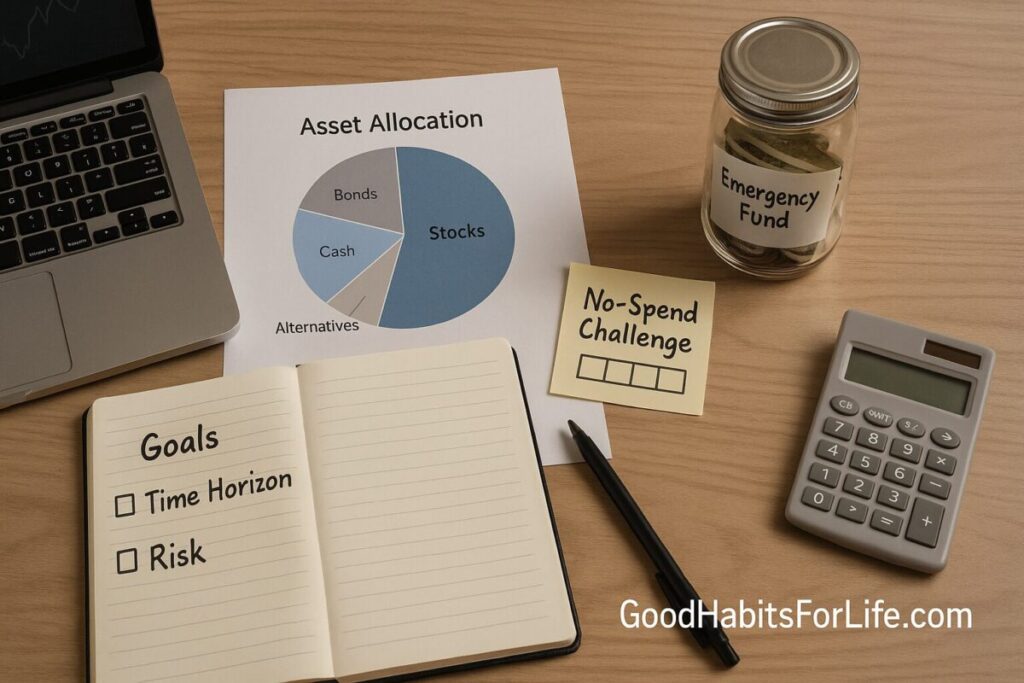
Asset Allocation: Stocks Bonds Cash Alternatives: No-Spend Challenge (2025)
Asset Allocation: Stocks, Bonds, Cash + No-Spend (2025)
Table of Contents
🧭 What Is Asset Allocation & Why It Matters
Asset allocation is the way you divide your money across major asset classes—stocks (equities), bonds (fixed income), and cash (plus a small sleeve of alternatives such as real estate/REITs, commodities, or gold). This mix is the largest driver of your portfolio’s long-term risk and return. Diversifying across assets with different behaviors smooths the ride and helps you stay invested through market swings.
Plain-English idea:
-
Stocks aim for growth but swing the most.
-
Bonds dampen volatility and provide income.
-
Cash protects near-term needs and emergencies.
-
Alternatives can add diversification but should be used modestly and thoughtfully.
Your right mix depends on goal, time horizon, ability and willingness to take risk, and your need for liquidity. If you need the money soon, you can’t afford big swings; if your goal is decades away, you can accept more volatility for higher expected returns.
✅ The Four Buckets: Stocks, Bonds, Cash, Alternatives
Use this quick cheat-sheet as a starting point (illustrative, not personal advice):
| Profile | Stocks | Bonds | Cash | Alternatives* |
|---|---|---|---|---|
| Capital-Preserver (≤3 yrs) | 10–30% | 40–60% | 20–40% | 0–10% |
| Balanced Builder (3–10 yrs) | 40–60% | 30–50% | 5–15% | 0–10% |
| Growth Focus (10+ yrs) | 70–90% | 10–25% | 0–10% | 0–10% |
*Alternatives = typically REITs, commodities, gold, or diversifiers. Keep this slice small and simple; many “alts” are complex and high-fee.
Stocks (Equities): Global diversification reduces single-country risk. Low-cost broad index funds/ETFs (e.g., total world + small tilt) keep fees down and market coverage up.
Bonds: Consider high-quality investment-grade bonds for ballast; mix of government and corporate; include some inflation-linked bonds for long horizons.
Cash: For emergencies and near-term spending. Use high-yield savings or money-market funds.
Alternatives: A small allocation can diversify, but beware fees, complexity, and liquidity limits.
🛠️ Quick Start: Do This Today
-
Write your single-sentence goal.
“I’m investing for a home down payment in 4 years,” or “I’m building retirement wealth in 25 years.” -
Pick a target mix that matches your horizon and sleep-at-night level (use the table above). Example: 60% stocks / 35% bonds / 5% cash.
-
Choose simple building blocks:
-
Equities: One global equity index fund/ETF (or a domestic + international pair).
-
Bonds: One broad investment-grade bond fund/ETF; consider an inflation-linked fund.
-
Cash: High-yield savings or money market.
-
Optional REIT/commodity fund up to 10%.
-
-
Automate contributions on payday (monthly or bi-weekly). Name the transfer “Future-Me.”
-
Set rebalancing rules:
-
Calendar: Check quarterly or semi-annually; rebalance if off by >5 percentage points.
-
Tolerance band: Rebalance whenever any asset drifts ±20% of its target weight (e.g., 60% stocks → band 48–72%).
-
-
Document it. Make a one-page Investment Policy Statement (IPS) (template below).
-
Fund it. If cash is tight, run the No-Spend Challenge for 30 days to free up money.
🗺️ A 30-60-90 Day Habit Plan
Day 0–30 (Build foundations)
-
Set your emergency fund target (ideally 3–6 months of essential expenses; start with 1 month).
-
Open accounts and choose funds (keep it to 2–4 total).
-
Turn on auto-transfers.
-
Kick off the No-Spend Challenge (see below) and funnel savings into emergency fund + first investments.
-
Draft your 1-page IPS.
Day 31–60 (Stabilize + automate)
-
Hit first emergency-fund milestone (1–2 months’ expenses).
-
Confirm your rebalancing rule and add calendar reminders.
-
Check fees and expense ratios (aim low).
-
If you hold taxable and tax-advantaged accounts, start tax location: put income-heavy assets (bonds) where taxes are lower, growth assets where long-term gains get favorable treatment (varies by country—follow local rules).
Day 61–90 (Test & refine)
-
Run your first mini-rebalance if drift >5 p.p.
-
Increase auto-transfer by 5–10% if budget allows.
-
Review IPS wording; confirm goal and risk level still feel right.
-
Celebrate consistency, not perfection.
🧠 Techniques & Frameworks (Glidepaths, 3-Fund, Rebalancing, Tax Location)
Glidepaths
Target-date funds use age-based allocations that get more conservative over time (the “glidepath”). You can mimic this by reducing equity by ~1–2 percentage points per year as you near a goal with a fixed date (e.g., college, retirement).
Three-Fund Portfolio
A timeless approach using:
-
Total (domestic) stock fund/ETF,
-
Total international stock fund/ETF,
-
Total bond fund/ETF.
It’s broad, low-maintenance, and cheap—great for most investors.
Rebalancing Methods
-
Calendar: simple and good for automation.
-
Tolerance bands: more responsive to big market moves.
-
Cash-flow rebalancing: direct new contributions toward underweight assets first to avoid selling.
Tax Location & Wrappers
Use your country’s tax-advantaged accounts for retirement/education first. Keep high-turnover or income-heavy funds in tax-sheltered accounts when possible.
Risk Management
-
Keep cash for emergencies outside the market.
-
Avoid concentrated single-stock bets.
-
If you add alternatives (e.g., REITs, commodities, gold), keep the total <10% unless you fully understand the risks.
💰 The No-Spend Challenge: Fund Your Allocation
A No-Spend Challenge is a short, rules-based sprint (7–30 days) where you pause all non-essential purchases and direct the savings to your emergency fund or investments.
How to run it (30-day template):
-
Define essentials: rent, utilities, groceries, transport, medicines, school fees.
-
Freeze non-essentials: eating out, snacks, impulse buys, subscriptions you don’t use.
-
Create a wish-list “parking lot.” If you want it, write it down; if it still matters after 30 days, revisit.
-
Track daily wins (e.g., spreadsheet or notes).
-
Auto-transfer every Friday whatever you saved into “Emergency Fund” or “Investing Boost.”
-
Debrief on day 31: keep the best cuts; cancel at least one subscription for good.
Why this works: It raises awareness, breaks autopilot spending, and funds your rebalancing and contributions without waiting for “extra” money.
👥 Audience Variations
Students:
-
Focus: emergency buffer + broad equity index fund for long horizon.
-
Start tiny (₹/$ 500–1,000 per month), automate, and raise by 10% each semester.
Parents (busy, many expenses):
-
Build 3–6 months’ expenses in cash equivalents.
-
Consider life/health insurance and goal-based buckets (education, home).
-
Prefer simplicity: target-date or 3-fund setup.
Professionals (variable income):
-
Use cash-flow rebalancing to smooth bonuses and uneven months.
-
Set wider tolerance bands if income is volatile; keep 6 months’ expenses in cash.
Seniors / Near-Retirees:
-
Sequence-of-returns risk matters.
-
Consider a bucket approach:
-
Bucket 1: 1–2 years’ withdrawals in cash equivalents,
-
Bucket 2: intermediate-term bonds,
-
Bucket 3: equities for growth.
-
⚠️ Mistakes & Myths to Avoid
-
Chasing last year’s winner. Your plan > headlines.
-
Too many funds. More funds ≠ more diversification; broad indices do the job.
-
Ignoring fees/taxes. Every 0.5% fee drags compounding.
-
Skipping rebalancing. Drift changes your risk without permission.
-
All-in on “alts.” Many are complex, illiquid, and expensive.
-
No cash buffer. Forced selling during downturns hurts most.
🧪 Real-Life Examples & Copy-Paste Scripts
Example 1 — Balanced Builder (Asha, 32)
-
Goal: early retirement savings; horizon 25+ years.
-
Target mix: 70% stocks / 25% bonds / 5% cash.
-
Funds: global stock index, total bond index, money market.
-
Rules:
-
Contribute on payday, increase by 1% every quarter.
-
Rebalance each June/December; tolerance band ±20% of target.
-
If drift > band, sell overweight and buy underweight.
-
Keep emergency fund at 4 months’ expenses.
-
Example 2 — Bucket Approach (Ravi, 60)
-
Needs: ₹/$ 40,000 per year from portfolio.
-
Bucket 1: ₹/$ 80,000 in cash equivalents (2 years).
-
Bucket 2: 40% intermediate bonds.
-
Bucket 3: 40% diversified equities.
-
Refill Bucket 1 annually from gains in 2 or 3; otherwise from new income.
Copy-Paste IPS (1 page)
-
Objective: “Invest for ___ goal by ___ date.”
-
Allocation: __% stocks / __% bonds / __% cash / __% alternatives (optional).
-
Contributions: ₹/$ ___ per month on the ___ of each month.
-
Rebalancing: Calendar (June/Dec) and when any asset deviates by >5 p.p. or ±20% of its target weight.
-
Tax/location: Use available tax-advantaged accounts first.
-
Behavioral rules: No reacting to daily news; review annually; sleep on any major change for 72 hours.
🔧 Tools, Apps & Resources
-
Budgeting & cash flow: Simple spreadsheets; government budgeting worksheets; envelope method apps.
-
Cost control: Compare expense ratios (ER); prefer broad index funds/ETFs with low ER.
-
Calculators: Compound interest, retirement and college calculators from official/regulator sites.
-
Education: Plain-language investor education portals from regulators and universities.
Pros/Cons of target-date funds
-
Pros: all-in-one diversification + age-based glidepath; easy to automate.
-
Cons: one-size-fits-most; can be tax-inefficient in taxable accounts.
📌 Key Takeaways
-
Decide your allocation first, funds second.
-
Keep it simple, low-cost, globally diversified.
-
Automate contributions and use clear rebalancing rules.
-
Use a No-Spend Challenge to bootstrap cash and stick to your plan.
-
Review annually; adjust only when your life changes, not the market.
❓ FAQs
1) What is a good asset allocation for beginners?
A simple 60/40 (stocks/bonds) or a target-date fund that matches your horizon. If you’re young with decades ahead, 70–90% equities can be reasonable if you can tolerate volatility.
2) How often should I rebalance?
Twice a year is common; many investors also use tolerance bands (e.g., rebalance if any asset drifts >5 percentage points from target).
3) Where do gold or real estate fit?
They’re “alternatives.” A small slice (0–10%) can diversify, but keep costs low and understand the risks.
4) Should I dollar-cost average (DCA) or invest a lump sum?
DCA reduces regret; lump sum often has higher expected return if markets rise. Use what helps you stay invested.
5) How big should my emergency fund be?
Aim for 3–6 months of essential expenses; more if your income is variable.
6) Are international stocks necessary?
Global diversification reduces reliance on one country’s economy and currency; many use a domestic + international blend.
7) Do bond funds still make sense if yields change?
Yes—high-quality bonds remain useful ballast against equity volatility over time.
8) What if I’m starting late?
Focus on savings rate, cost control, and risk-appropriate allocation. Automate, avoid high fees, and extend your horizon if possible.
9) Is a No-Spend Challenge realistic for families?
Yes—define essentials together, cut the “easy wins” (unused subscriptions, dining out), and route weekly savings to your emergency fund or investments.
10) How do I know if I picked the right mix?
You can stick with it through rough markets and still sleep well. If not, you’re probably taking too much risk—dial equities down.
📚 References
-
U.S. SEC — Asset Allocation, Diversification, and Rebalancing (Investor.gov).
https://www.investor.gov/introduction-investing/investing-basics/why-asset-allocation-important -
FINRA — Diversification and Asset Allocation.
https://www.finra.org/investors/learn-to-invest/advanced-investing/diversification -
Vanguard Research — Principles for Investing Success (low costs, diversification, discipline).
https://corporate.vanguard.com/content/dam/corp/research/pdf/ICRPRINC.pdf -
Vanguard Research — Best practices for portfolio rebalancing.
https://advisors.vanguard.com/insights/article/best-practices-rebalancing -
Bogleheads Wiki — Three-Fund Portfolio (overview and rationale).
https://www.bogleheads.org/wiki/Three-fund_portfolio -
CFPB — Budgeting and Cash-Flow Tools (funding the plan).
https://www.consumerfinance.gov/consumer-tools/budgeting/ -
NYU Stern (Aswath Damodaran) — Historical Returns by Asset Class (long-run context).
http://pages.stern.nyu.edu/~adamodar/New_Home_Page/datafile/histret.html -
OECD — Household Savings and Financial Resilience (context on buffers).
https://www.oecd.org/financial/education/ -
U.S. Dept. of Labor — Target-Date Funds — Tips for ERISA Plan Participants.
https://www.dol.gov/agencies/ebsa/about-ebsa/our-activities/resource-center/fact-sheets/target-date-funds-tips -
FCA (UK) — Smarter Investor: Diversification and Risk (plain-language regulator guidance).
https://www.fca.org.uk/consumers/investments
⚖️ Disclaimer
This article is for education only, not financial advice. Investing involves risk, including loss of principal. Consider your personal situation or consult a qualified advisor before acting.