
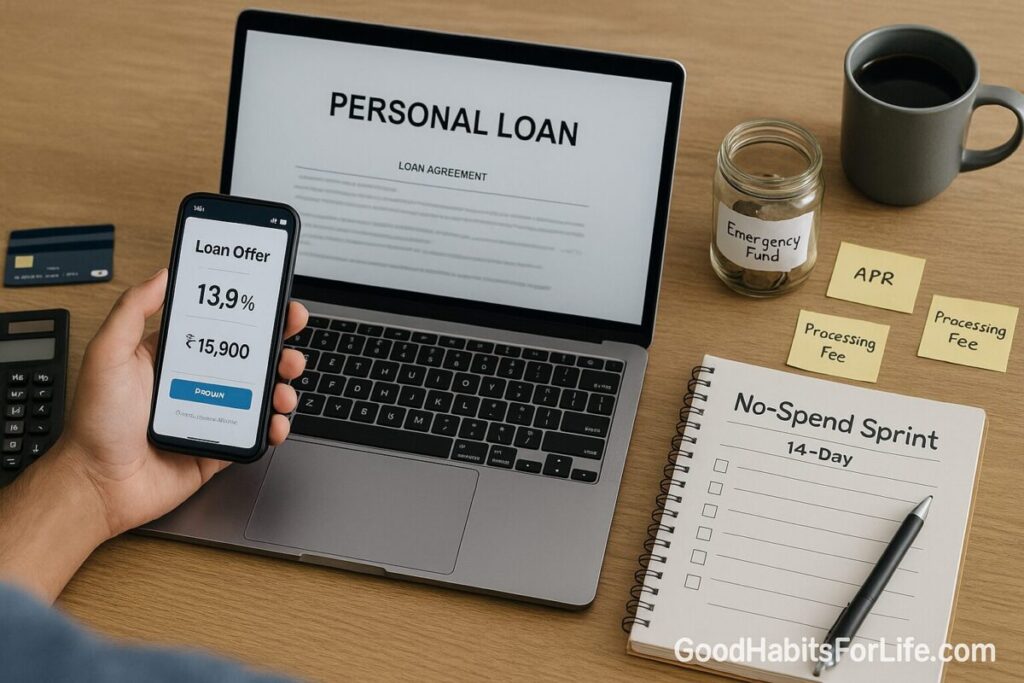
Personal Loans: Pitfalls & Smarter Alternatives: No-Spend Challenge (2025)
Personal Loans: Pitfalls, Alternatives & No-Spend (2025)
Table of Contents
🧭 What Counts as a “Personal Loan” (and Why People Take Them)
A personal loan is typically an unsecured installment loan—you borrow a lump sum and repay it in fixed payments over a set term (e.g., 12–60 months). Lenders market personal loans for consolidating credit cards, covering emergencies, funding weddings/travel, or paying for big purchases.
When personal loans help:
-
Consolidating higher-interest debt to a lower APR with a fixed payoff date
-
Replacing variable, revolving card balances with a simple, automated plan
-
Funding an urgent, essential expense when you have stable income and no cheaper options
When they hurt:
-
Borrowing for non-essentials, or extending the term so long that interest dominates
-
Adding new debt on top of old balances—debt stack grows
-
Paying avoidable fees and “extras” that inflate cost without adding value
✅ The Real Cost: APR, Fees & Total Repayment
APR vs. Interest Rate. Your APR bundles the interest rate plus most lender fees (like origination). Compare loans on APR—not just the headline rate—to see the real cost. Consumer Financial Protection Bureau
Total repayment. Multiply the monthly payment by the number of months; that’s the total you’ll pay. Favor the shortest term you can afford without straining cash flow. A low monthly installment often hides a high total cost if the term is long.
Watch for:
-
Origination fees (often 1–8%): charged upfront or netted from proceeds
-
Prepayment conditions (rare but possible in some products): fine print can penalize early payoff through waived-fee clawbacks or other terms—always check disclosures. Consumer Financial Protection Bureau
-
Add-on products (credit insurance, “protection” plans): typically optional, often overpriced
-
Variable vs. fixed rates: fixed eases planning; variable can spike payments later
Rule of thumb: If loan A’s APR is 2 points lower but requires expensive add-ons, and loan B has a slightly higher APR but no junk fees, loan B may be cheaper overall. Always do the math.
⚠️ Pitfalls to Watch (Scams, Add-ons, BNPL Spirals, “Instant Cash” Apps)
1) Advance-fee loan scams. If a “lender” asks for money upfront (gift cards, wire, crypto) to “guarantee” approval—walk away. Real lenders deduct fees from the loan or charge at closing, not before. Consumer Advice
2) BNPL debt stacking. Buy Now, Pay Later can feel interest-free, but multiple “pay-in-four” plans stacked together strain cash flow and increase missed payments. Regulators have clarified that BNPL lenders must provide protections similar to credit cards—more transparency is coming, but risk remains for overextension. Consumer Financial Protection BureauConsumer Financial Protection Bureau
3) “Instant cash”/cash-advance apps. Some fintech apps advertise quick cash with “tips” or fees that blur true costs; enforcement actions show hidden or misleading charges can occur. Read terms and watch the total you repay. Federal Trade Commission
4) Replacing revolving debt with new debt (without changing habits). Consolidation only helps if you don’t re-run the balances. Pair any borrowing with a spend plan and automatic overpayments.
5) Long terms that outlast the purchase. Don’t pay for three years on something that wears out in one.
Context: Household debt vulnerabilities have grown across many economies—taking on new credit without a payoff plan increases your exposure to shocks. OECD
🛠️ Quick Start: 12 Moves to Try Before You Borrow
-
Call your creditor/provider to ask for a hardship plan or temporary reduction.
-
Negotiate bills (mobile/data, broadband, streaming, insurance).
-
Switch to annual or basic plans where cheaper; cancel duplicates.
-
Sell unused items (local marketplace) to raise quick cash.
-
Micro-save: move ₹500–₹1,000 (or $10–$20) daily into a buffer for 10–20 days.
-
Side gigs: short bursts—weekend tutoring, rides, delivery, micro-tasks.
-
Ask for payment plans with hospitals/clinics or schools (often interest-free).
-
Use employer benefits (EAP grants, emergency advances) if available.
-
Bundle insurance or opt for higher deductibles (only if you have a buffer).
-
Pause non-essential subscriptions for 1–3 months.
-
Meal-plan + pantry week to cut grocery costs 20–30% temporarily.
-
Automate minimums + round-ups toward highest-cost debt.
If these steps bridge the gap, you may avoid borrowing altogether.
🧠 30-Day No-Spend Challenge (2025 Edition)
A tactical sprint to avoid taking a personal loan by freeing up cash fast.
Rules (simple):
-
Spend only on essentials: housing, utilities, transport for work/school, basic groceries, necessary meds.
-
No new clothes, gadgets, takeout, or impulse buys.
-
Replace entertainment with free/low-cost options (library, parks, home workouts).
-
Track “would-have-spent” amounts in a note; transfer the same cash to savings or debt.
Weekly plan:
-
Week 1: Audit & cancel. List all recurring charges; cancel/hold at least 3.
-
Week 2: Pantry & freezer week; batch-cook.
-
Week 3: Sell-off weekend; list 5–10 items.
-
Week 4: Negotiation blitz (see scripts below) + overtime/extra shift if possible.
Targets:
-
Free up ₹15,000–₹45,000 ($200–$600) in 30 days via cuts + sales + extra income.
-
Build a starter ₹25,000–₹40,000 ($300–$500) emergency buffer to resist new debt.
-
Direct any surplus to highest-APR balance.
Why now? Consumer well-being weakened through 2024—more households struggled to cover monthly bills—so building a cash cushion in 2025 is especially prudent. Consumer Financial Protection Bureau
🧠 Techniques & Frameworks (Debt Avalanche vs. Snowball, Sinking Funds)
Debt Avalanche (math-optimal): Pay extra toward the highest APR first while making minimums on others—saves the most interest.
Debt Snowball (motivation-optimal): Pay extra toward the smallest balance first to build momentum; roll freed payment to the next. Both are evidence-supported approaches noted by consumer finance educators and the CFPB. Pick the one you’ll stick with. Consumer Financial Protection Bureau
How to implement (in 4 steps):
-
List all debts: balance, APR, minimum, due date.
-
Choose Avalanche or Snowball.
-
Automate minimums + an extra payment on the target account.
-
After payoff, roll the freed payment to the next target.
Sinking funds: Create small, dedicated savings buckets (e.g., “medical,” “auto service,” “school fees”) to prevent future borrowing for predictable costs.
Refuse add-ons: Credit insurance/protection plans often duplicate other coverage and inflate cost—compare price vs. benefit carefully.
👥 Variations by Audience
Students
-
Use campus resources (financial counseling, emergency grants).
-
Keep BNPL and “pay-later” apps off essentials; plan purchases around academic cycles.
-
Build a ₹10,000–₹20,000 ($120–$250) starter buffer via part-time or freelancing.
Parents
-
Pre-save for school fees, birthdays, and uniform/tech refreshes (sinking funds).
-
Run a family “no-spend weekend” twice a month with free activities.
-
Prioritize term life and health insurance; loans should not plug protection gaps.
Professionals
-
Ask HR about salary-advance policies or EAP grants (often better than retail loans).
-
Expense policies: submit promptly to avoid carrying costs.
-
If consolidating, lock a fixed rate, short term, and automate overpayments.
Seniors
-
Beware cosigning loans for adult children—your credit and cash flow are at risk.
-
Review medical billing codes; request interest-free payment plans first.
-
Keep withdrawals predictable; avoid pledging home/securities for consumer needs.
Teens/Young adults
-
Learn Avalanche vs. Snowball early—practice with a small goal (e.g., student device).
-
Use prepaid or low-limit cards to build habits, not debt.
⚠️ Myths & Mistakes to Avoid
-
“Low monthly = cheap loan.” Not if the term is stretched—check total repayment.
-
“APR doesn’t matter if rate is low.” APR includes most fees; it always matters. Consumer Financial Protection Bureau
-
“BNPL is risk-free.” Multiple plans stack—missed payments and returns disputes are real frictions even with new protections. Consumer Financial Protection BureauConsumer Financial Protection Bureau
-
“Advance fee means faster approval.” It often means scam. Consumer Advice
-
“Debt consolidation fixes habits.” Only if you also change spending and automate payoff.
💬 Scripts & Real-Life Examples
A) Bill-Negotiation Script (Mobile/Internet)
“Hi, I’ve been a customer for __ years. I’m reviewing expenses this month. I see new customer plans at ₹___/mo. Can you match that or move me to a lower tier? If not, I may switch providers. What can we do today?”
B) Medical Payment Plan Script
“I received bill #____ for ₹. I’m unable to pay in full. Do you offer a 0% interest payment plan? I can commit ₹ on the 5th of each month.”
C) Credit Card Hardship Plan Script
“I want to avoid missing payments. Can you enroll me in a temporary hardship plan with reduced APR/fees for the next 6 months? I can pay ₹____ on the 1st.”
D) Debt Avalanche Example
-
Card A: ₹60,000 @ 36% APR; Card B: ₹40,000 @ 24%; Loan C: ₹80,000 @ 14%
-
Pay minimums on B & C; throw all extra at Card A. After A is cleared, roll its payment to B, then C.
E) No-Spend Savings Example (30 days)
-
Cancellations/pauses: ₹2,200
-
Pantry & cook-at-home: ₹4,500
-
Transport changes (carpool/metro): ₹2,000
-
Sold items: ₹8,000
-
Extra hours: ₹7,500
Total: ₹24,200 buffered—often enough to avoid a small personal loan.
🧰 Tools, Apps & Resources (Pros/Cons)
-
CFPB Reducing-Debt Worksheet (free PDF) — simple Avalanche/Snowball planner; printable. Pro: trusted; Con: manual. Consumer Financial Protection Bureau
-
University Extensions (UW, WVU, ACES) Guides — clear, research-aligned debt tactics. Pro: evidence-based; Con: U.S. context. Financial Education+1extension.wvu.edu
-
Budgeting apps (YNAB, Monarch, EveryDollar, Moneyfy, Walnut) — category budgets, rules, alerts. Pro: automation; Con: subscription in some cases.
-
Spending trackers (Sheet/Notion templates) — lightweight, customizable. Pro: free; Con: setup time.
-
Debt calculators (bank/credit union sites) — compare APR, fees, terms. Pro: quick what-ifs; Con: may promote own products.
-
Marketplace resell apps — turn clutter into cash fast. Pro: instant relief; Con: time/meetups.
📌 Key Takeaways
-
Borrow only with a payoff plan; always compare APR and total repayment. Consumer Financial Protection Bureau
-
Avoid advance-fee “loans,” scrutinize cash-advance/BNPL apps, and read the fine print. Consumer AdviceFederal Trade CommissionConsumer Financial Protection Bureau
-
Try a 30-Day No-Spend sprint first; pair it with bill negotiation and micro-savings.
-
Use Avalanche (math-optimal) or Snowball (motivation-optimal) and automate. Consumer Financial Protection Bureau
-
Build small sinking funds to prevent future borrowing; protect your future self.
❓ FAQs
1) Is a personal loan ever a good idea?
Yes—when it replaces higher-APR debt at a lower APR and shorter term, with an automated payoff plan. Avoid if it simply funds non-essentials or adds to existing balances.
2) What APR is “too high”?
Compare against your alternatives (card APRs, payment plans). A “low” monthly payment with a long term can still be expensive—compare total cost.
3) Should I consolidate my credit cards with a personal loan?
Maybe. If you reliably stop using the cards and schedule automatic overpayments, consolidation can help. If you continue spending, you’ll likely end up with both loan and card balances.
4) Avalanche or Snowball—which is better?
Avalanche saves more interest; Snowball often sustains motivation. Choose the method you’ll stick with (you can switch later). Consumer Financial Protection Bureau
5) Is BNPL safer than a personal loan?
Not necessarily. Multiple small BNPL plans can strain cash flow and complicate returns/disputes. Protections are improving, but overuse remains risky. Consumer Financial Protection BureauConsumer Financial Protection Bureau
6) How do I spot a loan scam fast?
Requests for upfront payment, pressure tactics, no physical address, and unusual payment methods are red flags. Verify licensing; don’t send money first. Consumer Advice
7) What if I already took an expensive loan?
Refinance to a lower APR if you qualify, or accelerate payoff using Avalanche/Snowball. Cut expenses temporarily (try the 30-Day No-Spend) and direct savings to the principal.
8) Are cash-advance apps safe?
Some are transparent; others have drawn regulatory action for hidden fees and misleading marketing. Read terms carefully and consider total cost. Federal Trade Commission
9) Should I use savings instead of borrowing?
If using savings avoids high interest and won’t leave you unable to cover essentials, yes. Rebuild the buffer afterward via automatic transfers.
10) What documents do I need to compare loans?
APR and payment schedule, origination fee, term, total of payments, prepayment terms, and any optional add-ons—get everything in writing.
📚 References
-
Consumer Financial Protection Bureau (CFPB). What is the difference between a loan interest rate and the APR? (2024). https://www.consumerfinance.gov/ask-cfpb/what-is-the-difference-between-a-loan-interest-rate-and-the-apr-en-733/
-
Federal Trade Commission (FTC). What To Know About Advance-Fee Loans. https://consumer.ftc.gov/what-know-about-advance-fee-loans
-
CFPB. Use of Digital User Accounts to Access Buy Now, Pay Later (Interpretive Rule, 2024). https://files.consumerfinance.gov/f/documents/cfpb_bnpl-interpretive-rule_2024-05.pdf
-
CFPB. Consumer Use of Buy Now, Pay Later and Other Unsecured Debt (2025). https://files.consumerfinance.gov/f/documents/cfpb_BNPL_Report_2025_01.pdf
-
CFPB. How to reduce your debt: Snowball vs. Highest-Rate methods. https://www.consumerfinance.gov/about-us/blog/how-reduce-your-debt/
-
University of Wisconsin–Madison Extension. Ways to Get Out of Debt (2024). https://finances.extension.wisc.edu/articles/ways-to-get-out-of-debt/
-
Alabama Cooperative Extension (ACES). Reducing Debt: The Snowball and Avalanche Methods (2020). https://www.aces.edu/blog/topics/finance-career/reducing-debt-the-snowball-and-avalanche-methods/
-
CFPB. Reducing-Debt Worksheet (tool). https://files.consumerfinance.gov/f/documents/cfpb_ymyg-toolkit_reducing-debt-worksheet.pdf
-
OECD. Household debt in OECD countries: vulnerabilities overview. https://www.oecd.org/en/publications/household-debt-in-oecd-countries_5jm3xgtkk1f2-en.html
-
FTC. Takes Action Against Online Cash Advance App Dave (2024). https://www.ftc.gov/news-events/news/press-releases/2024/11/ftc-takes-action-against-online-cash-advance-app-dave-deceiving-consumers-charging-undisclosed-fees
-
CFPB. Making Ends Meet in 2024 (Survey). https://www.consumerfinance.gov/data-research/research-reports/making-ends-meet-in-2024-insights-from-the-making-ends-meet-survey/
-
CFPB. Regulation Z – Content of Disclosures (prepayment/fees context). https://www.consumerfinance.gov/rules-policy/regulations/1026/18
Disclaimer: This article is educational and not financial advice; consider speaking with a qualified advisor for your specific situation.