
Avalanche vs Snowball vs Hybrid: Pick a Payoff Path: No-Spend Challenge (2025)
Avalanche vs Snowball vs Hybrid: 2025 Payoff Path
Table of Contents
🧭 What the Methods Are & Why They Work
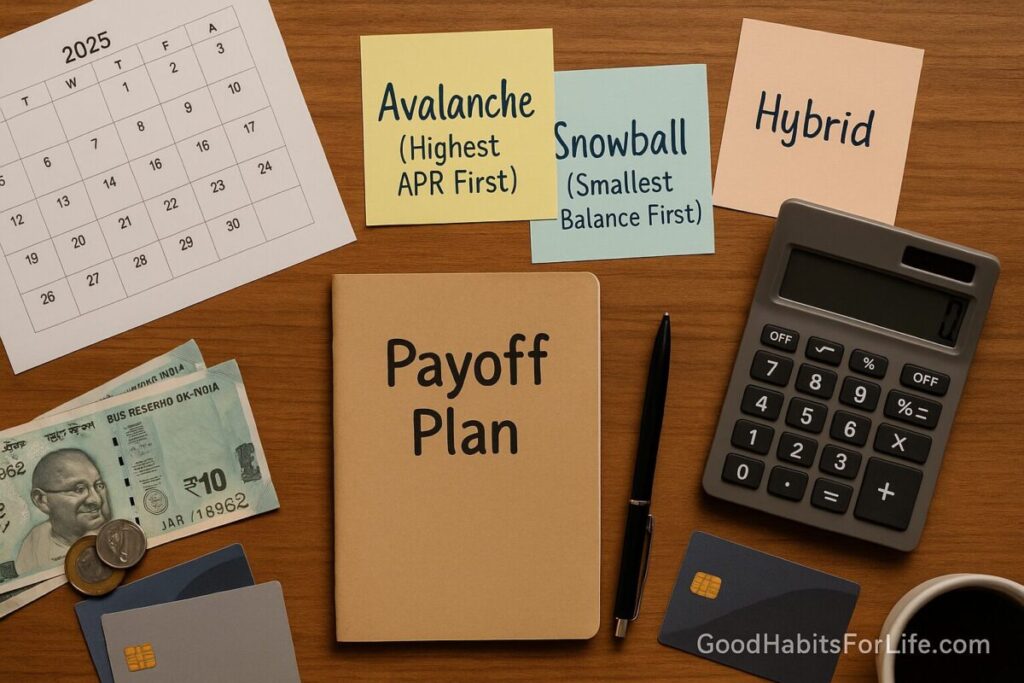
Avalanche (highest interest first). You list debts by APR and throw all extra money at the top APR while paying minimums on the rest. Result: lowest total interest and usually fastest mathematical payoff. This is the approach the Consumer Financial Protection Bureau (CFPB) calls the “highest-interest-rate method.” Consumer Finance.gov
Snowball (smallest balance first). You list debts by balance and pay off the smallest first to get quick wins, then roll those payments to the next balance (“snowballing”). Research shows that early, visible progress increases motivation and follow-through—why snowball can work better for some people despite costing a bit more interest. SAGE JournalsIDEAS/RePEc
Hybrid. Combine the two: keep an avalanche ordering but “snowball” any tiny balances under a threshold (e.g., ₹5,000 / $50–$200) or any debt that causes outsized stress. This preserves most interest savings while harnessing psychology.
Why this matters in 2025. Credit-card APRs remain historically high, so the cost of carrying balances is punishing; every extra month costs more than it did a few years ago. If you can sustain it, avalanche saves the most. If you’ve tried and stalled, snowball or hybrid can get you moving again. Federal Reserve
✅ Method Comparison (with quick chooser)
| Method | How it works | Best if you… | Watch-outs |
|---|---|---|---|
| Avalanche | Attack highest APR first | care about minimizing total interest; can stay motivated without quick wins | Progress may feel slow if the first target is big/high |
| Snowball | Attack smallest balance first | need early momentum; want frequent “paid in full” wins | Usually pays more interest than avalanche |
| Hybrid | Avalanche order, but clear any very small/stressful debts first | want balance of motivation + math | Requires a simple rule so you don’t drift into pure snowball |
Quick chooser:
-
Lots of high-APR card debt? ➜ Avalanche. Federal Reserve
-
You’ve tried before and quit? ➜ Snowball or Hybrid. SAGE JournalsIDEAS/RePEc
-
Mixed goals (save interest but need a win)? ➜ Hybrid.
🛠️ Quick Start: Pick and Launch Your Plan Today
-
List debts (balance, APR, minimum, due date). Use the CFPB reducing-debt worksheet if you want a printable. Consumer Financial Protection Bureau
-
Choose your method (avalanche/snowball/hybrid). Write it on top of the sheet—this is your rule.
-
Find your “extra”: cut ₹/$/£ from categories (subscriptions, eating out, delivery, impulse buys).
-
Automate: schedule the extra to the target debt the day after payday.
-
Snowball the wins: when a debt hits ₹0/$0, roll its entire old payment to the next target.
-
Track weekly: mark progress on a simple chart (balances dropping).
-
Protect yourself: if a collector calls, know your rights and verify in writing. Consumer Advice
🧱 30-60-90 Day Roadmap + No-Spend Challenge (2025)
Days 1–30 (Start & Momentum)
-
Pick your method and automate the extra payment.
-
Mini no-spend challenge (30 days): essentials only (rent, utilities, groceries, medicines, transport). Freeze discretionary spend; batch-cook; use “48-hour rule” for non-essentials. Apply every saved rupee/dollar to your target debt.
-
One-time cash boosts: sell 3 items, cancel 2 subscriptions, negotiate 1 bill.
-
Checkpoint (Day 30): At least one visible win: a small balance cleared or a big dent in the highest APR.
Days 31–60 (Systems & Scale)
-
Re-price expensive debt: explore balance-transfer or consolidation without upfront fees (avoid “debt relief” sales pitches; check FTC guidance). Consumer Advice
-
Raise income: one overtime/side task per week; send 100% of net to debt.
-
Refine hybrid rule: e.g., “Any balance under ₹10,000/$100 gets cleared immediately; otherwise avalanche order.”
Days 61–90 (Lock-in & Future-proof)
-
Snowball growth: every zeroed debt increases your monthly attack.
-
Emergency buffer: park ₹/$ 750–1,500 (or 1 month’s minimums) so surprises don’t force new debt.
-
Plan your “debt-free date” using a calculator; post it on your fridge.
🧠 Techniques & Frameworks (To stay on track)
-
Progress framing: Track number of accounts closed, not just balances—keeps motivation high. IDEAS/RePEc
-
Temptation bundling: Do an enjoyable activity only while listing/automating payments.
-
Default to “payday +1”: Payments go out the day after income lands.
-
Caps & rules: e.g., “No cart over ₹/$ 1,000 without 24-hour wait.”
-
Visual snowball: Print a bar for each debt; color it down to zero weekly.
👥 Audience Variations
Students/early career: prioritize high-APR cards; make minimums on subsidized student loans while you kill revolving balances; automate tiny weekly payments (₹/$ 10–25).
Parents: use the no-spend challenge as a family game (menu plan, “free fun” weekends).
Professionals: negotiate pay/retainers; redirect raises/bonuses to avalanche targets; keep lifestyle creep in check.
Seniors/retirees: be cautious with debt consolidation pitches; check a nonprofit credit counselor; never pay upfront “relief” fees. Consumer Advice
⚠️ Mistakes & Myths to Avoid
-
Myth: “Snowball is wrong math.” It can cost more interest, but research shows early wins increase completion rates—if that’s what you need, it’s the right choice. SAGE JournalsIDEAS/RePEc
-
Mistake: Only paying minimums when APRs are >20%. This prolongs debt dramatically; an avalanche targets that cost first. Federal Reserve
-
Myth: “Debt relief companies erase debt.” Many charge big upfront fees and deliver little; know your rights and options first. Consumer Advice
-
Mistake: Too many goals. Pick one method and a single target at a time.
-
Myth: “Consolidation always saves money.” Only if total costs (fees + APR + term) are lower and you stop new spending.
🗣️ Real-Life Examples & Copy-Paste Scripts
-
Balance-transfer ask (chat/secure message):
“Hi, I’ve been a customer since 2021 with on-time payments. Do you have a 0% balance-transfer offer for 12–18 months with no transfer fee?” -
Bill-negotiation call:
“I’m reviewing my budget. Can you check for any loyalty or retention discounts on my plan? Otherwise I’ll need to switch to a lower tier.” -
Debt-free announcement to yourself:
“I pay ₹/$ ___ extra to [Target Debt] every payday. When it’s zero, that full amount moves to the next account—no exceptions.”
🧰 Tools, Apps & Resources
-
Planning & worksheets: CFPB “Reducing debt” worksheet and “Your Money, Your Goals” toolkit (free, printable). Consumer Financial Protection Bureau+1
-
Calculators: Snowball payoff calculator (Schwab Moneywise) and your bank’s payoff estimator. Schwab Brokerage
-
Data & perspective: New York Fed Household Debt & Credit for the big picture. Federal Reserve Bank of New York
-
Safety: FTC pages on getting out of debt and avoiding scams. Consumer Advice
-
(Optional) Apps: choose ones that allow both avalanche and snowball, automate payments, and show a clear “debt-free date.” Check fees before subscribing.
📌 Key Takeaways
-
Avalanche saves the most interest; snowball often saves your motivation; hybrid balances both. Consumer Finance.govSAGE Journals
-
Automate payments, track visible wins, and run a 30-day No-Spend Challenge whenever you stall.
-
Beware debt-relief pitches with upfront fees; validate collectors in writing. Consumer Advice
-
Stick to one rule and one target at a time; roll every victory forward.
❓ FAQs
1) Which method is objectively “best”?
Strictly by interest cost and (often) speed, avalanche wins—especially when APRs are high. But if motivation is your bottleneck, snowball or hybrid can win in real life because you actually finish. Federal ReserveIDEAS/RePEc
2) How do I build a hybrid rule?
Example: “Clear any balance under ₹10,000/$100 first for a quick win, then follow avalanche by APR.” Write your rule down and follow it.
3) Should I start a no-spend challenge before or after choosing a method?
Start both together. The no-spend funnel provides the extra cash that powers your avalanche/snowball.
4) Do I need an emergency fund before paying extra to debt?
Keep at least a micro-buffer (e.g., ₹/$ 750–1,500) so surprises don’t push you back into debt. Then attack the balances.
5) Are balance transfers worth it?
Sometimes. Run the math on fees + promo length + revert APR, and only if you stop new spending. Avoid any offer that requires upfront “relief” payments to a third party. Consumer Advice
6) What about my student loan or mortgage?
If their APRs are low, prioritize revolving, high-APR credit-card balances first; still keep loans current. (Check benefits/tax implications for your country.)
7) How often should I review my plan?
Weekly check-ins for spending; monthly for the payoff schedule. Every paid-off account should increase your total monthly attack.
8) Can I switch methods later?
Yes—especially to hybrid. If avalanche feels slow, clear one small balance for momentum, then return to APR order.
9) How do I stay out of debt after I’m done?
Keep the same payment amount auto-transferred to savings/investing (“debt-freedom dividend”) and maintain a weekly budget ritual.
📚 References
-
Consumer Financial Protection Bureau. How to reduce your debt (avalanche & snowball explained). https://www.consumerfinance.gov/about-us/blog/how-reduce-your-debt/ Consumer Finance.gov
-
Federal Reserve Board. G.19 Consumer Credit (credit-card APR series). https://www.federalreserve.gov/releases/g19/current/ Federal Reserve
-
Amar, M., et al. (2011). The Psychology of Debt Management (debt-account aversion). Journal of Marketing Research. https://journals.sagepub.com/doi/10.1509/jmkr.48.SPL.S38 SAGE Journals+1
-
Kettle, K. L., Trudel, R., Blanchard, S. J., & Häubl, G. (2016). Repayment Concentration and Consumer Motivation to Get Out of Debt. Journal of Consumer Research. https://ideas.repec.org/a/oup/jconrs/v43y2016i3p460-477..html IDEAS/RePEc
-
CFPB. Reducing-Debt Worksheet (printable). https://files.consumerfinance.gov/f/documents/cfpb_ymyg-toolkit_reducing-debt-worksheet.pdf Consumer Financial Protection Bureau
-
New York Fed. Household Debt and Credit Report (macro context). https://www.newyorkfed.org/microeconomics/hhdc Federal Reserve Bank of New York
-
Federal Trade Commission. How to Get Out of Debt (consumer protection; avoid scams). https://consumer.ftc.gov/articles/how-get-out-debt Consumer Advice
-
FTC Consumer Advice. Debt Collection FAQs (know your rights). https://consumer.ftc.gov/debt-collection-faqs Consumer Advice
-
CFPB. Your Money, Your Goals: Dealing with Debt (toolkit). https://files.consumerfinance.gov/f/201405_cfpb_your-money-your-goals_dealing-with-debt.pdf Consumer Financial Protection Bureau
-
Schwab MoneyWise. Snowball Debt Elimination Calculator. https://www.schwabmoneywise.com/snowball-debt-elimination-calculator Schwab Brokerage
Disclaimer: This article provides general educational information, not personalized financial advice; consider consulting a qualified advisor for your situation.