
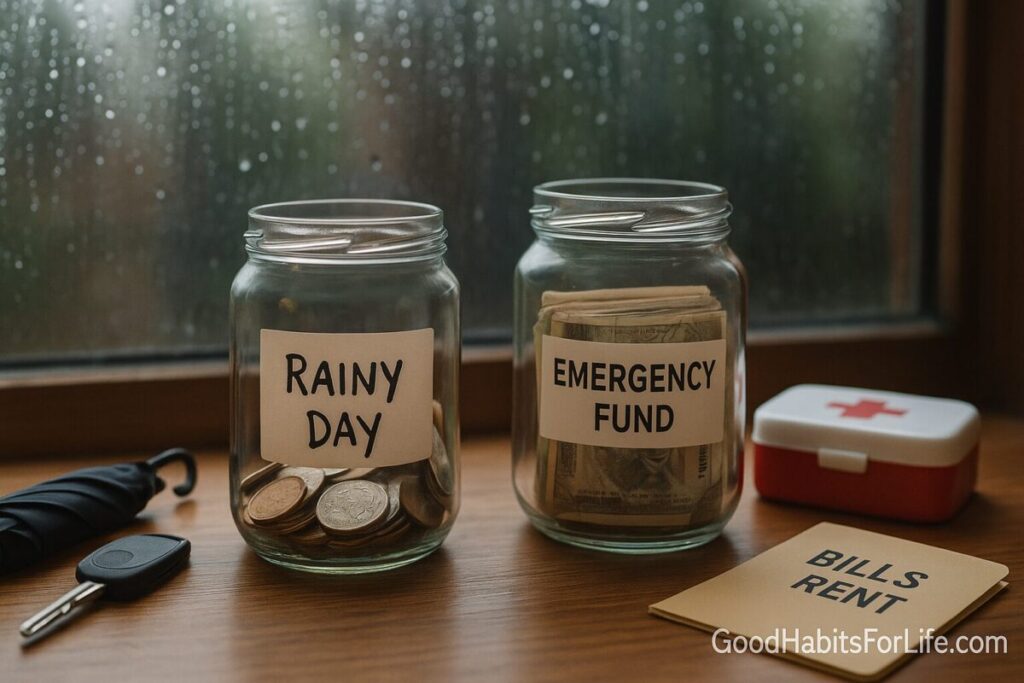
RainyDay vs Emergency: Name the Difference
Rainy Day vs Emergency: Know the Difference
Table of Contents
🧭 What These Funds Are (and Why Both Matter)
Rainy day fund: A small cash buffer for expected but irregular expenses (e.g., routine car/home maintenance, small medical copays, school fees, appliance fixes). It prevents minor bumps from turning into high-interest debt. Guidance from public agencies frames “emergency savings” broadly for unplanned bills; in practice, many households split “everyday bumps” (rainy day) from major shocks (emergency) to manage cash flow better. Consumer Financial Protection Bureau
Emergency fund: A larger reserve for rare, high-impact events—job/income loss, major medical bills, big repairs, displacement after disasters. Building this fund raises financial resilience—your ability to cover shocks without selling assets or borrowing. Federal Reserve Bank of St. LouisOECD
Why it matters: Globally, many adults report difficulty raising emergency cash quickly; a structured two-tier buffer boosts stability and lowers stress. World BankCenter for Financial Inclusion
At-a-glance comparison
| Use case | Rainy Day Fund | Emergency Fund |
|---|---|---|
| Typical costs | ₹1k–₹25k ($20–$300) examples: tire/brake fix, clinic copay, appliance repair | Months of living expenses: rent, groceries, utilities, insurance during job loss/major event |
| Frequency | Occasional, predictable over time | Rare but high-impact |
| Access | Instant | Instant |
| Vehicle | Regular/high-yield savings, flex RD | High-yield savings or money market deposit a/c |
| Refill rule | Top up after each use | Rebuild methodically after any draw |
(Amounts are illustrative—customize with your own spending data.)
✅ Quick Start: Do This Today
-
Open/label two buckets in your bank: “Rainy Day” and “Emergency.” Keep them separate for clarity.
-
Automate a modest transfer (even ₹300–₹1,000 / $5–$15 per day or week). Small amounts compound. FDIC
-
Seed the rainy day fund with the next free cash (refund, side income) so minor bumps don’t hit credit.
-
Park in liquid, insured accounts (savings or money market deposit accounts). FINRA
-
Turn on alerts and track progress on your phone/portal. Consumer Financial Protection Bureau
🛠️ 30-60-90 Day Build Plan
Days 1–30 (Foundation)
-
Target: Rainy Day = your average “oops” spend over 3 months × 1.5 (e.g., two minor repairs).
-
Auto-transfer every payday; divert windfalls (cashbacks, gifts).
-
Keep all micro-emergencies off credit while you build momentum. FDIC
Days 31–60 (Stability)
-
Target: Emergency = 1 month of essentials (rent, food, utilities, transport, insurance). MaPS
-
Reduce leakages (subscriptions, unused plans) and route savings to the fund.
Days 61–90 (Resilience)
-
Target: Emergency = 2–3 months (or more if self-employed/variable income). Common guidance scales to 3–6 months as risk rises. MaPSFINRA
-
After hitting your target, keep only replenishment transfers; invest surplus aligned to goals and risk tolerance.
🧠 Techniques & Frameworks that Work
-
Two-Pot Method: Pot A (Rainy Day), Pot B (Emergency). Never mix.
-
Pay-Yourself-First: Auto-transfer on payday so saving happens before spending. FDIC
-
Round-Up Rules: Round transactions and sweep the difference to Rainy Day.
-
Windfall Split: 50% to Emergency, 30% to debt, 20% enjoy.
-
Risk-Sizing: Stable salaried role? 3 months may suffice. Freelance/commission? Lean toward 6+ months. FINRA
📏 How Much Should You Save?
There’s no one number; use needs × risk:
-
Baseline: Build Rainy Day first, then at least 1 month in Emergency. MaPS
-
Standard: 3–6 months of essential expenses for Emergency; more if single-income, high medical risk, or variable pay. FINRA
-
Reality check (global): Many households struggle to raise emergency cash rapidly—small, steady contributions still improve resilience. World Bank
🏦 Where to Keep the Money (Safety & Access)
-
Liquidity first: Use an interest-bearing, easy-access account (savings/money market deposit). Avoid locking funds or market volatility. FINRA
-
Deposit insurance:
-
If balances exceed limits, spread across institutions/ownership categories as rules allow. Use official calculators (e.g., FDIC EDIE). FDICedie.fdic.gov
👥 Audience Variations
-
Students/Teens: Start with tiny, automated amounts; learn by doing. MaPS
-
Professionals: 3–6 months; more if sole earner or in cyclical industries. FINRA
-
Parents: Add typical child-related bumps (fees, medicines) into the Rainy Day target.
-
Seniors/Retirees: Keep larger cash buffers to avoid selling investments in downturns.
-
Small Business Owners/Freelancers: Prioritize a higher Emergency target and separate a business Rainy Day bucket. FINRA
⚠️ Mistakes & Myths to Avoid
-
Myth: “Invest your emergency fund for higher returns.” Markets can drop when you need cash; keep it liquid and safe. FINRA
-
Mistake: Mixing the two funds. Label accounts and automate.
-
Mistake: Waiting to start until you can save big. Small, consistent amounts work. FDIC
-
Mistake: Ignoring insurance limits. Know your country’s scheme (FDIC/DICGC, etc.). FDICDICGC
✍️ Examples & Ready-to-Use Scripts
Email to bank/app: open & label
“Please open two separate savings sub-accounts and label them ‘Rainy Day’ and ‘Emergency.’ Enable instant transfers between my current account and both sub-accounts.”
Autotransfer rule (bi-weekly)
“Transfer ₹2,000 every second Friday: ₹500 → Rainy Day, ₹1,500 → Emergency.”
Windfall rule
“Any income above ₹20,000/month: 50% → Emergency until I reach 3 months of essentials.”
Replenish after use
“If I spend from Rainy Day/Emergency, increase next three transfers by 25% until back at target.”
🧰 Tools, Apps & Resources (quick pros/cons)
-
High-yield savings / money market deposit a/c — +Liquid, insured; −Rates can change. FINRA
-
Recurring Deposit (RD) for Rainy Day (India) — +Habit-forming; −Less flexible than savings for same-day access.
-
Bank alerts & round-ups — +Frictionless saving; −Small amounts unless paired with windfalls. Consumer Financial Protection Bureau
-
Official insurance info & calculators — +Know your coverage; −Rules vary by ownership category. FDICedie.fdic.govDICGC
📚 Key Takeaways
-
Keep two buffers: Rainy Day (small bumps) and Emergency (big shocks). Consumer Financial Protection Bureau
-
Build Rainy Day first, then climb to 1–3–6 months based on risk. MaPSFINRA
-
Use liquid, insured accounts; automate and label to protect the purpose. FINRA
-
Check your deposit insurance limits (US: FDIC $250k; India: DICGC ₹5 lakh). FDICDICGC
❓ FAQs
1) How much should I keep in a rainy day fund?
Enough to handle the small but likely costs you see over a year (repairs, fees). A practical start is your 3-month average of such costs × 1.5, then adjust.
2) How big should my emergency fund be?
Common guidance: 3–6 months of essential expenses, scaled to your job stability and health risks; begin with 1 month as a milestone. MaPSFINRA
3) Where should I park the money?
In liquid, interest-bearing accounts (savings or money market deposit). Avoid market risk; you need instant access. FINRA
4) Is it okay to build savings while paying off debt?
Yes—build a small buffer first so surprises don’t send you back to high-interest debt; then accelerate repayments while continuing small automated savings. MaPS
5) Do insurance limits matter for me?
Yes. US deposits are typically insured up to $250,000 per depositor per bank per ownership category (FDIC); India up to ₹5 lakh per depositor per bank (DICGC). Spread balances if you exceed limits. FDICDICGC
6) Can I invest my emergency fund?
Keep it cash-like. The point is certainty and access, not return. FINRA
7) What if I use the fund—am I “back to zero”?
No—replenish with larger transfers for a few cycles until you’re back at target.
8) I’m a freelancer. How much is enough?
Bias higher (6+ months) because income is variable and shocks last longer. FINRA
References
-
CFPB — An essential guide to building an emergency fund (Dec 12, 2024). Consumer Financial Protection Bureau
-
FDIC — Saving for the Unexpected and Your Future (Jan 3, 2025). FDIC
-
FINRA — Financial Foundations (emergency funds should be liquid/interest-bearing). FINRA
-
St. Louis Fed — When the Unexpected Happens, Be Ready with an Emergency Fund (2025). Federal Reserve Bank of St. Louis
-
OECD — Supporting the financial resilience of citizens (policy brief). OECD
-
World Bank — Global Findex 2021: Financial resilience (headline results). World Bank
-
FDIC — Your Insured Deposits / Deposit Insurance FAQs (coverage rules). FDIC+1
-
FDIC — EDIE: Electronic Deposit Insurance Estimator. edie.fdic.gov
-
DICGC (India) — Guide to Deposit Insurance (₹5 lakh limit). DICGC
Disclaimer: This article is educational and does not constitute financial advice; consider speaking with a certified financial professional for your situation.