
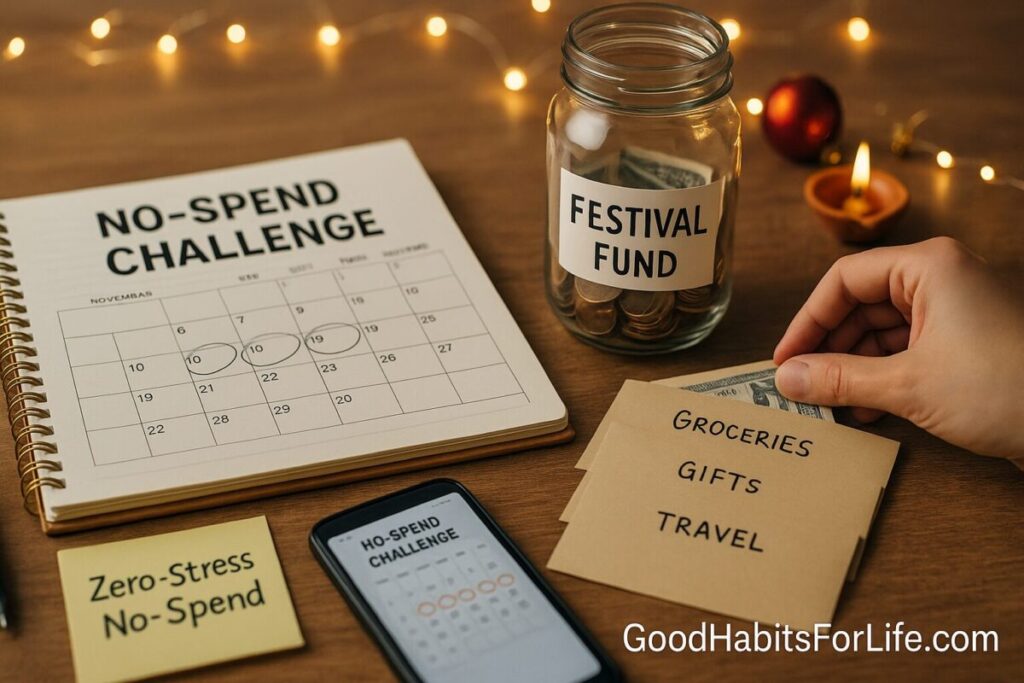
Festival & Holiday Funds: Spend with Zero Stress: No-Spend Challenge (2025)
Festival & Holiday Funds: Zero-Stress No-Spend (2025)
Table of Contents
🧭 What & Why: The Case for a No-Spend Festival Fund
Festivals and holidays are peak spending periods. In the UK, households spend about £700 more in December—roughly 29% above a typical month—showing how seasonal costs creep up fast. Planning early and ring-fencing cash prevents debt hangovers. Bank of England
Money stress is real and persistent. In APA’s Stress in America 2024, the economy remained a major source of stress for adults—so proactive budgeting for predictable events (like festivals and holidays) is a practical mental-health protector. APA
A No-Spend Challenge is a short, intentional period where you pause discretionary spending (e.g., dining out, impulse buys) and reroute savings into your festival fund. Government and regulator guidance consistently recommends making a realistic budget, tracking spending, and planning ahead—exactly what a challenge enforces. consumerfinance.gov+1
✅ Quick Start: Your 60-Minute Setup (Today)
Goal: Set up your festival fund and kick off a 14- to 30-day No-Spend Challenge.
-
Choose your event(s) and total budget. List every likely cost: gifts, travel, outfits, events, food, decorations, charitable giving, postage, wrapping, tips. (Add a 10% buffer.) Consumer Advice
-
Open or earmark a separate “Festival Fund.” This is a classic sinking fund: a pot for irregular expenses you fund monthly/weekly. ISED Canada
-
Automate a weekly transfer. Divide your total by the weeks left until your festival/holiday; set an automatic transfer each week. moneysmart.gov.au
-
Create a simple budget. Use a reputable planner to set limits and allocate to essentials first, then the festival fund. moneysmart.gov.au
-
Track spending. Run a two-week spending tracker to expose leaks you can pause during the challenge. Consumer Financial Protection Bureau
-
Define your No-Spend rules. Examples: “No takeout, no new clothes, no impulse gifts; exceptions: medicines, transport.”
-
Make a ‘Cap & List’ gift plan. Cap total spend and set per-person amounts; prepare a “wish swap/DIY” backup list. consumerfinance.gov
-
Announce it. Tell family/friends you’re doing a no-spend to fund stress-free celebrations—set expectations early. MaPS
🛠️ Techniques & Frameworks That Work
1) Zero-Based Budgeting (ZBB). Give every unit of currency a job (essentials, savings, debt, festival fund). Adjust monthly as prices or income change. moneysmart.gov.au
2) Sinking Funds. Pre-save for irregular expenses (gifts, travel, outfits). Canada’s insolvency counselling module explicitly teaches saving every paycheque for periodic costs—exactly what festivals require. ISED Canada
3) Envelope / Cash-Stuffing (or digital “pots”). Set fixed amounts for “Gifts,” “Food,” “Travel.” When the envelope is empty, you’re done. Track with a simple printable tool if cash-based. Consumer Financial Protection Bureau
4) “Cap & List” Rule. Make a recipient list, set per-person caps, and stick to it—classic regulator advice to curb impulse buys and overspending. Consumer Advice
5) Plan for Incidentals. Don’t forget postage, wrapping, décor, party supplies, taxis/parking. These small items derail budgets if not listed. Federal Trade Commission
6) Avoid Costly Credit Traps. Think carefully before opening store cards for discounts; know APRs and fees. If you do borrow, have a payoff plan. Go.USAConsumer Advice
7) Build an Emergency Buffer. Keeping a separate emergency fund (3–6 months of expenses, built gradually) stops crises from cannibalising your holiday fund. Canada Government
📅 Habit Plan: 30-60-90 Day Roadmap
Day 0 (Today): Do the Quick Start steps. Automate transfers. Print or download a spending tracker. Consumer Financial Protection Bureau
Days 1–30 (Phase 1—No-Spend Sprint):
-
Freeze all non-essentials; redirect savings to the fund.
-
Use ZBB + Envelopes weekly; reconcile on Sundays.
-
Mid-point check (Day 15): adjust caps if needed. moneysmart.gov.au
Days 31–60 (Phase 2—Optimization):
-
Unfreeze only the highest-value categories (e.g., one low-cost social event/week).
-
Price-check gifts early; add DIY/experience gifts to lower spend. consumerfinance.gov
-
Book travel/transport off-peak; confirm sharing arrangements.
Days 61–90 (Phase 3—Lock-In & Prep):
-
Pre-buy non-perishables and supplies on sale.
-
Finalize guest lists/outfits/meals; keep envelopes closed after caps are hit.
-
Post-event reset: sweep any leftover into emergency savings. moneysmart.gov.au
Checkpoints:
-
Weekly: Envelope balances ≥ planned? If not, trim wants.
-
Monthly: Fund balance on track vs target? Adjust automation by ±10%.
-
After Event: Zero credit card carryover? If there’s a balance, use highest-interest-first payoff. ISED Canada
👥 Audience Variations
Students: Use student-friendly budgets; prioritise low-cost potlucks/DIY gifts and public transport. Track daily to curb small leaks. moneysmart.gov.au
Parents: Budget for childcare, class gifts, travel, and meal scaling; set gift caps and communicate early with relatives. MaPS
Professionals: Watch “hidden” work-season costs (office parties, Secret Santa, commuting spikes). Set a micro-envelope for work socials. APA
Seniors: Prioritise health, heating, and transport envelopes; give experience or time-based gifts to reduce expense. moneysmart.gov.au
Teens: Try a mini no-spend (7–14 days) and use a simple tracker; discuss needs vs wants. Consumer Financial Protection Bureau
⚠️ Mistakes & Myths to Avoid
-
“I’ll just put it on a card and pay later.” Minimum payments prolong debt and increase total cost. Consumer Advice
-
Forgetting incidentals. Postage, wrapping, décor, taxis, and tips add up; list them. Federal Trade Commission
-
Opening a store card for a one-time discount. Weigh APR/fees and long-term impact first. Go.USA
-
No tracking. Two weeks of tracking reveals easy wins; don’t skip it. Consumer Financial Protection Bureau
-
No buffer. Emergencies happen—keep festival funds separate from your emergency fund. Canada Government
💬 Real-Life Examples & Scripts
1) Gift Limits with Family
“Hey, we’re doing a no-spend sprint to build our festival fund. Can we set a ₹/£/$ cap per person this year—or swap DIY/experience gifts?” MaPS
2) Office Secret Santa
“I’m on a budget—can we agree on a firm cap of ₹/£/$ X and gift receipts only?”
3) Kids’ Expectations
“Let’s pick one ‘big wish’ and two low-cost experiences. We’ll make memories and stay on budget.”
4) Potluck Hosting
“We’re hosting if everyone brings one dish. I’ll share a simple menu and portions so no one overspends.”
🧰 Tools, Apps & Resources
-
Budget Planner (Moneysmart, AU): Robust, free planner (Excel/web). Great for ZBB and envelope planning. moneysmart.gov.au
-
Spending Tracker (CFPB, US): Printable tool for 2-week leak-find. Consumer Financial Protection Bureau
-
Holiday Budgeting Guides (CFPB/FTC, US): Checklists for planning and staying out of debt. consumerfinance.gov+1
-
Saving for Christmas (MoneyHelper, UK): Government-backed guidance on caps, lists, and planning. MaPS
-
Emergency Fund Guide (FCAC, CA): How to build 3–6 months of expenses gradually. Canada Government
🔑 Key Takeaways
-
Seasonal overspending is predictable—pre-save with a dedicated sinking fund. ISED Canada
-
Run a No-Spend Challenge to fast-track cash into your festival fund. Canada Government
-
Use ZBB + Envelopes + Tracking to keep control; include “forgotten” costs. Consumer Financial Protection BureauFederal Trade Commission
-
Automate weekly transfers and review at 30/60/90 days. moneysmart.gov.au
-
Protect mental bandwidth by reducing money stress with a realistic plan. APA
❓ FAQs
1) What exactly is a festival/holiday “sinking fund”?
A separate pot you fill regularly to pay for predictable, irregular costs (e.g., gifts, travel) when they arrive—so you avoid debt. ISED Canada
2) How long should a No-Spend Challenge be?
Common runs are 14–30 days. Start with 14 days to build momentum; extend to 30 if you have a larger target. Canada Government
3) How do I decide my budget cap?
List all categories (including incidentals), then set per-person or per-event caps and a 10% buffer. Federal Trade Commission
4) Should I use credit cards for points?
Only if you’ll pay in full each cycle. Otherwise, interest wipes out rewards; store cards can be especially costly. Go.USA
5) What if I’m starting late in the season?
Run a shorter no-spend (7–14 days), cut low-value categories, and prioritise DIY or experience gifts to stay under cap. consumerfinance.gov
6) Is an emergency fund still necessary if I have a festival fund?
Yes—keep them separate. The emergency fund shields you from surprises so your festival fund stays intact. Canada Government
7) How can I keep the rest of my household on board?
Share the plan early, agree limits together, and use budget-friendly scripts to set expectations. MaPS
8) Any proof that tracking helps?
Regulators and government agencies recommend spending trackers to reveal patterns and reduce overspending. Consumer Financial Protection Bureau
9) Are layaway plans safe?
They can help if you avoid debt, but read the policy, fees, and refund terms carefully. Federal Trade Commission
10) What if prices are rising?
Review and adjust your budget monthly and reallocate in real time—ZBB is designed for changing costs. moneysmart.gov.au
📚 References
-
American Psychological Association. Stress in America™ 2024 (full report & summary). https://www.apa.org/pubs/reports/stress-in-america/2024 APA+1
-
Bank of England. “How much do we spend during the festive season?” https://www.bankofengland.co.uk/explainers/how-much-do-we-spend-at-christmas Bank of England
-
CFPB (U.S.). “A five-step spending plan to avoid holiday debt.” https://www.consumerfinance.gov/about-us/blog/five-step-spending-plan-avoid-holiday-debt/ consumerfinance.gov
-
CFPB (U.S.). “Three ways to enjoy the holidays without going into debt.” https://www.consumerfinance.gov/about-us/blog/three-ways-enjoy-holidays-without-going-debt/ consumerfinance.gov
-
CFPB (U.S.). “Spending tracker (tool).” https://files.consumerfinance.gov/f/documents/cfpb_spending-tracker_tool_2021-08.pdf Consumer Financial Protection Bureau
-
FTC (U.S.). “Happy holidays! Shopping tips from the FTC.” https://consumer.ftc.gov/consumer-alerts/2018/11/happy-holidays-shopping-tips-ftc Consumer Advice
-
FTC (U.S.). “Paying off holiday credit card debt.” https://consumer.ftc.gov/consumer-alerts/2018/01/paying-holiday-credit-card-debt Consumer Advice
-
MoneyHelper (UK). “Saving money for Christmas.” https://www.moneyhelper.org.uk/en/savings/types-of-savings/saving-money-for-christmas MaPS
-
FCAC (Canada). “Setting up an emergency fund.” https://www.canada.ca/en/financial-consumer-agency/services/savings-investments/setting-up-emergency-funds.html Canada Government
-
Moneysmart (AU). “Budget planner.” https://moneysmart.gov.au/budgeting/budget-planner moneysmart.gov.au
-
Government of Canada (OSB). “Budgeting Module—saving monthly for infrequent expenses.” https://ised-isde.canada.ca/…/Insolvency-Counselling-Program-02-Budgeting-Module.pdf ISED Canada
⚖️ Disclaimer
This guide provides general money-management education and is not individualized financial advice; consider consulting a qualified adviser for your situation.