
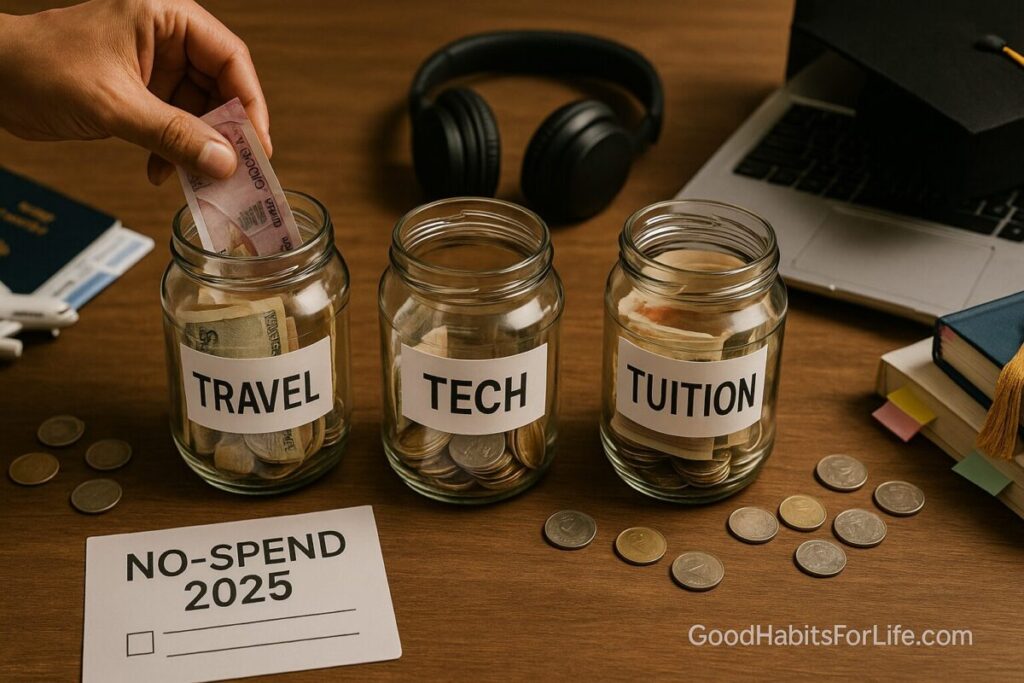
Goal Buckets: Travel, Tech, Tuition: No-Spend Challenge (2025)
No-Spend 2025: Goal Buckets for Travel, Tech & Tuition
Table of Contents
🧭 What This Is & Why It Works
The idea: Pair a focused no-spend challenge (temporary freeze on non-essentials) with three clearly labeled goal buckets—Travel, Tech, and Tuition. Every rupee you don’t spend flows into those buckets.
Why it works (behavioral edge):
-
Precommitment (deciding now to remove temptations later) reliably boosts follow-through on money goals. Programmes like Save More Tomorrow show how committing your future self can raise savings rates without feeling painful today. BehavioralEconomics.com | The BE Hub
-
Mental accounting gives money “labels.” Even though cash is fungible, our brains treat a “Tuition” pot differently from “Fun” money—use that bias to your advantage. Wiley Online Library
-
Less impulse shopping = fewer dopamine-driven splurges; research links higher dopamine and certain contexts to impulsivity and unplanned buying. PMC+1
Result: Clear targets + a temporary spending reset → faster progress toward travel memories, a smart tech upgrade, and education costs.
✅ Quick Start: Do This Today
-
Name your 3 buckets: Travel, Tech, Tuition (separate savings “pots” or sub-accounts).
-
Define your no-spend window: 30 days (non-essentials paused; essentials allowed).
-
Write your rules (keep it short): groceries, rent, medicines, transport = OK; restaurants, gadgets, apparel, decor, BNPL = paused. (BNPL can add fees and dispute hassles—skip it during your challenge.) Consumer Financial Protection Bureau+1
-
Automate a weekly transfer into each bucket (e.g., every Friday).
-
Track a single scoreboard: each bucket’s balance and % to goal—update twice a week.
-
Create friction: uninstall shopping apps, turn off one-click checkout, remove saved cards.
-
Replace the habit: line up no-cost alternatives (library, home workouts, free events, meal prep).
-
Finish-line ritual: when you hit 30 days, move the total “saved by not buying” into your buckets and celebrate with a free reward (picnic, movie night).
📅 30-60-90 Roadmap
Days 1–30 (Reset & Momentum)
-
Freeze non-essentials; weekly transfer to all three buckets.
-
Checkpoints (Days 10, 20, 30): review triggers, cancel 1 subscription, log total avoided spends.
-
Target: reach 15–25% of each goal.
Days 31–60 (Systems & Strength)
-
Re-introduce only planned small treats with a cap (e.g., ₹1,000/week).
-
Add a pay-yourself-first rule: transfers leave your account on payday.
-
Target: hit 50–60% of each goal.
Days 61–90 (Stability & Scale)
-
Keep low-temptation defaults (no cards saved, price-watch period of 72 hours).
-
Add a windfall rule: 50% of any bonus/refund goes to buckets.
-
Target: 80–100% (or lock in travel dates / tuition installment / schedule tech purchase).
🧳 Set Up the 3 Goal Buckets (Travel • Tech • Tuition)
Use this formula for each bucket:
Monthly Contribution = Target Amount ÷ Months to Deadline
Example (edit the numbers to your currency):
| Bucket | Target | Deadline | Monthly Contribution |
|---|---|---|---|
| Travel (7-day trip) | ₹90,000 (≈ $1,075) | 6 months | ₹15,000 |
| Tech (laptop + accessories) | ₹80,000 (≈ $955) | 5 months | ₹16,000 |
| Tuition (semester fee top-up) | ₹1,50,000 (≈ $1,790) | 9 months | ₹16,700 |
Tips per bucket
-
Travel: Price-watch flights; batch all “fun money” for experiences, not knick-knacks.
-
Tech: Prioritise performance over brand; wait for sales cycles you’ve pre-planned (not impulse “flash deals”).
-
Tuition: Sync contributions with the institution’s fee schedule; set a payment buffer of 10–15% for books/fees.
🧠 Techniques & Frameworks
-
Sinking funds / “goal buckets.” Separate pots for known future expenses (vs. your emergency fund, which is for unexpected events). This prevents budget shocks and debt. IG
-
Zero-based budgeting (ZBB). Give every rupee a job; unassigned money becomes a leak.
-
Envelope method (digital). Caps spending by category; when an envelope is empty, you stop.
-
Precommitment levers. Create barriers (no stored cards, unsubscribe from promos). Behavioral research shows commitments help counter low willpower and improve savings behavior. BehavioralEconomics.com | The BE Hub
-
72-Hour Rule. For any non-essential over your threshold (e.g., ₹5,000), add a 72-hour cooling-off period—most impulses fade.
-
Scoreboard & streaks. Visible progress sustains motivation; update balances twice weekly.
-
BNPL black-out. During the challenge, avoid BNPL: late fees, disputes and reporting rules can be tricky. Consumer Financial Protection Bureau+1
👥 Audience Variations
-
Students: Use fee calendars; route scholarship refunds with a “50% to Tuition” rule.
-
Parents: Add a micro-bucket for school activities; meal-prep to deflate restaurant spends.
-
Professionals: Tie transfers to payday; set a “work travel” per diem so reimbursements don’t become splurges.
-
Seniors: Prioritise medical and emergency cushions first; keep travel bucket liquid.
-
Teens: Start with a 14-day no-spend; use prepaid or teen accounts with built-in category limits.
⚠️ Mistakes & Myths to Avoid
-
Myth: “A no-spend means spending nothing.” Reality: you still pay essentials; the goal is pausing non-essentials to redirect cash to targets.
-
Mistake: Mixing emergency savings with goal money—keep them separate so you don’t raid either. The Fed tracks emergency-savings resilience by “3-months of expenses”—make this distinct from travel/tech/tuition goals. Federal Reserve
-
Mistake: Using BNPL “just this once.” One slip can add fees or complicate disputes. Consumer Financial Protection Bureau+1
-
Myth: “Small transfers don’t matter.” Compounding habits matter; even tiny, automated transfers add up (FDIC Money Smart). FDIC
-
Mistake: No social plan. Tell friends you’re on a challenge; suggest free/low-cost alternatives.
🗣️ Real-Life Scripts (Copy-Paste)
Declining a plan (friend):
“I’m on a 30-day no-spend for a travel/tuition goal. Can we do a home-movie night or park walk instead?”
Store checkout upsell:
“I only buy what’s on my pre-planned list. I’ll pass—thanks.”
BNPL pop-up:
“Not during no-spend. If I still want this after 30 days, I’ll pay from my Tech bucket.”
Family budgeting chat:
“We’re doing a 30-day reset. Essentials are covered; anything else waits 72 hours and needs a bucket.”
🛠️ Tools, Apps & Resources
-
Government budgeting worksheet: The FTC/Consumer.gov Make a Budget template is simple, printable, and free—great for mapping essentials vs. non-essentials. consumer.gov+1
-
Financial education: FDIC Money Smart (modules and games) to build skills and stay engaged. FDICMoney Smart
-
Bank “pots” / “sub-accounts”: Many banks let you create named goals inside one savings account—ideal for Travel/Tech/Tuition.
-
Spending blockers: Website/app blockers; delete stored cards and autofill; unsubscribe from promo emails.
-
Trackers: Any notes app or spreadsheet with a simple scoreboard; update balances twice weekly.
📌 Key Takeaways
-
No-spend + labelled buckets turns willpower into a system.
-
Precommitment and mental accounting, used wisely, reduce impulse buys and grow savings. BehavioralEconomics.com | The BE HubWiley Online Library
-
Keep emergency funds separate from goal buckets; automate weekly transfers. Federal Reserve
-
Avoid BNPL during the challenge window. Consumer Financial Protection Bureau
❓ FAQs
1) How long should my no-spend last?
Start with 30 days. If that’s easy, extend to 60 or target weekend-only “spend-free” streaks.
2) What counts as essential?
Housing, utilities, groceries, medicines, transport, school/childcare obligations. Everything else pauses.
3) Do I freeze subscriptions?
At least review them; pause/cancel any non-critical ones during the challenge window.
4) What if a limited-time travel deal appears?
Apply the 72-Hour Rule and only buy from the Travel bucket—never from emergency savings or debt.
5) How big should each bucket be?
Work backward from real prices and deadlines. Use Monthly Contribution = Target ÷ Months.
6) Isn’t “mental accounting” a bias I should avoid?
In investing decisions, yes—money is fungible. But for day-to-day saving, naming pots can harness that bias for good. Wiley Online Library
7) What about BNPL?
Skip it during the challenge. Late fees and dispute rules can complicate your progress. Consumer Financial Protection Bureau+1
8) Where should I keep the money?
Use a safe, liquid savings account (or sub-accounts/pots). Prioritise access for tuition deadlines and fixed travel dates.
9) How do I avoid post-challenge relapse?
Keep default friction (no saved cards), keep pots named and visible, and maintain payday automation.
📚 References
-
Thaler, R. H. (1999). Mental Accounting Matters. Journal of Behavioral Decision Making. (PDF) University of Bath
-
BehavioralEconomics.com — Precommitment & Commitment entries (summaries and evidence). BehavioralEconomics.com | The BE Hub+1
-
Federal Reserve (2025). Economic Well-Being of U.S. Households in 2024 — Savings & Investments (Emergency-savings indicator). Federal Reserve
-
Consumer.gov / FTC. Making a Budget (worksheet & guidance). consumer.gov+1
-
FDIC. Money Smart programme & “Starting Small Can Lead to Big Savings.” FDIC+1
-
CFPB. BNPL fees & protections (Ask CFPB; Interpretive Rule press release). Consumer Financial Protection Bureau+1
-
Pine, A. et al. (2010). Dopamine, Time, and Impulsivity in Humans. (PMC). PMC
-
Mandolfo, M. et al. (2021). Past, Present, and Future of Impulse Buying Research Methods. Frontiers in Psychology / PMC. PMC
-
IG (2025). Sinking funds in personal finance—definition and use. (Plain-language overview). IG
⚖️ Disclaimer
This guide is educational information, not financial advice. Consider your personal situation or consult a qualified adviser before making decisions.