
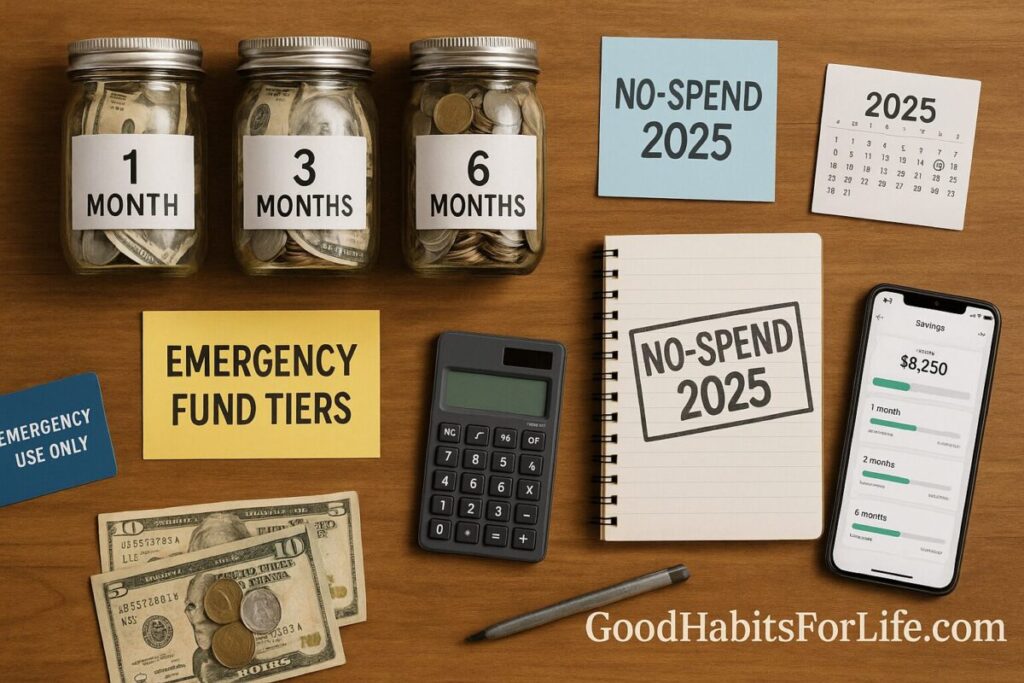
Emergency Fund Tiers: 1Month, 3Month, 6Month: No-Spend Challenge (2025)
Emergency Fund Tiers (1/3/6 Months) + No-Spend 2025
Table of Contents
🧭 What Is a Tiered Emergency Fund (and Why It Works)
A tiered emergency fund splits your safety net into clear milestones—1 month, then 3 months, then 6 months of essential expenses—so you see progress faster and match risk to reality. Leading consumer-finance bodies commonly recommend a 3–6-month buffer, with more for variable or single-income households. FINRA+1
Why tiers beat “save a lot, someday”:
-
Psychology: Smaller goals create early wins, which reinforce the habit loop.
-
Resilience: Even 1 month of liquid cash dramatically reduces the chance you’ll need high-interest debt during a shock. Research links adequate liquid buffers to less hardship during income/expense swings. JPMorgan Chase+1
-
Focus: Each tier has a job (see next section), so you don’t over-optimize for yield at the cost of access.
✅ The 1/3/6-Month Tier Map (Where to Keep Each Tier)
| Tier | Target | Purpose | Best Place to Park It | Notes |
|---|---|---|---|---|
| Tier 1 | 1 month of essentials | Absorb small shocks; avoid credit-card debt | High-yield savings or insured money market deposit (instant access) | Keep separate from checking. Know your local deposit-insurance limits. US: FDIC $250k per depositor/bank/category; India: DICGC ₹5 lakh per depositor/bank. FDIC+1 |
| Tier 2 | 3 months total | Job/income blips; larger repairs | High-yield savings or money market fund (T+0/T+1) | Consider splitting across institutions to stay under insurance caps. FDIC |
| Tier 3 | 6 months total (or 6–12 for freelancers/single earners) | Major disruptions; medical leave; job search runway | Mix: high-yield savings + short-term instruments (e.g., Treasury bills/CDs ladder) | Prioritize access first; only ladder a portion you won’t need same-day. Guidance to increase buffer for unstable income is common. FINRA |
Note: Deposit insurance protects bank deposits up to published limits; securities like money market funds are not FDIC-insured (though underlying holdings may be T-bills). Always verify product type. FDIC
🛠️ Quick Start: Build Your First 1-Month Cushion This Week
Day 1: Set the number. List essential monthly costs (housing, utilities, basic food, transport, minimum debt, insurance). That total is your Tier-1 goal.
Day 1 (10 minutes): Open a “safety only” account.
-
Online high-yield savings or insured money market deposit account. Name it “Emergency—Do Not Touch.”
-
Turn on two-factor auth; disable debit card if offered.
Day 2: Automate.
-
Schedule a pay-yourself-first transfer the day you’re paid (even ₹/$500 makes a dent).
-
Add round-ups or micro-saves if your bank/app supports it.
Days 3–9: Run a 7-Day No-Spend Sprint.
-
Allowed: rent, bills, basic groceries, meds, work travel.
-
Exceptions list: pre-committed essentials only.
-
Daily check-in: log the amount you diverted to the fund.
Day 10+: Re-deploy savings leaks. Cancel, downgrade, or pause one subscription; switch to generic brands for 30 days; sell one unused item.
Why this works: clear targets + automation + prompts = behavior sticks. (See science section.) Fogg Behavior Model
📅 30-60-90 Day Roadmap to 3 and 6 Months
Days 1–30 (Tier 1: 1 Month)
-
Hit 25% of the goal in Week 1 with the sprint above.
-
Add or boost auto-transfer on payday.
-
One “Replacement Rule”: for every discretionary purchase, move an equal amount to savings.
-
End of month: you should be near or at 1 month.
Days 31–60 (Tier 2: to 3 Months)
-
Extend your No-Spend into “Low-Spend”: set a weekly discretionary cap.
-
Consider parking a slice in a money market fund (if available/appropriate) to potentially nudge yield while keeping T+0/T+1 access.
-
Weekly review: verify you remain under deposit-insurance caps. FDIC+1
Days 61–90 (Tier 3: to 6 Months)
-
Ladder a small portion (e.g., 1–2 months of the total) in short CDs/T-bills rolling monthly; keep at least 2–3 months instantly accessible.
-
If you’re a freelancer/single earner, push beyond 6 months (toward 9–12 months). FINRA
-
Schedule a quarterly stress test: could you cover your deductibles + one job-search month without debt?
🧠 Science-Backed Techniques for Saving That Sticks
-
Implementation intentions: pre-decide the action for a cue: “If I get a refund/bonus, then I send 80% to Tier-2.” Meta-analyses show these plans boost goal attainment meaningfully. ScienceDirectPMC
-
B=MAP (Fogg): Behavior happens when Motivation, Ability, and a Prompt converge. Make saving easy (automation), motivating (progress bar), and prompted (calendar nudges). Fogg Behavior Model
-
Nudges & reminders: Personalized reminders and salient future needs (e.g., “what if the car dies?”) increase saving participation. EconStor
-
Default wins: Auto-sweeps on payday exploit inertia in your favor (pay-yourself-first). PMC
👥 Variations: Students, Parents, Professionals, Seniors, Freelancers
-
Students/early career: Start with 1 month, then 3; use campus/job income to automate tiny amounts.
-
Parents: Factor kids’ deductibles and school expenses; BNPL use is common—avoid leaning on it in emergencies. Federal Reserve
-
Professionals (dual income): You might be fine at 3–6 months if jobs are stable.
-
Seniors/retirees: Keep more cash locally to avoid selling investments in a downturn; align with health-care out-of-pocket needs.
-
Freelancers/gig workers: Income volatility → target 6–12 months total. FINRA
⚠️ Mistakes & Myths to Avoid
-
Investing your emergency fund in stocks/crypto. Market risk + timing risk—emergencies don’t wait for recoveries.
-
Chasing yield over access. If you can’t get the money within 0–2 days, it’s not Tier-1.
-
Mixing funds with day-to-day checking. Out of sight, out of mind prevents accidental spending.
-
Ignoring deposit-insurance limits. Spread large balances across insured institutions/categories. US FDIC covers $250k per depositor/bank/category; India DICGC covers ₹5 lakh per depositor/bank. FDICDICGC
-
Assuming 3 months is universal. Variable income or single-earner families often need more. FINRA
💬 Real-Life Scripts & Micro-plays (Copy/Paste)
-
No-Spend Announcement to Family/Roommates:
“For the next 14 days we’re on a No-Spend for non-essentials so we can finish Tier-1. Essentials stay. If we want something, we add it to a Later List. We review the list on Day 15.” -
Cash-First at Checkout:
“I’m building my 3-month emergency fund—skipping this for now. If I still want it in 72 hours, I’ll revisit.” -
Windfall Rule:
“If I receive a bonus/tax refund, 80% → emergency fund, 20% guilt-free.” (Pre-commit = implementation intention.) -
Friend Invite Swap:
“I’m on a savings sprint—can we swap dinner out for a home pasta night or a walk + chai?”
🧰 Tools, Apps & Calculators
-
Calculators:
-
NerdWallet Emergency Fund Calculator (quick target math). NerdWallet
-
HSBC Emergency Fund Calculator (3–6 months slider). hsbc.co.uk
-
-
Budgeting/Tracking:
-
YNAB / Monarch Money / Goodbudget—envelope/zero-based; great for “give every dollar a job.”
-
Splitwise—household cost-sharing clarity.
-
Round-up/Autosave features via your bank/fintech.
-
-
Where to park cash (learn more):
-
Vanguard guide to emergency funds (placement/options). investor.vanguard.com
-
Consumer Financial Protection Bureau (CFPB) emergency fund guide. consumerfinance.gov
-
📌 Key Takeaways
-
Build Tier-1 (1 month) fast, then Tier-2 (3 months), then Tier-3 (6+ months) if riskier income. FINRA
-
Keep Tier-1 ultra-liquid in insured accounts; mind FDIC/DICGC limits as balances grow. FDICDICGC
-
Use automation + No-Spend sprints + implementation intentions to accelerate progress. ScienceDirectFogg Behavior Model
❓ FAQs
How much should I save—1, 3, or 6+ months?
Start with 1 month quickly, then move toward 3–6 months. If your income is variable or you’re a single earner, target the higher end (6–12 months). FINRA
Where should I keep my emergency fund?
Tier-1 belongs in high-yield savings or insured money market deposits for immediate access. Tier-2/Tier-3 can blend savings with short CDs/T-bills to modestly improve yield while maintaining liquidity. Verify insurance coverage and product type. FDIC
Should I pay off high-interest debt before saving?
Do both: build a small starter cushion (e.g., 1 month) to avoid new debt, then aggressively tackle high-interest balances while continuing automatic contributions to tiers.
Are money market funds safe like bank deposits?
They’re different. Money market funds are not FDIC-insured; bank deposits are insured up to limits (e.g., US $250k per depositor/bank/category). FDIC
Is a No-Spend challenge realistic for families?
Yes—set an exceptions list (meds, kids’ essentials, pre-paid commitments) and do short sprints (7–14 days) with a shared tracker. Tie it to a visible milestone (reaching ₹/$X in Tier-1).
How do I rebuild after using the fund?
Restart the pay-yourself-first transfer, run another 7–14-day Low/No-Spend, and set a rule: 50–80% of any windfall refills the fund until tiers are restored.
Should I keep some cash at home?
A tiny amount for true emergencies is fine, but keep the bulk in insured accounts where it’s safer and can earn interest. The Washington Post
Do I count income or expenses?
Plan by essential expenses (better reflects reality); some calculators also show income-based targets—use whichever keeps you consistent. Investopedia
📚 References
-
Consumer Financial Protection Bureau (CFPB). An essential guide to building an emergency fund. https://www.consumerfinance.gov/ consumerfinance.gov
-
FINRA. Financial Foundations: Build an Emergency Fund; and Prepare for and Survive Financial Hardship. https://www.finra.org/ FINRA+1
-
Federal Reserve. Report on the Economic Well-Being of U.S. Households (2025) – Emergency Savings data. https://www.federalreserve.gov/ Federal Reserve+1
-
JPMorgan Chase Institute. Weathering Volatility 2.0; Coping with Costs. https://www.jpmorganchase.com/ JPMorgan Chase+1
-
FDIC. Deposit Insurance FAQs; Your Insured Deposits; Deposits at a Glance. https://www.fdic.gov/ FDIC+2FDIC+2
-
DICGC (RBI). Guide to Deposit Insurance; FAQs. https://www.dicgc.org.in/ DICGC+1
-
Vanguard. Guide to building an emergency fund. https://investor.vanguard.com/ investor.vanguard.com
-
Gollwitzer & Sheeran. Implementation Intentions and Goal Achievement: A Meta-analysis. (overview). https://www.sciencedirect.com/ ScienceDirect
-
Fogg, B.J. Fogg Behavior Model (B=MAP). https://www.behaviormodel.org/ Fogg Behavior Model
-
OECD/G20-INFE. Supporting resilience through digital financial literacy. https://www.gpfi.org/ gpfi.org
-
Investor.gov (SEC). Save for a Rainy Day (emergency buffer guidance). https://www.investor.gov/ Investor
-
NerdWallet. Emergency Fund Calculator. https://www.nerdwallet.com/ NerdWallet
-
HSBC UK. Emergency Fund Calculator. https://www.hsbc.co.uk/ hsbc.co.uk
Disclaimer: This guide is educational information, not financial advice. Consider your personal circumstances or consult a qualified advisor.