
Envelope Budget 2.0: Digital Jars that Actually Help
Envelope Budget 2.0: Digital Jars that Actually Help
Table of Contents
🧭 What Is “Envelope Budget 2.0” (Digital Jars)?
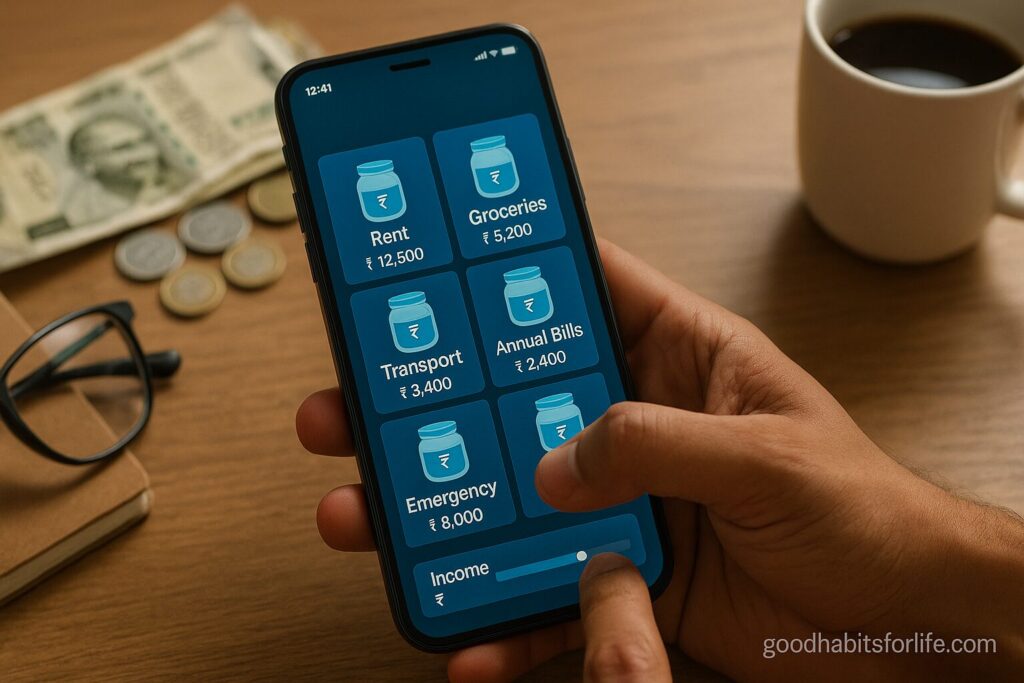
The classic cash-envelope system assigns each rupee to a purpose before you spend it. “Envelope Budget 2.0” does the same thing with digital jars (sometimes called pots, buckets, or spaces) inside your bank/app. You pre-divide income into jars—Rent, Groceries, Transport, Annual Bills, Emergency, Goals—then spend only from the relevant jar.
Why it works (the science):
-
Mental accounting. Humans naturally track money in categories; separating funds reduces impulse leakage between categories. Digital jars harness that tendency. Wiley Online Library
-
Partitioning/earmarking boosts saving. When money is split into sub-accounts, people save more and stay on plan. ResearchGate
-
Healthy payment friction. Abstract payments (credit/cards, tap-to-pay) feel “less painful,” which can nudge overspending; jars re-introduce a visible cap. SpringerLink
-
Budgeting improves financial control & well-being. Evidence and policy guidance link budgeting/savings behaviors to better outcomes. consumerfinance.govfiles.consumerfinance.govgpfi.org
✅ Quick Start: Set Up Your Jars in 15 Minutes
Before you begin: list fixed bills and typical monthly spends (rent, utilities, groceries, transport, phone, subscriptions) plus sinking funds (annual insurance, festivals/holidays, repairs) and goals (emergency, travel, education).
Step-by-step
-
Pick your home base. Choose a bank/account or budgeting app that lets you create sub-accounts/jars and schedule automatic transfers. (Many banks support “buckets/pots/spaces.”) Ally
-
Create 5–8 jars to start: Essentials (Rent/EMI, Utilities), Groceries, Transport, Spending, Annual Bills, Emergency, Goals. Keep it simple.
-
Name & cap each jar. Give each jar a monthly amount (₹) based on your past 1–3 months of spending; refine later. Use round numbers. consumerfinance.gov
-
Automate payday. Set standing orders so, on payday, money flows from main account → jars. “Pay yourself first” (Emergency + Goals) before anything else. consumerfinance.gov+1
-
Route cards to the right jar. Link your debit card/UPI to Spending (optional: separate card for Groceries).
-
Weekly 10-minute check. Top up underfunded jars, skim surplus to Goals, and zero out “Spending” every week.
-
Monthly review. Adjust jar amounts by +/-10% based on reality; re-set for next month. files.consumerfinance.gov
📅 30-60-90 Day Habit Plan
Days 1–30 (Build the rails)
-
Create jars and automate transfers.
-
Track daily in-app; do the Weekly 10 every Sunday.
-
Micro-win: hit ₹2,000 in Emergency (or your local equivalent). Vanguard Corporate
Days 31–60 (Tighten the fit)
-
Add Sinking Funds (insurance, school fees, car maintenance, festivals/holidays).
-
Introduce a “Buffer” mini-jar (3–5% of income) for tiny surprises.
-
If an envelope runs dry, pause or move from non-essential jars—don’t borrow from rent.
Days 61–90 (Scale & protect)
-
Increase Emergency toward 1–3 months of expenses, automated. Utah State University Extension
-
Add Goal jars (education/travel/home upgrades) with target amounts & dates. Ally
-
Review card settings: keep tap-to-pay tied to Spending only to preserve friction. SpringerLink
Checkpoints:
-
30-day: all transfers run automatically.
-
60-day: no mid-month panic; annual bills funded.
-
90-day: emergency jar growing each month.
🛠️ Techniques & Frameworks That Make It Stick
1) Implementation intentions (If-Then planning).
Write tiny rules: “If it’s payday at 09:00, then transfer ₹X to Emergency.” These cue-based plans turn intentions into action, especially for unpleasant tasks (like reducing discretionary spend). kops.uni-konstanz.deSPARQ
2) The 50-30-20 or Zero-Sum overlay.
Use 50% Needs, 30% Wants, 20% Saving as a sanity check—or give every rupee a job so jars sum to take-home (zero-sum). consumerfinance.gov
3) Earmarking + partitioning.
Keep annual/irregular costs in separate jars; people save more when money is visually partitioned and specifically labeled. ResearchGate
4) Friction where it matters.
Tap-to-pay and credit reduce the “pain of paying.” Keep those tied to a controlled jar so limits are salient. SpringerLink
5) Automatic savings boosters.
Standing orders and round-ups remove willpower from the loop; “set and forget” improves consistency. consumerfinance.gov
6) Financial literacy + digital literacy.
Budgeting and planning behaviors drive resilience—especially in a digital finance world. gpfi.org
👥 Audience Variations
Students: Use 4 core jars (Rent/Hostel, Food, Transport, Study/Fees) + Micro-Emergency. Time transfers to stipend arrival. consumerfinance.gov
Parents: Add Sinking Funds for school fees, healthcare, birthdays, holidays; automate months ahead.
Professionals with variable income (freelancers/sales): Create Income Smoothing jar holding last month’s average; pay yourself a fixed “salary” monthly.
Seniors: Prioritize healthcare, medicines, utilities; automate bill jars to prevent missed payments; keep emergency liquid.
Teens (with allowance): 3 jars (Spend/Save/Give) teach partitioning early.
⚠️ Mistakes & Myths to Avoid
-
Too many jars. Start with 5–8; complexity kills habits.
-
No plan for annual/irregular bills. Always add Sinking Funds.
-
Treating credit like income. Jars won’t save you if you overspend on credit; limit to Spending jar. SpringerLink
-
Failing to automate. Without automatic transfers, jars become wishful thinking. consumerfinance.gov
-
Never adjusting. Prices and needs change; review monthly. consumerfinance.gov
-
Skipping emergency savings. Even a small cushion materially improves well-being. Vanguard Corporate
💬 Real-Life Scripts & Rules You Can Copy
Payday rule (If-Then):
-
IF salary lands, THEN instantly move: Rent 30%, Groceries 12%, Transport 6%, Spending 12%, Annual Bills 10%, Emergency 10%, Goals 20%. kops.uni-konstanz.de
Overspend guardrail:
-
IF Spending jar < ₹500 mid-week, THEN pause eating out and move ₹300 from Fun → Groceries only.
Subscription control:
-
Keep streaming/music in Annual Bills; renewals paid only from that jar. If empty, cancel/downgrade.
Refund & windfalls:
-
50% to Emergency, 30% Debt Pay-down, 20% Fun (so you still enjoy some of it).
🧰 Tools, Apps & Resources (Pros/Cons)
You can implement jars with banks that offer buckets/pots/spaces or with budgeting apps that simulate envelopes.
| Tool/App | Type | Best for | Pros | Cons |
|---|---|---|---|---|
| Bank with “buckets/pots/spaces” (e.g., “savings buckets”) | Bank feature | Simple automation in one account | Native jars, easy transfers, goal targets | Feature depth varies by bank Ally |
| Goodbudget / YNAB / Monefy | Budgeting apps | Detailed envelope rules | Clear category caps, reports | Separate from bank; manual sync for some |
| Round-up or Auto-transfer features | Bank/app feature | “Pay yourself first” | Set-and-forget savings | May need minimum balances consumerfinance.gov |
| University/Extension resources | Education | Learning the basics fast | Free, unbiased guides | DIY effort required Utah State University Extension |
📌 Key Takeaways
-
Pre-decide where your money lives; jars are mini-budgets that protect priorities. Wiley Online Library
-
Automate everything on payday; manual willpower is a weak link. consumerfinance.gov
-
Partition irregular costs with sinking funds so “surprises” stop being surprises. ResearchGate
-
Keep friction on discretionary spend by limiting cards to the Spending jar. SpringerLink
-
Build emergency savings first; even small amounts make life noticeably less stressful. Vanguard Corporate
❓ FAQs
1) Are digital envelopes as effective as cash?
Yes—humans mentally budget; digital partitioning recreates the effect of cash envelopes while adding automation and guardrails. Wiley Online Library
2) How many jars should I start with?
Five to eight. Too many increases friction; you can add more later.
3) What if my income is irregular?
Use an Income Smoothing jar to pay yourself a fixed monthly “salary,” topping it up when months are strong.
4) Do I need multiple bank accounts?
Not necessarily. Many banks now offer sub-accounts or “buckets” within one account. Ally
5) How do I handle annual expenses (insurance, school fees, holidays)?
Create separate sinking-fund jars and automate a monthly amount so the total is ready by the due date. Partitioning increases success. ResearchGate
6) Should I use credit cards with jars?
If you do, tie card spending to a capped “Spending” jar to preserve friction; cards can otherwise nudge higher willingness-to-pay. SpringerLink
7) Does budgeting really reduce stress?
Budgeting and savings behaviors are associated with better financial well-being; small cushions help a lot. files.consumerfinance.govVanguard Corporate
8) I tried budgeting before and quit. What’s different here?
Automation + If-Then rules reduce effort; jars make limits visible and concrete. kops.uni-konstanz.de
📚 References
-
Consumer Financial Protection Bureau (CFPB). Budgeting: How to create a budget and stick with it. consumerfinance.gov
-
Thaler, R. H. (1999). Mental Accounting Matters. Journal of Behavioral Decision Making. Wiley Online Library
-
Gollwitzer, P. M. (1999). Implementation Intentions: Strong Effects of Simple Plans. American Psychologist. kops.uni-konstanz.de
-
Prelec, D., & Simester, D. (2001). Always Leave Home Without It: A Further Investigation of the Credit-Card Effect on Willingness to Pay. Marketing Letters. SpringerLink
-
CFPB. Looking for an easy way to save money? Make it automatic. (automatic transfers). consumerfinance.gov
-
Utah State University Extension. Create a Budget and Pay Yourself (budgeting & saving resources). Utah State University Extension
-
G20/OECD-INFE. Supporting Financial Resilience through Digital Financial Literacy. (budgeting & digital skills). gpfi.org
-
Vanguard Research (2024). The relationship between emergency savings, financial well-being, and financial stress. Vanguard Corporate
-
CFPB. Evidence-based strategies to build emergency savings. files.consumerfinance.gov
-
Ally Bank. Savings Buckets and Boosters (example of bank bucket features). Ally
Disclaimer: This article provides general educational information and is not financial advice; consider speaking with a qualified adviser for your specific situation.