
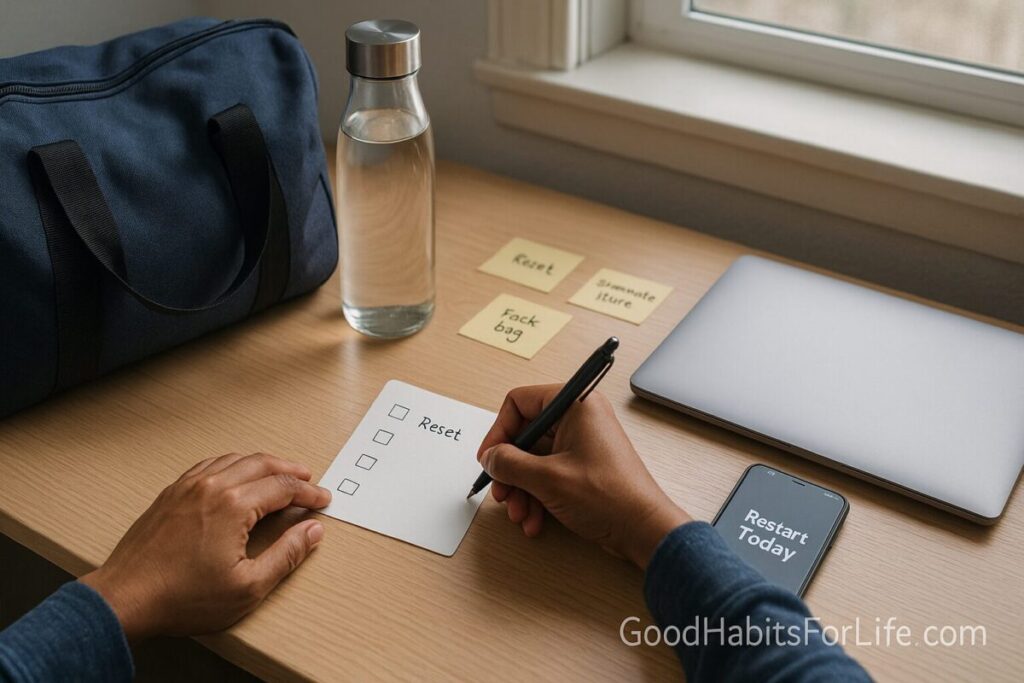
Motivation Dips: A Restart Protocol
Motivation Dips: A Restart Protocol
Table of Contents
🧭 What Are Motivation Dips & Why They Happen
Motivation dip = a temporary drop in energy, desire, or follow-through—even for goals you care about. It is normal, cyclical, and influenced by:
-
Friction & context: tiny barriers (app logins, cluttered desk, no gym bag packed) stall action.
-
Depleted attention: stress, sleep debt, and decision fatigue reduce initiation energy.
-
Value misfit: when tasks feel controlled, pointless, or isolating, motivation fades.
-
Expectations & reward timing: distant rewards lose their pull; immediate, visible progress sustains behavior.
You don’t need more willpower; you need a restart design that reduces friction, makes progress obvious, and reconnects the work to what matters.
✅ The RESTART Protocol (step-by-step)
A practical sequence you can run any time momentum slips.
R — Recognize (data, not drama)
-
Name it: “I’m in a dip.”
-
Check the last 7 days: What did happen (not why you “failed”)? Which day was the last successful rep?
-
Choose one habit to restart (not five).
E — Exhale & Equalize
-
60 seconds of physiological sighs or box breathing to calm noise.
-
Adopt self-compassion language: “Anyone dips. I can restart today.”
-
Decide to restart from where you are, not where you “should be.”
S — Shrink the Target
-
Define the Minimum Viable Habit (MVH): the smallest version you won’t skip (e.g., 2 push-ups; write 50 words; 5 minutes of tidy-up).
-
Use the “too easy to fail” test—if it still feels hard, halve it.
T — Trigger & Time-box
-
Create a specific if-then plan: “If it’s 7:30, after tea, then I walk for 10 minutes.”
-
Time-box to 10 minutes to start; you can continue if you want.
A — Anti-Friction Setup
-
Prepare the first 30 seconds: open document, lay out clothes, pre-fill water bottle, pin the tab you need, silence one distracting app.
-
Move tools into the path (desk, bag, phone home-screen).
R — Reward & Record
-
Add a tiny immediate reward (tick on a wall calendar, playlist, short video, sticker with kids).
-
Track in one visible place; aim for streaks of 3, not infinity.
T — Tune & Tell
-
Every 7 days, review: keep, cut, or tweak the MVH.
-
Tell one person (buddy, family, or team channel) your plan + send a weekly progress snapshot.
Motto: “Lower the bar. Raise the consistency.”
🛠️ Quick Start: Fix Today in 10 Minutes
-
Pick one habit to restart (exercise, writing, studying, tidying).
-
Write your MVH (e.g., 10-minute walk).
-
If-Then: “If it’s 6:30 p.m., after dinner, then I walk around the block.”
-
Remove one barrier (shoes by door; doc open; timer ready).
-
Start a 10-minute timer—do only the MVH.
-
Check off + small reward (playlist, herbal tea, sticker).
-
Text your buddy: “Restart done ✅. Next slot: tomorrow 6:30 p.m.”
Time invested: ~10 minutes. Momentum gained: disproportionate.
🗺️ 7-Day Restart Plan
Goal: rebuild momentum with tiny, reliable wins.
| Day | Focus | What to do (≤15 min) |
|---|---|---|
| 1 | Commit small | Define MVH; set if-then; do one rep; mark a big ✔ on a physical calendar. |
| 2 | Remove friction | Prep tools the night before; place cues in the path; do MVH again. |
| 3 | Make it pleasant | Add music, scenic route, favorite pen, or a cozy spot; MVH + optional minute. |
| 4 | Stack it | Attach to a daily anchor (“after brushing teeth…”); share a 1-sentence update with your buddy. |
| 5 | Proof of progress | Track one metric (minutes, pages, sets); take a photo or screenshot as evidence. |
| 6 | Plan B | Write an if-then for disruption: “If I miss 6:30, then I’ll do 5 minutes at 8:45.” Execute MVH. |
| 7 | Review & adjust | Keep/cut/tweak; decide whether to expand by 10–20% next week or keep steady. |
Repeat weekly. Expansion is optional; consistency isn’t.
🧠 Techniques & Frameworks That Work
If-Then Planning (Implementation Intentions)
-
Script the exact cue and action: “If [situation], then I will [behavior].”
-
Works because it pre-decides and automates the response, slashing hesitation.
Habit Stacking
-
Piggyback on a stable anchor: “After I make coffee, I review my top 3 tasks.”
Temptation Bundling
-
Pair a must-do with a want-to (podcast only during walks; favorite playlist only during kitchen clean-up).
The 20-Second Rule
-
Make good habits 20 seconds easier (weights next to desk), and distractions 20 seconds harder (sign out of social media, move TV remote away).
Time-Boxing & The 10-Minute Rule
-
Commit to just 10 minutes. Most resistance melts after you start; stopping is allowed.
WOOP (Wish–Outcome–Obstacle–Plan)
-
Visualize the obstacle you’ll face tonight and write the if-then that defeats it.
Self-Determination Boosters
Align tasks with Autonomy, Competence, Relatedness:
-
Autonomy: give yourself choice (which route to walk, which chapter first).
-
Competence: track wins & celebrate small milestones.
-
Relatedness: do it with someone or report to someone.
👥 Variations for Different Audiences
Students
-
Use a fixed place and time for study sprints (e.g., library table at 17:00).
-
MVH: read 1 page or review 5 flashcards; often grows naturally.
Professionals
-
Guard a Focus 10 at the start of the day: 10 minutes before email to progress one high-value task.
-
Time-box deep work; keep a done-list for visible progress.
Parents
-
Convert habits into family rituals: a 10-minute “reset” before dinner; sticker charts for shared streaks.
-
Use micro-prep at night to vanish morning friction.
Seniors
-
Prioritize gentle consistency (e.g., 10-minute walk, mobility routine).
-
Pair with social contact (neighbor call, group class) for relatedness.
Teens
-
Short, self-selected goals (autonomy).
-
Visible tracking (whiteboard in room) + fun rewards (playlist, game time).
⚠️ Mistakes & Myths to Avoid
-
All-or-nothing thinking: missing once doesn’t ruin momentum; plan a same-day Plan B.
-
Waiting for motivation: action often precedes motivation; design beats willpower.
-
Oversized restarts: restarting with the old peak invites another dip; start smaller.
-
Too many goals at once: restart one habit to re-build self-trust, then layer slowly.
-
Invisible progress: if you can’t see it, you’ll stop; make progress trackable and visible.
💬 Real-Life Examples & Copy-Paste Scripts
Exercise (after a long break)
-
If-Then: “If it’s 7:00 a.m., after brushing teeth, then I’ll do 5 minutes of walking outside.”
-
Anti-friction: shoes by door, playlist ready.
-
Reward: checkmark on wall calendar + favorite smoothie.
Writing
-
If-Then: “If it’s 20:00, after dishes, then I’ll write 50 words.”
-
Anti-friction: open doc + title the file earlier.
-
Reward: read 5 pages of a novel.
Studying
-
If-Then: “After afternoon tea, I’ll review 5 flashcards for chemistry.”
-
Anti-friction: deck pinned to home screen.
-
Reward: 5 minutes of a game.
Decluttering
-
If-Then: “After lunch, I’ll set a 10-minute timer and clear just the desk surface.”
-
Anti-friction: bin + cloth ready.
-
Reward: before/after photo to a friend group.
Team Productivity
-
If-Then: “After stand-up, we do 10 focused minutes on the week’s highest-impact task.”
-
Reward: quick wins shout-out in Friday recap.
🧰 Tools, Apps & Resources
-
Loop Habit Tracker (Android) — free, simple streaks; great for MVH. Con: Android-only.
-
Streaks (iOS) — visual streaks and reminders; Con: paid.
-
Google Calendar / Apple Calendar — reliable cues & time-boxes; Con: easy to ignore if cluttered.
-
Forest — stay-off-phone timer with playful trees; Con: less flexible for complex tasks.
-
Todoist — recurring tasks + sections; Con: can become another inbox.
-
Beeminder — commitment contracts; Con: overkill for small habits.
-
Analog wall calendar — cheapest visible tracker; Pro: dopamine from big ✔ marks.
Pick one tool. The best tracker is the one you’ll actually see daily.
📌 Key Takeaways
-
Normalize dips. They’re signals to redesign, not judgments of character.
-
Start tiny. MVH + 10-minute time-box beats grand plans.
-
Plan specifics. If-then scripts move you through the start.
-
Reduce friction first. Prepare the first 30 seconds.
-
Make progress visible & social. Track publicly with someone you trust.
-
Review weekly. Keep, cut, or tweak—and celebrate small wins.
❓ FAQs
1) How long does it take to feel momentum again?
Often 3–7 days of tiny daily wins are enough to feel the flywheel turning.
2) Should I rest first or restart immediately?
If you’re sleep-deprived or sick, rest is the restart. Otherwise begin with a 10-minute MVH today.
3) How small is “too small” for the MVH?
If you still feel resistance, halve it: from 10 minutes to 5; from 50 words to 25.
4) What if I keep relapsing?
Shorten the loop: daily MVH + Plan B if-then + visible tracking + weekly review. Consider social accountability.
5) Morning or evening—when is best?
Any time you can protect. Mornings offer fewer surprises for many; evenings may be better for night owls. Test for 7 days.
6) How do I rebuild after injury or illness (exercise)?
Get medical clearance if needed, then start with range-of-motion and low-intensity MVH; expand slowly.
7) Do streaks matter?
Short streaks (3–7) help re-ignite momentum. Don’t chase perfect streaks; chase today’s checkmark.
8) What if my environment is chaotic (kids, shift work)?
Use micro-windows (5–10 minutes), anchor to unavoidable routines, and keep a Plan B within 12 hours.
9) Can rewards backfire?
Extrinsic rewards can crowd out intrinsic motivation if misused. Use small, immediate, task-adjacent rewards plus visible progress.
10) Is motivation the goal?
No—systems are. Design a context where doing the right thing is the easy thing.
📚 References
-
Deci, E. L., & Ryan, R. M. (Self-Determination Theory overview). https://selfdeterminationtheory.org
-
Gollwitzer, P. M. (1999). Implementation intentions. American Psychologist. https://doi.org/10.1037/0003-066X.54.7.493
-
Oettingen, G. — WOOP method (official site). https://woopmylife.org
-
Milkman, K. L., Minson, J. A., & Volpp, K. G. (2014). Management Science — Temptation bundling. https://doi.org/10.1287/mnsc.2014.1901
-
Lally, P., et al. (2010). Habit formation in the real world. European Journal of Social Psychology. https://doi.org/10.1002/ejsp.674
-
Fogg, B. J. — Behavior Model (official). https://behaviormodel.org
-
Duckworth, A. L. & Gross, J. J. (2014). Self-control & grit. Psychological Science in the Public Interest. https://doi.org/10.1177/1529100614540652
-
American Psychological Association — Self-compassion & behavior change (Topic page). https://www.apa.org/topics/mindfulness/self-compassion
Disclaimer
This article is for general education on behavior change and habit design and is not medical, mental-health, or professional advice.