
Goal Setting 2025: Outcome vs Identity
Goal Setting 2025: Outcome vs Identity
Table of Contents
🧭 What “Outcome vs Identity” Really Means
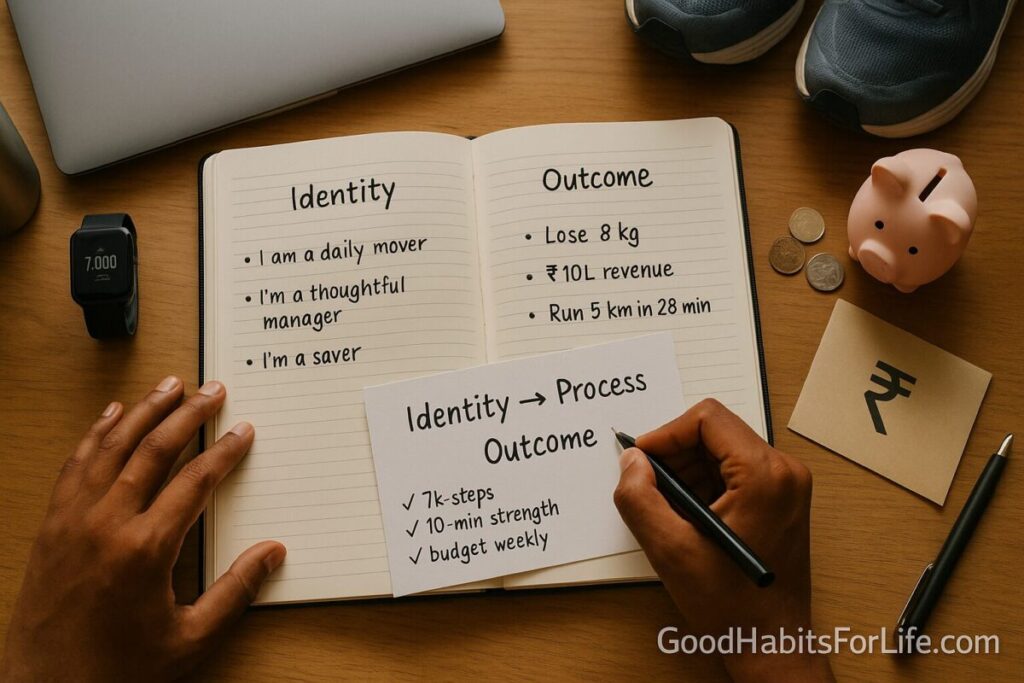
Outcome goals focus on results: “Lose 8 kg,” “Hit ₹10L revenue,” “Run 5 km in 28 minutes.”
Identity goals focus on who you are becoming: “I’m a person who trains daily,” “I’m a thoughtful manager,” “I’m a saver.”
Why identity first?
-
Results are lagging indicators. Behavior—the thing you do today—is the leading indicator.
-
When the behavior affirms your identity, you’re more likely to repeat it.
-
Outcomes still matter; they become milestones you measure, not the thing you are.
A simple formula
Identity → Process → Outcome
“I am a daily mover → I walk 7k steps and do 10-min strength daily → I reduce body fat and feel energized.”
🧠 The Science Behind Identity-Based Goals
-
Goal-Setting Theory: Specific, challenging goals boost performance—especially with feedback and commitment (Locke & Latham).
-
Self-Determination Theory: Habits stick when they satisfy autonomy, competence, and relatedness (Deci & Ryan).
-
Implementation Intentions: “If situation X, then I will do behavior Y” dramatically increases follow-through (Gollwitzer).
-
Habit Loop: Cue → routine → reward. Design the cue and immediate reward to make repetition easy.
-
Growth Mindset: Viewing ability as improvable supports persistence and skill acquisition (Dweck).
-
Temptation Bundling & Commitment Devices: Pair a wanted behavior with a treat (Milkman) and use stakes/pledges to prevent drift.
Takeaway: Identity gives meaning; plans give reliability; feedback gives improvement.
✅ Quick Start: Do This Today
-
Pick one identity statement (present tense, specific):
-
“I’m a consistent writer.”
-
“I’m a daily exerciser.”
-
“I’m a calm, clear communicator.”
-
-
Define a 2-minute anchor habit that proves it daily:
-
Writer → “Open my draft and write 50 words after tea.”
-
Exerciser → “10 body-weight squats before shower.”
-
Communicator → “3-minute daily check-in note to my team.”
-
-
Write one if-then plan (implementation intention):
-
“If it’s 7:30 a.m. at my desk, then I’ll write 50 words.”
-
-
Set one environment tweak (make it obvious/easy):
-
Lay out shoes, pin a sticky with your if-then, keep notes app open.
-
-
Track behavior, not outcome (checkbox or streak):
-
One line per day: ✅/❌ + optional 1 sentence.
-
-
Schedule a weekly 10-minute review (same day/time):
-
Keep/kill/tweak: What worked? What’s the next tiny upgrade?
-
🗺️ The 30-60-90 Identity Roadmap (with checkpoints)
Goal: lock an identity habit first; add difficulty after it’s automatic.
Days 1–30 — Identity Proof
-
Daily: do the 2-minute anchor (non-negotiable).
-
If-Then: one clear time/place trigger.
-
Environment: remove friction (e.g., pre-fill water bottle, open doc template).
-
Checkpoint (Day 30): ≥24/30 days completed? If yes, graduate. If not, keep at this level for 2 more weeks.
Days 31–60 — Process Build
-
Upgrade once per week (not daily):
-
Writer: +50 words per week (50 → 100 → 150…).
-
Exerciser: +2 minutes or +1 set per week.
-
-
Feedback loop: brief weekly reflection; one metric chart (e.g., minutes, sessions).
-
Checkpoint (Day 60): ≥10% improvement from Day-30 baseline and ≥80% adherence.
Days 61–90 — Outcome Alignment
-
Introduce one outcome metric that reflects the identity:
-
Fitness: total minutes/week, consistent 7k–9k steps, or form quality.
-
Work: weekly deep-work hours, shipped tasks, or customer calls.
-
-
Accountability: peer or team share once per week (screenshot/log).
-
Checkpoint (Day 90): Identity feels natural, process runs with low friction, outcome trend is up. Decide: stabilize or set a fresh outcome target with a new 30-day identity proof.
🛠️ Techniques & Frameworks That Work in 2025
SMART → SMARTER (add Evaluate & Refine)
-
Specific | Measurable | Achievable | Relevant | Time-bound | Evaluate weekly | Refine monthly
FAST goals (great for teams)
-
Frequent discussions, Ambitious, Specific metrics, Transparent dashboards.
Implementation Intentions (if-then)
-
“If I finish lunch, then I will walk 10 minutes.”
-
“If I open Slack at 9:30, then I’ll send one recognition note.”
Habit Stacking
-
“After I brew coffee, I’ll do 1 minute of mobility.”
-
“After standup, I’ll plan my top 3 tasks.”
Temptation Bundling
-
Only listen to your favorite podcast while walking.
-
Watch a show only on the stationary bike.
Environment Design
-
Default printer to duplex (save paper identity: I’m a careful steward).
-
Keep fruit at eye level; hide ultra-processed snacks.
Commitment Devices
-
Deposit on StickK/Beeminder; peer pledges; public weekly scorecards.
OKRs for identity scaling
-
Objective: Become a “reliable teammate.”
-
Key Results: 90% tasks done by due date; 1 proactive risk flagged/week; 2 peer assists/month.
🧩 Audience Variations
Students
-
Identity: “I’m a steady learner.”
-
Anchors: 20-minute focus blocks after class; flashcard review on commute.
-
Outcome: weekly quiz scores, assignment on-time rate.
Professionals/Workplace
-
Identity: “I’m an essentials-first operator.”
-
Anchors: plan Top 3 by 9:45; 60 minutes deep work before meetings.
-
Outcome: shipped deliverables, fewer context switches.
Parents
-
Identity: “I’m a calm, connected parent.”
-
Anchors: 10-minute 1:1 each evening; Sunday logistics huddle.
-
Outcome: reduced morning friction, consistent routines.
Seniors
-
Identity: “I’m an active, social walker.”
-
Anchors: 15-minute morning walk; call a friend after lunch.
-
Outcome: step counts, mood/energy notes.
Teens
-
Identity: “I’m a respectful self-starter.”
-
Anchors: 10-minute room reset; homework timer before scrolling.
-
Outcome: completed assignments, fewer screen conflicts.
⚠️ Mistakes & Myths to Avoid
-
Myth: “If I set big outcomes, I’ll stay motivated.”
Reality: Big targets without daily wins create failure loops. -
Myth: “Identity is fluffy.”
Reality: It’s a behavioral prime. Each repetition is a vote for the type of person you are. -
Mistake: Upgrading too fast.
Fix: Upgrade weekly at most; never break the chain. -
Mistake: Relying on willpower at the hardest time of day.
Fix: Front-load important habits; use if-then for known friction points. -
Mistake: Tracking only scale/revenue numbers.
Fix: Track inputs (minutes, sets, drafts); outcomes will lag but follow.
💬 Real-Life Examples & Copy-Paste Scripts
1) Exercise identity
-
Identity: “I’m a daily mover.”
-
If-Then: “If it’s 7:00 a.m., then I’ll do 10 squats + 10 pushups.”
-
Weekly Upgrade: add 1 set on Mondays.
-
Micro-reward: mark a ✅ on the wall calendar and make tea.
2) Writing identity
-
Identity: “I’m a consistent writer.”
-
If-Then: “If I open my laptop after breakfast, then I’ll write 50 words.”
-
Weekly Upgrade: +50 words.
-
Accountability: send Friday draft snippet to a friend.
3) Manager identity
-
Identity: “I’m a clear, caring manager.”
-
If-Then: “If it’s 9:30, then I’ll post the day’s priorities.”
-
Weekly Upgrade: one quality 1:1 per direct report.
-
Metric: % of tasks clarified before noon.
Self-Talk Reframes
-
“I missed two days → I’m the kind of person who returns quickly.”
-
“I’m tired → Just start for 2 minutes, then decide.”
Environment Scripts
-
“Before sleep, place shoes by door + water bottle filled.”
-
“Pin the if-then card near the kettle/monitor.”
🧰 Tools, Apps & Resources
| Tool | Best For | Pros | Cons |
|---|---|---|---|
| Google Calendar | If-then time anchors | ubiquitous, reminders | easy to overbook |
| Todoist / Things | Daily anchors & streaks | quick capture, filters | lists can balloon |
| Notion / Obsidian | Identity dashboards | templates, backlinks | setup time |
| Streaks / Habitify | Simple habit tracking | streak view, widgets | limited analytics |
| Beeminder / StickK | Commitment devices | real stakes | anxiety for some |
| Forest / Freedom | Deep work blocks | reduces distractions | needs discipline |
| Apple Health / Google Fit | Activity basics | auto-tracking | noisy data |
| Wearables (Garmin, Fitbit) | Consistency trends | heart-rate, VO₂ est. | cost, calibration |
Tip: Create one “Identity Board” in Notion with: identity statement, if-then, anchor habit, weekly reflection, and a simple input metric.
📌 Key Takeaways
-
Lead with identity, operationalize with if-then, and measure inputs.
-
Keep anchors tiny and daily; upgrade weekly, not daily.
-
Use environment design and accountability to outlast motivation dips.
-
Review weekly; every repetition is a vote for your identity.
-
After 60–90 days, layer outcome metrics—don’t start there.
❓ FAQs
1) Should I completely ignore outcome goals?
No—use them as compasses and dashboards. Identity + process create the behaviors; outcomes verify the direction.
2) How small should the first habit be?
Small enough to do even on bad days (≈2 minutes or one easy set). If you miss it, it’s too big.
3) What if my environment is chaotic (kids, shifts)?
Use portable anchors (e.g., after brushing teeth, during commute). Make two if-then plans: Plan A (ideal) and Plan B (backup micro-version).
4) How long until the habit feels automatic?
Varies widely; research suggests ranges from ~18 to 254 days. Focus on consistency over the calendar; your 30-60-90 plan creates stability.
5) How do I pick a reward?
Use immediate, modest rewards (tick mark, brief stretch, playlist). The reward should not undermine the identity (e.g., avoid junk-food rewards for fitness).
6) Can I run multiple identity goals at once?
Start with one. Add a second only after ≥80% adherence for 30 days.
7) What if I’m already very outcome-driven at work?
Translate outcomes into behavioral inputs you control (calls, drafts, code reviews). Keep outcomes as review metrics, not daily drivers.
8) How do I avoid “all-or-nothing” thinking?
Write a restart script: “When I miss, I return within 24 hours with the smallest version.”
📚 References
-
Locke, E. A., & Latham, G. P. (2002). Building a practically useful theory of goal setting and task motivation. American Psychologist. https://doi.org/10.1037/0003-066X.57.9.705
-
Gollwitzer, P. M. (1999). Implementation intentions: Strong effects of simple plans. American Psychologist. https://doi.org/10.1037/0003-066X.54.7.493
-
Deci, E. L., & Ryan, R. M. (2000). The “what” and “why” of goal pursuits: Human needs and the self-determination of behavior. Psychological Inquiry. https://selfdeterminationtheory.org
-
Dweck, C. S. (2006/2016). Mindset: The New Psychology of Success. (Research summaries at Stanford). https://mindset.stanford.edu
-
Wood, W., & Rünger, D. (2016). Psychology of habit. Annual Review of Psychology. https://doi.org/10.1146/annurev-psych-122414-033417
-
Milkman, K. L., Minson, J., & Volpp, K. (2014). Holding the Hunger Games Hostage… Temptation bundling. Management Science. https://doi.org/10.1287/mnsc.2013.1784
-
Lally, P., van Jaarsveld, C., Potts, H., & Wardle, J. (2010). How are habits formed: Modelling habit formation in the real world. European Journal of Social Psychology. https://doi.org/10.1002/ejsp.674
-
Fogg, B. J. (2019). Tiny Habits. (Stanford behavior model resource). https://behaviormodel.org