
HabitStacking Exercise with Coffee in 2025: Ai-Assisted Tactics
Habit-Stacking Exercise with Coffee (2025): AI Tactics
Table of Contents
🧭 What Is “Coffee × Exercise” Habit-Stacking & Why It Works
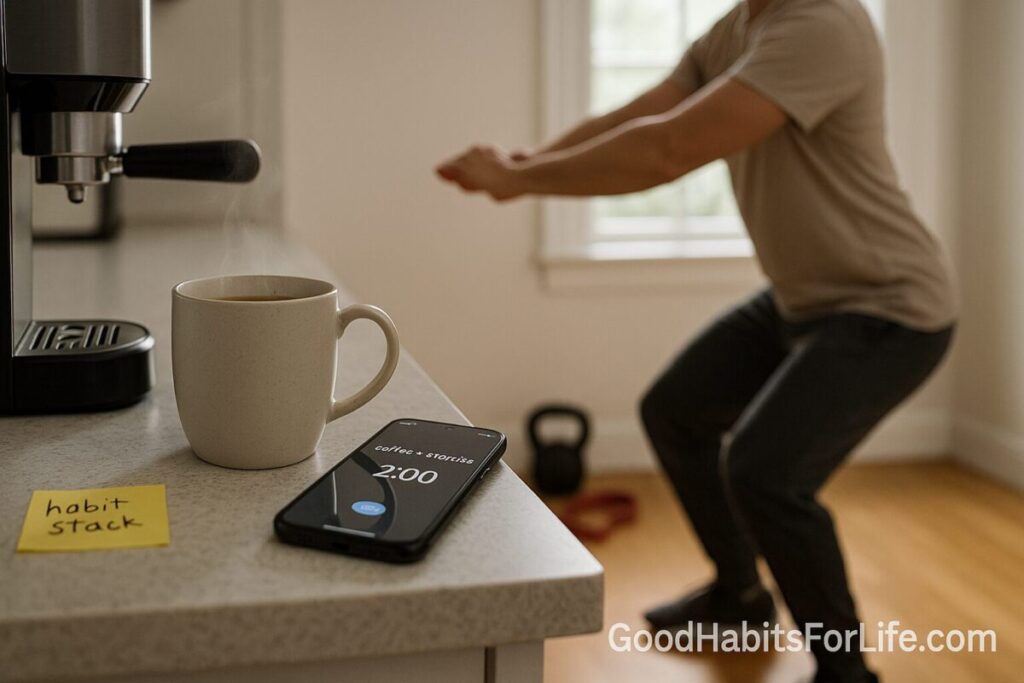
Habit-stacking means attaching a new behavior to an existing, reliable cue. Your daily coffee is a perfect “anchor.” When the kettle boils or the espresso machine whirs, you perform a tiny, repeatable movement routine (e.g., 2 minutes of mobility or 20 slow air squats). Over time, the cue–routine link becomes automatic, reducing willpower needs and decision fatigue—exactly how habit psychology predicts habits form (context cue → automatic response).
Why pair with coffee?
-
Reliable cue: Most coffee drinkers prepare or buy coffee at predictable times.
-
Physiology: Caffeine can acutely improve alertness and exercise performance in many people, especially for endurance and high-effort tasks.
-
Workday fit: Coffee breaks are socially acceptable, short, and frequent—ideal for “exercise snacks.”
-
Sedentary offset: Micro-bouts of movement break up sitting, which benefits glucose and insulin responses and reduces stiffness.
Evidence snapshot
-
Regular physical activity lowers risk of NCDs and improves mental health.
-
Caffeine (for most adults) up to ~400 mg/day is generally considered safe; many performance studies use ~3–6 mg/kg taken ~60 minutes pre-exercise.
-
Habit formation research shows consistent context cues and repetition are key; many everyday habits solidify over weeks to months.
✅ Quick Start: Do-This-Today Setup
Goal: Lock in one 2–5-minute exercise snack with your first coffee of the day.
-
Choose your micro-routine (2–5 min):
-
Option A (Mobility): Neck circles ×20s → Shoulder CARs ×30s → Hip hinges 10 → Calf raises 15 → Spine rotations ×30s.
-
Option B (Strength): Air squats 10–20 → Counter push-ups 8–12 → Split squats 6/leg → Plank 20–40s.
-
Option C (Cardio-ish): March in place 60s → Step-ups 10/leg → Jumping jacks 15 (or low-impact jacks 20).
-
-
Place the cue: Put a sticky note on your mug: “Coffee = 3-minute Move.” Keep resistance band near the kettle.
-
Set a friction-free timer: Start a 3-minute phone timer when water boils. Move until it ends.
-
Log it once: Check one box on a printed habit card or in a notes app. (No perfectionism; just a tick.)
-
Fail-safe: If you buy coffee outside, do the “doorway drill”: 20 calf raises while you wait; wall push-ups before you sit.
🛠️ 7-Day Starter & 30-60-90 Roadmap
7-Day Starter (single coffee pairing)
-
Day 1–2: 2 minutes of mobility with first coffee.
-
Day 3–4: 3 minutes; add 1 easy strength move (e.g., 10 chair squats).
-
Day 5–6: 4–5 minutes; include a 20–40s plank or wall sit.
-
Day 7: Review your log. If ≥5/7 success, advance; otherwise repeat this week.
30-60-90 Habit Roadmap
-
Days 1–30 (Consistency > intensity): One micro-routine with first coffee daily. Goal: 24+/30 completions.
-
Days 31–60 (Double anchor): Add routine with mid-morning or post-lunch coffee/tea 3–5 days/week.
-
Days 61–90 (Personalization):
-
Strength focus: Progress reps or add a light band.
-
Cardio focus: Insert 60–90s brisk stair climbs or step-ups.
-
Mobility focus: Add thoracic/hip flows and 1–2 long (45–60s) holds.
-
-
Checkpoints: Every 30 days, re-assess: energy, mood, steps/day, stiffness, and sleep quality.
🤖 AI-Assisted Tactics (Prompts, Automations, Tracking)
Why AI? It reduces planning friction, builds variety, and triggers the routine at the right moment—even on busy days.
1) Prompt Packs (copy-paste)
-
Daily plan: “Create 3 different 3-minute micro-workouts I can do next to my desk with no equipment. I have mild knee pain; keep impact low. Include reps/times.”
-
Progression: “Turn this week’s micro-workouts into a 4-week progression adding small difficulty each week. Keep each under 5 minutes.”
-
Mobility focus: “Design a 5-minute mobility snack for neck/shoulders/hips after long computer sessions. Keep it office-friendly.”
-
Travel day: “I’m at an airport with 10 minutes. Give me a quiet, space-efficient routine—no floor work.”
2) Automations you can set in 10 minutes
-
Phone Shortcuts / Routines:
-
Trigger: “When I stop a 4-minute coffee timer” → Action: Start a 3-minute “Move Now” timer and display today’s micro-routine note.
-
NFC trick: Stick an NFC tag on your mug; scanning starts your “Move Now” timer and opens your micro-routine checklist.
-
-
Calendar nudges: Event titled “☕→🏃 3-min Move” at typical coffee time; include the micro-routine in the description.
-
Smart speaker: “When I say ‘Coffee time,’ read out today’s micro-routine and start a 3-minute countdown.”
-
Work chat: Auto-post to a private Slack channel: “Coffee’s on—3-minute mobility now.”
3) Tracking & feedback
-
Micro-streak board: AI logs your completion and shows a weekly streak (Mon–Sun) with green dots.
-
Auto-titration: If you miss 2 days, AI swaps in a lighter routine (pure mobility) for the next 3 days.
-
Form tips: Upload a quick video; get AI pointers (“knees track over toes,” “neutral spine”).
Privacy note: store only what you’re comfortable with; avoid recording sensitive health data in shared workspaces.
🧠 Timing, Dosage & Safety of Caffeine
General guidance (adults):
-
Many guidelines consider ≤400 mg/day caffeine safe for most healthy adults. That’s roughly up to ~4 small cups of brewed coffee (240 ml/8 oz each), but caffeine content varies widely.
-
Timing for exercise: Performance studies often use ~3–6 mg/kg caffeine ~60 minutes pre-exercise; smaller doses (e.g., 1–3 mg/kg) can still help some people and may reduce jitters.
-
Cut-off time: Avoid caffeine 6–8 hours before bedtime to protect sleep.
-
Pregnancy: Limit to ≤200 mg/day; discuss with your clinician.
-
Sensitivity & conditions: If you have arrhythmias, uncontrolled hypertension, anxiety disorders, GERD, or are on interacting meds, consult your clinician and consider decaf pairing (habit works even without caffeine).
Approximate caffeine (per serving)
| Beverage (typical) | Caffeine (mg) |
|---|---|
| Brewed coffee 240 ml (8 oz) | 80–120 |
| Espresso 30 ml (1 oz) | 60–75 |
| Black tea 240 ml (8 oz) | 40–70 |
| Green tea 240 ml (8 oz) | 20–45 |
| Cola 355 ml (12 oz) | 30–40 |
| Energy drink 250 ml (8.4 oz) | 70–80 |
Values vary by brand and brew; check labels.
👥 Audience Variations
-
Students: Use campus coffee lines as cues. Do low-impact sets (wall angels, chair squats) between study blocks; protect sleep by skipping evening caffeine.
-
Professionals: Pair with morning stand-up or calendar coffee slots. Add back-friendly mobility (hip flexor stretch, thoracic rotations).
-
Parents: Nap-time coffee → 3-minute “quiet” routine (glute bridges, dead bugs). Baby-wearing? March-in-place and calf raises.
-
Seniors: Prioritize balance and joint-friendly moves: sit-to-stand, heel-to-toe walks, wall push-ups. Consider decaf; focus on mobility and light strength.
-
Teens: Replace energy drinks with tea or water when possible; keep routines playful (shadow boxing, dance jacks). Guard sleep strictly.
⚠️ Mistakes & Myths to Avoid
-
Going too hard, too soon: Micro-workouts should feel easy-to-complete—you’re training the habit, not maxing out.
-
Caffeine creep: Stacking multiple coffees + energy drinks can exceed 400 mg/day quickly. Track intake.
-
Ignoring sleep: A stronger coffee won’t fix chronic sleep loss; late caffeine sabotages recovery.
-
All-or-nothing thinking: Missed a session? Do a 30-second reset (neck, shoulders, calf raises) and move on.
-
“No coffee = no workout”: The habit pair is useful, but the movement stands on its own—use decaf or water if needed.
💬 Real-Life Scripts & Micro-Workouts
Scripts
-
At the kettle: “Water’s heating—starting my 3-minute hip & back reset now.”
-
At the café: “Before I sit, 15 wall push-ups and 20 calf raises.”
-
On a call: “Coffee poured—muting to do chair squats x15.”
Three rotating 3-minute routines (no equipment)
-
Desk Mobility:
-
Chin tucks 10 → Shoulder CARs 5/side → Thoracic rotations 20s/side → Calf raises 20.
-
-
Strength Lite:
-
Air squats 12 → Counter push-ups 10 → Split squats 6/leg → Plank 20–30s.
-
-
Cardio-Light:
-
March in place 60s → Step-ups 10/leg (or stairs) → Low-impact jacks 20.
-
Two 5-minute upgrades
-
Posterior Chain Fix: Hip hinge 12 → Glute bridge 12 → Good-morning (hands on hips) 12 → Hamstring sweep 30s/side → Calf stretch 30s/side.
-
Upper-Body Posture: Band pull-apart 15 → Wall slides 10 → Reverse fly (band) 12 → Doorway chest stretch 30s/side.
🧰 Tools, Apps & Resources
-
Timer/Shortcuts: Built-in phone timer, iOS Shortcuts / Android Routines.
-
Smart speakers: Alexa/Google Assistant countdowns.
-
Habit trackers: Streaks, Habitify, Loop.
-
Work chat nudges: Slack/Teams reminders to a private channel.
-
Bands & mini-equipment: Light resistance band; door anchor; compact step.
Pros: Remove planning friction; consistent triggers; visible streaks.
Cons: Over-automation can become noisy; adjust frequency to avoid alert fatigue.
📌 Key Takeaways
-
A reliable cue (coffee) + tiny movement = a sticky daily habit.
-
AI reduces friction: auto-generate routines, trigger timers, and track streaks.
-
For most adults, keep caffeine ≤400 mg/day and avoid late-day intake.
-
Start with one 2–5-minute routine, then scale to a second coffee cue after 30 days.
-
Personalize for joints, space, equipment, and energy; decaf works for the habit pattern too.
❓ FAQs
1) Does this work with tea or decaf?
Yes. The anchor is the ritual, not the stimulant. Tea or decaf provides the same cue without extra caffeine.
2) How long until this feels automatic?
Habits can take weeks to months to feel automatic. Consistency with the same cue accelerates the process.
3) What if coffee upsets my stomach?
Try eating first, switch to tea/decaf, or do the routine before coffee. If symptoms persist, speak with a clinician.
4) When is the best time to exercise relative to coffee?
For performance, many studies use caffeine ~60 minutes pre-exercise. For micro-routines, just move as you brew—the goal is consistency.
5) Is caffeine necessary to get benefits from exercise?
No. Exercise delivers benefits with or without caffeine.
6) How do I avoid evening sleep disruption?
Set a caffeine cut-off 6–8 hours before bed. Use decaf for late-day pairings.
7) Can I do “coffee × mobility” multiple times a day?
Yes, but watch total caffeine. Use decaf or water for second/third pairings.
8) Is this safe if I have high blood pressure or anxiety?
Talk to your clinician. You may use decaf or focus on gentle mobility to keep the habit while minimizing stimulation.
9) Will tiny routines actually matter?
Breaking up sitting and adding strength/mobility “snacks” can meaningfully improve comfort, readiness, and overall activity—especially when done daily.
10) Can AI actually help form habits?
It helps by reducing planning effort, providing timely prompts, and giving feedback. You still own the reps—but AI keeps them simple and consistent.
📚 References
-
World Health Organization. WHO Guidelines on Physical Activity and Sedentary Behaviour (2020). https://www.who.int/publications/i/item/9789240015128
-
U.S. Department of Health and Human Services. Physical Activity Guidelines for Americans, 2nd ed. (2018). https://health.gov/paguidelines/second-edition/
-
Centers for Disease Control and Prevention. Physical Activity Basics. https://www.cdc.gov/physicalactivity/basics/
-
NIH Office of Dietary Supplements. Caffeine — Fact Sheet for Health Professionals. https://ods.od.nih.gov/factsheets/Caffeine-HealthProfessional/
-
European Food Safety Authority (EFSA). Scientific Opinion on the safety of caffeine (2015). https://www.efsa.europa.eu/en/efsajournal/pub/4102
-
International Society of Sports Nutrition. Position Stand: Caffeine and Exercise Performance (2021). J Int Soc Sports Nutr. https://jissn.biomedcentral.com/articles/10.1186/s12970-021-00418-8
-
Grgic J., et al. Caffeine supplementation for improving exercise performance: An umbrella review of meta-analyses (2020). Sports Medicine. https://link.springer.com/article/10.1007/s40279-020-01295-0
-
Lally P., et al. How are habits formed: Modelling habit formation in the real world (2009). Eur J Soc Psychol. https://onlinelibrary.wiley.com/doi/10.1002/ejsp.674
-
Wood W., Rünger D. Psychology of Habit (2016). Annu Rev Psychol. https://www.annualreviews.org/doi/10.1146/annurev-psych-122414-033417
-
Dunstan D.W., et al. Breaking up prolonged sitting reduces postprandial glucose and insulin responses (2012). Diabetes Care. https://diabetesjournals.org/care/article/35/5/976/30416/
Disclaimer: This article provides general fitness and nutrition information and is not medical advice; consult your healthcare professional for personal guidance.