
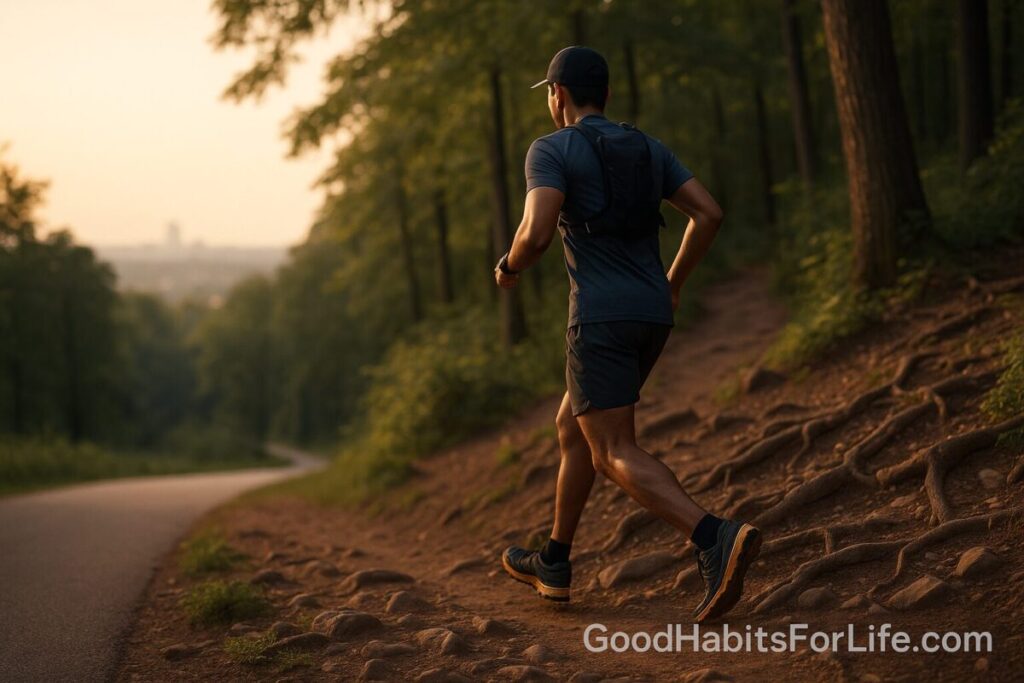
Trail Running for Road Runners
Trail running for road runners: a smart, safe upgrade
Table of Contents
🧭 What is trail running (and why road runners love it)
Definition. Trail running is running on unpaved, natural surfaces—park paths, forest roads, single-track—often with elevation changes, variable footing, and scenery you can’t get on pavement.
Why it helps road runners.
-
Lower monotony, higher enjoyment: varied terrain reduces repetitive loading and mental fatigue.
-
Strength & balance: uneven surfaces recruit stabilizers (hips, ankles, core) and slopes improve muscular endurance and eccentric control on descents. Reviews on uphill/downhill mechanics show distinct demands that can build capability when progressed sensibly. PubMedPMC
-
Cardio benefits: It’s still aerobic training. Meeting weekly activity targets on trails counts toward the same health benefits noted by WHO and U.S. guidelines. PubMedCDC
Mindset shift: On trails, pace becomes secondary. Judge efforts by time-on-feet and perceived exertion. Walking (“power-hiking”) steep sections is normal—and smart.
✅ Quick Start: Your first three trail outings
Prereqs: You can comfortably run 30–40 min on roads and have basic hydration sorted.
Outing 1 — Green-grade loop (45–60 min):
-
Pick a well-marked beginner trail (≤150 m elevation gain).
-
Effort: easy conversational. Hike any slope that raises breathing to moderate-hard.
-
Drills: short strides on flat dirt (4×15 s) + ankle/hip mobility post-run.
-
Safety: tell someone your route; carry water and a charged phone. NPS “Hike Smart” tips apply equally to trail runs. National Park Service+1
Outing 2 — Rolling terrain (50–70 min):
-
Add gentle ups/downs; practice short quick steps on rocky bits.
-
Technique: on downhills, shorten stride, keep cadence high, lean slightly forward from the ankles—never brake hard with a long heel-strike. Biomechanics research links downhill running to higher eccentric demand; control beats speed. PubMed
Outing 3 — Skills sampler (60–75 min):
-
Include: 10 min smooth single-track, 10 min moderate climb, 10 min controlled descent, 10 min dirt road.
-
Insert 4×2-min steady efforts on climbs; walk between if needed.
-
Post-run: easy calf/quad glute work (2×10 bodyweight eccentric squats; 2×20 calf raises).
🧠 30-60-90 Roadmap: From newbie to confident trail runner
Goal: Build trail skill, durability, and confidence while keeping road speed.
Days 1–30 (Foundation)
-
2 trail runs/wk + 2 road runs/wk.
-
Key session: 60–75 min easy trail (time-on-feet focus).
-
Hill practice: After warm-up, 4–6×60 s uphill hikes/run-walk, easy jog down.
-
Strength (2×/wk): single-leg RDLs, step-downs, lateral band walks (2–3 sets).
-
Safety habit: Pack the 10 essentials scaled for running (water, calories, map, light, layer, mini-first-aid, whistle, phone, sun/bug protection). NPS/ITRA stress planning and preparedness. National Park ServiceITRA
Days 31–60 (Skills & Stamina)
-
3 trail runs/wk + 1–2 road runs.
-
Key session: “Uphill economy” (20–30 min total of hill repeats at comfortable hard; hike when form degrades).
-
Descent technique block: 6–10 min continuous gentle downhill focusing on quick cadence and soft footfalls. Downhill work raises eccentric load; progress gradually. PMC
-
Long trail: 90 min easy, walk any steep grades.
-
Hydration checklist: Begin well-hydrated and drink according to thirst; avoid both dehydration and over-drinking. PubMed
Days 61–90 (Confidence & Specificity)
-
4 trail runs/wk + 1 road maintenance session.
-
Key session: “Progression trail”: last 20–30 min at steady effort on rolling terrain.
-
Technical skills: choose a rooty/rocky segment and practice foot placement at slow-moderate speed.
-
Long trail: 2–2.5 h easy, fueling every 30–40 min.
-
Optional tune-up: enter a local 10–15 km trail race or time trial on familiar routes—follow ITRA safety guidance for events (kit, self-care). ITRA
🛠️ Technique essentials: hills, descents, footwork, pacing
Uphills
-
Shorten stride; keep chest tall.
-
Run-walk strategy: 30–90 s run / 30–60 s hike on steeps to keep heart rate in check.
-
Plant poles only if terrain and goals justify them.
Descents
-
Slight forward lean from ankles; do not sit back.
-
Quicker cadence, smaller steps to reduce braking forces at the knee. PubMed
-
Train downhill sparingly at first. Downhill running is linked with higher muscle damage; volume and slope matter. PMC+1
Footwork & vision
-
Look 2–3 steps ahead; think “quiet feet.”
-
On rocks/roots: land mid-foot under hips; avoid big lateral leaps.
Pacing on trails
-
Use time and effort. For most easy runs: able to talk in full sentences.
-
Benchmark fitness by repeating the same loop rather than chasing road splits.
👟 Gear & shoes: what actually matters
Shoes:
-
Comfort first. Research supports choosing shoes that feel most comfortable; comfort tends to reduce injury risk and improve economy for many runners. British Journal of Sports MedicinePMC
-
Grip & protection: Look for lugs (3–5 mm) for mixed trails; rock plate if terrain is sharp.
-
Stability vs. “control”: Motion-control features may help some runners but are not universally protective; individual response varies. British Journal of Sports Medicine
-
Fit tips: secure midfoot/heel; thumb-width toe room; test on a short descent.
Other essentials:
-
Soft-flask vest or belt (carry 0.5–1.0 L for <90 min; more for heat/long runs).
-
Thin merino or technical socks; brimmed cap; light shell if weather shifts.
-
Minimal first-aid (blister kit, bandage, antiseptic wipe) and whistle.
🧭 Safety, navigation & wildlife
-
Plan & tell: Check weather, route, daylight, and share your plan. Use park guidance on hiking safety and bear country where relevant. National Park Service+1
-
Stay on marked trails and respect closures—safer for you and the environment. National Park Foundation
-
Hydrate & fuel: Start euhydrated and drink to thirst; on long/hot runs, include electrolytes and steady calories. PubMed
-
Wildlife: Make noise in dense vegetation; avoid dawn/dusk in bear areas; carry bear spray where recommended. Some parks discourage trail running in prime bear habitat due to surprise encounters—know local rules. Glacier National Park Conservancy
-
Navigation: Download offline maps; keep phone in airplane mode to conserve battery. Carry a small light if there’s any chance of dusk.
📈 Training mix: blending road + trail for performance
-
For 5–10 km road goals: 1 trail long run + 1 trail easy + 2 road quality (intervals/tempo).
-
For half-marathon or longer: 2–3 trail runs (including long and hill skills) + 1–2 road economy sessions.
-
Recovery: After heavy downhill days, schedule easy road or rest; DOMS peaks 24–72 h after eccentric loading. PMC
👥 Audience variations
Beginners: Start with 60–75 min easy trails weekly; add hill hikes instead of hard intervals.
Busy professionals: Use 45–55 min lunch-loop trails + one weekend long run; keep a car-kit (shoes, vest, light shell).
Seniors (65+): Same principles; add balance work and aim for guideline targets with 2 days strength + balance activities. CDC
Teens: Keep long runs modest; emphasize fun, skill circuits, and group safety.
⚠️ Mistakes & myths to avoid
-
Chasing road pace on trails. Different terrain = different demand.
-
Overdoing downhills early. Build eccentric tolerance gradually. PMC
-
Believing a shoe can “fix” your stride. Comfort and fit beat rigid “pronation control” for most. British Journal of Sports Medicine
-
Skipping hydration and calories on hot/long runs. Start hydrated; sip to thirst; bring simple carbs. PubMed
-
Going solo on remote routes without telling anyone. Follow park “Hike Smart” guidance. National Park Service
💬 Real-life scripts & checklists
Text to a friend before you go:
“Heading to [Trail Name] 5:15–6:45 pm. Route: 9 km loop, clockwise. If I’m not back by 7:30, please call me. Live location on.”
Passing hikers courteously:
“Hi! Two runners behind me as well—just a heads-up. Thanks!”
Micro-checklist (pocket-size):
-
Phone + ID + ₹/cash or card
-
0.5–1.0 L water + 1–2 gels/bars
-
Thin shell + cap/sunscreen
-
Small first-aid + whistle
-
Map app downloaded offline
🧰 Tools, apps & resources
-
AllTrails / Gaia GPS: route discovery and offline maps.
-
Strava / Coros / Garmin: effort and time-on-feet tracking; segment comparisons.
-
Local park websites / NPS pages: closures, wildlife alerts, and safety bulletins. National Park Service
-
ITRA resources: event checklists and safety guidance for longer outings. ITRA
📌 Key takeaways
-
Shift mindset from pace to time-on-feet and effort.
-
Comfortable, grippy shoes beat gimmicks; fit and terrain match matter most. British Journal of Sports Medicine
-
Build skill with short strides, hill hikes, and controlled descents.
-
Follow park safety and hydration basics; plan, tell, and carry essentials. National Park ServicePubMed
-
Use the 30-60-90 plan to progress without overuse injuries.
❓ FAQs
1) Can trail running replace my road speedwork?
Not entirely. Keep 1 road session for economy and turnover; do hills/longs on trails.
2) How do I pace when GPS is erratic under trees?
Use time and effort (talk test / RPE). Compare laps on the same loop rather than absolute pace.
3) Do I need poles?
Only for steep, sustained climbs or long ultras. They help power-hiking but add complexity.
4) Are minimalist shoes better for trails?
Not universally. Evidence suggests comfort-driven selection and individual response matter more than a single shoe type. British Journal of Sports MedicinePMC
5) How much water should I carry?
Arrive well-hydrated and drink to thirst; in heat/long runs bring extra fluids/electrolytes. PubMed
6) Is downhill running bad for my knees?
Downhills increase knee demands and muscle damage markers; gradual exposure and good technique make it a useful training tool. PubMedPMC
7) What if I meet wildlife?
Give space, make noise in dense brush, and follow local guidance; in bear country, carry spray and avoid surprising animals. Glacier National Park Conservancy
8) How often should I do trails if I train for a road half-marathon?
Two to three trail runs per week (one long, one skills/hills, one easy) plus one road tempo/interval session works well for many.
📚 References
-
World Health Organization. Guidelines on Physical Activity and Sedentary Behaviour (2020). https://bjsm.bmj.com/content/54/24/1451 British Journal of Sports Medicine
-
CDC. Adult Physical Activity Guidelines: Overview (2023). https://www.cdc.gov/physical-activity-basics/guidelines/adults.html CDC
-
CDC. What You Can Do to Meet the Guidelines (2024). https://www.cdc.gov/physical-activity-basics/guidelines/index.html CDC
-
National Park Service. Hike Smart / Hiking Safety (2024). https://www.nps.gov/articles/hiking-safety.htm and https://www.nps.gov/subjects/trails/hiking-safety.htm National Park Service+1
-
International Trail Running Association (ITRA). Safety Guidelines. https://itra.run/Info/SafetyGuidelines ITRA
-
Nigg BM. Running shoes and running injuries: mythbusting and a proposal for two paradigms. Br J Sports Med. 2015;49(20):1290–1294. https://bjsm.bmj.com/content/49/20/1290.abstract British Journal of Sports Medicine
-
Agresta C, et al. Running Injury Paradigms and Their Influence on Footwear Recommendations. 2022. https://pmc.ncbi.nlm.nih.gov/articles/PMC8959543/ PMC
-
Malisoux L, et al. Injury risk in runners using standard or motion-control shoes. Br J Sports Med. 2016;50(8):481–487. https://bjsm.bmj.com/content/50/8/481 British Journal of Sports Medicine
-
Vernillo G, et al. Biomechanics and Physiology of Uphill and Downhill Running. Sports Med. 2017. https://pubmed.ncbi.nlm.nih.gov/27501719/ PubMed
-
Paavolainen L, et al. Downhill Running: Effects and Adaptations – Review. 2020. https://pmc.ncbi.nlm.nih.gov/articles/PMC7674385/ PMC
-
ACSM Position Stand. Exercise and Fluid Replacement. Med Sci Sports Exerc. 2007;39(2):377–390. https://pubmed.ncbi.nlm.nih.gov/17277604/ PubMed
-
Peiffer JJ, et al. Downhill running increases markers of muscle damage… 2023. https://pmc.ncbi.nlm.nih.gov/articles/PMC11129977/ PMC
⚖️ Disclaimer
This article provides general fitness guidance and is not a substitute for personalized medical advice; consult a healthcare professional before starting or changing your training.