
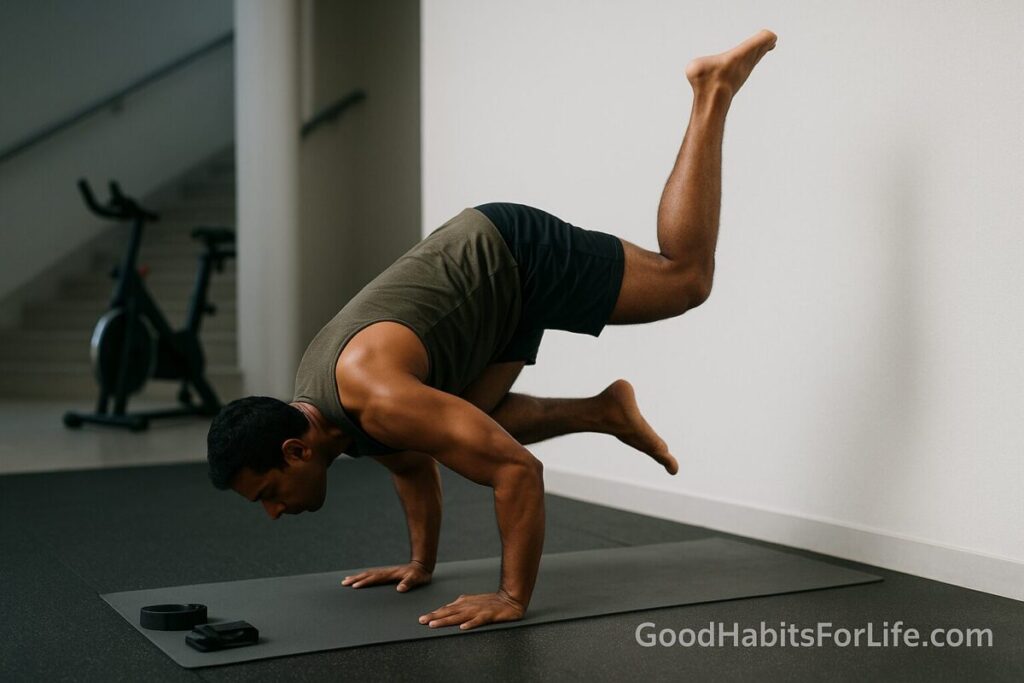
Calisthenics Skills: From Crow to Handstand: Zone 2 + NEAT (2025)
Calisthenics Skills: Crow to Handstand + Zone 2 & NEAT
Table of Contents
🧭 What This Program Is & Why It Works
Goal: Build the shoulder, core, and balance needed to move from crow (a stable bent-arm balance) to a controlled handstand, while using Zone 2 cardio and NEAT to enhance recovery, capacity, and body composition.
Why it works
-
Skill-first progressions. Small, repeatable steps (e.g., frog stand → crow → headstand → wall-assisted handstand) leverage motor learning and progressive overload without risking joints.
-
Zone 2 (easy aerobic work). Training at a conversational pace improves mitochondrial function and work capacity, helping you recover between strength sessions.
-
NEAT (Non-Exercise Activity Thermogenesis). Everyday movement—walking, chores, stair-taking—can meaningfully increase total daily energy expenditure without adding gym stress.
-
Minimum effective dose. 3–4 focused strength/skill sessions plus 2–4 Zone 2 days and steady NEAT deliver results while fitting real life.
Safety first: wrists, elbows, and shoulders tolerate load best when intensity and volume rise slowly. Pain ≠ progress; back off and regress when needed.
✅ Quick Start (Do This Today)
-
Warm-up (8–10 min).
-
2–3 min easy cardio; wrist circles, palm rocks, shoulder CARs.
-
2×10 scapular push-ups; 2×15s hollow/arch holds.
-
-
Choose your level (pick one):
-
Level A: Crow balance attempts 6×10–20s + frog stand 3×20–30s.
-
Level B: Wall-facing handstand hold 6×15–25s; eccentric pike push-ups 3×6–8.
-
Level C: Freestanding handstand entries 8–12 kick-ups; wall handstand shoulder taps 4×10/side.
-
-
Accessory strength (15 min).
-
Pike push-ups or wall walks 3–4×6–10 (RPE 7–8).
-
Ring rows or inverted rows 3–4×8–12.
-
Hollow body rocks 3×20–30s.
-
-
Cool-down (5 min).
-
Wrist flexor/extensor stretch, doorway pec stretch, child’s pose + deep breathing.
-
-
Zone 2 later today or tomorrow (20–40 min).
-
Conversational pace cycling, brisk walk, or easy jog (RPE 3–4).
-
-
NEAT habit: set phone reminder for 1,000–1,500 steps after lunch. Repeat daily.
📅 30-60-90 Habit Plan (with Weekly Template)
Weeks 1–4 (Foundation & Joint Prep)
-
Sessions/week: 3 skill+strength, 2–3 Zone 2, daily NEAT.
-
Skill focus: frog stand → crow; headstand entries; wall-facing handstand holds.
-
Volume: 60–90s total time under tension per skill per session.
-
Checkpoint (end of week 4): 30s stable wall-facing handstand or 20s crow; 30–40 min continuous Zone 2 at RPE 3–4.
Weeks 5–8 (Confidence & Control)
-
Sessions/week: 3–4 skill+strength, 2–3 Zone 2, daily NEAT.
-
Skill focus: box pike handstand holds; wall handstand shoulder taps; kick-ups with soft exit.
-
Add: eccentric handstand push-up prep (3–5s lowers), scapular elevation shrugs in handstand.
-
Checkpoint (end of week 8): 5–8 consistent kick-ups touching balance; 45–60 min Zone 2 comfortable; daily NEAT average 7k–10k steps.
Weeks 9–12 (Refinement & Freestanding Time)
-
Sessions/week: 4 skill+strength (one is lighter), 2–3 Zone 2, daily NEAT.
-
Skill focus: freestanding handstand holds, controlled toe-taps to wall, tuck-to-straight line drills.
-
Deload: reduce volume by ~30% in week 12.
-
Checkpoint (end of week 12): 10–20s freestanding hold, smooth bail; maintain Zone 2 and NEAT baselines.
Weekly Template (example)
| Day | Focus |
|---|---|
| Mon | Skill+Strength A (crow/handstand holds, push/pull core) |
| Tue | Zone 2 30–45 min + NEAT walk |
| Wed | Skill+Strength B (wall walks, shoulder taps, rows) |
| Thu | NEAT emphasis (extra 2–3k steps) or mobility |
| Fri | Skill+Strength C (kick-ups, eccentrics, hollow/arch) |
| Sat | Zone 2 40–60 min (hike, cycle) |
| Sun | Optional Skill Light (balance play) + recovery walk |
🛠️ Progressions: Crow → Handstand
Wrist & Shoulder Prep (every session)
-
Wrist rockers (palms/backs), finger pulses 2×10.
-
Scapular push-ups 2×10–12 (protraction/retraction).
-
Hollow/arch 2×20–30s; wall slides 2×10.
Crow Pathway
-
Frog stand (knees on elbows) → 20–30s steady.
-
Crow (elbows slightly forward; gaze ahead) → 20–30s steady.
-
Crow transitions: knee taps/slow lowers to toes 3×5.
-
Headstand entries (tripod, neck neutral) 4×15–25s.
Handstand Pathway
-
Wall-facing handstand (nose to wall, hollow body) 5–7×15–30s.
-
Box pike handstand (hips over shoulders) 4×20–30s.
-
Wall handstand shoulder taps 4×8–12/side (slow, ribs tucked).
-
Kick-ups to wall 8–12 attempts/session; stick soft contact, return.
-
Freestanding holds 10–20 total attempts with soft exits (cartwheel bail).
Strength support (2–3 moves/session):
-
Pike push-ups or wall walks 4×6–10 (RPE 7–8).
-
Ring rows/inverted rows 4×8–12.
-
Scap elevation shrugs in HS 3×8–12 (small range).
-
Hollow rock + compression 3×20–30s / 3×8–10.
Progression rules
-
Increase time under tension by 10–20% per week when pain-free.
-
Master each step (e.g., 5×20s holds) before moving up.
-
Film 1–2 sets to check line: wrists under shoulders, ribs down, glutes lightly squeezed.
🫀 Zone 2 & 🚶 NEAT: Add Without Overtraining
What is Zone 2?
-
An easy, conversational intensity (RPE 3–4).
-
Rough guide: ~65–75% HRmax (HRmax ≈ 220 − age) or 60–70% heart-rate reserve (Karvonen).
-
You should breathe through your nose or speak in full sentences.
How much?
-
2–4 sessions/week, 30–60 min each (start at 20 min).
-
Best modes: brisk walking, cycling, light jog, elliptical, rowing.
Benefits for calisthenics
-
Improves recovery between sets and sessions.
-
Builds aerobic base for longer practice blocks.
-
Helps manage body composition in combination with NEAT and nutrition.
NEAT (Non-Exercise Activity Thermogenesis)
-
Target: 7,000–10,000 steps/day (or +2–3k above your baseline).
-
Stack it: 10-minute post-meal walks, stairs, stand-up calls, carry your groceries, park farther.
-
Why it matters: Big impact on daily energy burn without draining training batteries.
Scheduling tip: Place Zone 2 after skill work or on alternate days. Keep hard intervals for a different cycle—this block is aerobic easy.
👥 Audience Variations
-
Students/Professionals: 30–40-minute lunch blocks: 15 min skill + 10 min accessory + 10–15 min Zone 2 walk. Use Pomodoro NEAT breaks.
-
Parents: Involve kids—“balance time” (crow/headstand near wall), stroller walks for NEAT. Keep sessions 25–35 min.
-
Seniors/returning movers: Prioritize joint prep and wall-facing holds. Use elevated pike work. Focus on Zone 2 walking or cycling.
-
Teens: Technique first; avoid chasing max volume. Keep efforts mostly RPE ≤8; ensure full recovery and supervision when inverted.
⚠️ Mistakes & Myths to Avoid
-
Skipping wrist prep. Hands are your “feet” in handstands—treat them like runners treat ankles.
-
Jumping progressions too soon. Holds under 10–15s aren’t “owned” yet.
-
Only practicing when fresh. Short daily touches (3–5 min) build balance faster than one long day.
-
Thinking HIIT is mandatory. For this phase, easy Zone 2 complements skill work better.
-
Training through pain. Regress, reduce volume, and address mobility—especially wrists and shoulders.
-
Arching to find balance. Aim for ribs down, glutes light squeeze, gaze between hands.
🗣️ Real-Life Scripts & Cues
5-Minute Micro-Practice (any day)
-
Wrist sequence (60s) →
-
3 crow attempts or 4 kick-ups →
-
2×20s wall-facing hold →
-
60s breathing walk.
“Just show up; one clean rep beats ten sloppy ones.”
Kick-up cues
-
“Long line, quiet toes, stack wrists-shoulders-hips.”
-
“Kick soft, don’t slam the wall.”
-
“To bail: turn hips, step down like a cartwheel.”
Crow cues
-
“Look forward (not straight down), elbows slightly forward, knees high on triceps, push the floor away.”
Self-talk for consistency
-
“I practice balance, not bravado.”
-
“If I can talk, I’m in Zone 2.”
-
“NEAT never misses—walk after meals.”
🧰 Tools & Resources
-
Timers: Seconds, Tabata Timer – easy EMOM/holds. Pros: simple; Cons: ads on free versions.
-
Tracking: Strong, Hevy – log holds (time), RPE, notes. Pros: tags and graphs; Cons: learning curve.
-
Video: Phone camera + slow-mo; tripod or wall shelf. Pros: instant line feedback; Cons: storage.
-
Mobility: GOWOD/ROMWOD or free YouTube wrist/shoulder flows. Pros: guided; Cons: subscriptions.
-
Steps: Phone Health app, Google Fit, Pedometer. Pros: automatic; Cons: accuracy varies.
🔑 Key Takeaways
-
Build from stable to dynamic: frog → crow → wall HS → free HS.
-
Keep sessions short and focused; progress weekly by time under tension and cleaner lines.
-
Add Zone 2 2–4×/week and daily NEAT to recover better and manage body composition.
-
Film, review, and iterate one cue at a time.
-
Deload every 4–6 weeks; pain means regress and rebuild.
❓ FAQs
How long to get a freestanding handstand?
Most adults need 8–12+ weeks to hold 10–20s if practicing 3–5×/week with good prep; backgrounds vary.
What if my wrists hurt?
Stop skill work, switch to forearm variations and lower-load prep (wrist rocks, finger pulses). Resume only when pain-free; progress volume slowly.
How do I know I’m in Zone 2?
You can speak full sentences, breathing stays calm, RPE 3–4. Heart-rate estimate: ~65–75% HRmax or 60–70% HRR (Karvonen).
Can I lift weights too?
Yes—place heavy presses/rows on the same days after skill work, or on separate days. Keep total push volume in check.
Will NEAT and Zone 2 help fat loss?
They raise daily energy expenditure with minimal recovery cost; pair with adequate protein and a modest calorie deficit for fat loss goals.
Is handstand training safe for the neck/back?
Use wall-facing lines, active shoulders, and controlled exits. Avoid loading the neck; no head pressure in handstands.
How often should I practice?
Short daily touches (3–10 min) + 3 structured sessions/week beat one long weekly grind.
What if I’m heavier or new to training?
Emphasize Zone 2 walking/cycling, NEAT, and upper-body strength basics (rows, incline push-ups). Progress inversions more slowly.
📚 References
-
World Health Organization. Guidelines on Physical Activity and Sedentary Behaviour (2020). https://www.who.int/publications/i/item/9789240015128
-
U.S. Department of Health and Human Services. Physical Activity Guidelines for Americans, 2nd ed. (2018). https://health.gov/sites/default/files/2019-09/Physical_Activity_Guidelines_2nd_edition.pdf
-
American College of Sports Medicine. Progression Models in Resistance Training for Healthy Adults. Med Sci Sports Exerc. 2009. https://pubmed.ncbi.nlm.nih.gov/19204579/
-
Achten J, Jeukendrup AE. Maximal fat oxidation during exercise in trained men. Int J Sports Med. 2003/2004. https://pubmed.ncbi.nlm.nih.gov/12784106/
-
Levine JA. Non-exercise activity thermogenesis (NEAT). Best Pract Res Clin Endocrinol Metab. 2002/2004. https://pubmed.ncbi.nlm.nih.gov/15171782/
-
Garber CE, et al. ACSM Position Stand: Quantity and Quality of Exercise… Med Sci Sports Exerc. 2011. https://pubmed.ncbi.nlm.nih.gov/21694556/
-
Behm DG, et al. Canadian Society for Exercise Physiology Position Stand—Resistance Training in Adults. Appl Physiol Nutr Metab. 2020. https://pubmed.ncbi.nlm.nih.gov/32215542/
-
Fong SSM, et al. Shoulder muscle recruitment in handstand. (biomechanics studies overview). Example PubMed entry: https://pubmed.ncbi.nlm.nih.gov/20432151/
Note: References include global and national guidelines plus peer-reviewed studies on aerobic intensity, NEAT, and resistance training principles that underpin skill progressions.
Disclaimer: This content is educational and not a substitute for personalized medical advice; consult a qualified professional if you have pain, injury, or health conditions.