
Travel Fitness Kit: 5 Items, 20 Workouts: Zone 2 + NEAT (2025)
Travel Fitness Kit: 5 Items, Zone 2 + NEAT (2025)
Table of Contents
🧭 What & Why: Zone 2 + NEAT for travel fitness
Travel throws off routines, but two levers keep you fit with minimal stress: Zone 2 cardio and NEAT (non-exercise activity thermogenesis). Zone 2 is an easy, conversational effort (roughly 55–65% of predicted HRmax or “can talk, not sing”), ideal when you’re jet-lagged or short on time. NEAT is all the extra movement—walking, stairs, standing—that quietly boosts daily energy burn and health. Together, they cover aerobic health, recovery, and weight management while a small band-based kit preserves strength.
-
Public-health targets: aim for 150–300 min/week of moderate cardio + 2 days/week of strength—doable with walks and band circuits while traveling. WHO AppsPMCACSM
-
Finding the right intensity: the talk test (talk but not sing) reliably gauges moderate effort without gadgets. CDCPMC
-
Why NEAT matters: everyday movement can meaningfully raise energy expenditure; walking can double it versus rest, and ~7,000 steps/day is linked with lower mortality. PMC+1
🧰 The 5-Item Travel Fitness Kit
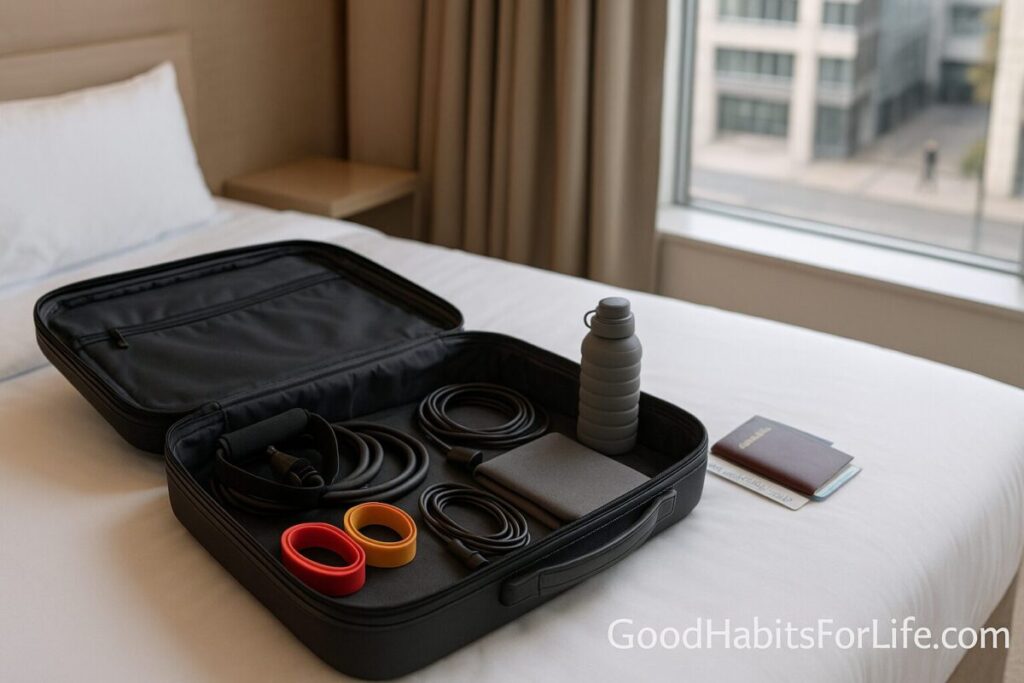
Pack these once; train anywhere (hotel room, hallway, park, airport corner):
-
Lightweight walking/running shoes — foundation for Zone 2 & steps.
-
Long resistance tube with door anchor — rows, presses, pulldowns, hinges.
-
Mini-loop bands (set of 3–5) — glute/shoulder activation; scalable strength.
-
Suspension strap/travel trainer (door/beam anchor) — rows, presses, core.
-
Collapsible water bottle — hydration habit, easy carry, doubles as weight.
Evidence check: elastic bands build strength comparable to free weights; suspension training is safe and improves core activation/balance—perfect for small spaces. PMC+1PubMed
✅ Quick Start: Do this today
-
Set your week: 150–300 min of Zone 2 + 2 strength days (20–30 min each). WHO Apps
-
Pick your intensity rule: use the talk test or RPE 12–13/20 as your Zone 2 anchor. CDCSpringerOpen
-
NEAT autopilot: schedule 3 × 10-min brisk walks between meetings + take stairs.
-
Lay out kit at night: band loop on door, shoes visible, water bottle filled.
-
Track the minimums: steps (goal 7,000+), Zone 2 minutes, and 2 strength checkmarks. PMC
🗓️ 7-Day Starter Plan (with checkpoints)
Goal: arrive, adapt, and maintain capacity without beating yourself up.
-
Day 1 (Arrival): 30–40 min Zone 2 walk + 10 min mobility (loops: hips/shoulders).
-
Day 2: Strength A (25 min): tube rows, split-squats, push-ups, band RDLs, plank (2–3 sets each).
-
Day 3: 45–60 min Zone 2 city loop; add 10 flights of easy stairs sprinkled in.
-
Day 4: Strength B (25 min): suspension rows, band presses, hip thrusts (band), Y-T-W shoulders, side plank.
-
Day 5: 30–50 min Zone 2 (park path); finish with 8–12 min mini-band glutes.
-
Day 6: 20–30 min mobility/flows + 30 min leisurely walk (museum/market).
-
Day 7: 60–75 min scenic walk or hike (Zone 2); reflect + plan next week.
Checkpoints:
🛠️ 20 Hotel-Friendly Workouts (Zone 2 & Strength)
Zone 2 & NEAT (10 options)
-
City Loop 40 — 40 min brisk, talk-friendly walk; add two 30-sec posture resets every 10 min.
-
Airport Laps 30 — 3 × 10 min brisk terminal walks between gates.
-
Stair & Stroll 30 — 5 min easy stairs + 5 min hallway walk × 3 (keep breathing easy).
-
Greenway 50 — park path walk at RPE 12–13; nasal-breathing cues.
-
Museum Miles 60–90 — continuous strolling; stand tall, relaxed arms.
-
Morning Loops 3×12 — short hotel-perimeter loops across the day; stack to 36 min.
-
Hills & Flats 45 — gentle hill repeats (30–60 sec) with long easy flats; keep talk test.
-
Buddy Stroll 40 — conversational pace with a colleague; finish with 5 min stretch.
-
Treadmill Easy 35 — incline 2–4%, speed for talkable pace; no handrails.
-
Errand Walk 30 — walk for coffee, groceries; carry bottle as a light load.
Intensity guardrails: stay “can talk, not sing.” If stairs push you breathless, slow down to return to Zone 2. CDC
Strength, Mobility & Core (10 options)
Each 20–30 min. Rest ~45–60 sec between moves.
A. Band Basics (No Door)
11) Mini-Loop Lower — lateral walks 12/side • band RDL 12 • glute bridge 15 • calf raise 20 × 2–3.
12) Mini-Loop Upper — pull-apart 15 • external rotation 12/side • push-up 8–12 • plank 30–45s × 2–3.
13) Carry & Squat — fill bottle/backpack: goblet squat 10–12 • suitcase carry 30 m/side • dead-bug 8/side × 3.
B. Door-Anchor Tube
14) Push-Pull Core — chest press 12 • row 12 • anti-rotation press 10/side • split-squat 10/leg × 3.
15) Pull-Dominant — lat pulldown 12 • face-pull 15 • reverse lunge 10/leg • side plank 30–45s × 3.
C. Suspension Strap
16) Total-Body 5×5 — row 8–10 • push-up 8–10 • hip hinge 10 • squat 10 • hollow hold 30–40s × 3–4.
17) Core & Balance — fall-out 8–10 • single-leg hinge 8/leg • ham curl 12 • plank saw 20–30s × 3.
18) Upper Focus — inverted row 8–12 • chest press 8–12 • “T” raise 10 • triceps press 10 × 3.
D. Mobility & Flow
19) Jet-Lag Reset 20 — cat-camel • thoracic rotations • hip flexor rocks • 90/90 switches • calf wall stretch (2–3 rounds).
20) Band-Assisted Flow 20 — band shoulder dislocates 10 • ankle mobilizations • squat pry 30s • hamstring floss 10/side × 2–3.
Why bands/straps? Elastic resistance increases strength comparably to free weights; suspension work safely trains core and balance—ideal where space is tight. PMC+1
🧠 Techniques & Frameworks (intensity, pacing, tracking)
-
Talk Test First: simplest, validated way to keep Zone 2 on the road. PMC
-
RPE Anchor: ride RPE 12–13/20 for Zone 2; keep most sessions there. SpringerOpen
-
Heart-Rate Estimate (optional): use ~55–65% of predicted HRmax for easy running/walking (or 60–70% in many five-zone models). Pair with the talk test if uncertain. Cleveland Clinic
-
Weekly Budgeting: 3 × 40–50 min or 5 × 30–35 min walks hit 150–250 min quickly. WHO Apps
-
NEAT Stackers: stairs instead of lift, stand for calls, walk for coffee, museum/market strolls—these add up and correlate with better outcomes around ~7,000 steps/day. PMC
👥 Audience Variations
-
Professionals on back-to-back meetings: 3 × 10-min brisk loops + one 25-min band circuit at day’s end.
-
Parents with kids: make museum miles a game; do mini-band squats, carries while they snack.
-
Seniors: prioritize balance (suspension fall-outs, heel-to-toe walks), moderate steps (6–8k), gentler stairs. WHO Apps
-
Students/backpackers: do “carry & squat” with your pack; 30–40 min city loop at dusk.
⚠️ Mistakes & Myths to Avoid
-
Myth: “If it’s not intense, it doesn’t count.”
Reality: Moderate, conversational Zone 2 drives big aerobic gains and is highly sustainable during travel. Cleveland Clinic -
Mistake: Hammering stair sprints on jet lag.
Fix: Keep stairs easy; stay talk-capable to avoid drifting out of Zone 2. CDC -
Myth: “Bands aren’t real strength.”
Reality: Elastic resistance can match conventional strength gains—and travels better. PMC
🗣️ Real-Life Examples & Scripts
-
Front-desk script (stairs/space): “Hi! Do you have a safe stairwell or quiet area where I can do brief band exercises for 20 minutes?”
-
Colleague text: “Walk-and-talk for 15? I’m keeping a Zone 2 streak—promise I won’t make you jog.”
-
Travel checklist: shoes • tube + door anchor • mini-loops • suspension strap • collapsible bottle • timer app • download city offline map.
📚 Tools, Apps & Resources
-
Tracking: Apple Health / Google Fit (steps & minutes); simple Interval Timer app for circuits.
-
HR (optional): chest strap or optical band; if none, rely on the talk test. CDC
-
Maps & routes: Google Maps “Walking,” AllTrails/Komoot for local paths.
-
Programs/logs: any notes app or Strong/Hevy for sets/reps.
Guideline anchors: WHO & AHA cardio targets; ACSM for twice-weekly strength. WHO Appswww.heart.orgACSM
🧾 Key Takeaways
-
Zone 2 + NEAT is travel-proof: conversational walks + stairs + standing breaks.
-
A 5-item kit (shoes, tube, loops, strap, bottle) covers strength & mobility.
-
Hit 150–300 min moderate cardio + 2 strength sessions weekly, mostly via walks and bands. WHO Apps
-
Use the talk test or RPE 12–13 to stay in Zone 2 without gadgets. PMCSpringerOpen
-
Aim for ~7,000+ steps/day to bank health benefits on any itinerary. PMC
❓ FAQs
1) How do I know I’m in Zone 2 without a heart-rate monitor?
Use the talk test: you can talk in sentences, not sing. If you’re gasping, slow down. CDC
2) Is walking enough for cardio while traveling?
Yes. Brisk, continuous walking at a talkable pace meets moderate intensity and stacks up fast toward the 150–300 min target. WHO Apps
3) Will I lose muscle on a 1–3 week trip?
Unlikely if you do 2 weekly band/strap circuits that train major muscle groups and push within 2–3 reps of fatigue. Bands are effective for maintaining strength. PMC
4) Are stairs “too hard” for Zone 2?
They can be. Keep pace easy; if you can’t hold a light conversation, switch to flats or shorten bouts. CDC
5) What step target should I use?
Research links ~7,000 steps/day with lower mortality; more is fine if joints and schedule allow. PMC
6) How long should each strength session be?
20–30 minutes works: 4–6 moves, 2–3 sets, 8–15 reps. Two days/week meets guideline minimums. ACSM
7) What if I only have 10 minutes?
Do three 10-min walks spread through the day or 10-min mini-loop circuits—consistency beats perfection. WHO Apps
8) Do bands really challenge legs?
Yes—use heavier loops, slow eccentrics, and longer ranges; meta-analyses show comparable strength gains to machines/free weights. PMC
9) Is hydration part of fitness?
Travel dehydrates; keep a collapsible bottle on you to support endurance and reduce perceived effort.
10) Can seniors use this plan safely?
Yes—prioritize balance moves, moderate steps (6–8k), and talk-test intensity; clear changes with your clinician if you have medical conditions. WHO Apps
📚 References
-
World Health Organization. Guidelines on Physical Activity and Sedentary Behaviour (Adults: 150–300 min/wk moderate). 2020. WHO AppsPMC
-
American College of Sports Medicine. Physical Activity Guidelines (include ≥2 days/wk strength). ACSM
-
CDC. Measuring Physical Activity Intensity (talk test). CDC
-
Kwon Y et al. The talk test as a useful tool to monitor aerobic exercise intensity (review). 2023. PMC
-
Paluch AE et al. Steps per Day and All-Cause Mortality (JAMA Network Open, 2021). PMC
-
Levine JA. Non-exercise activity thermogenesis (NEAT) (definitions & mechanisms). 2002–2004. PubMed
-
Fountaine CJ et al. Metabolic and energy cost of sitting vs standing. 2016. PMC
-
Lopes JSS et al. Elastic resistance vs conventional resistance—systematic review/meta-analysis. 2019. PMC
-
Blasco JM et al. Effects of suspension training on balance & performance. 2023. PMC
-
Cleveland Clinic. Heart-Rate Zones Explained (practical Zone 2 framing). 2023. Cleveland Clinic
Disclaimer: This guide is educational and not a substitute for personalized medical advice; consult your healthcare professional before starting or changing a fitness program, especially if you have health conditions or recent injuries.