
DumbbellOnly 2/Week Plan in 2025: Trends Tactics
Dumbbell-Only 2-Day/Week Plan (2025): Trends & Tactics
Table of Contents
🧭 What & Why
Definition. A minimalist, full-body program using only dumbbells, trained two days per week, designed to progress strength, muscle, and general fitness with limited time and equipment.
Why it works.
-
Training frequency vs results. When weekly volume is equated, 2–3+ days/week produce similar hypertrophy—so two well-planned sessions can be enough.
-
Minimal effective dose. Meta-analyses suggest ~10+ weekly sets per muscle is a solid target, with diminishing returns above ~20+ for most.
-
Older adults & beginners respond well to low-frequency, progressive resistance training, with meaningful gains in strength, function, and health markers.
-
Low vs high loads. Muscle growth is comparable across a wide load range (light to heavy) when sets are taken close to failure—perfect for home dumbbells.
(See References for supporting sources.)
✅ Quick Start (do this today)
-
Pick your days. Example: Tue + Sat (72–96 h apart).
-
Warm-up (6–8 min). Brisk steps or skipping (2 min), dynamic hips/shoulders (2 min), two ramp sets for first lifts (2–4 min).
-
Run this Session A (45–55 min):
-
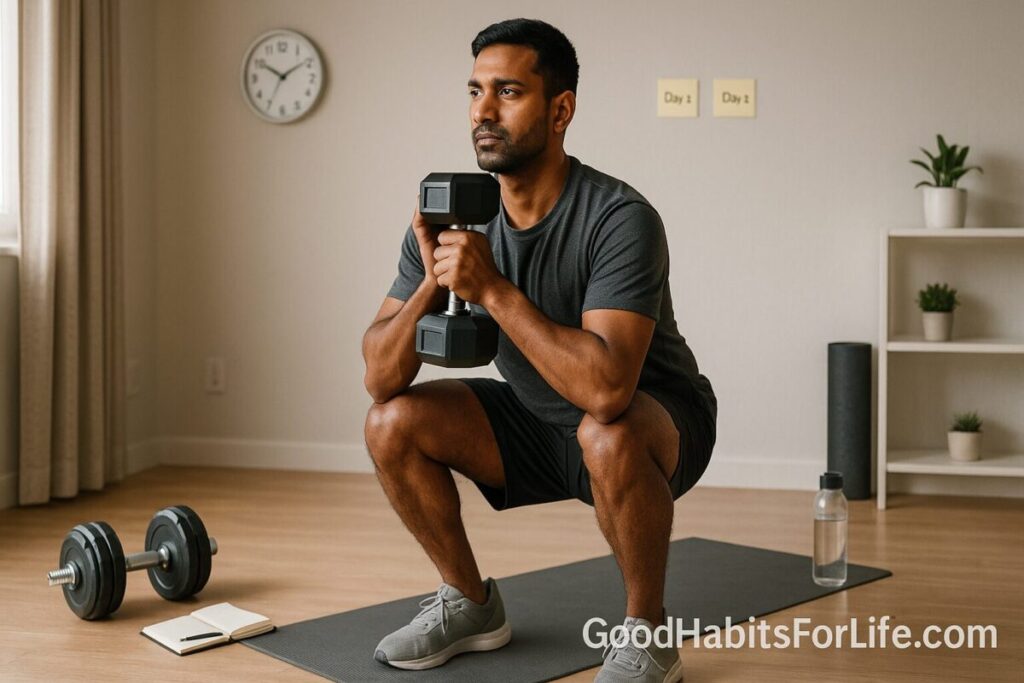
Goblet Squat 3×6–10 @ RPE 7–8 (1–3 reps in reserve)
-
One-Arm Row 3×8–12/side
-
DB Bench Press or Floor Press 3×6–10
-
Romanian Deadlift 3×8–12
-
Half-Kneeling DB Press 2–3×8–12/side
-
Carry (farmer or suitcase) 3×30–60 m
-
Core: Dead bug or Side plank 2–3×30–45 s
-
-
Run Session B later in the week:
-
Reverse Lunge 3×6–10/side
-
Pull (DB Pullover or Band-assist Row) 3×8–12
-
Incline or Neutral-Grip DB Press 3×8–12
-
Hip Hinge: Staggered RDL 3×8–12/side
-
Vertical Press: Push Press or Arnold Press 2–3×6–10
-
Carry: Overhead or Front-rack 3×20–40 m
-
Core: Hollow hold or Paloff press 2–3×20–40 s
-
-
Progression rule. When you hit the top of the rep range for all prescribed sets with the same load, add 1–2 kg (2–5 lb) next week or add one more set (up to cap).
-
Log it. Track lifts, reps, RPE. Aim to improve one small thing weekly.
🧠 30-60-90 Day Habit Plan
Days 1–30 (Foundation).
-
Goal: Consistency + technique.
-
Volume: 2 sessions/week; ~10–12 hard sets per major muscle group per week.
-
Intensity: RPE 6–8; stop 2–3 reps before failure.
-
Checkpoint (Day 30): 8–10% load or rep increase on core lifts; no form red flags.
Days 31–60 (Build).
-
Add a 4th set to 2–3 big patterns across the week or a short finisher (5–7 min): e.g., 10-minute EMOM of 6 goblet squats + 6 rows.
-
Intensity: occasional RPE 9 set on final set for one lift.
-
Checkpoint (Day 60): total weekly sets up to 12–16 per muscle; improved work capacity; waist/measurements tracked.
Days 61–90 (Peak & Consolidate).
-
Undulate: Week A higher reps (10–12), Week B moderate (6–8).
-
Introduce special methods (tempo reps; 3-sec eccentrics; paused reps) for 1–2 lifts.
-
Checkpoint (Day 90): 5–15% strength gain from baseline; better movement quality; adherence ≥85%.
🛠️ Techniques & Frameworks
Movement patterns (cover each weekly):
-
Squat (goblet, front-rack, split squat)
-
Hinge (RDL, hip thrust, good morning)
-
Horizontal push/pull (press/row)
-
Vertical push/pull (overhead press; pull variations)
-
Lunge (forward, reverse, step-up)
-
Core (anti-extension/rotation)
-
Carries (farmer, suitcase, front-rack, overhead)
Progressive overload ladder:
-
Fill the rep range → 2) add sets (to cap) → 3) add load → 4) increase difficulty (tempo/ROM).
RPE/RIR autoregulation. Work mostly at RPE 7–8 (2–3 RIR). Push to RPE 9 sparingly. If sleep/stress is poor, hold load and focus on technique.
Weekly volume targets (guide):
-
Chest/Back/Quads/Glutes/Hamstrings: 10–16 sets
-
Shoulders/Arms/Calves: 8–14 sets
(Split over two sessions via multi-joint lifts + accessories.)
Rest intervals: 90–150 s on big lifts, 60–90 s on accessories. Longer rest improves strength/hypertrophy for compound moves.
Conditioning without killing gains: On 1–2 off-days, do 20–30 min zone-2 (brisk walk/cycle) or steps 7–10k; keep hard intervals ≥24 h away from lifting.
Nutrition anchors:
-
Protein: 1.6–2.2 g/kg/day; per meal ~0.3 g/kg.
-
Carbs: Fuel sessions (1–3 g/kg/day depending on activity).
-
Hydration & sleep: 7–9 h; create a 60-min wind-down.
👥 Audience Variations
Beginners: start with 2 sets/exercise; practice slow eccentrics; cap RPE at 7 for 2–3 weeks.
Busy professionals/parents: 35-min “density” option—run A/B with supersets (e.g., squat ↔ row, press ↔ RDL).
Seniors (60+): prioritize split squats to chair height, supported RDLs, lighter loads 10–15 reps; add balance drills; keep carries suitcase-style.
Students/teens: technique first; don’t chase failure; keep total sets on the low end, progress weekly.
Fat-loss focus: maintain protein, keep loads challenging; add 10–15 min steady cardio after lifts or on off-days.
⚠️ Mistakes & Myths to Avoid
-
Myth: “Two days can’t build muscle.” → If weekly volume and effort are adequate, you can grow.
-
Error: Random exercise rotation. → Keep core lifts stable for at least 4–6 weeks.
-
Myth: “Light dumbbells are useless.” → Take sets near failure; use tempo/ROM progressions.
-
Error: Always training to failure. → Reserve for last set on one lift, not all.
-
Error: Skipping logs and sleep. → You can’t improve what you don’t track.
🗂️ Real-Life Examples & Scripts
Minimal-gear 12-week progression (example):
| Week | Lower Push | Upper Pull | Upper Push | Hinge | Lunge | Carry | Core |
|---|---|---|---|---|---|---|---|
| 1–2 | Goblet 3×8 | 1-Arm Row 3×10 | DB Bench 3×8 | RDL 3×10 | Rev Lunge 2×8/side | Farmer 3×40 m | Side Plank 2×30 s |
| 3–4 | 3×10 (add 1–2 kg if capped) | 3×12 | 3×10 | 3×12 | 3×8/side | Suitcase | 3×30–40 s |
| 5–6 | 4×8 (new set) | 3×8 heavier | 4×6–8 | 3×8 heavier | 3×10/side | Front-rack | 3×40–50 s |
| 7–8 | Tempo 3-0-1 goblet | Row 4×8 | Incline 3×8–10 | RDL 4×6–8 | Split squat 3×10/side | Overhead | Paloff 3×12 |
| 9–10 | Pause 1 s at bottom | Row 3×10–12 | Bench 3×10–12 | Hip thrust 3×10–12 | Step-up 3×12/side | Farmer heavier | Dead bug 3×12 |
| 11–12 | Deload 60–70% volume, RPE 6–7; retest reps/loads in Week 12 |
Copy-paste check-in text (accountability):
“I’m on the GoodHabits 2-day dumbbell plan. Lifting Tue/Sat. Today is Session A. Hold me to it—will text you my top set and RPE after.”
Warm-up script (2 minutes of moves):
10 air squats → 10 hip hinges → 8 thoracic rotations/side → 10 band pull-aparts (or towel). Two lighter ramp sets for first lift.
🧰 Tools, Apps & Resources
-
Tracking apps: Strong, Hevy, Stacked—easy logging, charts; free tiers available.
-
Timers: Any EMOM/interval timer; look for auto-rest counters.
-
Adjustable dumbbells: Space-saving; micro-plates help when jumps are big.
-
Bands/straps: Add resistance angles; assist pulling patterns if you lack heavy bells.
-
Heart-rate monitor (optional): Keep conditioning in zone-2 on off-days.
📌 Key Takeaways
-
Two well-designed dumbbell sessions can match higher frequencies when weekly volume and effort are on point.
-
Cover all major patterns each week; progress via reps, sets, load, and technique.
-
Log sessions, manage recovery, and undulate reps across blocks to keep progressing.
-
Keep it simple: consistency beats complexity.
❓ FAQs
Can I build muscle with only two days/week?
Yes—if you reach sufficient weekly hard sets (roughly 10–20 per muscle) and push close to failure on working sets.
Is full-body better than upper/lower here?
For two days, full-body maximizes frequency per muscle and time efficiency.
What if my dumbbells are too light?
Slow the tempo (3–4 s eccentrics), add pauses, extend ROM (elevated heels for squats), and shorten rest—then invest in heavier bells when you cap out.
Should I train to failure?
Use it sparingly (last set of 1–2 exercises). Most work should stay at RPE 7–8 for sustainable progress.
How long should workouts be?
45–60 minutes including warm-up. A 30–35-minute density variant with supersets also works on busy weeks.
Can I combine this with running or sports?
Yes. Keep hard conditioning ≥24 h away from lifting; do zone-2 on off-days.
I’m 60+. Any changes?
Favor controlled tempos, split stance work for balance, slightly higher reps (8–15), and longer rests. Results are still meaningful.
How do I eat for gains?
Protein 1.6–2.2 g/kg/day, sufficient calories, and prioritize a protein-rich meal within a few hours post-training.
When do I deload?
Every 6–8 weeks or when performance/soreness/sleep red-flags appear—cut sets ~30–40% for one week.
What’s a good sign I’m progressing?
More reps at same load, heavier load for same reps, smoother technique, or shorter rests at the same performance.
📚 References
-
Schoenfeld BJ, et al. “Effects of Resistance Training Frequency on Measures of Muscle Hypertrophy: A Systematic Review and Meta-Analysis.” Sports Med. 2016. https://doi.org/10.1007/s40279-016-0543-8
-
Ralston GW, et al. “Weekly Training Frequency Effects in Trained Individuals.” J Strength Cond Res. 2018. https://doi.org/10.1519/JSC.0000000000001935
-
Schoenfeld BJ, et al. “Dose-Response Relationship Between Weekly Resistance Training Volume and Muscle Hypertrophy.” J Sports Sci. 2017. https://doi.org/10.1080/02640414.2016.1210197
-
Morton RW, et al. “Neither Load Nor Systemic Hormones Determine Resistance Training-Mediated Hypertrophy.” J Appl Physiol. 2016. https://doi.org/10.1152/japplphysiol.00154.2016
-
American College of Sports Medicine (ACSM). Position Stand: “Progression Models in Resistance Training for Healthy Adults.” Med Sci Sports Exerc. 2009. https://doi.org/10.1249/MSS.0b013e3181915670
-
Fragala MS, et al. “Resistance Training for Older Adults.” Med Sci Sports Exerc. 2019. https://doi.org/10.1249/MSS.0000000000001942
-
WHO. “2020 Guidelines on Physical Activity and Sedentary Behaviour.” https://www.who.int/publications/i/item/9789240015128
-
CDC. “Physical Activity Guidelines for Americans—Strength Activities.” https://www.cdc.gov/physicalactivity/basics/strength-training/index.htm
-
Schoenfeld BJ, et al. “Strength and Hypertrophy Adaptations Between Low- vs High-Load Resistance Training.” J Strength Cond Res. 2017. https://doi.org/10.1519/JSC.0000000000002200
-
Grgic J, et al. “Effects of Rest Interval Duration on Muscular Strength & Hypertrophy.” Sports Med. 2018. https://doi.org/10.1007/s40279-018-0955-7
Disclaimer: This fitness guidance is educational and not a substitute for personalized medical advice; consult a professional if you have injuries or medical conditions.