
ApartmentFriendly Workouts (No Jumps): Zone 2 + NEAT (2025)
Apartment-Friendly Workouts (No Jumps): Zone 2 & NEAT 2025
Table of Contents
🧭 What is Zone 2 & NEAT (and why it works)
Zone 2 is easy, steady cardio where you can hold a conversation (roughly 60–70% HRmax or RPE 3–4/10). Training here improves mitochondrial function, fat oxidation, and aerobic base without joint stress—perfect when you must keep noise and impact low.
NEAT (Non-Exercise Activity Thermogenesis) is the energy you spend on everything that isn’t formal exercise: standing, housework, errands, pacing during calls. Raising NEAT meaningfully boosts daily energy expenditure and long-term weight management while keeping perceived effort low.
Evidence snapshot
-
Health bodies recommend 150–300 min/week of moderate activity (Zone 2 intensity) for major cardiometabolic benefits.
-
NEAT differences between individuals can account for hundreds of kcal/day.
-
Replacing sitting with light activity improves metabolic markers and long-term risk.
✅ Quick Start: Today’s no-jump session (30–35 min)
Warm-up (5 min):
-
Ankles/hips/shoulders circles → marching in place → gentle arm swings.
Main set (20–25 min, conversational pace): pick 1–2 and rotate every 3–5 min
-
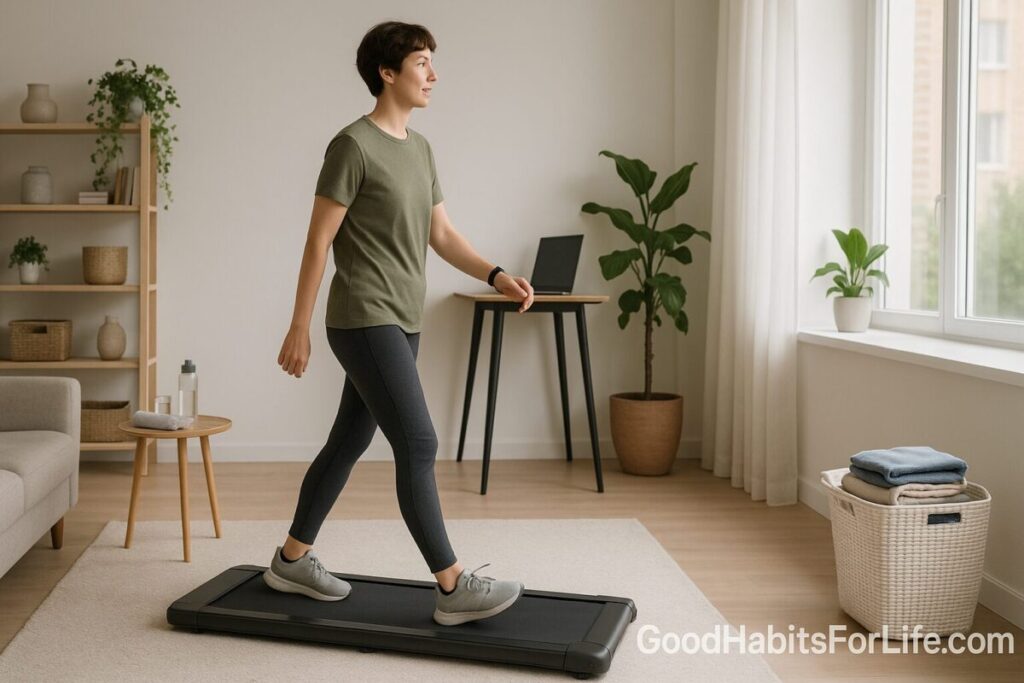
Incline walk on treadmill (low speed) or marching in place
-
Step-ups on a sturdy low step (slow, controlled)
-
Shadow boxing (no bounce), soft knees
-
Mini-band side steps + glute bridges combo
-
Stationary cycling (upright/desk bike) if available
Strength finisher (5 min, circuit ×1–2):
-
Wall push-ups ×10–15
-
Tempo squats (slow 3-sec down) ×10–12
-
Bird-dog each side ×8
-
Dead bug ×8–10
Cool-down (2–3 min): nasal breathing + easy stretches.
NEAT add-ons (today):
-
3× 5-minute quiet “movement snacks” (hallway laps, stair walk, dish-washing + calf raises, standing desk block).
🗺️ 30-60-90 Day Habit Plan
Goal: build volume first, intensity later; keep impact + noise minimal.
Days 1–30 (Foundation)
-
Frequency: 4–5 days/week Zone 2 (20–30 min).
-
NEAT: set hourly 2–3 min stand/move reminders during work; 1 evening 10-min tidy-walk.
-
Strength: 2×/week 10–15 min (wall push-ups, chair squats, glute bridges, rows with backpack).
-
Checkpoint: you can do 30 min conversational without excess fatigue the next day.
Days 31–60 (Build)
-
Frequency: 5 days/week, 30–40 min Zone 2 (or 25 min + 5 min brisk).
-
NEAT: average 8–10k steps/day equivalent via indoor laps if needed.
-
Strength: 3×/week 15–20 min (add bands or light dumbbells).
-
Checkpoint: resting HR trending down; weekly total ≥180 min.
Days 61–90 (Solidify)
-
Frequency: 5–6 days/week, 35–50 min Zone 2; 1 day can include short strides (4×20–30 s fast walk) if joints tolerate.
-
NEAT: keep micro-bursts after meals (5–10 min walk) to help glucose control.
-
Strength: progress reps/tempo or load; 20–25 min.
-
Checkpoint: you can maintain effort during travel or busy weeks using 10-minute tiles (3 tiles = full session).
🧠 Techniques & Frameworks
Intensity anchors
-
Talk test: full sentences = Zone 2; short phrases = just above.
-
RPE 3–4/10 feels “easy-moderate.”
-
Heart rate: estimate HRmax (220 − age) and aim 60–70%; or use HRR (Karvonen) at 50–60% for a gentler start.
Cadence & posture for quiet cardio
-
Soft knee bend, roll through foot, “quiet feet” cue.
-
Use metronome 100–120 bpm for marching rhythm.
-
Nasal breathing encourages relaxed pacing.
Progression levers (choose one every 1–2 weeks):
-
+5 minutes/session
-
Slight incline or cadence
-
Add a second daily NEAT block (5–10 min)
🛠️ Apartment-Friendly Exercise Menu
No equipment
-
Marching in place (arms drive)
-
Slow step-ups to low step
-
Split-stance sit-to-stand (from chair)
-
Wall push-ups or countertop push-ups
-
Tempo squats; half-kneel to stand
-
Glute bridge → single-leg bridge (quiet, controlled)
-
Bird-dog, dead bug, side plank (knees)
-
Mobility flows: cat-cow, thoracic rotations, hip openers
Light gear
-
Mini-bands: lateral walks, monster walks
-
Long band: rows around a door anchor, face pulls
-
Adjustable dumbbells/kettlebell (4–12 kg / 9–26 lb): suitcase holds during marches
-
Under-desk or upright bike, compact stepper
-
Yoga mat, low step, metronome app
Noise-proofing tips
-
Train on a rug or mat; avoid stomping.
-
Control eccentrics (slow lowering).
-
Time sessions for non-quiet hours if possible.
👥 Audience Variations
-
Students: 15-min study breaks = 8-min march + 5-min mobility + 2-min reset; backpack rows.
-
Professionals (WFH): calendar walking 1:1s; hallway “commute” loop morning/evening.
-
Parents: stroller pushes (indoor mall laps), family tidy-walk game after dinner.
-
Seniors: prioritize balance (tandem stance near support), lower step height, longer warm-ups.
-
Plus-size/new exercisers: start with RPE 2–3, seated cycle or chair-assisted moves; extend to tolerance.
⚠️ Mistakes & Myths to Avoid
-
Myth: “If I’m not breathless, it won’t work.” → Zone 2 drives big aerobic gains with low stress.
-
Mistake: jumping/plyos in thin-walled apartments; swap for tempo strength.
-
Mistake: chasing calories on a single session; focus on weekly minutes + NEAT.
-
Myth: “Heart-rate formulas are exact.” → they’re estimates; use the talk test + RPE to calibrate.
-
Mistake: skipping warm-ups or sudden volume spikes; progress gradually.
💬 Real-Life Examples & Scripts
30-min Quiet Cardio (no gear)
-
5 min warm-up →
-
8 min march (RPE 3) → 4 min step-ups → 8 min shadow box (no bounce) →
-
5 min finisher circuit (wall push-ups, squats, bird-dog).
10-minute NEAT tile (repeat 2–3×/day)
-
3 min hallway laps → 2 min dish-wash + calf raises → 3 min laundry fold walk → 2 min stretch.
Work call script:
-
“I’ll take this call walking. If my audio drops, I’ll pause walking.” (Headset on, mute when breathing heavier.)
Rainy-day steps:
-
Set a 300–500 step loop inside home; do 3–4 loops spread across the day.
🧰 Tools & Apps (quick pros/cons)
-
Google Fit / Apple Health / Samsung Health — free, auto-logs steps; cons: HR accuracy depends on device.
-
Strava — strong tracking/social; cons: public by default (adjust privacy).
-
Polar / Garmin / Coros — accurate HR with belts; cons: hardware cost.
-
Pedometer++ / StepsApp — simple step tracking; cons: fewer training metrics.
-
HR straps (chest/optical) — best for Zone 2; cons: extra gear, pairing.
📌 Key Takeaways
-
Build a quiet, low-impact routine anchored in Zone 2 for aerobic base.
-
Layer NEAT throughout the day to raise total movement without fatigue.
-
Progress minutes first, then add light resistance or incline.
-
Use talk test + RPE for simple, equipment-free intensity control.
-
A steady 30-60-90 progression cements a sustainable habit.
❓ FAQs
1) How do I know I’m in Zone 2 without a heart-rate monitor?
Use the talk test: you can speak full sentences comfortably. It should feel easy-moderate (RPE 3–4/10).
2) Can Zone 2 help with fat loss?
Indirectly—by increasing weekly energy expenditure and improving metabolic flexibility. Pair with nutrition and sleep.
3) How many days per week?
Aim for 4–6 days of Zone 2, totaling 150–300 minutes/week, plus daily NEAT.
4) Will no-jump training still build legs and glutes?
Yes. Use tempo squats, split-squat holds, glute bridges, band work, and gradually add load.
5) Is stair climbing too intense for Zone 2?
It can be. Slow your pace, reduce floors, or alternate stairs with hallway laps to keep conversation-easy.
6) What if my knees hurt with step-ups or squats?
Reduce depth, use a higher chair, do wall sits or seated leg extensions; prioritize marching/cycling.
7) Can I split 30 minutes into mini sessions?
Absolutely. 3×10 minutes yields similar health benefits and is great for busy days.
8) How does NEAT differ from steps?
Steps are one part of NEAT. NEAT also includes standing, fidgeting, chores—all light movement counts.
9) When do I add harder intervals?
After 8–12 weeks with consistent Zone 2 and if recovery is good, add brief strides or RPE 6 efforts 1×/week.
10) What if my downstairs neighbor complains?
Stick to marches, bridges, slow strength, and use mats. Avoid hops, burpees, and fast foot drills.
📚 References
-
U.S. Department of Health and Human Services. Physical Activity Guidelines for Americans, 2nd ed. https://health.gov/our-work/nutrition-physical-activity/physical-activity-guidelines/second-edition
-
World Health Organization. Guidelines on Physical Activity and Sedentary Behaviour (2020). https://www.who.int/publications/i/item/9789240015128
-
CDC. Target Heart Rates & Exercise Intensity. https://www.cdc.gov/physicalactivity/basics/measuring/index.htm
-
American Heart Association. Target Heart Rates. https://www.heart.org/en/healthy-living/fitness/fitness-basics/target-heart-rates
-
Levine JA. Non-exercise activity thermogenesis (NEAT). Nutr Rev. 2004;62(7 Pt 2):S82–S97. PubMed: https://pubmed.ncbi.nlm.nih.gov/15277143/
-
Ekelund U, et al. Does physical activity attenuate the association between sitting time and mortality? Lancet. 2016;388:1302–1310. https://www.lancet.com/journals/lancet/article/PIIS0140-6736(16)30370-1/fulltext
-
Borg G. Psychophysical bases of perceived exertion. Med Sci Sports Exerc. 1982;14(5):377–381. https://pubmed.ncbi.nlm.nih.gov/7154893/
-
ACSM. Quantity and Quality of Exercise for Developing and Maintaining Fitness. Position Stand. https://www.acsm.org/
-
Harvard Health Publishing. Zone 2 Training: building your aerobic base. https://www.health.harvard.edu/
-
CDC. Physical Activity and Health: The Basics. https://www.cdc.gov/physicalactivity/basics/pa-health/index.htm
Disclaimer: This article offers general fitness education and is not a substitute for personalized medical advice. Consult a healthcare professional before starting a new exercise program, especially if you have health conditions or joint pain.