
PCOSFriendly Fitness: Strength + Walks: Zone 2 + NEAT (2025)
PCOS-Friendly Fitness: Strength, Zone 2 & NEAT (2025)
Table of Contents
🧭 What this guide covers & why it works
Polycystic ovary syndrome (PCOS) affects metabolic health—especially insulin resistance. High-quality guidelines and reviews recommend lifestyle management with regular aerobic activity and muscle-strengthening for women with PCOS. Monash UniversityPubMed
What works best overall:
-
Strength training improves body composition and may help androgen profile (via higher SHBG). ScienceDirect
-
Aerobic training—from moderate “Zone 2” to vigorous intervals—improves insulin sensitivity and fitness. Europe PMC
-
NEAT (non-exercise activity thermogenesis: standing, strolling, fidgeting, chores) meaningfully raises daily energy use and is linked to lower obesity risk. PubMedNCBI
-
Breaking up sitting with brief activity (2–5 min every 20–30 min) reduces post-meal glucose/insulin spikes. PMC
About “Zone 2”: It’s a moderate intensity where you can talk in full sentences. It’s great for building aerobic base, but it’s not uniquely magical; mixing intensities (including some vigorous work) can maximize cardiometabolic benefits. PubMed
✅ Quick Start (do this today)
-
Full-body strength (30–45 min):
-
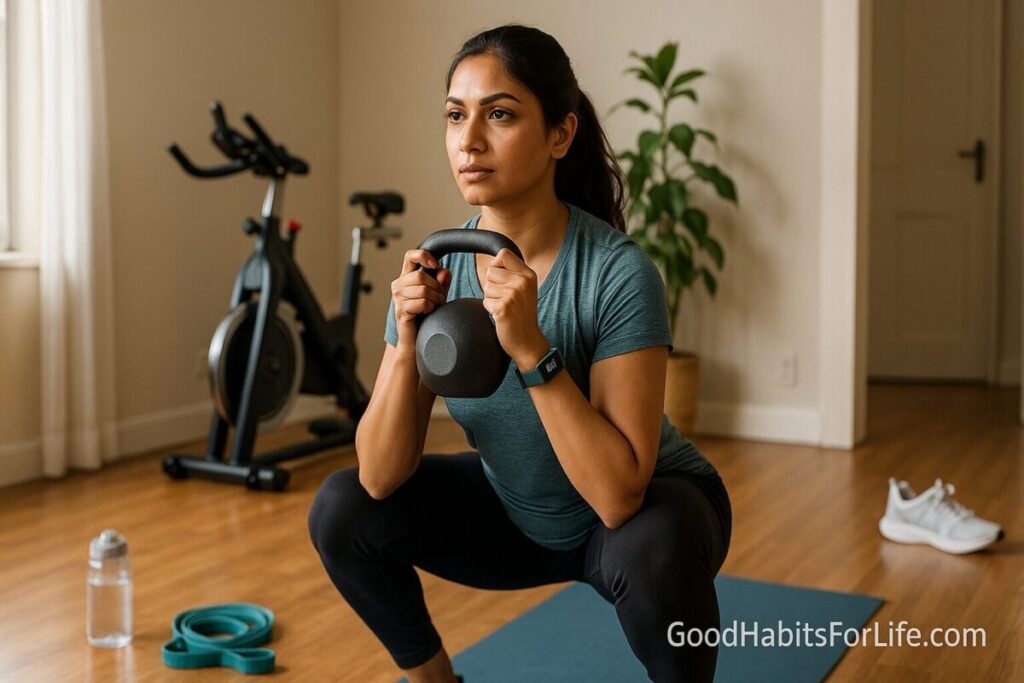
Goblet squat 3×8–10
-
Hip hinge (Romanian deadlift or hip thrust) 3×8–10
-
Push (incline push-up or dumbbell press) 3×8–10
-
Pull (row) 3×8–10
-
Core carry/plank 2×30–45 s
Work at RPE 7–8; stop 2 reps before failure.
-
-
Zone-2 walk (30 min): brisk pace where you can talk but not sing. Accumulate 150–300 min/week (e.g., 5×30–60). PubMed
-
NEAT breaks: set a 30-min timer; do 2–3 min of easy movement (hallway walk, stairs, 20 chair-stands). Aim 7,000–9,000 steps/day to start. PMC
-
After-meal mini-walks: 2–10 min within 20–30 min after eating to blunt glucose spikes. PMC
-
Track 3 numbers weekly: sessions completed, total steps, top 3 lifts’ loads.
🛠️ 30-60-90 Day PCOS Fitness Roadmap
Weeks 1–4 (30 days): Base
-
Strength 2×/week (A/B days).
-
Aerobic 5×/week Zone-2 walks (25–40 min).
-
NEAT: 2–3 min breaks every 30 min of sitting; step goal 7–9k.
-
Progress check: RPE feels easier at same pace; add 2.5–5 kg total per lift across the month.
Why: Regular aerobic + muscle-strengthening aligns with WHO guidance and PCOS guidelines. PubMedMonash University
Weeks 5–8 (60 days): Build
-
Strength 3×/week; add a third set to major lifts.
-
Aerobic 4×/week Zone-2 (30–45 min) + 1 short HIIT (e.g., 6×1-min hard/2-min easy).
-
NEAT: raise steps by ~1k/day average.
-
Progress check: resting HR down; faster pace at same HR; gradual load increases.
Why: In PCOS, intervals and progressive strength show improvements in insulin sensitivity and fitness. PLOS
Weeks 9–12 (90 days): Optimize
-
Strength 3×/week; rotate rep ranges (6–8 / 8–10 / 10–12).
-
Aerobic 3× Zone-2 (40–60 min) + 1 HIIT or tempo (10–20 min comfortably hard).
-
NEAT: keep breaks; aim 8–10k steps/day average.
-
Progress check: stronger lifts; better cycle regularity/energy for many. Europe PMC
🧠 Techniques & frameworks
Intensity made simple
-
Talk Test: Zone-2 = talk in sentences; vigorous = short phrases only. PubMed
-
Heart-rate rough guide: Zone-2 ≈ 60–70% HRmax; vigorous ≈ 77–95% HRmax.
RPE for lifting (1–10 scale)
-
Warm-ups RPE 4–5 → Work sets RPE 7–8 → Leave 1–3 reps in reserve.
Progression
-
Add 1–2 reps first; then 2–5% load; deload 1 week every 6–8 weeks.
NEAT ladder (pick what fits): stand calls → hallway loops → stairs → 10-min errand walks. Evidence supports frequent, brief breaks to reduce post-prandial glycemia/insulin. PMC
Zone-2 vs. intervals: Use Zone-2 for volume and recovery; add small amounts of vigorous work for maximal cardiometabolic benefit. PubMed
👥 Training variations by life situation
-
Students & desk pros: use calendar nudges for 2–3-min “movement pings” each half hour; 20-min campus/office loops after lunch. PMC
-
Parents with little time: 3×/week 25-min EMOMs (every minute on the minute) with squats, rows, carries; stroller walks for Zone-2.
-
Beginners or deconditioned: start with body-weight circuits and 10-min walks; add 5 min/week until 30–40 min.
-
Seniors or joint concerns: swap jumps for cycling/elliptical; use box-squats and supported rows; add balance work.
⚠️ Mistakes & myths to avoid
-
Myth: “Only Zone-2 matters.” → Great tool, not a magic zone. Combine intensities over time. PubMed
-
Mistake: Chasing weight loss only. → Exercise improves insulin resistance and health even without weight loss; keep training. PLOS
-
Myth: “Strength isn’t for PCOS.” → Resistance work supports body composition and hormonal profile. ScienceDirect
-
Mistake: Sitting for hours after workouts. → Break up sitting to improve post-meal metabolism. PMC
💬 Real-life examples & scripts
Desk-day loop (every 30 min):
“Timer’s up—2 minutes. Stand, 20 chair-stands, 1 hallway lap. Back to work.”
After-meal habit stack:
“Plate down → shoes on → 7-minute outside walk.” (Set a 10-minute phone timer.)
Strength day A (40 min):
-
Warm-up 5 min walk + mobility
-
Goblet squat 3×10 (RPE 7)
-
DB press 3×8
-
Row 3×10
-
RDL 3×8
-
Carry 2×40–60 m
Strength day B (40 min):
-
Hip thrust 3×10
-
Split squat 3×8/leg
-
Lat pulldown or band pull-down 3×10
-
DB overhead press 3×8
-
Plank 2×45 s
HIIT sample (15–20 min):
-
5-min warm-up → 6×(1-min hard, 2-min easy) → cool-down 5 min.
🧰 Tools & resources
-
Tracking: Apple Health / Google Fit; simple pedometer.
-
Strength logging: Strong, Hevy, or a spreadsheet.
-
HR guidance: Any wrist HR monitor; optional chest strap for accuracy.
-
Timers: Repeat 30-min alarms; use smartwatch “stand” prompts.
📌 Key takeaways
-
Combine strength (2–3×/wk) + aerobic (150–300 min/wk) + NEAT breaks. PubMed
-
Use Zone-2 for base, add vigorous intervals gradually. PubMed
-
Break up sitting every 20–30 min and take short post-meal walks. PMC
-
Progress slowly; consistency beats intensity spikes.
-
Benefits occur even without weight loss—keep going. PLOS
❓ FAQs
1) How much should I walk each week?
Aim for 150–300 minutes of moderate aerobic activity (e.g., brisk walking) plus muscle-strengthening on 2+ days. PubMed
2) Is Zone-2 better than intervals for PCOS?
Zone-2 builds endurance; intervals often provide additional fitness and insulin-sensitivity benefits. Use both over time. PLOSEurope PMC
3) Do I need to lose weight for benefits?
No. Exercise can improve insulin resistance and body composition even without weight loss. PLOS
4) What’s a safe starting intensity for beginners?
Use the Talk Test (able to speak in sentences). Start with 10–20 min walks; add 5 min weekly. PubMed
5) How often should I take NEAT breaks?
Every 20–30 min of sitting, do 2–3 min of light movement; add a 2–10 min walk after meals. PMC
6) Can strength training affect hormones in PCOS?
Evidence suggests resistance training helps body composition and may improve androgen profile (via higher SHBG), though research is still growing. ScienceDirect
7) What if I have joint pain?
Swap walking for cycling or elliptical; shorten intervals; focus on controlled tempo lifts.
8) How do I know I’m in Zone-2 without a monitor?
If you can talk but not sing, you’re close. Keep it comfortable-steady. PubMed
9) Are short sessions worth it?
Yes—even 2–5 minutes helps when done frequently across the day. PMC
10) Will training help my menstrual regularity?
Improved fitness and insulin sensitivity are linked with better cycle regularity in PCOS; intervals may help for some. PubMed
📚 References
-
International Evidence-based Guideline for PCOS (2023 update). Monash/ESHRE/ASRM. Monash University
-
WHO 2020 Guidelines on Physical Activity & Sedentary Behaviour. PubMed
-
Breyley-Smith A, et al. Effect of Exercise on Cardiometabolic Risk Factors in Women with PCOS: Systematic Review & Meta-analysis (2022). Europe PMC
-
Almenning I, et al. HIIT and Strength Training in PCOS—Pilot RCT (PLOS One, 2015). PLOS
-
Patten RK, et al. HIIT vs MICT in PCOS (2022). PubMed
-
Sabag A, et al. Exercise in the Management of PCOS (2024). ScienceDirect
-
Levine JA, et al. Interindividual Variation in Posture Allocation: Role in Obesity (NEAT) (2005). PubMed
-
von Loeffelholz C. NEAT in Human Energy Expenditure (NCBI Bookshelf, 2022). NCBI
-
Quan M, et al. Interrupting Prolonged Sitting: Meta-analysis (2020). PMC
-
Storoschuk KL, et al. Much Ado About Zone 2—Narrative Review (2024/25). PubMed
-
ACOG. PCOS—Patient FAQ (updated 2025). ACOG
Disclaimer: This guide is educational and not a substitute for personal medical advice—consult your clinician before starting or changing your exercise program.