
Shin Splints Fix: Load, Shoes, Surfaces: Zone 2 + NEAT (2025)
Shin Splints Fix: Load, Shoes, Surfaces + Zone 2/NEAT
Table of Contents
🧭 What “Shin Splints” Really Are (and why load is king)
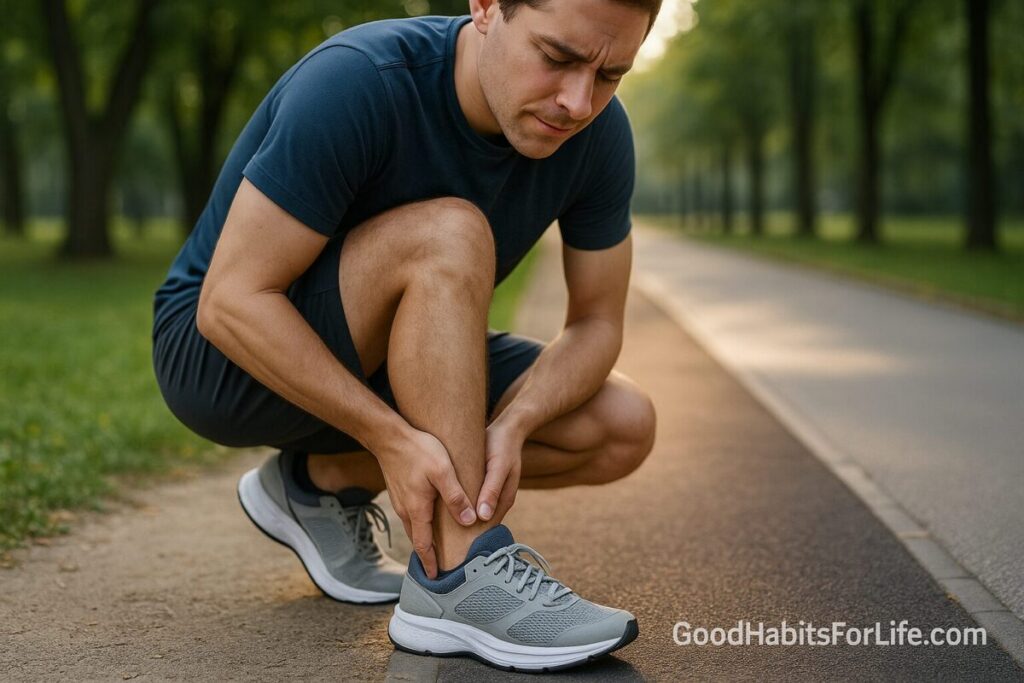
“Shin splints” usually means Medial Tibial Stress Syndrome (MTSS)—diffuse pain along the inner border of the tibia from repetitive load exceeding recovery. It sits on the bone-stress continuum: irritation → stress reaction → stress fracture if loading errors persist. Common drivers: rapid spikes in training volume/intensity, hard/uneven surfaces, poor footwear match, and limited calf/hip strength or biomechanics that increase tibial bending/traction. Women and new runners carry higher risk, as do low energy availability and vitamin D deficiency.
Goal: Calm symptoms by reducing tibial load, then rebuild capacity with graded impact, strength, and gait tweaks—while maintaining fitness via Zone 2 cardio and NEAT.
✅ Quick Start: Do This Today
-
Back off impact for 7–10 days: no hard runs, hills, or sprints. Swap to bike/elliptical/row at Zone 2 (easy conversational) 30–45 min, 4–6×/week.
-
Surface choice: if you must run, use treadmill/track/grass, not concrete; keep it easy and short (pain ≤2/10 during, gone by next morning).
-
Footwear audit (same day): rotate to a well-cushioned, not worn-out shoe. If you visibly over-pronate or have recurring MTSS, consider a temporary orthotic or shock-absorbing insole.
-
Strength micro-routine (daily, 10–15 min):
-
Standing and bent-knee calf raises 3×12–15
-
Tibialis anterior raises (wall “shin raises”) 3×12–15
-
Hip abductor/ER band work 2×15/side
-
Soleus wall sits (heels down) 3×30–45s
-
Gentle ankle dorsiflexion/soleus stretches 2×30s
-
-
Gait nudge: on easy runs, increase cadence by ~5–10% (use a metronome app) to reduce overstride and tibial shock.
-
Green flags to progress: pain ≤2/10 while running, no next-morning increase, and no focal point tenderness.
🛠️ 30-60-90 Fix Roadmap (with checkpoints)
Days 1–30: Calm & Capacity
-
Impact: 0–2 short easy runs/wk (10–20 min) on soft surface only if pain ≤2/10 and resolves by next day; otherwise cross-train.
-
Cardio: Zone 2 (bike/elliptical/row) 30–60 min, 4–6×/wk.
-
Strength (3×/wk):
-
Calf raise progression to single-leg (straight + bent knee) 4×8–12
-
Tibialis (loaded if possible) 3×12–15
-
Hip abductors/ER (band walks, clams) 3×12–15
-
Split squat or step-down 3×8–10/side
-
-
Checkpoints: Can hop 10× on one leg with ≤2/10 pain? Morning tenderness gone? If yes, begin Return-to-Run (below).
Days 31–60: Rebuild & Retrain
-
Return-to-Run (3×/wk, soft surface):
-
W1–2: Run-walk 1:2 × 10–12 reps (≈30–36 min), cadence +5–10%.
-
W3–4: Run-walk 2:1 × 10 reps; add gentle strides only if fully pain-free.
-
-
Strength: maintain; add soleus-dominant (seated calf, wall sits) and isometrics (45–60s holds) for tendon comfort.
-
Shoes/surfaces: continue cushioned pairs; avoid sudden changes.
Days 61–90: Build Back Smarter
-
Progression:
-
Increase weekly run volume ≤10%.
-
Re-introduce hills/tempos gradually (1 variable/week).
-
-
Surfaces: mix in road last; save concrete for shortest sessions.
-
Strength: move to heavy calf work (6–8 reps), plyo intro (low-amplitude pogos, 2×/wk) if pain-free.
-
Checkpoint to “graduate”: full week of planned running at target volume, zero morning pain, and single-leg hop test pain-free.
🛣️ Load, Surfaces, and Shoes (what to change first)
Load rules that prevent relapse
-
No spikes: keep weekly volume increases ≤10% and intensity blocks to 1 new stress per week (e.g., add hills or intervals, not both).
-
Hard days hard, easy days easy: separate intensity by at least 48 hours.
-
Pain rule: 0–2/10 during; no worse the next morning.
Surface guide (relative tibial impact, approximate)
| Surface | Relative impact | Use when |
|---|---|---|
| Treadmill (cushioned) | Low | Early return; cadence practice |
| Grass/turf | Low–Moderate | Variety; watch uneven footing |
| Track (synthetic) | Moderate | Controlled reps; not daily |
| Asphalt road | Moderate–High | Later phases; short doses first |
| Concrete | High | Avoid until fully robust |
(Choose consistency over novelty; avoid sudden big surface changes that create new spikes.)
Shoes & insoles
-
Replace at 500–700 km (300–450 mi) or when midsole feels dead.
-
Match your mechanics: neutral vs. stability.
-
Consider shock-absorbing insoles/orthoses temporarily if you over-pronate or have recurrent MTSS; evidence supports benefits for some runners, especially in military/novice populations. See References.
🧠 Strength & Mobility You Actually Need
Targets that matter for MTSS:
-
Soleus & gastrocnemius (both angles): heavy slow raises, seated calf, isometrics.
-
Tibialis anterior (shin): raises and controlled lowering.
-
Foot intrinsic muscles: short-foot drills, towel curls (2–3×/wk).
-
Hip abductors/external rotators: reduce dynamic valgus/over-pronation moments.
-
Ankle dorsiflexion mobility and soleus length (knee-bent calf stretch).
Sample 30-min session (2–3×/wk):
-
Seated calf raise (soleus) 4×8–10 heavy
-
Standing single-leg calf (gastroc) 3×10–12
-
Tibialis raises 3×12–15
-
Lateral band walks 3×15/side
-
Split squat 3×8–10/side
-
Short-foot hold 3×30–45s + knee-bent calf stretch 2×30s
🏃♀️ Gait Tweaks: Cadence & Overstride
-
Increase step rate by ~5–10% from your baseline; this typically reduces overstride and tibial shock without major trade-offs.
-
Keep torso tall, feet under center of mass, and avoid aggressive forefoot striking if it aggravates calves.
-
Add these during easy runs first, then to workouts after pain-free weeks.
🧑🎓 Audience Variations
-
Students/Novice runners: use run-walk templates; prioritize shoes/insoles and surface consistency.
-
Busy professionals: preserve fitness with Zone 2 cross-training + NEAT goal of 7,000–10,000 steps/day; brief but heavy calf work.
-
Seniors: favor elliptical/cycling water-running early; progress hops/plyos cautiously; check meds/bone health.
-
Teens: watch growth-spurts, energy availability, and shoe wear; coach-parent alignment on load rules.
⚠️ Mistakes & Myths to Avoid
-
“Push through it.” Risk of stress fracture rises when pain localizes and persists.
-
Only stretching the calves. Helpful for mobility, but capacity (strength) and load management fix the cause.
-
Sudden minimalist shoes or barefoot when painful—often spikes tibial load.
-
Only icing and massage. Symptom relief ≠ solving overload.
-
Jumping straight back to speedwork once pain dips—follow the roadmap.
🗣️ Real-Life Examples & Scripts
Coach/Manager note (copy-paste):
I’m managing medial tibial stress symptoms. For 2–3 weeks I’ll swap impact for Zone 2 cardio, strengthen calves/hips, and use softer surfaces. I’ll reintroduce running via a graded plan and keep cadence +5–10%. Please schedule workouts accordingly.
Physio/Doctor checklist:
-
Diffuse vs. focal bony tenderness?
-
Consider vitamin D/energy availability risks.
-
Imaging if red flags: night pain, swelling, focal point tenderness, or worsening despite 2–3 weeks of deload.
Return-to-run card:
-
Pain ≤2/10 while running
-
No next-morning increase
-
Single-leg hop 10× pain-free
-
Cadence target met
📲 Tools, Apps & Resources
-
Cadence metronome apps: set +5–10% above baseline.
-
HR monitor or watch: hold Zone 2 (conversational, ~60–70% HRmax) for cross-training.
-
Step tracker: keep NEAT high (movement snacks, walking meetings).
-
Strength gear: slant board or step, resistance bands, a dumbbell/kettlebell for heavy calf work.
-
Surfaces map: identify local track/park/treadmill access for early phases.
📌 Key Takeaways
-
MTSS is an overload problem—solve it with load control first.
-
Zone 2 + NEAT keep cardio and recovery humming while the tibia calms.
-
Use cushioned shoes/appropriate insoles and forgiving surfaces early.
-
Build soleus/gastroc/tibialis + hip strength; then add gait tweaks.
-
Follow a 30-60-90 progression; green-light tests prevent relapse.
❓ FAQs
1) How do I know if it’s a stress fracture?
Shin splints feel diffuse along the inner shin and warm up with movement; stress fractures trend focal, may hurt at rest/night and worsen with activity. Persistent or focal pain warrants medical evaluation and possibly imaging.
2) Do compression sleeves help?
They may give short-term comfort, but evidence for preventing or curing MTSS is limited. Use them as a comfort tool—not the fix.
3) Which shoe is best?
The one that matches your mechanics and feels comfortable at your training pace. Cushioned models help many; stability features or orthoses may help over-pronators or recurrent cases.
4) Can I keep running through pain?
Light running on soft surfaces can be okay if pain stays ≤2/10 and resolves by next morning. Otherwise, switch to cross-training until criteria are met.
5) Will stretching alone cure shin splints?
No. Stretching helps mobility, but strength + graded load are the proven levers.
6) Are hills or speedwork off-limits?
Temporarily. Re-introduce one stressor at a time in the 61–90 day phase, monitoring next-day symptoms.
7) Is vitamin D relevant?
Low vitamin D and poor energy availability raise bone-stress risk. Test/treat with a clinician if you’re high-risk.
8) How many steps for NEAT?
Aim for 7,000–10,000 steps/day as a practical target while you rebuild impact tolerance.
📚 References
-
StatPearls (NCBI Bookshelf): Medial Tibial Stress Syndrome. https://www.ncbi.nlm.nih.gov/books/NBK539783/
-
AAOS OrthoInfo: Shin Splints (Medial Tibial Stress Syndrome). https://orthoinfo.aaos.org/en/diseases–conditions/shin-splints/
-
Winters M, et al. Efficacy of interventions for MTSS: systematic review. Sports Med. 2018. https://pubmed.ncbi.nlm.nih.gov/29470830/
-
Moen MH, et al. Risk factors and aetiology of MTSS: systematic review. Sports Med. 2009/2012. https://pubmed.ncbi.nlm.nih.gov/20131130/
-
Heiderscheit BC, et al. Effects of step rate manipulation on running mechanics. Med Sci Sports Exerc. 2011. https://pubmed.ncbi.nlm.nih.gov/21367953/
-
CDC: How much physical activity do adults need? https://www.cdc.gov/physicalactivity/basics/adults/index.htm
-
Levine JA. Non-exercise activity thermogenesis (NEAT). Best Pract Res Clin Endocrinol Metab. 2002. https://pubmed.ncbi.nlm.nih.gov/12468415/
-
Warden SJ, Davis IS, Fredericson M. Bone stress injuries: etiology, evaluation, management. Curr Sports Med Rep. 2014. https://pubmed.ncbi.nlm.nih.gov/24966238/
-
Lappe J, et al. Calcium–vitamin D reduces stress fractures in naval recruits. J Bone Miner Res. 2008. https://pubmed.ncbi.nlm.nih.gov/18411085/
-
NHS: Shin splints. https://www.nhs.uk/conditions/shin-splints/
Disclaimer: This guide is educational and not a substitute for personalized medical advice; seek care if symptoms are severe, focal, or persist despite load reduction.