
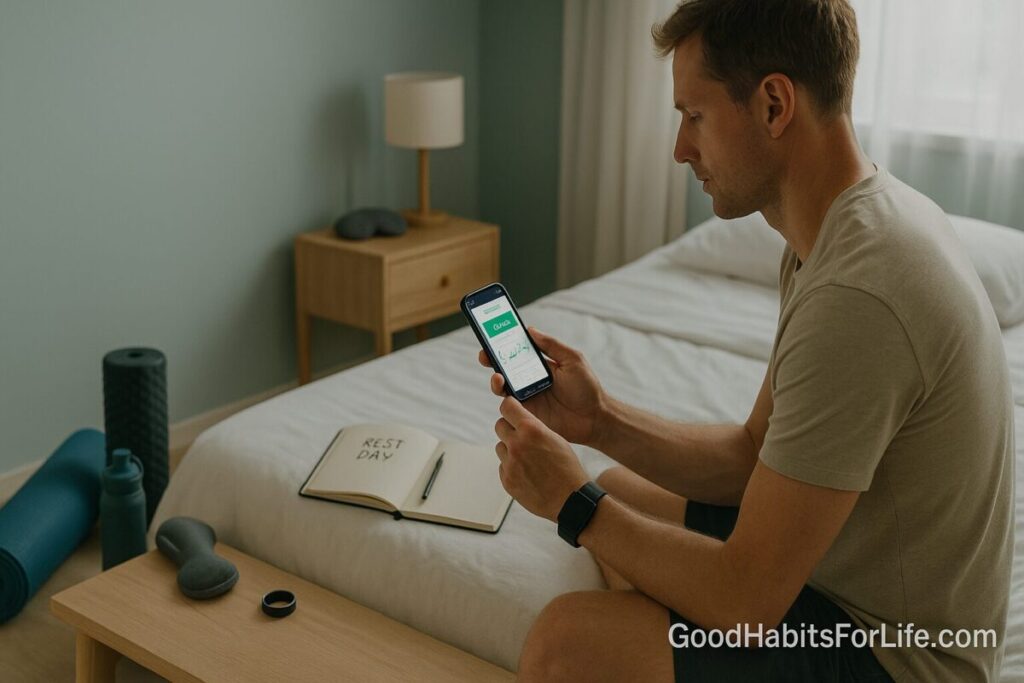
Recovery 2025: HRVSmart Rest Days
Recovery 2025: HRV Smart Rest Days
Table of Contents
🧭 What HRV Is & Why It Drives Smarter Rest Days
Heart Rate Variability (HRV) is the beat-to-beat variation in time between heartbeats. Higher parasympathetic (vagal) activity generally raises HRV, signaling recovery and readiness; sustained reductions can indicate fatigue, illness, or excess load. rMSSD (or lnRMSSD) is the preferred day-to-day training metric because it reflects vagal tone and resists breathing-rate confounds. Evidence shows HRV-guided training improves endurance performance and helps individualize load versus rest decisions.
Benefits for 2025 training:
-
Personalized rest days based on your baseline (not a one-size plan).
-
Fewer “junk” sessions by avoiding high-intensity work on low-recovery mornings.
-
Earlier flags for illness/overreaching when HRV trends drop or deviate for several days.
-
Better long-term consistency and lower injury risk via evidence-aligned load management.
✅ Quick Start: Your First HRV-Smart Week
Goal: Get a clean 7-day baseline and one decision rule you can use immediately.
What you need
-
A validated method: chest strap (e.g., Polar H10) + app (HRV4Training, Elite HRV, Kubios) or validated PPG device/app.
-
A quiet routine: Same time each morning after waking, before caffeine, seated/supine, 60–90s.
Steps (Day 1–7)
-
Measure HRV each morning (rMSSD or lnRMSSD), record resting HR, sleep hours/quality, soreness, and mood.
-
Baseline: Calculate the 7-day rolling average and standard deviation (SD) (apps do this).
-
Set a “Yellow” threshold: Smallest worthwhile change (SWC) ≈ 0.5 × SD below your rolling average (use lnRMSSD if available).
-
Decision rule:
-
Green: within baseline ± SWC → train as planned.
-
Yellow: 1–2 days below average by >SWC or resting HR up ≥5–7 bpm → reduce intensity/volume 30–50%.
-
Red: ≥2 consecutive days >SWC drop or strong fatigue/poor sleep/illness signs → active recovery or rest.
-
-
Log adjustments (kept/eased/skipped). Note feelings later that day—this validates your thresholds.
🧠 30-60-90 Roadmap for HRV-Guided Recovery
Days 1–30: Build your baseline & one simple rule
-
7–14 days: stabilize measurement routine; lock your Green/Yellow/Red thresholds.
-
Weeks 3–4: start HRV-guided rest days—swap HIIT for Zone 2 or mobility on Yellow/Red days.
-
KPI: Adherence ≥85% to morning readings; 2+ subjective PRs (e.g., feeling fresher, better sleep).
Days 31–60: Individualize load & add cross-checks
-
Add orthostatic test (supine → stand 60s) once or twice weekly; note HR/HRV reactivity.
-
Start block periodization: e.g., 3-week build + 1-week deload, refined by HRV.
-
KPI: Fewer RPE 8–10 sessions on Yellow/Red days without performance drop.
Days 61–90: Automate and scale
-
Automate rolling averages & SWC in app; enable alerts.
-
Layer in sleep duration/efficiency and training load (TRIMP/TSS) dashboards.
-
KPI: Monotony stays <2.0, no back-to-back Reds, and HRV trend stable/up across the block.
🛠️ Techniques & Frameworks
Color-Zone Framework (daily)
-
Green: lnRMSSD within baseline ± SWC; resting HR within 2–4 bpm of baseline → Do planned session.
-
Yellow: lnRMSSD below baseline by >SWC or resting HR up ≥5–7 bpm → Lower intensity/volume (e.g., cut intervals, shift to Zone 2, mobility).
-
Red: ≥2 days below by >SWC or compounding fatigue/illness → Active recovery, breathwork, easy walk, or rest.
2-Signal Confirmation
Use HRV + one more: resting HR, sleep efficiency, soreness, mood, or grip strength. Two negatives → adjust training.
Weekly Review (Sunday, 15 minutes)
-
Check 7/28-day trends, note triggers (late nights, alcohol, travel), and adjust the next microcycle.
“Recovery Stack” (30–60 minutes on Yellow/Red)
-
10 min nasal breathing (4-6 breaths/min), 20–30 min Zone 1–2 walk or cycle, 10 min mobility, 5 min journaling what helped.
👥 Variations by Audience
-
Students: Measure after waking from short nights; protect sleep consistency and limit late caffeine. Shift hard sessions away from exam weeks.
-
Busy parents: If mornings are chaotic, do a same-time mid-morning reading (pre-caffeine) and keep the Recovery Stack bite-sized (e.g., 15–20 min).
-
Professionals/travelers: Tag red-eye flights/time-zone jumps; expect 48–72h HRV suppression—keep Zone 2 and mobility only.
-
Seniors: Prioritize walks, strength twice weekly, balance work; HRV may be lower overall—track your trend, not absolute numbers.
-
Teens: Growth and sport schedules swing HRV; emphasize sleep duration and tech curfews.
⚠️ Mistakes & Myths to Avoid
-
Chasing a “high number.” Absolute HRV varies huge between people—trend beats score.
-
Making big calls on one bad day. Look for 2–3-day patterns plus a second signal.
-
Ignoring context. Illness can paradoxically raise resting parasympathetic markers in some phases; watch symptoms.
-
Using SDNN for daily training (too global for short readings). Prefer rMSSD/lnRMSSD.
-
Skipping deloads. Even with Green days, plan deload weeks per activity guidelines.
💬 Real-Life Examples & Ready-to-Use Scripts
Runner (10k plan):
-
Mon: Green → intervals (6×800 m) as planned.
-
Thu: Yellow + poor sleep → swap to 40-min Zone 2 run + 10-min strides.
-
Sun: Red (2 days) → 30-min walk + mobility; resume build Monday.
Strength lifter:
-
Green → 5×5 back squat.
-
Yellow → 3×5 at 80% of planned load + tempo work; finish with core.
-
Red → technique drills, sled work, breathwork.
Coach/partner script:
-
“My lnRMSSD is down >SWC for 2 days and RHR is +7 bpm. I’m switching today to active recovery and moving the hard session to Friday.”
-
“Travel + poor sleep dropped my HRV; I’ll keep volume light and reassess tomorrow.”
📚 Tools, Apps & Resources (Pros & Cons)
-
HRV4Training (iOS/Android, camera or strap) — Pros: research-aware metrics (lnRMSSD), easy baselines; Cons: camera needs good lighting.
-
Elite HRV (strap-based) — Pros: reliable morning readings; Cons: more manual setup.
-
Kubios HRV — Pros: gold-standard analysis; Cons: advanced UI.
-
Wearables (Garmin, Polar, Oura, WHOOP, Apple Watch) — Pros: passive nightly data, readiness scores; Cons: algorithms differ; still confirm with morning readings when decisions matter.
🔑 Key Takeaways
-
Measure daily, same time, and track lnRMSSD (or rMSSD) with a 7–28-day rolling baseline.
-
Use SWC (~0.5×SD) to create Green/Yellow/Red decision zones.
-
Adjust training on Yellow/Red rather than pushing through fatigue.
-
Confirm decisions with a second signal (RHR, sleep, soreness, mood).
-
Review trends weekly and plan deloads to protect long-term progress.
❓ FAQs
1) What’s the best HRV metric for training decisions?
Use rMSSD/lnRMSSD from a short morning reading; it reflects vagal tone and is less affected by breathing/pacing than SDNN.
2) How long should my morning reading be?
60–90 seconds seated or supine is sufficient for rMSSD; be consistent with posture/time of day.
3) What if my HRV drops but I feel fine?
Check a second signal (resting HR, sleep). One off-day isn’t decisive; 2–3 days below baseline or symptoms → scale back.
4) Does alcohol or poor sleep affect HRV?
Yes—both commonly lower HRV the next morning; protect sleep and hydration on build weeks.
5) Can high HRV ever be a bad sign?
During some illness phases, HRV can be atypically high/variable; use symptoms and resting HR to interpret.
6) Do I need a chest strap?
Chest straps remain the gold standard; some PPG/wearables are improving but confirm key calls with a validated method.
7) How do rest days fit with official activity guidelines?
Plan weekly volume per national guidelines (e.g., 150–300 min moderate or 75–150 min vigorous) but allow HRV-guided rest/adjustments to stay consistent.
8) Should beginners use HRV?
Yes—start simple: build a baseline, one threshold, and one adjustment rule. Keep training fun and sustainable.
References
-
Task Force of the European Society of Cardiology and the North American Society of Pacing and Electrophysiology. Heart rate variability: standards of measurement, physiological interpretation and clinical use. Circulation (1996). https://www.ahajournals.org/doi/10.1161/01.CIR.93.5.1043
-
Shaffer F, Ginsberg JP. An Overview of Heart Rate Variability Metrics and Norms. Frontiers in Public Health (2017). https://www.frontiersin.org/articles/10.3389/fpubh.2017.00258/full
-
Buchheit M. Monitoring Training Status with HR Measures. Sports Medicine (2014). https://link.springer.com/article/10.1007/s40279-014-0258-4
-
Kiviniemi AM et al. Endurance training guided individually by daily HRV measurements. Eur J Appl Physiol (2010). https://link.springer.com/article/10.1007/s00421-009-1212-z
-
Plews DJ et al. The practical application of HRV monitoring in endurance athletes. Frontiers in Physiology (2013). https://www.frontiersin.org/articles/10.3389/fphys.2013.00303/full
-
Stanley J, Peake JM, Buchheit M. Cardiac parasympathetic activity and its relationship with training status, performance and training load: a review. Sports Medicine (2013). https://link.springer.com/article/10.1007/s40279-013-0083-4
-
Natarajan A et al. Association of wearable device-measured HRV, resting heart rate and sleep with COVID-19. npj Digital Medicine (2020). https://www.nature.com/articles/s41746-020-00318-9
-
U.S. Department of Health and Human Services. Physical Activity Guidelines for Americans, 2nd edition. (2018). https://health.gov/our-work/physical-activity/current-guidelines
Disclaimer: This article provides general fitness information and is not a substitute for personalized medical advice; consult a qualified professional before changing your training or recovery plan.