
Fascia 101: Slow Loaded Stretching: Zone 2 + NEAT (2025)
Fascia 101: Slow-Loaded Stretching, Zone 2 & NEAT
Table of Contents
🧭 What Is Fascia? Why It Matters
Fascia is a continuous, body-wide network of connective tissue wrapping muscles, joints, nerves, and organs. It transmits force, guides movement, and houses many sensory receptors. When hydrated and well-loaded, fascia behaves like an elastic spring; when under-used or over-stressed, it can feel “sticky,” stiff, or painful.
Key benefits of caring for fascia
-
Better mobility and joint comfort
-
More efficient force transfer (movement feels “lighter”)
-
Reduced next-day stiffness; quicker recovery
-
Lower injury risk via improved load tolerance
Fascia adapts to mechanical loading (slow tension, compression, shear) and to fluid dynamics (movement pumps water in/out of tissues). That’s why we combine slow-loaded stretching, Zone 2 cardio, and NEAT.
✅ What Is Slow-Loaded Stretching (SLS)?
Slow-loaded stretching blends end-range mobility work with light external load or active tension through the range. Instead of passively hanging out in a stretch, you:
-
move slowly into end-range,
-
apply a small load or active contraction,
-
breathe and control the position, then
-
return with control.
Why SLS works
-
Builds range + strength at end-range (useful range, not floppy range)
-
Provides the time-under-tension fascia loves (viscoelastic tissues lengthen better when loaded slowly)
-
Encourages tissue remodeling and improved tendon-muscle unit tolerance
Examples
-
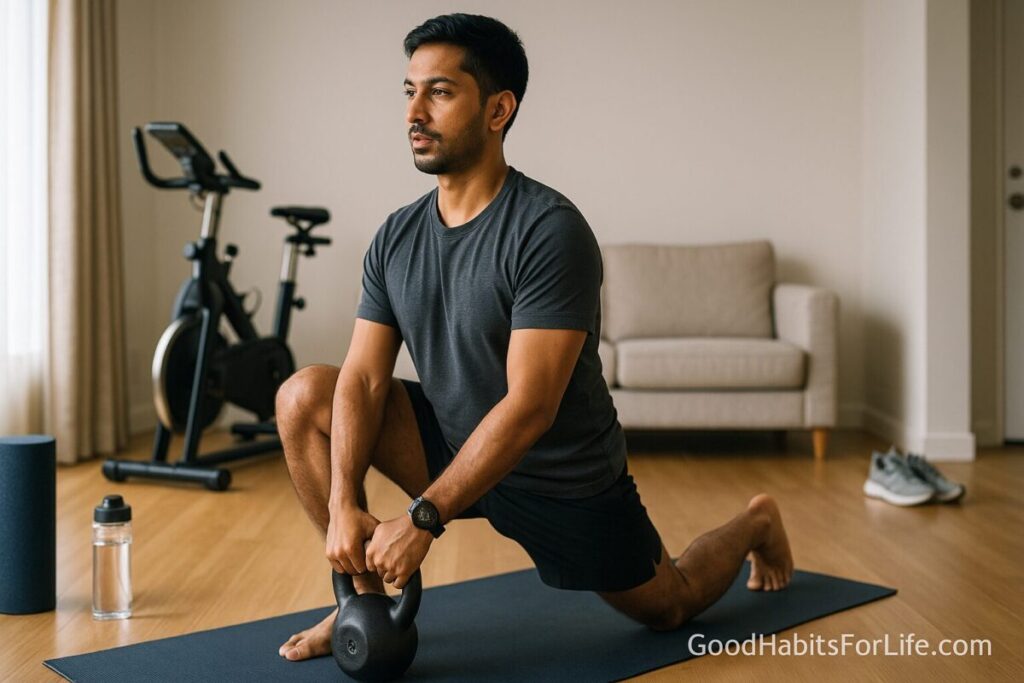
Heel-elevated split squat hold (light weight) for hip flexors/quads
-
Jefferson curl (very light) for posterior chain
-
Calf incline raise-and-lower with long pauses
-
Cossack squat with isometric holds at the bottom
🧠 Why Pair SLS with Zone 2 & NEAT
-
Zone 2 cardio = easy, conversational aerobic work at roughly 60–70% VO₂max (often ~70–80% HRmax). This boosts capillary density, mitochondrial function, and blood flow, supporting tissue nutrition and recovery.
-
NEAT = non-exercise activity thermogenesis (standing, steps, chores). It breaks up sitting, hydrates fascia via gentle, frequent movement, and keeps baseline stiffness down.
Synergy
-
SLS remodels local tissues.
-
Zone 2 improves the circulatory “delivery system.”
-
NEAT keeps the fluid pump on all day so adaptations stick.
🛠️ Quick Start: Do-This-Today Plan
Time: ~30–35 minutes
-
Warm up (5 min): brisk walk or easy cycle; joint circles.
-
SLS block (15–18 min):
-
Pick 3 moves (e.g., split squat hold, calf incline, Jefferson curl).
-
2 sets each, 30–45 s hold per rep, 2–3 reps per set, light load (RPE ~4–5/10).
-
Slow nasal breathing: 4-sec in / 6-sec out.
-
-
Zone 2 finisher (10 min): easy bike/row/jog at conversational effort.
-
NEAT goal (all day): 7,000–10,000 steps (4.3–6.2 miles) or short 2–3 min movement breaks every 30–45 min of sitting.
📆 30-60-90 Habit Roadmap
Goal: durable mobility, less stiffness, better daily movement.
Days 1–30 (Foundation)
-
SLS: 3×/week, 3–4 exercises, 2–3 sets, 30–45 s holds, very light load.
-
Zone 2: 2×/week, 20–30 min.
-
NEAT: 7–9k steps/day; stand up every 45 min.
-
Checkpoint: note morning stiffness (0–10), sit-to-stand ease, and reach test.
Days 31–60 (Progress)
-
SLS: 3–4×/week; add tempo (5-second lowers) or micro-load increases.
-
Zone 2: 3×/week, 25–35 min.
-
NEAT: 8–10k steps/day; add 1–2 short mobility snacks (2–3 min).
-
Checkpoint: deeper positions feel steadier; fewer “tight days.”
Days 61–90 (Performance & Resilience)
-
SLS: 4×/week; include end-range eccentrics (e.g., slow down-phase).
-
Zone 2: 3–4×/week, 30–45 min; optional strides (4×20–30 s very easy-fast) if you run.
-
NEAT: 9–12k steps/day; aim for 1–2 “walk-and-talk” calls daily.
-
Checkpoint: improved tolerance to long days, faster warm-ups, better posture.
🔧 Techniques & Frameworks (Protocols)
SLS Protocol (per exercise)
-
Load: bodyweight to light kettlebell/dumbbell (2–12 kg / 5–25 lb) as tolerated
-
Tempo: 3–5 s into end-range → 30–60 s hold → 3–5 s out
-
Breath: 4-in / 6-out; keep face/jaw relaxed
-
Sets/Reps: 2–3 sets × 2–3 “breath reps” per side
-
Progression: slightly deeper range or +1–2 kg each week if smooth
Zone 2 Finder
-
Talk test: full sentences, nose breathing mostly OK
-
Heart rate (rough guide): ~70–80% HRmax (HRmax ≈ 220 − age)
-
Time: accumulate 150+ min/week moderate activity (include Zone 2 blocks)
NEAT Anchors
-
Default to walking: stairs > lift; 10-minute post-meal walks
-
Micro-break loop: 10 air squats + 10 calf raises + 10 arm swings every 45–60 min
-
Home base: keep a light kettlebell near your desk—do 5 slow goblet squats at each break
👥 Audience Variations
Students
-
5-minute “pomodoro mobility” between study blocks; campus walking loops; backpack carry as light load.
Parents
-
Stroller walks for Zone 2; floor-time SLS (cossacks, shin box) while kids play.
Busy Professionals
-
20-min lunch Zone 2 + evening SLS micro-circuit; walking meetings for NEAT.
Seniors
-
Prioritize support (countertop/chair) for SLS; Zone 2 via brisk walks or recumbent bike; emphasize balance holds (tandem stance) and slower progressions.
⚠️ Mistakes & Myths to Avoid
-
Myth: “More stretch time = better.”
Reality: Quality tension + control beats long passive holds. -
Mistake: Jumping to heavy loads at end-range.
Fix: Start very light; progress weekly only if technique is smooth. -
Myth: “Cardio and mobility are separate worlds.”
Reality: Zone 2 blood flow accelerates tissue recovery and hydration. -
Mistake: Doing SLS once a week.
Fix: Fascia adapts to regular loading; aim for 3–4×/week. -
Mistake: All-or-nothing NEAT.
Fix: Many tiny breaks outperform one giant session.
💬 Real-Life Examples & Scripts
Desk Break (2–3 min)
-
“Timer went off—stand → 10 calf raises on a step (5 s down) → 6 slow Cossacks (hold 20 s each side) → sit tall, breathe 4/6 for 30 s.”
Evening Reset (12–15 min)
-
Warm walk 3 min → Split squat hold 2×30 s/side → Calf incline raise 2×8 (3 s down, 2 s pause) → Easy bike 6–8 min Zone 2.
Weekend Combo (30–40 min)
-
Trail walk (Zone 2) + park bench SLS: hip flexor long lunge holds and standing calf eccentrics.
🧩 Tools, Apps & Resources
-
Timer apps (iOS/Android) for 4/6 breathing and sit-break reminders
-
Wearables (HR monitor, smartwatch) for Zone 2 pacing
-
Simple kit: yoga block, small wedge/board for calves, light kettlebell (6–12 kg)
-
Tracking: note morning stiffness (0–10), weekly step average, and three end-range positions you’re working on
Pros/Cons quick take
-
Wearables: precise effort / can distract if over-watched
-
Light weights: enable end-range strength / require patience
-
Wedges/blocks: fast setup / small cost
✨ Key Takeaways
-
Fascia thrives on slow, regular, progressive loading.
-
Combine SLS + Zone 2 + NEAT for mobility that lasts beyond the session.
-
Progress is measured (less morning stiffness, deeper control, easier daily movement).
-
Small daily choices (walks, breaks, breathing) compound into springy, pain-resistant tissues.
❓ FAQs
1) How heavy should I load in SLS?
Light enough to keep perfect control and nasal breathing; RPE ~4–5/10. Increase slowly (1–2 kg) when holds feel steady.
2) How long until I feel less stiff?
Many notice change in 2–4 weeks with 3–4 SLS sessions/week, daily NEAT, and 2–3 Zone 2 sessions.
3) Is Zone 2 necessary if I already lift?
Lifting is great, but Zone 2 improves circulation and recovery and pairs exceptionally with fascia-focused work.
4) Can I replace SLS with foam rolling?
Rolling can help short-term. SLS builds end-range capacity and longer-term adaptation.
5) What if my knees/back feel sensitive?
Shorten the range, reduce load, and slow down. Use supports (bench, rail). If pain persists, consult a qualified clinician.
6) What step count should I aim for?
Aim 7–10k steps/day and frequent stand-move breaks. Consistency beats perfection.
7) How do I know I’m in Zone 2 without a monitor?
You can talk in full sentences, breathing through your nose most of the time, and finish feeling fresh.
8) Can I do SLS on off-days from running or lifting?
Yes—keep loads light and use SLS as a recovery-plus-mobility session.
9) Does stretching before workouts reduce strength?
Long static holds immediately before max-strength efforts might; SLS with light loads and active control is typically fine when not fatiguing.
10) How many exercises per SLS session?
Start with 3–4 patterns that target your tightest lines (calves/hamstrings/hip flexors/hips) and rotate weekly.
📚 References
-
World Health Organization. Physical activity guidelines & facts. https://www.who.int/news-room/fact-sheets/detail/physical-activity
-
American College of Sports Medicine. ACSM Guidelines for exercise & flexibility recommendations. https://www.acsm.org
-
Levine JA. Non-exercise activity thermogenesis (NEAT). Proc Nutr Soc. 2002;61(3):375–386. https://pubmed.ncbi.nlm.nih.gov/12446481/
-
Seiler S. Training intensity distribution in endurance athletes. Int J Sports Physiol Perform. 2010;5(3):276–291. https://pubmed.ncbi.nlm.nih.gov/20861522/
-
Schleip R. Fascial plasticity—A new neurobiological explanation. J Bodyw Mov Ther. 2003/2004. https://pubmed.ncbi.nlm.nih.gov/18440264/
-
Wilke J, et al. Myofascial chains: evidence update. Arch Phys Med Rehabil. 2016;97(3):454–461. https://pubmed.ncbi.nlm.nih.gov/26905937/
-
Beyer R, et al. Heavy slow resistance vs eccentric training for tendinopathy. Am J Sports Med. 2015;43(7):1704–1711. https://pubmed.ncbi.nlm.nih.gov/26144986/
-
Behm DG, Chaouachi A. Acute effects of stretching on performance. Eur J Appl Physiol. 2011;111(11):2633–2651. https://pubmed.ncbi.nlm.nih.gov/21127885/
-
Magnusson SP, Kjaer M. Mechanical properties and remodeling of tendon/connective tissue with loading. Scand J Med Sci Sports. 2019;29(1):4–18. https://pubmed.ncbi.nlm.nih.gov/30146754/
-
Weppler CH, Magnusson SP. Increasing muscle extensibility: a matter of tolerance vs structural change. Phys Ther. 2010;90(3):438–449. https://pubmed.ncbi.nlm.nih.gov/20075147/
Disclaimer: This guide is educational and not a substitute for personalized medical advice; consult a qualified clinician if you have pain, injury, or medical conditions.