
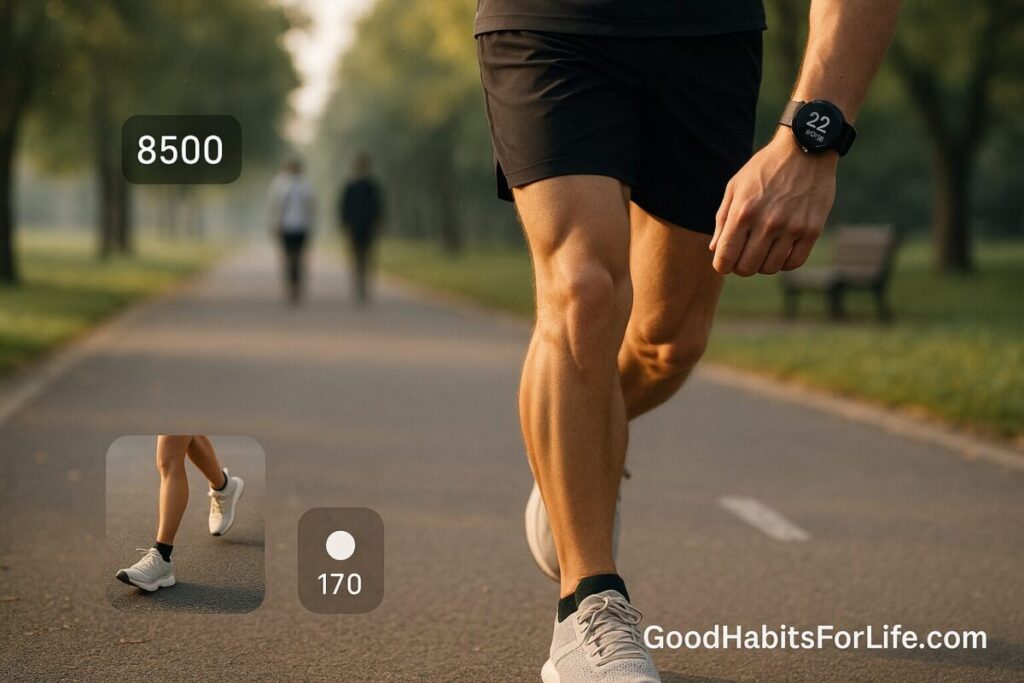
Ankles & Knees: Bulletproof for Runners: Zone 2 + NEAT (2025)
Bulletproof Ankles & Knees for Runners: Zone 2 + NEAT (2025)
Table of Contents
🧭 What & Why
Goal: Make your ankles and knees resilient so you can run more with fewer setbacks.
Why it works
-
Aerobic base (Zone 2)—steady-easy running increases capillary density and mitochondrial function, supporting cartilage and tendon metabolism and enabling you to handle more weekly volume with less stress. In practical terms, it’s the pace where you can speak in full sentences and keep HR roughly ~65–75% of max (or ~60–70% of heart-rate reserve).
-
NEAT (Non-Exercise Activity Thermogenesis)—your background movement (steps, standing, light chores) improves blood flow, joint lubrication (synovial fluid), and recovery between harder runs.
-
Strength + balance fortify the kinetic chain: strong calves/tibialis stabilize the ankle; quads and glutes control knee valgus and impact; balance training reduces ankle sprain risk.
-
Cadence and form tweaks reduce joint loading without changing shoes or stride length dramatically.
The combo—Zone 2 + NEAT + strength/balance + cadence tune-up—is a low-risk, high-return approach to “bulletproof” your lower limbs.
✅ Quick Start (Do This Today)
-
Set your Zone 2: warm up 5–10 min, then run at a pace where you can talk comfortably (RPE 3–4/10). Keep HR ~65–75% max.
-
Add NEAT: hit 8,000–10,000 steps/day (or +2,000 more than your current baseline). Break up long sits every 30–60 min.
-
Strength (15 min):
-
Calf raises (straight-knee) 3×12
-
Tibialis raises (heel on floor, lift forefoot) 3×12
-
Spanish squats or sit-to-stands 3×8–10
-
Side-lying hip abduction or banded monster walks 2×12
-
-
Balance (5 min): single-leg stand eyes-forward 3×30s/side; progress to head turns or soft surface.
-
Cadence bump: on easy runs, increase steps/min by ~5% (e.g., 165→173) using a metronome for 3×2-minute bouts.
-
Micro-mobility post-run: 60–90 s each—ankle circles, calf stretch, quad/hip flexor stretch.
-
Progress rule: if no next-day soreness worse than 3/10 and you sleep ≥7–8 h, you may add +5–10% weekly easy volume.
🛠️ 30-60-90 Roadmap (Durability First)
Checkpoints: Move forward only when the week’s work feels “comfortable” and you pass the tests.
Days 1–30 (Foundation: Tissue capacity + cadence)
-
Running: 3–4 Zone-2 runs/week (20–40 min each). Optional 1 technique session (run-walk with cadence drills).
-
Strength (3×/week):
-
Eccentric calf lowers off a step 3×8 (3 s down)
-
Tibialis raises 3×15
-
Bodyweight split squats 3×8/side
-
Hip bridge or hip thrust 3×10
-
-
Balance (daily 3–5 min): single-leg stance + toe-to-heel rockers.
-
NEAT: 8–10k steps/day.
-
Checkpoint (end of Day 30): hold single-leg balance 30 s eyes-open (no wobble), complete 3×8 eccentric calf lowers with good control, run 30 min Zone 2 without knee pain >2/10.
Days 31–60 (Strength & range)
-
Running: 4–5 runs/week; one can be a short strides session (6×15–20 s fast relaxed with full recovery), rest Zone 2.
-
Strength (3×/week):
-
Calf raise (heavy or single-leg) 4×6–8
-
Spanish squat 3×8–10
-
Lateral step-downs (low box) 3×8/side
-
Hip abduction (band) 3×12
-
-
Plyo (1×/week): small hops in place 2×20, line hops 2×20—stop if pain.
-
Mobility (after runs): ankle dorsiflexion drill (knee-to-wall) 2×8 each.
-
NEAT: keep 9–11k steps/day; add 5-min walk breaks every hour of desk time.
-
Checkpoint (Day 60): 45 min continuous Zone 2 comfortable; 10 controlled single-leg calf raises/side; painless 15-cm lateral step-downs.
Days 61–90 (Resilience & specificity)
-
Running: 5–6 days/week; 70–80% Zone 2. Optional one threshold or hill technique session/week (short, controlled).
-
Strength (2–3×/week): maintain heavy calf work 3×5–6, step-downs 3×8, rear-foot elevated split squats 3×6–8, hip thrust 3×6–8.
-
Plyo (1–2×/week): low-box jumps 3×6, single-leg pogo 2×20—only if painless next day.
-
NEAT: 10–12k steps/day average; evening 10-min walk on recovery days.
-
Form: hold the cadence bump on easy runs (e.g., +5–7% from baseline).
-
Checkpoint (Day 90): pain-free 60 min Zone 2; 15 single-leg calf raises/side; 60-s single-leg balance eyes-closed; ready to add volume or race-specific work.
🧠 Techniques & Frameworks
Zone 2 made simple
| Marker | Practical Cue |
|---|---|
| Breathing | Nose-dominant or easy conversation |
| HR | ~65–75% HRmax (or ~60–70% HRR) |
| RPE | 3–4/10 “all-day pace” |
| Talk test | Full sentences without gasping |
Why runners need it: keeps most training low-stress so tissues adapt (tendons, cartilage) while your aerobic system improves—less inflammation, more durability.
NEAT: the quiet recovery multiplier
-
Aim for 8–12k steps/day (or +2k above baseline).
-
Break sedentary time: 1–2 min every 30–60 min.
-
Add “habit hooks”: after coffee → 5-min walk; after meetings → stairs once.
Strength pillars (ankle → knee → hip)
-
Calf complex: gastrocnemius (knee-straight raises) + soleus (knee-bent raises).
-
Tibialis anterior: dorsiflexion strength (shin splint buffer).
-
Quads (VMO): Spanish squats, wall sits (knee-friendly).
-
Glute med/max: lateral step-downs, bridges/thrusts, monster walks to control knee valgus.
Cadence & impact
-
A small cadence increase (~5%) typically reduces hip/knee joint loading while keeping speed similar. Use a metronome or music BPM.
Mobility/ROM that matters
-
Ankle dorsiflexion: knee-to-wall drill to reach 8–10 cm (3–4 in).
-
Hip extension: short half-kneeling stretch post-run (60–90 s).
-
Dynamic warm-up (before): leg swings, marching A-steps, ankle circles (3–5 min).
👥 Audience Variations
-
Beginners/Students: use run-walk (e.g., 2 min run / 1 min walk) to stay in Zone 2; prioritize balance daily.
-
Busy Professionals: 30-min Zone-2 commute run + standing desk micro-walks; two 20-min strength snacks/week.
-
Parents: stroller walks = NEAT; mini-circuits at playground: step-ups, calf raises on curb.
-
Masters/Seniors: emphasize soleus work (seated calf raises), lower plyo volume, extra rest day if morning stiffness >30 min.
-
Trail Runners: balance on uneven surfaces, add short hill hikes for strength without impact.
⚠️ Mistakes & Myths to Avoid
-
Myth: “More stretching fixes knee pain.”
Reality: mobility helps, but strength + load management are primary. -
Mistake: jumping into intervals without a base.
-
Mistake: large cadence changes (>10%) at once—use +5–7%.
-
Myth: “Knee pain means you can’t run.”
Many runners train around mild symptoms while addressing strength/form (see FAQs). -
Mistake: ignoring sleep/hydration; poor recovery undermines tissue adaptation.
-
Myth: “Minimalist/max-cushion shoes alone fix problems.”
Footwear can help comfort, but technique and strength do the heavy lifting.
🗣️ Real-Life Examples & Scripts
5-Minute Pre-Run Prep (copy-paste checklist)
-
30 s ankle circles each way
-
10 marching A-steps + 10 leg swings/side
-
10 calf raises (slow)
-
10 sit-to-stands
-
2×20 s cadence drill at target BPM
Cadence cue script
-
“Light and quick feet.”
-
“Knees soft, land under hips.”
-
“Zip-up posture, eyes forward.”
Self-check after runs
-
Pain ≤2/10 and resolves within 24 h? ✅
-
Next-morning stiffness <20–30 min? ✅
-
If not, cut next run volume by 20–30% and add a walk.
Return-to-run micro-progression (for a minor flare)
-
Day 1–2: brisk walks 20–30 min + strength (no plyo)
-
Day 3–4: run-walk 1:1 × 20–30 min
-
Day 5–7: continuous Zone 2 20–30 min if symptom-stable
🧰 Tools, Apps & Resources
-
Metronome apps / music BPM (free): easy cadence control. Pros: precise; Con: needs earbud or phone.
-
GPS watch with HR + cadence: tracks Zone 2 & step rate. Pros: objective data; Con: cost.
-
Mini-bands / tibialis bar or wedge: targeted strength. Pros: specific; Con: store-bought kit.
-
Step counter (phone): supports NEAT goals. Pros: always on you; Con: undercounts if wrist-based only.
-
Safety: well-lit routes, gradual hills; swap to soft surfaces if joints feel cranky.
🔑 Key Takeaways
-
Keep 70–80% of weekly time in Zone 2; add volume slowly.
-
Hit 8–12k steps/day (or +2k above baseline) to boost recovery.
-
Do calf/quad/glute strength 2–3×/week + daily balance.
-
Use a +5–7% cadence bump to lower knee load.
-
Follow the 30-60-90 roadmap and progress only when checkpoints feel easy.
❓ FAQs
1) What exactly is Zone 2 for me?
Use the talk test (full sentences) and HR ~65–75% of max. If you don’t track HR, run at an “all-day” pace where breathing stays calm.
2) How many steps should I aim for?
A practical target is 8–12k/day, or simply +2,000 over your current baseline. The goal is frequent low-level movement, not perfection.
3) My knees ache after runs—stop or modify?
If pain is ≤3/10, not worsening, and settles within 24 h, many runners modify (more Zone 2, less hills, keep strength). If pain escalates or alters gait, rest and consult a clinician.
4) Does increasing cadence make me faster?
Indirectly. A small increase (~5%) can reduce knee/hip loading, letting you train more consistently. Speed comes from volume + workouts you can recover from.
5) Best shoes to protect knees?
Prioritize comfort and fit. Minimalist vs. maximalist is less important than what you can run in without hot spots, with room for toes and stable heel.
6) Are squats safe for runners’ knees?
Yes—properly dosed squats and step-downs strengthen quads and improve control. Start with bodyweight, slow tempo, pain-free range.
7) Should I stretch before running?
Do a dynamic warm-up (leg swings, marching, ankle circles). Save longer static stretches for after running or a separate session.
8) How fast should I progress weekly mileage?
Add 5–10% at most, and only after an easy week feels truly easy and recovery markers (sleep, soreness) are solid.
9) Do I need plyometrics?
Light plyo (hops, pogos) can help tendon stiffness and running economy—add gradually and skip if it provokes symptoms.
10) What if I’m training for a race?
Keep the durability base: 70–80% Zone 2, 1 quality session/week, and maintain strength twice weekly. Taper volume, not strength completely.
📚 References
-
World Health Organization. Guidelines on physical activity and sedentary behaviour (2020).
-
American College of Sports Medicine. ACSM’s Guidelines for Exercise Testing and Prescription, 11th ed.
-
CDC. Target Heart Rates for Exercise (moderate/vigorous intensity ranges).
-
Levine JA. Non-exercise activity thermogenesis (NEAT). Proc Nutr Soc. 2002;61(3):679-681.
-
Heiderscheit BC, et al. Effects of step rate manipulation on joint mechanics during running. Med Sci Sports Exerc. 2011;43(2):296-302.
-
Crossley KM, et al. Best practice guide to patellofemoral pain. Br J Sports Med. 2016;50(14):845-852.
-
Barton CJ, Lack S, et al. Hip + knee exercises for patellofemoral pain. Br J Sports Med. 2015;49(14):1028-1036.
-
Alfredson H, et al. Heavy-load eccentric calf training for Achilles tendinopathy. Am J Sports Med. 1998;26(3):360-366.
-
McKeon PO, Hertel J. Balance training and ankle sprain prevention. J Athl Train. 2008;43(3):305-315.
-
Behm DG, Chaouachi A. A review of dynamic vs static stretching. Appl Physiol Nutr Metab. 2011;36(5):495-510.
-
Esteve-Lanao J, et al. Training intensity distribution and performance in distance runners. Int J Sports Med. 2007;28(9):741-747.
-
Milewski MD, et al. Sleep and injury risk in adolescent athletes. J Pediatr Orthop. 2014;34(2):129-133.
Disclaimer: This information is educational and not a substitute for personalized medical advice; consult a qualified professional if you have pain, injury, or medical conditions.