
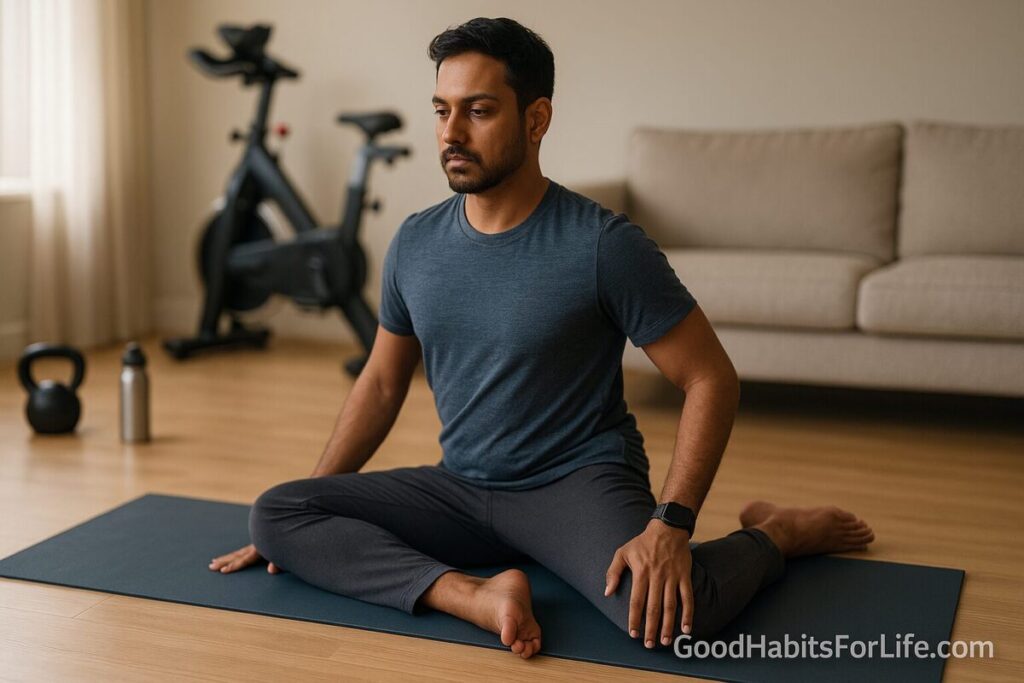
Hips That Dont Hurt: 90/90 & CARS Routine: Zone 2 + NEAT (2025)
Hips That Don’t Hurt: 90/90 & CARS + Zone 2 & NEAT (2025)
Table of Contents
🧭 What & Why
The goal: comfortable, mobile hips that let you sit, stand, walk, squat, and train without stiffness or pinching.
Core pieces of the habit:
-
90/90 stretch to reclaim internal/external rotation.
-
CARS (Controlled Articular Rotations) to nourish the joint, maintain range you earn, and build control.
-
Zone 2 cardio (conversational pace, ~60–70% max heart rate) to improve circulation and recovery.
-
NEAT (non-exercise activity thermogenesis) — all the movement you do outside workouts — to reduce stiffness from long sitting.
Evidence snapshot
-
Regular moderate-intensity aerobic exercise improves cardiometabolic health and aids recovery capacity.
-
Daily movement/NEAT meaningfully raises energy expenditure and reduces sedentary risk.
-
Strength + mobility around the hips supports function, reduces risk of overuse, and helps with common aches when progressed gradually.
(See References.)
✅ Quick Start (Do This Today)
Time needed: 15–20 minutes.
-
2-minute warm-up: brisk walk or marching in place.
-
Hip CARS (2 sets):
-
Slow circles from a quadruped or standing position, 3–5 reps each direction per side (tempo: slow and smooth).
-
-
90/90 Sequence (5–7 min):
-
90/90 holds: 30–45 s per side.
-
90/90 switches: 6–10 controlled reps.
-
End-range lift-offs: 3–5 reps holding 3–5 s at the “edge.”
-
-
Isometric strength (3–4 min):
-
Glute bridge iso: 2×30–45 s.
-
Side-lying hip abduction iso (top leg lifted): 2×20–30 s/side.
-
-
Zone 2 or Steps:
-
20–30 min easy cycling/walking or top up to 7–10k steps by day’s end.
-
-
Pain rule: stay at or below 3/10 during and after; reduce volume if higher.
-
Track: jot down sets, perceived tightness (0–10), and total steps.
🛠️ 7-Day Starter Plan → 30-60-90 Roadmap
7-Day Starter (15–25 min/day)
-
Daily: Hip CARS (2×3–5 slow circles/direction/side), 90/90 holds + switches, end-range lift-offs.
-
3×/week: Glute bridges 3×8–12, split-squat 2×8/side (bodyweight), side-lying abductions 2×10/side.
-
2–4×/week: Zone 2 cardio 20–40 min at conversational pace.
-
Every day: NEAT target 7–10k steps; stand up each hour for 2–3 min.
30-60-90 Progression
-
Days 1–30 (Restore & Groove):
-
Add tempo reps (3–1–3) to glute bridges and split-squats.
-
90/90 lift-offs: progress to 5–8 reps with 5-s holds.
-
Zone 2: 2–3 sessions/week × 30–40 min.
-
-
Days 31–60 (Build Strength):
-
Add Romanian deadlift (dumbbells) 3×6–8 and step-ups 3×8/side.
-
Introduce isometric hip flexor holds (seated knee lifts) 3×10 s/side.
-
Keep CARS daily; 90/90 5 days/week.
-
-
Days 61–90 (Capacity & Resilience):
-
Progress weights modestly each week (2–5%).
-
Add single-leg RDL 3×6/side, goblet squat 3×8–10.
-
Zone 2: 3–4 sessions/week or alternate with easy cycling.
-
NEAT: bias to 9–12k steps on non-lifting days.
-
Checkpoints (every 2 weeks)
-
Rotation test: sit in 90/90 and photograph angles.
-
Sit-to-stand ease: rate stiffness 0–10 after 60 min sitting.
-
Walk test: comfortable 5-km pace and post-walk tightness rating.
🧠 Techniques & Frameworks
CARS — Controlled Articular Rotations
-
Purpose: lubricate the joint capsule (synovial fluid), maintain range, and build end-range control.
-
Execution: slow, pain-limited circles; avoid spine compensations; irradiate tension (mild bracing).
-
Dose: daily, 2–3 sets of 3–5 CARS/direction/side.
90/90 Routine
-
Set up: front hip in ~90° external rotation, back hip ~90° internal rotation.
-
Flow: holds → switches → lift-offs (end-range contractions).
-
Cues: tall spine, square chest, breathe; make the “hard parts” small but strong.
Isometrics for calming pain
-
20–45 s holds can reduce perceived pain temporarily and let you move better.
-
Use before loaded work or when “pinchy.”
Strength that matters to hips
-
Prioritize hip extension (glutes), abduction/adduction (lateral chain), and hip flexor strength.
-
2–3 days/week, total 8–12 hard sets for the lower body works well for most.
Zone 2 Cardio
-
Intensity markers: nose-breathing possible, speak in full sentences; ~60–70% HRmax; RPE 3–4/10.
-
Benefits: mitochondrial health, recovery, weight management, joint nutrition via blood flow.
NEAT
-
Stand, stroll, take stairs, do quick chores, walking calls.
-
Micro-rule: 3 minutes movement every hour you’re seated.
🎯 Audience Variations
-
Students & Desk-bound Professionals:
-
Pomodoro 50/10 with hip mini-circuits in the 10. Keep a lacrosse ball at the desk for hip flexor/ glute med pressure work (1–2 min).
-
-
Parents with Little Time:
-
“Sandbox stack”: while kids play, do 2 rounds of CARS + 90/90 + bridges (≈10–12 min).
-
-
Seniors:
-
Use higher chairs for 90/90 setup; hold onto a support for split-squats; emphasize balance and slow tempo.
-
-
Athletes/Active People:
-
Add pails/rails-style end-range contractions in 90/90; keep Zone 2 on easy days; avoid crushing intensity the day after heavy squats.
-
⚠️ Mistakes & Myths to Avoid
-
Chasing stretches without control. Earn range, then own it with lift-offs and strength.
-
Forgetting hip flexors. Weak hip flexors can limit gait and squat depth.
-
No progression. Keep a log and increase time, reps, or load gradually.
-
Ignoring pain signals. Sharp, catching pain or night pain → see a clinician.
-
Myth: “If I just ice and rest, it’ll fix itself.” Movement beats immobility for most everyday stiffness.
🗣️ Real-Life Examples & Scripts
-
Desk script (3×/day): “Finish email → 2 hip CARS/side → 6 90/90 switches → 30-s bridge hold.”
-
Walk upgrade: “At minute 10, 20, 30, do 30-s standing hip CAR each leg.”
-
Gym finisher (2 rounds): 90/90 lift-offs 5/side → side plank with top-leg abduction 8/side → slow goblet squats 8.
🧰 Tools, Apps & Resources
-
Timer apps (any): set hourly stand/move alerts.
-
Step trackers (phone/watch): aim 7–10k baseline; trend upward.
-
Bands & light dumbbells: cheap, scalable resistance for bridges, RDLs, abductions.
-
Stationary bike/elliptical: easy Zone 2 on sore-hip days.
Pros: low friction, measurable. Cons: gadgets don’t build the habit—your routine does.
📌 Key Takeaways
-
Do CARS daily and 90/90 most days; add isometrics and strength to lock gains.
-
Keep Zone 2 2–4×/week and NEAT high every day to reduce stiffness.
-
Progress slowly, track pain and performance, and personalize the plan.
❓ FAQs
1) How long until hips feel better?
Many notice ease within 1–2 weeks; durable change typically takes 4–8 weeks of consistent practice.
2) What if 90/90 hurts my knees?
Prop hips with cushions, reduce angles, or try figure-4 and half-kneeling hip flexor variations. Pain >3/10 → modify or consult a clinician.
3) Do I need heavy lifting?
Not to start. Bodyweight + light dumbbells work. Over 60–90 days, gradual load improves tissue capacity and long-term comfort.
4) How do I know Zone 2 without a heart-rate monitor?
Use talk test: you can speak in full sentences. Breathing steady, not gasping.
5) Can I run instead of walk/cycle?
Yes, if pain-free. Keep intensity easy; mix with cycling on sore days.
6) How many CARS is enough?
Quality over quantity: 2–3 slow reps each direction per side daily maintains benefits.
7) Is stretching alone enough?
Usually no. Combine mobility + isometrics + strength for changes that stick.
8) What if I already lift heavy?
Keep the program; place CARS/90-90 in warm-ups or on recovery days. Do not add aggressive mobility right before 1RM attempts.
9) Are steps really that important?
Yes. Higher NEAT correlates with better energy expenditure and less stiffness from prolonged sitting.
10) When should I seek medical advice?
If you have sharp catching pain, radiating symptoms, weakness, night pain, or history of trauma.
📚 References
-
World Health Organization. Guidelines on physical activity and sedentary behaviour (2020). https://www.who.int/publications/i/item/9789240015128
-
American College of Sports Medicine. ACSM Guidelines for Exercise Testing and Prescription (overview). https://www.acsm.org
-
American Heart Association. Target Heart Rates and Exercise Intensity. https://www.heart.org/en/healthy-living/fitness/fitness-basics/target-heart-rates
-
Seiler, S. What is Best Practice for Training Intensity and Duration Distribution in Endurance Athletes? Int J Sports Physiol Perform (2010). https://journals.humankinetics.com
-
Levine, J.A. Non-exercise activity thermogenesis (NEAT): environment and biology. Proc Nutr Soc (2003). https://www.cambridge.org/core/journals/proceedings-of-the-nutrition-society
-
Mayo Clinic. Hip pain — self-care and exercise guidance. https://www.mayoclinic.org
-
National Health Service (NHS). Hip pain and exercises. https://www.nhs.uk
-
Schiøtz Andersen, T. et al. Effectiveness of hip strengthening on pain and function (systematic perspectives). Br J Sports Med (assorted resources). https://bjsm.bmj.com
-
Behm, D.G. et al. Acute effects of muscle stretching on performance, ROM, and injury incidence. Appl Physiol Nutr Metab (2016). https://cdnsciencepub.com
-
Lewis, C.L. et al. Role of hip muscles in lower-limb function and pain (review). J Orthop Sports Phys Ther. https://www.jospt.org
Disclaimer: This guide is educational and not a substitute for personalized medical advice; consult a qualified professional if you have pain or a medical condition.