
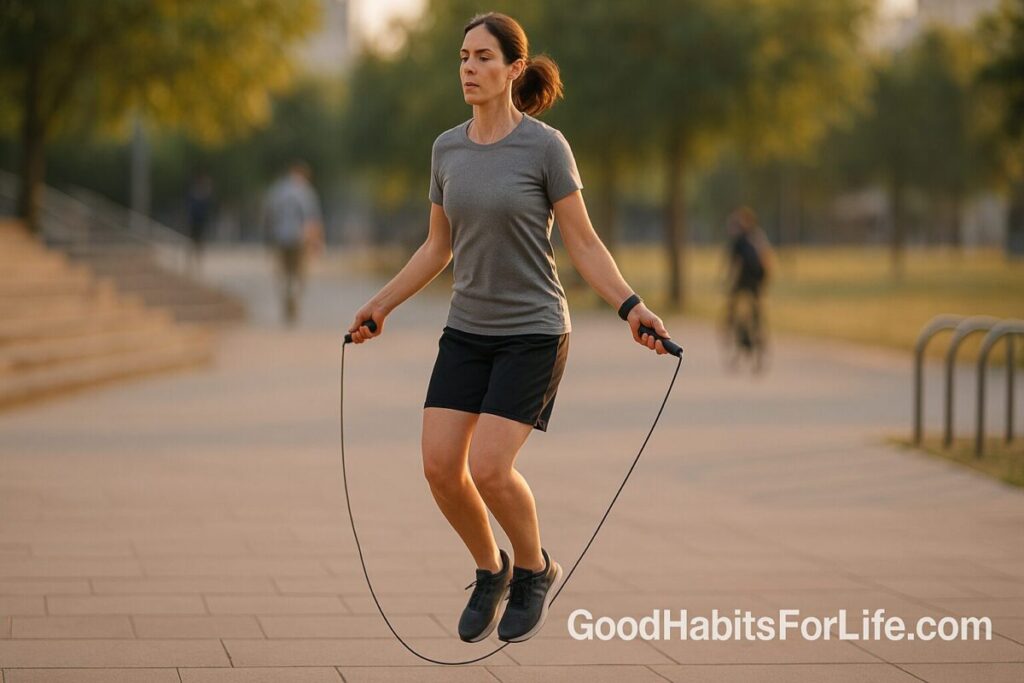
Jump Rope Conditioning: 10Minute Finishers: Zone 2 + NEAT (2025)
Jump Rope Conditioning: 10-Minute Finishers (Zone 2 + NEAT)
Table of Contents
🧭 What & Why
What: Jump rope conditioning uses brief, repeatable rope-skipping blocks to build aerobic capacity, footwork, and coordination. This article focuses on 10-minute finishers you can bolt onto the end of workouts (or lunch breaks) to accumulate Zone 2 time while keeping weekly impact manageable. You’ll also leverage NEAT—the calories you burn from daily movement outside exercise—to amplify results.
Why it works (evidence-aligned):
-
Aerobic fitness & VO₂ improvements: Rhythmic, cyclical movements like rope skipping elevate heart rate efficiently, improving cardiorespiratory fitness similarly to running or cycling when the dose is matched.
-
Zone 2 for endurance & recovery: Training at a comfortable, conversational intensity improves mitochondrial adaptations and base endurance while keeping fatigue low.
-
NEAT drives long-term expenditure: Small, frequent movement bouts plus more steps meaningfully increase daily energy burn and cardiometabolic health markers.
-
Practicality: A rope is cheap, portable, and time-flexible—ideal for adherence and habit formation.
✅ Quick Start: Do This Today
-
Gear & setup (5 minutes)
-
Basic speed rope; adjust so the handles reach your armpits when you stand on the middle.
-
Wear flexible trainers. Skip on rubber flooring, a mat, or wooden court—avoid rough concrete.
-
-
Warm-up (3 minutes)
-
30 sec marching in place → 30 sec ankle circles → 30 sec calf pumps each side → 1 min light shadow jumps.
-
-
10-minute finisher (aerobic)
-
Protocol A: 30 sec jump / 30 sec walk × 10.
Intensity: RPE 4–6/10 (conversational). If HR-tracking, aim ~60–70% HRR or ~65–75% HRmax.
-
-
Cool-down (2 minutes)
-
Slow walk + calf and hip flexor stretch.
-
-
NEAT add-on
-
2,000 extra steps today (about 15–20 minutes easy walking).
-
Do this 3×/week to start. If you feel great, go 4×/week.
🛠️ The 10-Minute Finisher Framework
Goal: Accumulate quality aerobic minutes with low injury risk and high adherence.
Structure (mix & match):
-
Intervals: 20–40 sec jump / equal rest.
-
Blocks: 2–3 minutes continuous jump / 1 minute walk.
-
Ladders: 20–30–40 sec up, then down, with 20–30 sec walks between.
-
Skill sets: 60–90 sec basic bounce → 30 sec shadow jump; repeat.
Weekly distribution suggestions
-
Beginners: 3 sessions × 10 minutes (30 min/week).
-
Intermediates: 4–5 sessions × 10–12 minutes (40–60+ min/week).
-
Lifters/Team-sport athletes: 2–3 finishers on lifting days; 1 longer Zone 2 walk/cycle on off-days.
Surface & impact management
-
Keep jumps low (1–2 cm). Land softly; knees slightly bent; elbows tucked; wrists turn the rope.
🧠 Zone 2 Basics (and How to Measure It)
What is Zone 2? An easy-to-moderate intensity where you can talk in full sentences and primarily use aerobic metabolism.
How to stay in Zone 2 with a rope
-
Talk test: You can say a sentence without gasping.
-
RPE: 4–6/10 effort.
-
Heart rate (simple estimate):
-
HRmax ≈ 220 − age (rough guide).
-
Zone 2 ≈ 65–75% of HRmax or 60–70% of heart-rate reserve (HRR).
-
-
Use walk breaks or slower turns to keep HR from creeping into high-end Zone 3.
Why Zone 2 matters
-
Improves mitochondrial density and fat oxidation.
-
Builds a base that supports harder intervals later.
-
Enhances recovery and day-to-day energy.
🚶 NEAT: The Multiplier Most People Forget
NEAT = Non-Exercise Activity Thermogenesis—everything you burn outside formal workouts (standing, steps, chores).
Why it matters here
-
Two or three 10-minute rope finishers + 2–5k extra daily steps can rival the energy burn of far longer gym sessions—without the soreness.
-
NEAT is highly variable between people; tracking steps makes your progress predictable.
Simple NEAT habits
-
3 × 10-minute walks (post-meal).
-
Stand during calls; pace the hallway.
-
Put printer/water across the room; take stairs.
-
“2k-step rule” on rope days; 5k-step rule on non-rope days.
🛠️ Techniques, Variations & Progressions
Foundations
-
Basic bounce (both feet), alternate-foot step, boxer step.
-
Keep elbows close; rotate with wrists; land quietly.
Low-impact options
-
Shadow jumping (no rope).
-
March-step rope (heel-toe, minimal hop).
-
Rope-walk (swing and step through).
Skill progressions (once you own the basics)
-
Side-to-side shifts → high-knees → single-leg hops (5–10 sec bouts) → criss-cross → double-unders (advanced; not required for conditioning).
Progression rules
-
Volume before speed: Add sets or minutes first.
-
Consistency before complexity: Master basic bounce for 2–3 weeks.
-
Add intensity last: Shrink rests or add short 10–20 sec brisk bursts.
Recovery & mobility
-
2–3×/week calf raises (3×12–15), tibialis raises, and ankle mobility.
-
If Achilles/calf feel tight, swap one rope finisher for a brisk incline walk that day.
👥 Audience Variations
Students & Teens
-
Micro-sets between study blocks: 2–3 minutes rope + 2 minutes walk × 3 in the afternoon.
-
Emphasize skill variety to keep engagement high.
Busy Professionals
-
End strength sessions with a 10-minute rope block; walk meetings for NEAT.
-
Keep a rope in your laptop bag for hotel workouts.
Parents
-
Family “movement snack”: 5-minute rope + 10-minute dog walk after dinner.
-
Use shadow jumps or low-impact march-step on hard days.
Seniors (or joint-sensitive)
-
Prioritize shadow jump, march-step rope, or seated rope mimic (turn handles without jumping + heel taps).
-
Start with :20 on / :40 off × 10; monitor RPE and balance.
-
Consider alternate days with cycling or elliptical.
⚠️ Mistakes & Myths to Avoid
-
Going too hard too soon: Double-unders on day one = cranky calves. Win with easy volume.
-
Chasing sweat, not zones: Conditioning is about dose and repeatability, not suffering.
-
Skipping soft surfaces: Concrete increases repeated impact; use mats or wooden courts.
-
Ignoring NEAT: One hard session can’t out-pace a sedentary 16-hour day.
-
Overgripping the handles: Fatigues forearms; relax grip and spin from the wrists.
-
Myth: “Short sessions don’t count.” Ten focused minutes × 5 days = 50 minutes of cardio—they absolutely count.
🧾 Real-Life Examples & Copy-Paste Scripts
Beginner Aerobic Builder (10 min)
-
:30 jump / :30 walk × 10 (RPE 4–5).
-
Add +1 round each week until 12 minutes.
Strength-Day Finisher (10–12 min)
-
90 sec basic bounce → 30 sec walk × 5–6 (RPE 5–6).
-
Keep HR in Zone 2; if it climbs, switch to alternate-foot step.
Skill Mix (10 min)
-
40 sec basic bounce → 20 sec walk
-
40 sec boxer step → 20 sec walk
-
40 sec alternate-foot → 20 sec walk
-
Repeat the 3-mini-circuit twice.
Low-Impact Day (10–12 min)
-
20 sec march-step rope → 40 sec walk × 6–9 (RPE 4–5).
-
Finish with 2 minutes easy walk.
Zone 2 + NEAT Day
-
Morning: 10-minute finisher (Protocol A).
-
Midday: 1,500–2,500 steps.
-
Evening: 10–15 minutes relaxed walk after dinner.
🗺️ 30-60-90 Roadmap (with Checkpoints)
Days 1–30: Base & Skill
-
Frequency: 3–4×/week, 10 minutes.
-
Target: Stay strictly Zone 2 (RPE 4–6).
-
Checkpoint (Day 30): You can complete 10 minutes with controlled breathing and minimal calf tightness.
Days 31–60: Volume & Variety
-
Frequency: 4–5×/week, 10–12 minutes.
-
Add: One “skill mix” session weekly; one longer Zone 2 walk (30–45 min).
-
Checkpoint (Day 60): 50–60 minutes/week of rope cardio; steps average +2–3k/day above baseline.
Days 61–90: Efficiency & Light Intensity
-
Frequency: 5×/week (some days 12–15 minutes).
-
Add: 1 session with short brisk bursts (e.g., :20 brisk / :40 easy) while staying predominantly aerobic.
-
Checkpoint (Day 90): Resting HR trending down, recovery good, weekly cardio 60–75 minutes, steps consistently +3–5k/day.
🧩 Tools, Apps & Resources
Hardware
-
Adjustable speed rope; optional beaded rope for feedback.
-
Foam or rubber mat; watch or HR monitor (optional but helpful).
Apps (pros/cons)
-
Interval timers (Seconds, Interval Timer, Tabata apps): Simple programming; minimal data.
-
HR tracking (Polar, Garmin, Apple Watch, Fitbit): Zone visibility; cost/charging.
-
Habit/steps (Google Fit, Apple Health, Pacer): NEAT tracking; accuracy varies by device.
📌 Key Takeaways
-
Short 10-minute rope finishers are an efficient way to accumulate Zone 2 without derailing recovery.
-
Pair with NEAT (extra steps) to compound benefits for endurance, weight management, and energy.
-
Progress volume → skill → intensity; protect your calves/Achilles with soft landings and rest.
-
Use talk test/RPE/HR to steer intensity; walk breaks keep you aerobic.
-
Consistency wins: 30–60–90 days of small sessions outperforms sporadic hard days.
❓ FAQs
1) Is jump rope okay for beginners or heavy individuals?
Yes—start with shadow jumps or march-step rope on soft surfaces, use short bouts (:20 on / :40 off), and progress slowly. Pair with low-impact walks.
2) How many days per week?
3–5 days. Aim for ≥150 minutes/week of moderate-intensity activity across all movement; your rope minutes count toward that.
3) What if my shins or calves get sore?
Reduce volume, add rest days, and include calf raises/tibialis work. Swap one rope day for a brisk walk or cycling. Gradual build is key.
4) How do I know I’m in Zone 2 without a monitor?
Use the talk test and RPE 4–6. If speaking full sentences is hard, slow the rope or insert walk breaks.
5) Are double-unders required?
No. They’re a skill. For conditioning, basic bounce, boxer step, and alternate-foot are plenty.
6) Can I do a 10-minute finisher on lifting days?
Yes—keep it aerobic to avoid impacting strength gains. Save high-intensity rope for non-lifting days.
7) What’s the best surface?
Rubber mat, gym floor, or wooden court. Avoid abrasive concrete/asphalt to reduce impact and save your rope.
8) How quickly will I see results?
Most people notice better breathing control and stamina in 3–4 weeks of consistent Zone 2 sessions plus added steps.
9) How does NEAT fit in?
Treat NEAT as a daily baseline: +2–5k steps/day. It preserves your energy balance and reduces sitting time risks.
10) Can seniors use jump rope safely?
Yes—with modifications (shadow jump, march-step rope, balance support) and medical clearance if needed.
📚 References
-
World Health Organization. Guidelines on physical activity and sedentary behaviour (2020). https://www.who.int/publications
-
Centers for Disease Control and Prevention. How much physical activity do adults need? https://www.cdc.gov/physicalactivity
-
American College of Sports Medicine. ACSM’s Guidelines for Exercise Testing and Prescription (10th ed.). https://www.acsm.org
-
Borg G. Psychophysical bases of perceived exertion. Med Sci Sports Exerc. 1982. https://pubmed.ncbi.nlm.nih.gov/
-
Seiler S. What is best practice for training intensity and duration distribution in endurance athletes? Sports Med. 2010. https://link.springer.com
-
Levine JA. Non-exercise activity thermogenesis (NEAT). Best Pract Res Clin Endocrinol Metab. 2002. https://pubmed.ncbi.nlm.nih.gov/12468415
-
Mayo Clinic. Move more, sit less: Understanding NEAT. https://www.mayoclinic.org
-
Garber CE, et al. Quantity and Quality of Exercise for Developing and Maintaining Fitness. Med Sci Sports Exerc. 2011. https://journals.lww.com
-
Tomporowski PD, et al. Aerobic exercise and cognitive function: a review. Neurosci Biobehav Rev. 2008. https://pubmed.ncbi.nlm.nih.gov/
-
del Vecchio FB, et al. Rope skipping training and cardiorespiratory fitness: review. J Sports Med Phys Fitness. (Year). https://pubmed.ncbi.nlm.nih.gov/
(Note: Access dates vary; use the most recent versions/pages where applicable.)
⚕️ Disclaimer
This article provides general fitness guidance and is not a substitute for personalized medical advice. Consult a qualified professional if you have health conditions or pain.