
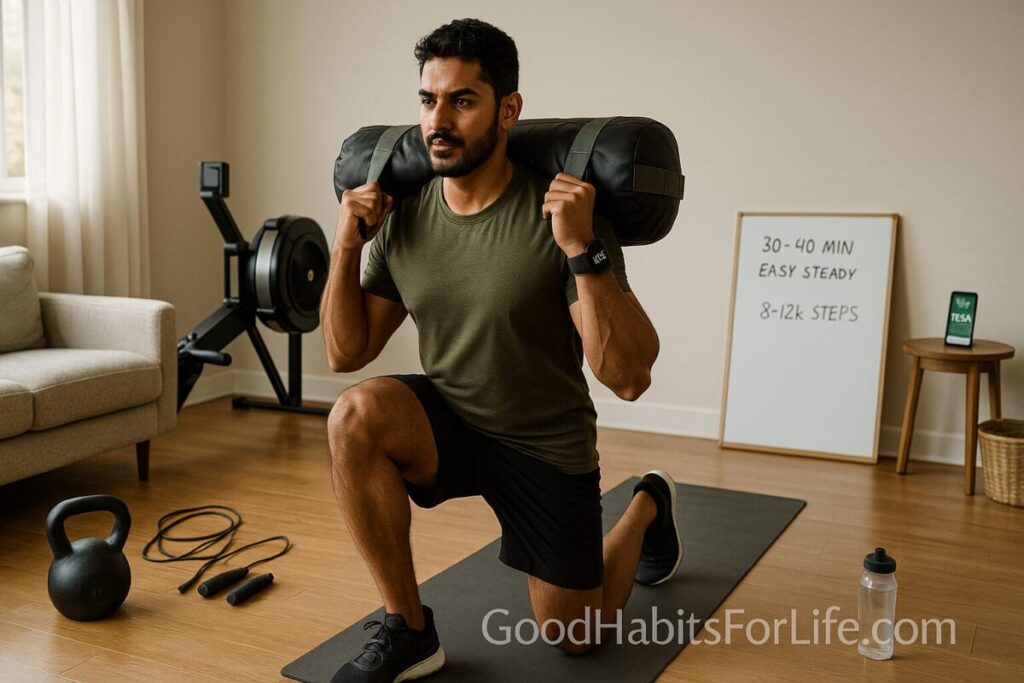
HYROX-Style Conditioning at Home: Zone 2 + NEAT (2025)
HYROX-Style Conditioning at Home: Zone 2 + NEAT (2025)
Table of Contents
🧭 What is HYROX-style conditioning? Why Zone 2 + NEAT
HYROX is an endurance-meets-functional fitness race built around running and eight stations (ski-erg, sled push/pull, burpee broad jumps, row, farmers carry, sandbag lunges, wall balls). You can recreate the training stimulus at home by emphasizing two science-backed levers:
-
Zone 2 aerobic work: Easy, steady effort around 60–70% of maximum heart rate (HRmax). You should be able to speak in full sentences (“talk test”). Benefits include improved mitochondrial density, fat oxidation, recovery capacity, and durability—critical for long functional events.
-
NEAT (Non-Exercise Activity Thermogenesis): All movement outside workouts (steps, housework, standing). NEAT meaningfully increases daily energy expenditure and supports weight management and cardio-metabolic health.
Why pair them? Zone 2 builds the engine; NEAT keeps you idling efficiently all day, compounding calorie burn and recovery without extra strain. For most people, this “easy most of the time” approach outperforms constant HIIT for sustainable endurance and body-composition change.
How to estimate Zone 2
-
%HRmax: 60–70% (use 220 − age for a rough HRmax).
-
Talk test: You can converse comfortably; breathing deeper but controlled.
-
RPE: ~ 3–4/10 perceived effort.
Target: 3–4 Zone 2 sessions/week (30–60 min) + daily NEAT (8–12k steps).
✅ Quick Start (Do This Today)
-
Baseline: Note resting HR (morning), current step count, and a comfortable 20-min steady pace (distance or bike/walk speed).
-
Pick your Zone 2 mode: brisk walk (incline), cycling, jump rope intervals at easy pace, step-ups to a 20–30 cm step (8–12 in), rucking (5–10 kg backpack).
-
20–40 minutes, easy: Stay in the talkable Zone 2 range. If HR spikes, slow down or reduce incline/weight.
-
Add NEAT right away: Two 10-minute walks after meals + take calls standing; aim for 8–12k steps today.
-
Mini HYROX flavor (easy):
-
5 min brisk walk
-
3 rounds (easy pace):
-
60 sec band pulldown (ski-erg mimic)
-
60 sec marching sled mimic (push a loaded suitcase on carpet / slow high-knees with band around hips)
-
60 sec suitcase carry with water jugs
-
60 sec step-ups
-
60 sec air squats
-
60 sec rest
Keep it conversational.
-
-
-
Hydrate + protein: 20–30 g protein within 1–2 hours.
-
Log it: Time in Zone 2, steps, and how you felt.
🛠️ Home HYROX Template (Zone 2 + NEAT Week)
Weekly goal: 3–4 Zone 2 sessions + 1 skills/strength session + daily NEAT.
| Day | Focus | What to do | Notes |
|---|---|---|---|
| Mon | Zone 2 (walk/ruck) | 40–50 min brisk walk or 30–40 min ruck (5–10 kg) | Keep HR 60–70% HRmax |
| Tue | Zone 2 (bike/rope) | 30–45 min easy cycling or jump rope “steady” (10×2 min easy / 1 min walk) | Conversational pace |
| Wed | Skills/Strength (easy) | 3 rounds: 8–10 step-ups/side, 30 m carry, 10 band rows, 10 lunges, 10 wall ball substitutes (light ball to target) | Rest 60–90 s; keep HR easy |
| Thu | Zone 2 | 30–60 min: incline treadmill or outdoor walk with small hills | Use talk test |
| Fri | Optional Threshold Teaser | 30 min total: 10 min Z2, 2×4 min “comfortably hard” (Z3) w/3 min easy, 8 min Z2 | Only if recovered |
| Sat | Long NEAT Day | 90+ minutes accumulated walking: errands, park loops, stairs | Accumulate steps |
| Sun | Off / Mobility | 20–30 min mobility + easy stroll | Recharge |
Station swaps (home-friendly, low-intensity versions):
-
Ski-erg → band pulldowns or towel lat pulls.
-
Sled push → heavy backpack march or towel-on-floor pushes.
-
Sled pull → rope drag with a bag on a rug or band-anchored walk-backs.
-
Farmers carry → water-jug carries (20–30 m laps).
-
Lunges → walking lunges with light load.
-
Wall balls → light ball toss to a mark or tempo goblet squats.
🗺️ 30-60-90 Day Roadmap
Metrics to track monthly: resting HR, average weekly steps, Z2 minutes, 20-min steady test pace/distance, perceived recovery.
Days 1–30: Build the Base
-
Volume: 150–210 min/week in Zone 2 (3–4 sessions).
-
NEAT: 8–10k steps/day average.
-
Strength-skills: 1–2 easy circuits/week (movement quality > load).
-
Checkpoint (Day 30): Repeat 20-min steady test; expect better pace at same HR or lower HR at same pace.
Days 31–60: Extend & Sharpen
-
Volume: 210–270 min/week Zone 2.
-
Add: 1 Z3 “comfortably hard” session/week (e.g., 3×6 min) if recovered.
-
NEAT: 10–12k steps/day.
-
Checkpoint (Day 60): Pace improves 3–8%; RHR trending down.
Days 61–90: Specificity for HYROX-like Endurance
-
Volume: 240–300+ min/week Zone 2.
-
Specific easy circuits: Every 7–10 days, do a HYROX-sequence simulation at easy effort (8 stations separated by 3–5 min brisk walk).
-
Optional: One Z3 session OR hill strides/week; keep 80–90% of total time easy.
-
Checkpoint (Day 90): Longest Z2 now 60–90 min without drift; breathing calmer at familiar paces.
🧠 Techniques & Frameworks
Heart-Rate Zones (simple)
-
HRmax (rough): 220 − age.
-
Zone 2 target: 60–70% HRmax (e.g., age 40 → HRmax ≈ 180; Z2 ≈ 108–126 bpm).
-
Talk test: Full-sentence speech without gasping = Z2.
-
RPE: 3–4/10.
The 80/20 Principle for Endurance
Keep ~80% of training easy (Z1–Z2), ~20% moderate-hard (Z3+). This distribution is linked with better long-term endurance adaptations and lower injury risk.
Guardrails to stay easy
-
Cardiac drift check: If HR rises >5–8 bpm at same pace in last third, slow down earlier next time.
-
Nasal-breathing bouts: Use periodic nasal breathing to cue ease.
-
Conversation test with timer: Every 5 minutes, say a 20-word sentence aloud. If you can’t, downshift.
NEAT Builders (stack into your day)
-
10-minute post-meal walks (2–3×/day).
-
Pomodoro strolls: 3–5 min each hour.
-
Standing calls; stairs whenever possible.
-
House carry: 5-minute water-jug carry loop while tidying.
🧑🤝🧑 Audience Variations
-
Beginners/returning after layoff: Start with 20–30 min Z2, 3×/week; prioritize flat walking; add load last.
-
Professionals (desk-based): Calendar block NEAT: 3×10-min walks + walking 1:1s; ruck commutes (5–8 kg).
-
Parents: Stroller walks; “playground circuits” at easy effort; carry groceries as farmer’s carries.
-
Students/teens: Bike commutes; campus stairs; short rope intervals at conversational pace.
-
Seniors: Favor low-impact modes (cycle, flat walks); include balance (tandem walks, heel-to-toe) and light strength 2×/week; medical clearance if needed.
⚠️ Mistakes & Myths to Avoid
-
“If I’m not wrecked, it didn’t work.” Aerobic adaptations happen best when it feels easy.
-
Too much HIIT. Great tool, but chronic high intensity blunts recovery and Z2 volume.
-
Ignoring NEAT. It can account for hundreds of kcal/day; don’t leave it on the table.
-
Chasing numbers only. Use HR + talk test + RPE together; each has error margins.
-
Heavy sled mimics in Z2. Keep loads light enough to maintain conversational breathing.
💬 Real-Life Examples & Scripts
-
Calendar script: “Block 12:30–13:10 ‘Z2 Walk—Headphones OK.’ Move if meeting conflicts.”
-
Family buy-in: “Let’s walk 10 min after dinner; phones stay in pockets. Kids pick the route.”
-
Pace cue: “Could I read a paragraph aloud right now? If not, slow down.”
-
Desk habit: “Every call under 20 minutes is a walking call.”
-
Travel hotel circuit (easy): 10 min walk → 3 rounds: 12 step-ups, 30 m suitcase carry, 10 band rows, 10 goblet squats (light) → 10 min walk.
🧰 Tools, Apps & Resources (quick takes)
-
Heart-rate straps/watches: Accurate HR keeps you honest in Z2. Pros: objective, logs drift. Cons: cost; wrist-HR less accurate on intervals.
-
Step tracker (phone/watch): Makes NEAT visible. Pros: simple daily target. Cons: can overcount arm swings.
-
Apps: Polar Beat, Garmin Connect, Coros, Strava, Runalyze. Pros: clear Z2 breakdowns. Cons: notifications clutter—mute them.
-
Bands, light med ball, water jugs: Cheap station mimics; portable. Cons: load ceilings; progress with time instead.
📌 Key Takeaways
-
Make easy your default: most minutes in Zone 2 and keep moving all day (NEAT).
-
Mimic HYROX stations at low intensity to layer functional capacity without spiking HR.
-
Progress volume first, sprinkle small amounts of Z3 only when recovered.
-
Track a few simple signals: time in Z2, steps, resting HR, 20-min pace.
-
Consistency across 90 days beats any single “killer” workout.
❓ FAQs
1) How many Zone 2 sessions per week do I need?
Aim for 3–4 sessions (30–60 min) plus daily NEAT. More is fine if recovery and life stress allow.
2) Can I do this without any equipment?
Yes—brisk walking, hill/incline walking, step-ups, light carries with household items, and band pulldowns cover most needs.
3) Will Zone 2 help fat loss?
It improves fat oxidation and lets you sustain more weekly volume with less fatigue. Pair with diet quality and NEAT for best results.
4) Where does HIIT fit?
1 short session/week (or strides) once you have a base. Keep 80–90% of total time easy.
5) My HR spikes even when walking—now what?
Flatten terrain, shorten stride, or lower ruck weight. If it still spikes, use talk test/RPE and keep it truly conversational.
6) What’s a good step goal?
Start at your average + 2,000 steps, then build toward 8–12k/day.
7) How do I know I’m improving?
Your 20-min steady pace gets faster at the same HR (or HR is lower at the same pace), and everyday tasks feel easier.
8) Is Zone 2 safe with knee pain?
Often yes with low-impact modes (cycling, flat walks); strengthen hips/quads; consult a clinician if pain persists.
9) How heavy should home carries be?
Light enough to talk calmly for the set distance—usually 10–20% body mass split across two hands for beginners.
10) Can I split sessions?
Absolutely—two 20-minute Z2 bouts in a day deliver similar aerobic time with easier scheduling.
📚 References
-
World Health Organization. WHO Guidelines on Physical Activity and Sedentary Behaviour (2020). https://www.who.int/publications/i/item/9789240015128
-
American Heart Association. Target Heart Rates Chart. https://www.heart.org/en/healthy-living/fitness/fitness-basics/target-heart-rates
-
ACSM Position Stand (2011). Quantity and Quality of Exercise for Developing and Maintaining Cardiorespiratory, Musculoskeletal, and Neuromotor Fitness in Apparently Healthy Adults. Medicine & Science in Sports & Exercise. Summary: https://www.acsm.org/docs/default-source/files-for-resource-library/quantity-and-quality-of-exercise.pdf
-
Seiler, S. (2010). What is best practice for training intensity and duration distribution in endurance athletes? Scand J Med Sci Sports. https://onlinelibrary.wiley.com/doi/10.1111/j.1600-0838.2010.01184.x
-
Levine, J. A. (2002). Non-exercise activity thermogenesis (NEAT). Nutrition Reviews. https://academic.oup.com/nutritionreviews/article/60/7/ S90/1880672
-
Levine, J. A. et al. (2005). Role of NEAT in weight gain resistance. Science. https://www.science.org/doi/10.1126/science.1112060
-
Brooks, G. A. (2018). The Science and Translation of the Lactate Shuttle Theory. Cell Metabolism. https://www.cell.com/cell-metabolism/fulltext/S1550-4131(18)30410-0
-
Centers for Disease Control and Prevention. Measuring Physical Activity Intensity (Talk Test & RPE). https://www.cdc.gov/physicalactivity/basics/measuring/index.htm
-
HYROX Official. The Workout: Race Format & Stations. https://hyrox.com/the-workout/
-
UK Chief Medical Officers (2019). Physical Activity Guidelines: Adults. https://assets.publishing.service.gov.uk/media/5d8b1b7be5274a66d8bfb4d1/physical-activity-guidelines-uk-chief-medical-officers.pdf
Disclaimer
This article provides general fitness information and is not a substitute for personalized medical advice; consult a qualified professional if you have health concerns.