
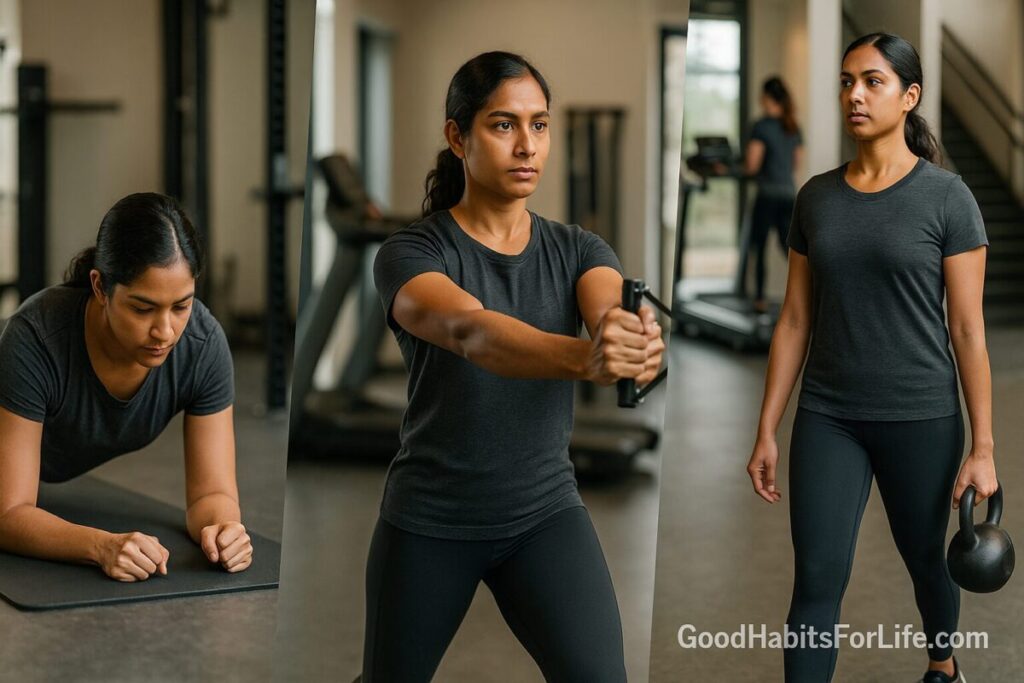
Core 360: Anti-Extension, Anti-Rotation, Carry: Zone 2 + NEAT (2025)
Core 360: Anti-Extension, Anti-Rotation + Zone 2 & NEAT
Table of Contents
🧭 What “Core 360” Means & Why It Works
Core 360 is a practical framework that builds a strong, resilient trunk by training the core’s main job—to resist unwanted motion—and then testing that strength in real-life carries. You’ll train:
-
Anti-extension: resist arching the lower back (e.g., plank, dead bug progressions).
-
Anti-rotation: resist twisting forces (e.g., Pallof press, dead-bug press, offset loading).
-
Carries: move while maintaining posture under load (farmer’s, suitcase, front-rack).
Why it works
-
The core’s role is to transmit force and stabilize the spine and pelvis so hips/shoulders can express strength and speed. Anti-movement tasks (planks, Pallof presses) target this function and are commonly recommended in evidence-informed back-care and performance programs.
-
Loaded carries integrate breathing, gait, grip, and posture—great for “real-world strength,” with high time-under-tension at safe intensities.
-
Pairing strength with Zone 2 cardio (easy-steady) improves mitochondrial function and endurance with low stress, supporting recovery and work capacity.
-
NEAT—all movement outside workouts—can meaningfully raise daily energy expenditure, supporting body-composition goals.
✅ Quick Start: Today’s 25-Minute Session
Warm-up (5 min): brisk walk or bike + 3 rounds: 5 cat-camel, 5 glute bridges, 5 dead-bug breaths.
Core 360 Circuit (15 min): repeat 3 rounds, rest 45–60 s between moves.
-
Front plank — 30–40 s (anti-extension)
-
Half-kneeling Pallof press — 8–10/side (anti-rotation)
-
Suitcase carry — 20–30 m/side with a heavy-ish dumbbell (neutral ribs, tall posture)
Zone 2 finisher (5 min): easy spin/ walk maintaining nose-breathable pace (talkable).
NEAT nudge: add a 10-minute after-meal walk later today.
🧠 30-60-90 Day Plan (with checkpoints)
Goal: Build spine-friendly trunk stiffness, integrative carry strength, and an aerobic base.
Days 1–30: Foundation
-
Core 3×/week:
-
Plank (front/side) 3×30–40 s
-
Pallof press 3×8–10/side
-
Suitcase carry 3×20–30 m/side
-
-
Zone 2 2–3×/week, 20–30 min/session (RPE 3–4/10; conversational).
-
NEAT: hit 7,000–9,000 steps/day; add standing breaks each hour.
-
Checkpoint: No back/hip irritation; holds stable; carries steady posture.
Days 31–60: Progress & Variety
-
Progress planks → RKC plank or stir-the-pot; Pallof → press-out iso; carries → farmer’s + front-rack.
-
Add offset loading (one-side heavier) to challenge anti-rotation.
-
Zone 2 to 30–40 min; one optional strides session (6×15 s fast walk/ easy jog with full recovery).
-
NEAT: aim 8,500–10,000 steps; add 10-min post-meal walks (1–2 meals).
-
Checkpoint: Can carry bodyweight × 0.5 total for 30 m with form; breathing controlled.
Days 61–90: Capacity & Density
-
Superset anti-extension and anti-rotation; reduce rest to build density.
-
Carries progress: farmer’s → suitcase → front-rack → mixed; increase distance to 40–50 m.
-
Zone 2 3–4×/week (35–50 min); include one tempo (RPE 5–6) every 7–10 days if recovered.
-
NEAT: 10,000+ steps; add “movement snacks” (3×/day of 2–3 min brisk movement).
-
Checkpoint: Posture tall under load, no rib-flare/low-back crank; steady conversational cardio.
🛠️ Techniques & Coaching Cues
Anti-Extension
-
Front plank: elbows under shoulders; ribs down, glutes lightly squeezed; breathe quietly through the nose. Stop 1–2 breaths before shaking.
-
Dead-bug breathing: exhale to set ribs; maintain lumbar contact; reach long.
-
Progressions: front → RKC plank → stir-the-pot (on ball) → long-lever plank.
Anti-Rotation
-
Pallof press (half-kneeling): tall spine; exhale on press; don’t let cable/band twist you.
-
Press-out iso / holds: 10–20 s holds at full reach.
-
Offset loads: one-handed kettlebell front-rack or dumbbell bench with light opposite hand reach.
Carries
-
Suitcase carry: one kettlebell/dumbbell; shoulders level; don’t lean; walk slow, short steps.
-
Farmer’s carry: two implements; pack shoulders; think “zipper up” through crown of head.
-
Front-rack carry: elbows slightly forward; ribs down; tiny inhale-exhale cadence.
-
Distances & loads: 20–40 m lanes; start ~25–35% bodyweight per hand for farmer’s if experienced; lighter for beginners. Increase distance before load.
Breathing: “Exhale, set ribs, hold light brace, walk, drip air out.”
Stop on technique loss: lean, rib-flare, or low-back pinch.
🚴 Zone 2 & 👣 NEAT: Build the Engine, Burn More
Zone 2 = easy-steady effort where you can speak in full sentences and breathe mostly through the nose. Practical anchors:
-
Talk test passes; RPE 3–4/10.
-
Roughly 60–70% HRmax for many adults (individual variation).⁶ ⁷
-
20–50 min per session, 2–4×/week. Benefits include improved fat oxidation and mitochondrial density—good for health and recovery.³ ⁴
NEAT (Non-Exercise Activity Thermogenesis) = calories burned outside formal exercise—walking, standing, chores. It can vary hundreds of kcal/day between people and is a powerful lever for weight management.⁵
NEAT boosters
-
Walk calls/errands; take stairs; park farther.
-
5–10 min post-meal walks (glucose friendly).
-
“Movement snacks”: 2–3 min every hour: brisk steps, air squats, wall push-ups.
👥 Variations by Audience
-
Students & desk-workers: 50–55 min work blocks + 3–5 min walk/mobility; backpack front-rack carry with books for short laps.
-
Parents: stroller or toddler-in-carrier walks for Zone 2; groceries as farmer’s/suitcase carries (short, perfect posture).
-
Professionals traveling: resistance band for Pallof; hotel DBs for carries; hallway 20–30 m laps.
-
Seniors (as cleared by a clinician): shorter sets (10–20 s) more often; lighter carries (bags with soft handles); prioritize talk-test for cardio and handrails for safety.
⚠️ Mistakes & Myths to Avoid
-
Myth: “More crunches = stronger core.” → Train resistance to motion, not just spinal flexion.¹ ²
-
Mistake: Going heavy on carries while leaning/arching. Technique first.
-
Mistake: Skipping low-intensity cardio. Zone 2 is the base that lets you do more work.³
-
Myth: “Only gym workouts matter.” → NEAT can rival workout calories and is sustainable.⁵
-
Mistake: Progressing all variables at once. Change one thing (distance or load or density).
-
Mistake: Holding breath. Use quiet exhale to set ribs and a light, continuous brace.
🧩 Real-Life Scripts & Mini-Workouts
5-Minute Office Reset
-
1 min brisk walk
-
30 s front plank
-
30 s Pallof hold (band) per side
-
1× 20 m suitcase carry (briefcase/bag) per side
-
1 min nose-breathing walk
Grocery-Run Carry Game
-
Park far. Farmer’s carry to car (two bags) → posture tall.
-
Suitcase carry one bag to house per side.
-
Two flights of stairs = bonus Zone 2 minutes.
Weekend Core 360 (30 min)
-
Warm-up 5 min
-
Circuit ×4: 30 s plank, 8/side Pallof, 30 m farmer’s
-
Cool easy walk 10 min (stay talkable)
🧰 Tools, Apps & Resources
-
Timer apps (intervals/AMRAP) for density progressions.
-
HR monitors (chest/optical) if you like numbers; else use talk test (free).
-
Resistance bands for Pallof anywhere; KB/DB for carries.
-
Step trackers (phone/watch) to drive NEAT streaks.
Pros/cons: Gadgets can motivate but aren’t required; prioritize consistency, form, recoverability.
🔑 Key Takeaways
-
Train the core to resist extension and rotation, then reinforce it with carries.
-
Keep cardio easy-steady most days (Zone 2); it supports recovery and health.
-
NEAT is your quiet fat-loss and health multiplier—move more across the day.
-
Progress patiently: distance → load → density; quality beats quantity.
-
Breathe, stack ribs over pelvis, and stop before form breaks.
❓ FAQs
How many days per week should I do Core 360?
3–4 dedicated core/carry sessions plus 2–4 Zone 2 days works well; some days can combine.
Can I replace planks with crunches or sit-ups?
Use planks/dead-bugs for anti-extension first; add small amounts of flexion work only if your back tolerates it and your program needs it.
What’s a good starting load for carries?
Beginners: a weight you can carry 20–30 m without leaning or losing rib position. Experienced lifters often start at 25–35% bodyweight per hand for farmer’s.
How do I know I’m in Zone 2 without a HR monitor?
You can talk in complete sentences, breathing mostly through the nose; effort feels easy-steady (RPE 3–4/10).
Is Zone 2 enough for fat loss?
Fat loss is mostly calories in/out; Zone 2 helps you do more total activity and recover, while NEAT adds daily burn.
What if my lower back gets tired during carries?
Lighten the load, shorten the distance, exhale to set ribs, and think “tall and narrow.” If pain persists, consult a qualified professional.
Can seniors do carries?
Yes—with medical clearance, lighter loads, shorter distances, and safe environments (clear path, good handles).
Do I need heavy equipment?
No. Bands and a pair of dumbbells or kettlebells can cover months of progress; even household items work for light carries.
📚 References
-
McGill SM. Core training: Evidence translating to better performance and injury prevention. Sports Health (2010). https://pubmed.ncbi.nlm.nih.gov/23016040/
-
Hibbs AE, et al. Optimizing performance by improving core stability and core strength. Sports Med (2008). https://pubmed.ncbi.nlm.nih.gov/18201144/
-
Seiler S. What is best practice for training intensity distribution in endurance athletes? Int J Sports Physiol Perform (2010). https://pubmed.ncbi.nlm.nih.gov/20861520/
-
San-Millán I, Brooks GA. Reexamining the roles of lactate in human performance. Cell Metab (2018). https://pubmed.ncbi.nlm.nih.gov/29953862/
-
Levine JA. Non-exercise activity thermogenesis (NEAT). Proc Nutr Soc (2003). https://pubmed.ncbi.nlm.nih.gov/14692610/
-
Achten J, Jeukendrup AE. Heart rate monitoring: applications and limitations. Sports Med (2003). https://pubmed.ncbi.nlm.nih.gov/12525676/
-
Reed JL, Pipe AL. The talk test: a useful method for prescribing exercise intensity. Curr Opin Cardiol (2014). https://pubmed.ncbi.nlm.nih.gov/24759240/
-
US HHS. Physical Activity Guidelines for Americans, 2nd ed. (2018). https://health.gov/our-work/physical-activity
-
WHO. Guidelines on physical activity and sedentary behaviour. (2020). https://www.who.int/publications/i/item/9789240015128
-
Willardson JM. Core stability training: applications to sports conditioning. Strength & Conditioning Journal (2007). https://journals.lww.com/nsca-scj/Abstract/2007/08000/Core_Stability_Training__Applications_to_Sports.8.aspx
⚖️ Disclaimer
This guide provides general fitness information and is not a substitute for individualized medical advice; consult a qualified professional before starting or modifying exercise.