
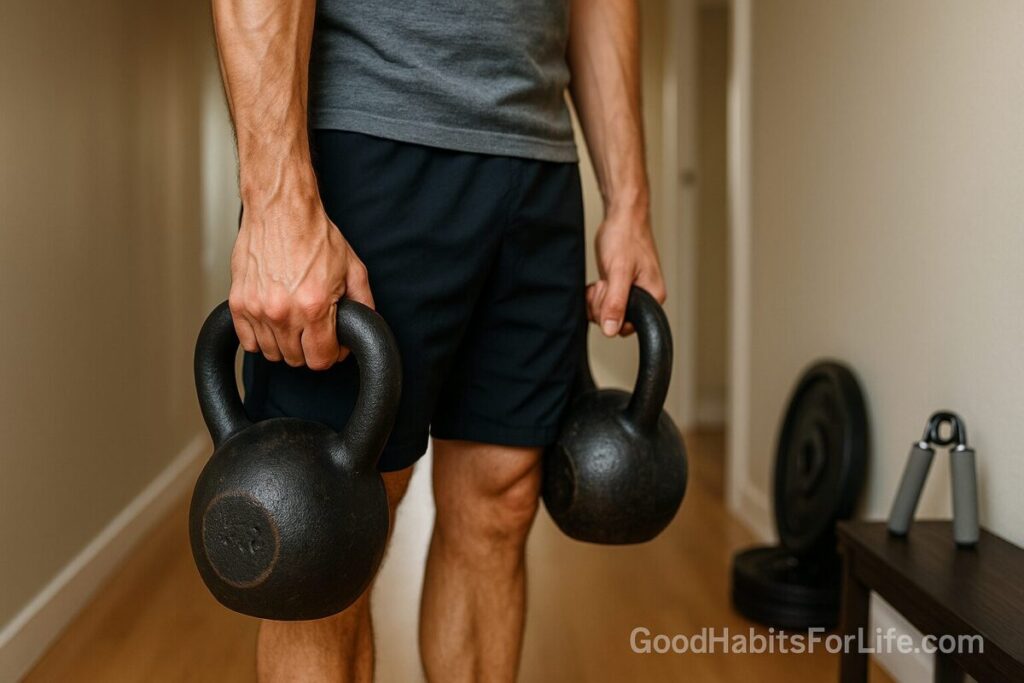
Grip Strength Habits for Everyday Performance in 2025: Trends Tactics
Grip Strength Habits for Everyday Performance (2025)
Table of Contents
🧭 What & Why: A simple definition with big benefits
Grip strength is the force your hands can produce, usually measured with a hand dynamometer in kilograms. It matters because strong hands:
-
make everyday tasks easier (opening lids, carrying bags, typing with less strain),
-
improve performance in pulls, rows, deadlifts, and sport skills,
-
support joint health in wrists, elbows, and shoulders when trained sensibly, and
-
correlate with healthier aging and lower risk of several adverse outcomes in large cohorts (see References).
The three grip patterns you’ll train
-
Crush (closing fingers into the palm; e.g., grippers, towel squeezes)
-
Pinch (thumb + fingers; e.g., plate pinches)
-
Support (holding load for time; e.g., farmer’s carries, dead hangs)
Evidence snapshot (high level)
-
Population studies link lower handgrip with higher all-cause and cardiovascular mortality.
-
Strength training 2–3×/week with progressive overload improves function across ages.
-
Balanced programs that include forearm extensors (rubber-band opens) reduce overuse risk.
✅ Quick Start: Do this today (10 minutes)
Warm-up (2 min): wrist circles (30 each way), finger flicks (30), easy forearm massage.
Circuit (2–3 rounds; 8 min total):
-
Dead hang from a bar, 20–30 s (bend knees if needed).
-
Farmer’s carry: 2 × 20–30 m with ~25–35% body mass per hand (e.g., 20–30 kg if you’re ~80 kg).
-
Plate pinch: 2 × 20 s each hand (use books if no plates).
-
Extensor opens with rubber band: 20–30 reps.
Stop rule: mild forearm pump is fine; sharp pain or tingling is not. Rest 48 h between hard grip days.
📈 7-Day Starter Plan (10–15 min/day)
-
Day 1 – Support focus: Dead hangs 3 × 20–30 s; Farmer’s carry 3 × 20–30 m; Extensor opens 2 × 20.
-
Day 2 – Recovery & mobility: Wrist CARs, prayer stretch, nerve-glide flossing (median/ulnar) 5 min.
-
Day 3 – Crush focus: Gripper or towel squeeze 3 × 8–12/hand; Wrist curls 2 × 12; Extensor opens 2 × 20.
-
Day 4 – Light technique: Plate pinches 3 × 15–20 s; Supination/pronation with light hammer 2 × 12.
-
Day 5 – Mixed: Dead hangs 3 × 25–35 s; Farmer’s carry 3 × 30–40 m; Extensor opens 2 × 20.
-
Day 6 – Forearm balance: Reverse wrist curls 3 × 12; Rice-bucket opens/closes 2 × 45 s.
-
Day 7 – Test & log: Best dead-hang time, best pinch hold time, RPE notes.
🗺️ 30-60-90 Grip Roadmap (with checkpoints)
Baseline tests (Week 0):
-
Max handgrip with dynamometer (best of 3/hand).
-
Longest dead hang (s).
-
Longest farmer’s carry distance with 30% body mass/hand (m).
Weeks 1–4 (Foundation)
-
Frequency: 3 sessions/week (Mon-Wed-Fri).
-
Main lifts: hangs 4 × 20–30 s, carries 4 × 20–30 m, gripper 3 × 8–12.
-
Balance: extensor opens every session 2 × 20.
-
Progression: add 5 s per hang or 2–4 m per carry when all sets are comfortable.
Checkpoint: +10–20 s hang, +20–40 m total carry, +2–4 kg on dynamometer.
Weeks 5–8 (Progressive overload)
-
Introduce thick handles (fat grips) on rows/carries 1–2 sets.
-
Pinch specialization: 4 × 20–30 s; alternate single-hand plate pinches.
-
Overload rule: when you exceed 40 s hangs easily, add 10% body weight with a belt.
Checkpoint: crush/pinch up 10–20%, hang ≥40–60 s, carry ≥40 m at same load.
Weeks 9–12 (Specific & resilient)
-
Wave loading: one heavy support day (shorter, heavier), one volume day (longer holds).
-
Eccentric-biased crush: close gripper with two hands, slow 5-s open × 5–6 reps.
-
Anti-overuse: reverse curls 3 × 12; deload every 4th week (halve volume).
Checkpoint (Day 90): +4–8 kg dynamometer, hang +30–60 s vs baseline, carry +30–60 m vs baseline.
🛠️ Techniques & Frameworks that work
-
Progression knobs: time under tension (s), load (kg), lever arm (thicker handles), instability (towel, rope), and symmetry (single-hand).
-
RPE guide: keep most sets at RPE 6–8; leave 1–2 reps in reserve to protect elbows.
-
Balance the system: for every crush/support block, include extensor work and reverse curls.
-
Stack with pulls: put hangs/carries after rows, pull-ups, or deadlifts.
-
Micro-dosing: on non-training days, do 60–90 s easy hangs + 20 extensor opens.
-
Warm wrists, cool tendons: warm-up is dynamic; after training, gentle stretch + 60–90 s cool water for sore areas if helpful.
-
Testing cadence: quick checks every 2 weeks; formal testing every 4–6 weeks.
🧠 Audience Variations
-
Students/Desk Workers: 60–90 s “typing break” (wrist CARs + extensor opens); replace one coffee walk with one 30 m carry.
-
Parents/Caregivers: practice safe goblet carry (10–20 kg) with neutral wrists; short daily hangs aid shoulder comfort.
-
Professionals (manual): prioritize support pattern and tissue care (forearm massage, 5 min nightly).
-
Seniors (balance & independence): start seated squeezes with a soft ball + light carries (5–10 kg total), 2–3×/week; focus on pain-free range.
-
Athletes (climbers, racquet, cricket): add single-arm hangs and pronation/supination; deload every 3–4 weeks.
⚠️ Mistakes & Myths to Avoid
-
Only training crush: neglecting pinch/support and extensors invites elbow pain.
-
Going to failure every set: spikes tendon irritation; use RPE 6–8.
-
Thinking bigger forearms = strongest grip: neural factors and pattern-specific practice matter.
-
Skipping recovery: forearm tissues love short, frequent movement and gradual load.
-
All gloves, no chalk: for performance carries/pulls, chalk improves friction; gloves often reduce it.
💬 Real-Life Examples & Scripts
-
1-minute office break: “Stand up, wrist circles 30–30, rubber-band opens 20, breathe.”
-
Grocery run habit stack: “Every bag drop, do a 20-s suitcase hold; switch sides.”
-
Doorway micro-hang: “Before showers, 2 easy 20-s hangs on a towel over the frame (if sturdy).”
-
Gym finisher: “After rows: 3 × 30-m farmer’s carry; note distance in phone.”
-
Deload week script: “Cut volume in half; keep intensity moderate; add mobility.”
🧰 Tools, Apps & Resources (pros/cons in brief)
-
Hand dynamometer (Camry/Jamar): objective tracking; Jamar is gold-standard, pricier.
-
Grippers (Captains of Crush): precise crush loading; mind your elbows.
-
Fat grips (thicker handles): rapid support gains; start light.
-
Plates/books for pinches: cheap and effective; easy to overdo—time sets.
-
Rice bucket + rubber bands: best value for balanced forearm health.
-
Apps: Google Fit/Apple Health (logging), Seconds (interval timer), Streaks/Habitify (habit chains).
🔑 Key Takeaways
-
Train crush, pinch, support each week; pair with extensor work.
-
Use micro-doses daily plus 2–3 structured sessions for progress without pain.
-
Track dynamometer kg, hang time, carry distance; progress one variable at a time.
-
Deload every 4th week or at first sign of elbow irritation.
-
Stronger hands = easier life, better lifts, more independence.
❓ FAQs
1) How often should I train grip?
2–3 focused sessions/week with light daily “maintenance” (60–90 s hangs + extensor opens).
2) Do I need a gripper?
No. Hangs, carries, and pinches build most real-world strength; grippers are a useful add-on.
3) What’s a good goal for dead hangs?
General adults: 60–90 s two-hand hang is a solid baseline; climbers may exceed 120 s.
4) My elbows ache—what now?
Reduce volume, add reverse curls/extensor work, and use a pain-free range. If pain persists, consult a clinician.
5) Can I train grip daily?
Yes, if most days are easy and you rotate patterns; reserve high-effort work for 2–3 days/week.
6) What’s the fastest way to progress?
Increase time under tension by 5–10 s per set or add 2–5 kg to carries once sets feel solid.
7) Do thicker handles help?
Yes—fat grips boost support strength; start with lighter loads to protect elbows.
8) Should kids/teens do grip training?
Yes, with light, skill-based holds/hangs; focus on form and avoid maximal strain.
9) Any supplements that help?
Adequate protein supports adaptation; creatine monohydrate has strong evidence for strength, if appropriate for you.
10) How do I know if I’m overdoing it?
Persistent tenderness on the inner elbow, night pain, or grip that’s weaker day-to-day—deload immediately.
📚 References
-
Celis-Morales C. et al. Grip strength and disease-specific/mortality outcomes (UK Biobank). BMJ, 2018. https://www.bmj.com/content/361/bmj.k1651
-
Leong D. et al. Prognostic value of grip strength (PURE study). The Lancet, 2015. https://www.thelancet.com/article/S0140-6736(14)62000-6/fulltext
-
WHO Guidelines on physical activity and sedentary behaviour. 2020. https://www.who.int/publications/i/item/9789240015128
-
Ratamess N. et al. ACSM Position Stand: Progression models in resistance training. Med Sci Sports Exerc, 2009. https://journals.lww.com/acsm-msse/Fulltext/2009/03000/Progression_Models_in_Resistance_Training_for.26.aspx
-
Dodds R. et al. Grip strength across the life course: normative data. Age and Ageing, 2014. https://academic.oup.com/ageing/article/43/6/654/2812238
-
Fragala M. et al. Resistance training for older adults—position statement (NSCA). Strength & Conditioning Journal, 2019. https://journals.lww.com/nsca-scj/Fulltext/2019/10000/Resistance_Training_for_Older_Adults__Position.1.aspx
-
Kreider R. et al. ISSN Position Stand: Creatine monohydrate. J Int Soc Sports Nutr, 2021. https://jissn.biomedcentral.com/articles/10.1186/s12970-021-00408-w
-
ACSM’s Guidelines for Exercise Testing and Prescription. 11th ed., 2021. (Book)
Disclaimer: This content is educational and not a substitute for personalized medical advice—consult a qualified professional before starting or changing your exercise program.