
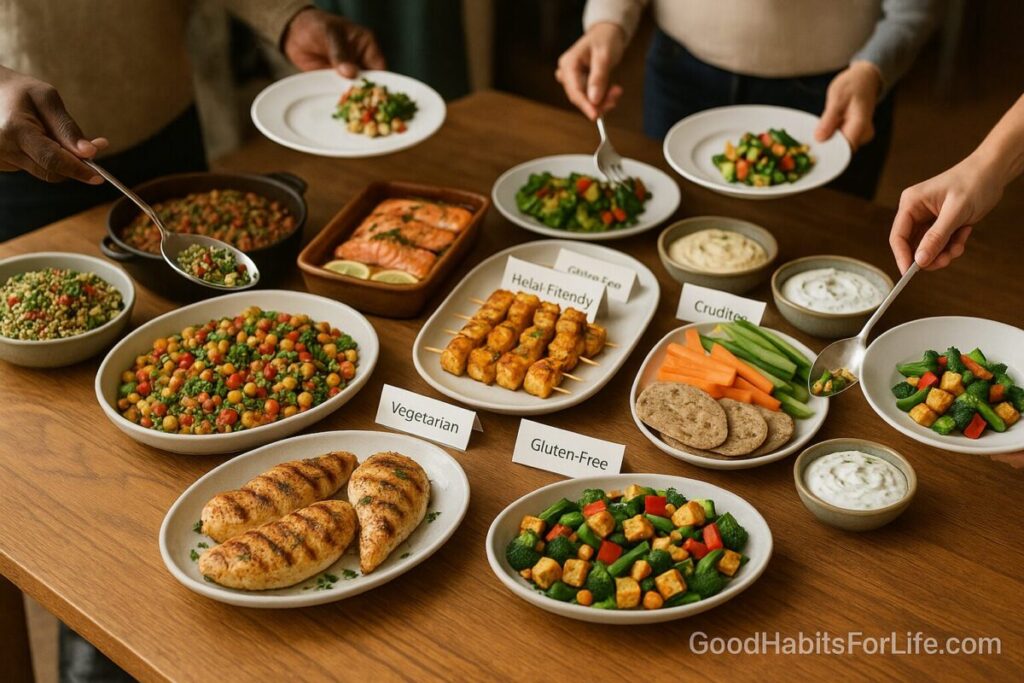
Community Potlucks: Healthy Dishes People Actually Want: Protein-Forward Plan (2025)
Healthy Potluck Dishes: Protein-Forward Crowd-Pleasers
Table of Contents
🧭 What & Why Protein-Forward Wins
A protein-forward potluck centers each plate around a satisfying lean protein (meat, fish, eggs, dairy, legumes, tofu/tempeh, lentils, beans) and builds color and crunch with vegetables, grains, and smart sauces. Done right, it’s crowd-pleasing, budget-friendly, and inclusive.
Why protein?
-
Satiety & steady energy: Protein increases fullness and helps stabilize post-meal blood sugar compared with carb-only dishes.
-
Nutrition balance: Most adults need roughly 0.8 g of protein per kg body weight/day (≈0.36 g/lb). For a potluck plate, aim for ~20–30 g protein per adult serving—easy with chicken, beans, eggs, tofu, paneer, fish, Greek yogurt dips, or lentil-based mains.
-
Flexibility: You can meet many dietary patterns (vegetarian, high-fiber, lower-carb, gluten-free, Halal, Jain, etc.) with the right protein base.
✅ Quick Start (Do-This-Today)
-
Pick a role: One of these: high-protein main • veg-heavy side with protein add-ins • protein dip with veg crudités • grain-legume salad.
-
Set servings: Ask the host for headcount. Default: 10–12 servings per tray or bowl.
-
Choose a base protein: Chicken thighs • chickpeas/lentils • paneer/tofu • eggs • tuna/beans • yogurt.
-
Flavor profile: Pick one: Mediterranean (lemon-herb), North Indian (tandoori/tikka), Tex-Mex (lime-cumin), East Asian (ginger-garlic-soy), Middle Eastern (za’atar-tahini).
-
Plan make-ahead: Marinate or cook 1–2 days ahead. Cool, pack shallow, and reheat safely (details below).
-
Label: Dish name, main allergens (gluten, nuts, dairy, egg, sesame, soy, fish), heat level, and veg/vegan/GF symbols.
-
Transport kit: Insulated carrier, thermometer, serving spoon/tongs, extra napkins, tape/marker, sanitizer, and cooling/heating packs.
🛠️ The 3-2-1 Potluck Formula
-
3 colors of veg (raw + roasted/steamed): think greens + reds/oranges + whites/purples.
-
2 protein sources (primary + stealth): e.g., chicken + chickpeas; tofu + edamame; eggs + Greek yogurt dip.
-
1 bold flavor (herb blend, spice rub, or sauce) to pull the plate together.
Sauce-smart: Use yogurt-herb, salsa verde, chimichurri, tahini-lemon, or peanut-lime. Offer sauce on the side so everyone can control sodium/spice.
🍽️ Dish Ideas People Actually Eat (with Make-Ahead Notes)
| Dish (protein-forward) | Why it works | Make-ahead & reheat | Diet flags |
|---|---|---|---|
| Lemon-Herb Chicken Thighs (sheet-pan) | Juicy, forgiving, inexpensive; 25–30 g protein/serving | Marinate 12–24 h; bake day-of; hold hot in insulated carrier | GF |
| Tandoori Chicken Skewers / Tikka Bites | Tender from yogurt; big flavor, bite-size | Marinate 24 h; grill/bake; reheat 10 min at 180 °C | GF |
| Baked Fish with Chermoula | Light but satisfying; bright herbs | Bake close to serving; transport hot | GF |
| Turkey or Chicken Meatballs (baked) | Crowd-friendly; portionable | Bake ahead; simmer in light tomato/herb sauce to reheat | GF possible |
| Paneer Tikka (oven or air-fryer) | High protein vegetarian; familiar spices | Marinate 12 h; cook day-of; transport hot | Veg, GF |
| Tofu & Veg Sheet-Pan Teriyaki | Vegan protein with colorful veg | Press tofu; roast; pack sauce separately | Vegan |
| Lentil-Walnut “Keema” Sloppy Joes | Hearty plant protein; sandwich-ready | Make 2 days ahead; reheat gently | Vegan possible |
| Chickpea-Quinoa Tabbouleh + Feta | Complete protein; travels cold | Cook grains/legumes ahead; dress day-of | Veg, GF |
| Black Bean & Corn Lime Salad | Fiber + protein; stays crisp | Make fully ahead; bring extra lime | Vegan, GF |
| Egg Frittata (sheet-pan) with Veg | Breakfast-for-dinner hit; slices well | Bake day-of; serve warm or room temp | GF |
| Greek Yogurt Ranch Dip + Veg Platter | High-protein dip; kids eat it | Mix 1 day ahead; keep ≤4 °C | Veg, GF |
| Tuna & White Bean Herb Salad | Pantry-friendly; protein-packed | Assemble morning-of; chill | GF |
Tip: Offer one vegetarian/vegan protein even if you bring meat. It disappears first.
📦 Portion & Scaling Calculator (Rules of Thumb)
-
Adult portions (mains):
-
Cooked poultry/meat: 150–180 g per person (≈5–6 oz).
-
Cooked legumes/tofu/paneer: 175–200 g per person (≈1–1¼ cups beans; 150–180 g tofu/paneer).
-
-
Salads/sides: 1 cup per person if it includes protein; ½–¾ cup if not.
-
9×13-inch / 23×33 cm pan: serves 12 as a side or 8–10 as a main.
-
Meatballs: 3–4 standard (30–35 g each) per person.
-
Dips: 2–3 tbsp per person if multiple dips; ¼ cup if only one.
-
Scaling: Multiply ingredients by (guests ÷ original servings); increase salt/acids more slowly (taste and adjust).
🥶 Food Safety for Potlucks (Non-Negotiable)
-
Hot foods hot: Hold at ≥60 °C (140 °F); reheat leftovers to 74 °C (165 °F) (especially poultry/combined dishes).
-
Cold foods cold: Keep at ≤4 °C (40 °F) with ice packs/coolers.
-
2-hour rule: Discard perishable food left out >2 hours (or >1 hour if >32 °C/90 °F).
-
Shallow cooling: Cool cooked food in shallow containers; refrigerate within 2 hours.
-
Safe temps (examples): Chicken 74 °C (165 °F); ground meats 71 °C (160 °F); fish 63 °C (145 °F).
-
Serving tools: Provide dedicated tongs/spoons; avoid cross-contamination.
-
Allergens: Clearly label gluten, dairy, egg, nuts, peanuts, soy, sesame, fish/shellfish; if used, list oils/seeds.
👥 Audience Variations
-
Parents & Kids: Finger-friendly pieces (tikka bites, meatballs, paneer/tofu cubes). Offer mild + spicy sauces separately.
-
Students (budget): Lentil/bean mains, egg frittata, chickpea-pasta salads, yogurt dips; buy seasonal veg and bulk grains.
-
Professionals (office): Reheat-friendly trays, no-mess servings (skewers, mini-wraps, jar salads).
-
Seniors: Tender textures (slow-cooked chicken, baked fish), lower-sodium sauces, clear labels for allergens.
-
Vegetarian/Vegan: Hearty plant proteins (lentils, chickpeas, tofu, edamame) + nuts/seeds (if permitted).
-
Gluten-free: Rice/quinoa bases, corn tortillas, potato trays; avoid breadcrumb binders unless GF.
⚠️ Mistakes & Myths to Avoid
-
“Healthy = salad only.” Add protein or it won’t satisfy.
-
“Lean = dry.” Use thighs, marinades, yogurt/tomato bases, and rest meats before slicing.
-
“Low-fat everything.” Smart fats (olive oil, nuts, seeds) boost flavor and satiety; keep portions reasonable.
-
“Sauce it all now.” Keep sauce on the side to manage texture, sodium, and spice.
-
“No label needed.” Labels prevent allergen accidents and reduce food waste.
🗣️ Real-Life Scripts, Labels & Notes
Label card (copy-paste):
Dish: Tandoori Chicken Bites
Contains: Dairy (yogurt). No gluten, nuts, soy.
Spice: Mild. Allergen note: Prepared in a kitchen that handles nuts.
Group message before the event:
“I’m bringing a protein-forward main (Paneer Tikka) + a vegan bean salad. Each serves 10–12. I’ll label allergens. If you need gluten-free or nut-free, ping me!”
Allergen-aware offer:
“I can bring a nut-free dip and a gluten-free grain salad so everyone’s covered.”
🧰 Tools, Apps & Resources
-
Instant-read thermometer (avoid guessing doneness).
-
Insulated hot/cold carriers + ice packs.
-
Food storage: Shallow containers (glass or high-quality BPA-free).
-
Apps:
-
FoodKeeper (USDA) for storage times.
-
Cronometer (macro estimates) or MyFitnessPal for quick protein counts.
-
AnyList/Paprika for shared shopping lists and scaling.
-
🗓️ 7-Day Starter Plan (Countdown)
-
Day −7: Confirm theme, headcount, power/oven availability, and dietary needs. Pick 1–2 dishes.
-
Day −5: Shop pantry staples (spices, grains, beans, foil, containers, labels, ice packs).
-
Day −3: Marinate proteins or cook legumes/grains; make sauces (chimichurri, tahini).
-
Day −2: Cook one dish fully if possible (meatballs, bean salad). Cool shallow and refrigerate.
-
Day −1: Finish mains; chop veg; pack sauces separately. Print allergen labels.
-
Day 0 (AM): Reheat to safe temps; pack hot ≥60 °C (140 °F) or cold ≤4 °C (40 °F). Load carriers, tools, sanitizer.
-
On site: Set up hot/cold zones, place labels and serving tools, refresh ice/heat after 60–90 min, and rotate dishes.
🧾 Key Takeaways
-
Anchor plates with 20–30 g protein and colorful veg.
-
Choose make-ahead, transport-friendly recipes with sauce on the side.
-
Use the 3-2-1 formula to balance flavor, color, and protein.
-
Scale with simple portion rules and label allergens.
-
Keep food safe: hot ≥60 °C, cold ≤4 °C, and respect the 2-hour rule.
❓FAQs
1) How much should I cook for 12 people?
One protein-forward main in a 23×33 cm (9×13-in) pan typically serves 8–10. Bring two pans or add a protein side (beans/tofu/eggs) to comfortably feed 12.
2) What are easy vegetarian proteins for potlucks?
Paneer/tikka, tofu sheet-pan, lentil-walnut keema, chickpea-quinoa salad, black-bean corn salad, Greek-yogurt dips, and edamame.
3) Best budget options?
Chicken thighs, lentils, chickpeas, eggs, frozen veg, canned tuna/beans, bulk rice/quinoa. Use spice pastes and citrus to add punch.
4) How do I keep food safe during transport?
Use insulated carriers; keep hot foods ≥60 °C and cold foods ≤4 °C with ice packs. Limit travel time and check with a thermometer.
5) What if the venue has no reheating?
Choose foods good at room temp for ≤2 hours: paneer/tofu tikka, chickpea-quinoa salad, frittata, bean-corn salad, yogurt dip + veg.
6) How do I label allergens?
List the big eight/nine (gluten, dairy, egg, soy, sesame, nuts/peanuts, fish/shellfish). Include a “prepared in a kitchen that handles ___” note when relevant.
7) Can I freeze ahead?
Meatballs, lentil stews, marinated chicken (raw), and tomato-based sauces freeze well. Thaw in the fridge, then reheat to 74 °C (165 °F).
8) How do I make it lower-sodium?
Use herbs, citrus, garlic, and spices; drain/rinse canned beans; choose low-sodium stock; serve sauces on the side.
9) Can I bring nuts?
Ask the host. Many community events are nut-restricted. If allowed, label clearly and keep nut dishes physically separate.
10) How can I estimate protein per serving quickly?
Roughly: 100 g cooked chicken ≈ 25–30 g protein; 1 cup cooked lentils/beans ≈ 15–18 g; 150 g tofu ≈ 18–20 g; 40 g paneer ≈ 7 g; 170 g Greek yogurt ≈ 15–17 g.
📚 References
-
U.S. Department of Agriculture & U.S. Department of Health and Human Services. Dietary Guidelines for Americans, 2020–2025. https://www.dietaryguidelines.gov
-
FAO/WHO/UNU. Protein and Amino Acid Requirements in Human Nutrition. WHO Technical Report Series 935 (2007). https://www.fao.org/3/aa040e.pdf
-
Harvard T.H. Chan School of Public Health. Protein – The Nutrition Source. https://www.hsph.harvard.edu/nutritionsource/what-should-you-eat/protein/
-
American Heart Association. Healthy Cooking and Protein Choices. https://www.heart.org
-
USDA Food Safety & Inspection Service. Safe Minimum Internal Temperature Chart. https://www.fsis.usda.gov/food-safety
-
Centers for Disease Control and Prevention. Food Safety: Clean, Separate, Cook, Chill. https://www.cdc.gov/foodsafety
-
U.S. Food & Drug Administration. Food Code (time/temperature control for safety). https://www.fda.gov/food
-
USDA. FoodKeeper App (Storage Times). https://www.foodsafety.gov/keep-food-safe/foodkeeper-app
⚖️ Disclaimer
This guide is educational and not a substitute for personalized medical or dietary advice.