
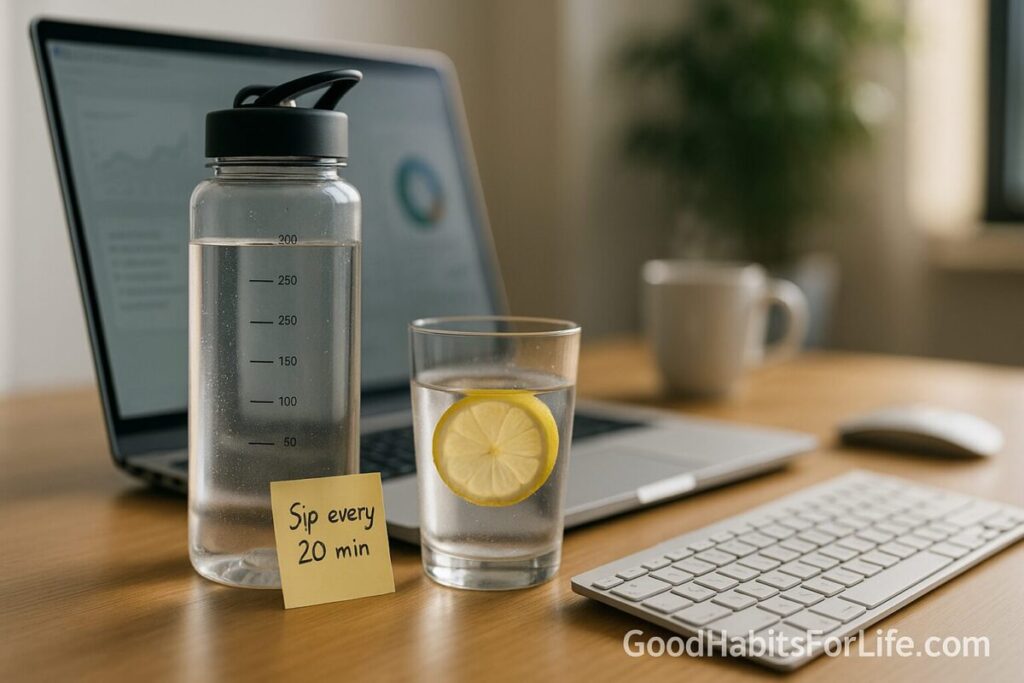
Hydration at the Desk: Sips that Beat Slumps: AI workflows (2025)
Desk Hydration: Sips That Beat Slumps (2025 Guide)
Table of Contents
🧭 What & Why: The Case for Desk Hydration
Definition. Desk hydration is the intentional practice of taking small, regular sips during computer-based work or study to maintain optimal fluid balance and brain performance.
Why it matters. Mild dehydration—about 1–2% of body mass—is linked with worse attention, memory, and mood, the very ingredients of an “afternoon slump.” Controlled studies in healthy adults show measurable declines in vigilance and working memory with modest fluid deficits, alongside higher fatigue and headache reports. Evidence-based daily adequate intakes (AIs) for total water (from beverages + foods) are ~3.7 L for men and 2.7 L for women (US guidance), with European guidance at ~2.5 L men / 2.0 L women; roughly 70–80% typically comes from drinks. Context (heat, air-conditioning dryness, caffeine, salty food, exercise) can push needs higher.
Bottom line: steady sipping helps maintain cognition, mood, and productivity.
A practical desk target. If you prefer a simple rule for a temperate office day:
-
1.5–2.5 L from beverages across the day (6–10 cups of ~250 mL), plus water-rich foods.
-
Add 250–500 mL for hot rooms, long calls, or intense mental sprints; add more with exercise/heat.
✅ Quick Start: Do-This-Today Checklist
-
Place a 600–750 mL bottle within arm’s reach; fill it first thing.
-
Set a 30–45 min “sip cue.” Use a Pomodoro timer, smartwatch, or calendar ping.
-
Attach sips to habits you already do: every meeting start, every code run, every email batch.
-
Front-load morning fluids (500–750 mL) to avoid evening bathroom trips.
-
Pair coffee/tea with water. One mug of coffee? Sip 200–250 mL water beside it.
-
Log once at lunch (quick check: ~50% of bottle gone?) and refill for afternoon.
-
Finish with dinner water rather than late-night chugging.
🛠️ 7-Day Starter Plan → 30-60-90 Roadmap
7-Day Starter
-
Day 1: Choose your bottle (graduated markings help). Add one cue: sip at meeting starts.
-
Day 2: Add a Pomodoro cue (25-5 or 50-10). Refill once before lunch, once at 3 p.m.
-
Day 3: Morning preload 500 mL within 90 minutes of waking.
-
Day 4: Flavor assist (slice of lemon/cucumber) if taste is a barrier.
-
Day 5: Bathroom plan: schedule bio-breaks near natural transitions (after standups).
-
Day 6: Ambient-temperature test—many sip more when water isn’t ice-cold.
-
Day 7: Review your logs (or bottle markings). Aim for 6–10 cups; adjust for climate/activity.
30-60-90 Roadmap
-
30 days: Standardize 3 anchors (morning preload, meeting-start sip, Pomodoro).
-
60 days: Add “Sip-Before-Send” rule (one sip before hitting Send/Deploy/Run).
-
90 days: Add heat/activity auto-adjust (see AI Workflows) and travel mode (collapse to 3 large sips: wake-up, mid-day, early evening).
🧠 Techniques & Frameworks That Stick
1) The “3×3 Hydration Grid”
-
Three windows: Morning / Midday / Afternoon-Early Evening.
-
Three goals: 500–750 mL each window → 1.5–2.25 L from beverages.
2) Pairing & Stacking
-
Stack on habits you never miss: logins, standups, bathroom breaks, coffee prep.
-
Pair with glass-half-full rule: your bottle is never below half during core work hours.
3) Micro-Rules for Focus
-
Sip-Before-Send: One sip before sending an email, message, or commit.
-
Meeting Bookends: 2–3 sips at start/end; larger meetings = larger sips.
-
Pomodoro Sips: End every work block with 2–3 sips during the 5-min break.
4) Environment Tweaks
-
Keep water within 30 cm of your dominant hand.
-
Choose a straw lid if it makes you sip more.
-
Try room-temp if very cold slows your intake.
🤖 AI Workflows: Automate Your Sips
A) iPhone/iPad (Shortcuts)
-
“Hydration Nudge” Shortcut:
-
Triggers: 30- or 45-min repeating timer during 09:00–18:00 on weekdays.
-
Action: Show notification “2–3 sips now,” log to Apple Health (Water).
-
Add Weather check: If outside temp > 32 °C (90 °F), increase reminders by 1/hr.
-
B) Android (Routines/Automations)
-
Google Clock + Routine:
-
Timers at :25 and :55 past each hour; Routine shows a toast “Sip-Before-Send.”
-
Location condition = “At Work Wi-Fi”; time window = 09:00–18:00.
-
C) Slack/Teams nudges
-
Slack Workflow Builder / Teams Power Automate:
-
DM yourself at 11:30 & 15:30: “💧 Refill & 5 sips.”
-
Channel custom emoji reaction (e.g., :droplet:) at the start of each standup to cue sips.
-
D) Calendar-Aware Sips
-
Google Calendar “Focus blocks” with a notification + emoji title: “Focus 🔵 + 💧”.
-
Outlook quick step: auto-insert 2-min buffer before long calls named “Hydrate.”
E) Smart Bottles & Wearables
-
HidrateSpark / Fitbit / Apple Watch: auto-log water; watch tap every 45 min.
-
IFTTT/Tasker: When bottle level drops < 20% by 15:00 → send phone reminder.
F) ChatGPT Prompt (copy/paste)
“Act as my hydration coach. I work 09:30–18:00 at a desk in [city/climate]. I drink 2 coffees and exercise [none/light/moderate] at [time]. Build a weekday sip schedule (in mL), add refill times, and a bathroom-break plan that avoids back-to-back meetings. Adapt for hotter days.”
👥 Audience Variations
Students: Use class transitions as sip anchors; carry a 500 mL bottle; schedule a refill after lunch; avoid huge pre-exam chugs—small sips protect focus.
Professionals (desk): Set meeting bookends; keep a straw-lid bottle; add a 15:30 “refill & steps” micro-break.
Seniors: Favor steady sips (thirst can be blunted with age). Keep a log card; coordinate with medications/diuretics—ask your clinician for personalized advice.
Teens: Gamify with streaks (7-day run = small reward); pair sips with homework blocks and sports practices.
⚠️ Mistakes & Myths to Avoid
-
Myth: “Coffee dehydrates you.” Normal coffee/tea do count toward fluids; just pair them with water and avoid over-caffeination late.
-
All-at-once chugging. Leads to bathroom sprints and doesn’t support steady cognition.
-
Ignoring climate/AC. Dry air and fan heaters increase losses.
-
Giant evening catch-up. Push intake earlier; sleep > late-night chugging.
-
Electrolyte overkill. Most desk days don’t require sports drinks; focus on balanced meals + water.
-
Overhydration. Rare but risky—don’t force liters rapidly without electrolytes, especially in endurance events.
🗣️ Real-Life Examples & Scripts
Email rule:
-
Before you hit Send: one sip. If the email is heated, take three slow sips.
Meeting script:
-
“Quick hydration check—2 sips and we start.” (Works great as a team habit.)
Office signage:
-
“Refill at 11:30 & 15:30 → Fewer slumps, clearer thinking.”
Self-talk when you forget:
-
“Missed an hour? No guilt. Two sips now, refill at the next break.”
Travel mode (airport/long commute):
-
Big sips at security line, mid-flight water, and post-landing—avoid overdoing it before boarding.
🧰 Tools, Apps & Resources (Pros & Cons)
| Tool | Best For | Pros | Cons |
|---|---|---|---|
| HidrateSpark smart bottle | Auto-tracking | Bluetooth logging; watch/app nudges | Cost; charging |
| Apple Health / Google Fit | Central logging | Integrates with many apps/devices | Manual entry unless paired |
| WaterMinder / Aqualert | Simple reminders | Clean UI; widgets; custom cups | Another app to manage |
| Shortcuts / Android Routines | DIY automations | Free; highly customizable | Setup time |
| Slack Workflow / Teams | Work-context cues | Meets you where you work | Notification fatigue |
| Straw-lid bottle (750 mL) | Habit ease | Faster, quieter sips at desk | Some dislike straw taste |
| Insulated tumbler (1 L) | Fewer refills | Stays cool/neutral | Bulky on small desks |
📚 Key Takeaways
-
Maintain steady sips, not sporadic chugs; 1.5–2.5 L from drinks is a solid desk-day range for many adults.
-
Tie hydration to predictable anchors (meetings, Pomodoro, refills).
-
Use AI nudges and smart bottles for hands-off consistency.
-
Adjust for heat, AC, caffeine, salty meals, and activity.
-
Keep it light, early, and bathroom-break aware—hydration should help, not hassle.
❓ FAQs
1) How much water should I drink at work?
Most adults do well with 1.5–2.5 L from drinks during a typical day, plus water-rich foods—then adjust for heat and activity. Use the 3×3 Grid to spread it out.
2) Do coffee and tea count?
Yes. They contribute to your daily fluids. Pair caffeinated drinks with water and avoid loading them late in the day.
3) What are signs I’m under-hydrated at the desk?
Thirst, darker urine, headache, sluggish thinking, irritability. Even 1–2% body water loss can nudge cognition and mood downward.
4) Is sparkling water OK?
Absolutely—if it helps you drink more. Watch added sodium/sugar in flavored varieties.
5) Do I need electrolytes?
Not for most air-conditioned, sedentary workdays. Use them for heavy sweating (exercise/heat) or as advised by a clinician.
6) How do I avoid too many bathroom breaks?
Front-load morning fluids, sip steadily (not huge gulps), and cluster refills before natural breaks. Avoid catch-up chugging late.
7) Can I overdo water?
Yes—rapid, excessive intake can dilute blood sodium (hyponatremia). Space your sips and listen to thirst/appetite cues.
8) What about kids/teens studying at home?
Use class/homework blocks as anchors; a 500 mL bottle and two planned refills usually cover a school day, adjusting for sports.
9) Is room temperature better than ice-cold?
Whatever you will drink more consistently is best. Many find room-temp easier for frequent sips.
10) Any quick metric to check I’m on track?
If your 750 mL bottle is refilled 2–3× before evening, you’re likely in a good range (context-dependent).
References
-
Harvard T.H. Chan School of Public Health. Water. https://www.hsph.harvard.edu/nutritionsource/water/
-
National Academies of Sciences, Engineering, and Medicine. Dietary Reference Intakes for Water, Potassium, Sodium, Chloride, and Sulfate. https://nap.nationalacademies.org/catalog/10925
-
European Food Safety Authority (EFSA). Scientific Opinion on Dietary Reference Values for Water. EFSA Journal 2010;8(3):1459. https://www.efsa.europa.eu/en/efsajournal/pub/1459
-
Centers for Disease Control and Prevention (CDC). Get the Facts: Drinking Water & Your Health. https://www.cdc.gov/healthywater/drinking/nutrition/index.html
-
Armstrong LE, et al. Mild dehydration affects mood in healthy young women. J Nutr. 2012. https://pubmed.ncbi.nlm.nih.gov/22190027/
-
Ganio MS, et al. Mild dehydration impairs cognitive performance and mood of men. Br J Nutr. 2011. https://pubmed.ncbi.nlm.nih.gov/21272266/
-
Masento NA, et al. Effects of hydration status on cognitive performance and mood. Nutrients. 2014. https://pubmed.ncbi.nlm.nih.gov/24622520/
-
NHS. Water, drinks and your health. https://www.nhs.uk/live-well/eat-well/water-drinks-nutrition/
-
Mayo Clinic. Water: How much do you need? https://www.mayoclinic.org/healthy-lifestyle/nutrition-and-healthy-eating/in-depth/water/art-20044256
Disclaimer: This guide is educational and not a substitute for personalized medical advice; consult a healthcare professional for individual hydration needs, especially with health conditions or medications.