
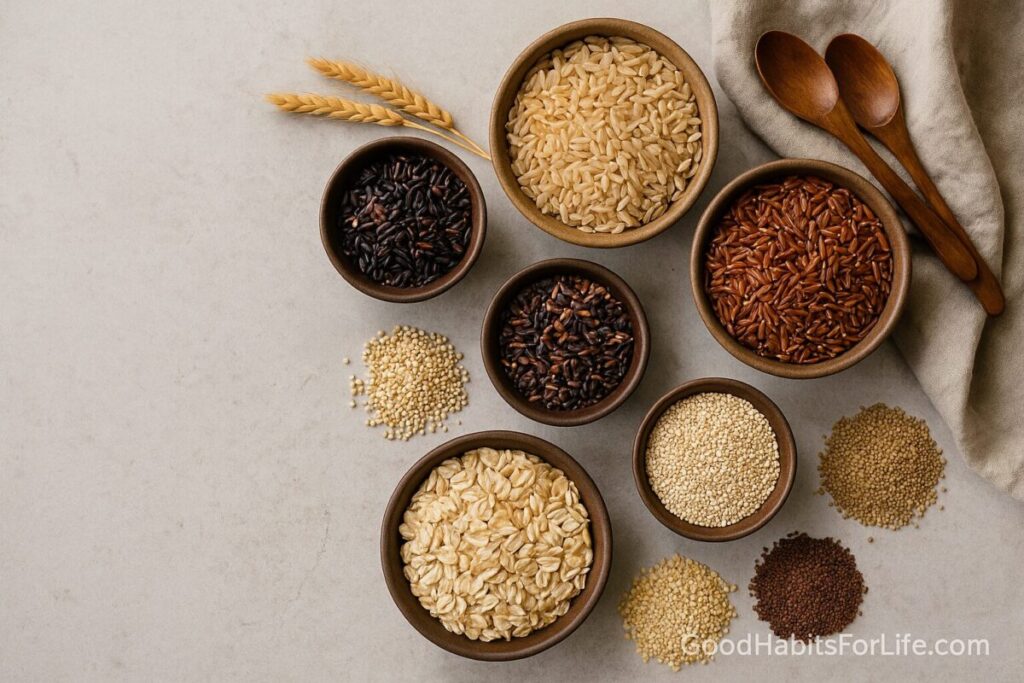
Whole Grains 101: Rice, Quinoa, Millets
Whole Grains 101: Rice, Quinoa & Millets
Table of Contents
🧭 What Are Whole Grains & Why They Matter
Whole grains contain all three parts of the kernel—the bran, germ, and endosperm—so you keep the fiber and nutrients that get milled away in refined grains. Examples: brown/red/black rice, quinoa, oats, barley, and millets like jowar (sorghum), bajra (pearl millet), and ragi (finger millet). Harvard Health
Eating more whole grains is consistently linked with better heart and metabolic health; major cardiac guidelines highlight whole grains for lowering risk of heart disease and supporting digestive health and diabetes prevention. www.heart.org
Public health guidance also recommends making at least half of your grains whole. In India, the 2024 ICMR-NIN Dietary Guidelines advise preferring at least 50% cereals/millets as whole grain—practical for rotis, dosas, idlis, and rice swaps. myplate.govnin.res.in
Millets deserve a special call-out: they’re nutritious, naturally hardy, and part of global efforts to diversify diets and support climate-resilient farming (International Year of Millets, 2023). FAOHome+1
✅ Quick Start: Simple Swaps Today
-
Breakfast: Oats or ragi porridge; leftover brown rice + yogurt + fruit; quinoa upma.
-
Lunch: 50:50 mix of white:brown rice to start; millet khichdi; quinoa pulao.
-
Dinner: Jowar/bajra rotis; brown rice with dal + sabzi; quinoa salad bowls.
-
Snacks: Plain popcorn; murmura (puffed rice) mixed with roasted chana; millet crackers.
-
Shopping rule: First ingredient should read “whole…” (whole wheat, whole oats, etc.). myplate.gov
🛠️ 7-Day Starter Habit Plan
Goal: Make ≥50% of your grains whole this week (plates, rotis, bowls, snacks).
Day 1 (Prep): Batch-cook 3–4 cups whole grain (brown rice or millet) + 2 cups quinoa. Cool, portion (1 cup cooked each) and refrigerate/freeze.
Day 2: Swap half your usual rice for brown or red rice.
Day 3: Try bajra or jowar rotis; keep extras for tomorrow.
Day 4: Quinoa bowl: quinoa + chana + cucumber/tomato + lemon + peanuts.
Day 5: Millet khichdi (foxtail or little millet) with veggies.
Day 6: Brown-rice pulao; add peas and paneer/tofu.
Day 7 (Review): Check energy, digestion, satiety; plan next week’s batch.
Checkpoint: If you managed ≥7 whole-grain portions (about ½ cup cooked per portion), you’re on track. Keep rotating varieties (rice types, quinoa, 2–3 millets). (General portion targets vary; focus on replacing refined with whole and building a sustainable routine.) myplate.gov
🧠 Techniques & Frameworks (Research-Aligned)
The Plate Method (fast portioning):
-
½ plate vegetables, ¼ protein, ¼ whole grains (brown rice/quinoa/millets). It helps moderate total carbs and stabilize energy—especially useful for blood-sugar control. (Low-GI grains and minimally processed carbs generally raise glucose more slowly.) diabetes.org.uk
Batch-Cook & Freeze: Cook grains once; freeze flat in zipper bags or small containers. Defrost in minutes for instant bowls.
Texture tuning:
-
Fluffier rice/quinoa: Let rest 5–10 min off heat, then fluff.
-
Creamier (for khichdi/porridge): Add more water and simmer longer.
Spice Map (quick flavor wins):
-
Rice: jeera, bay leaf, cloves, turmeric.
-
Quinoa: lemon, olive oil, parsley/mint, roasted peanuts.
-
Millets: mustard seeds, curry leaves, ginger, green chili.
Diabetes-friendly tweaks: Pair grains with protein/fat/fiber (dal + veg + peanuts) and choose lower-GI options more often; brown rice/quinoa/millets typically have lower GI than polished white rice. The Nutrition Sourcediabetes.org.uk
🍳 Cooking Basics: Rice, Quinoa & Millets
Home-kitchen reference ranges; adjust for your cookware and preferred texture.
Rice (brown/red/black):
-
Stovetop absorption: ~1 cup rice : 1¾–2 cups water; simmer 35–45 min (brown).
-
“Pasta” method: Boil in excess water 25–30 min; drain, rest 10 min (great for hands-off).
-
Arsenic note: Cooking rice in excess water can lower inorganic arsenic; rinsing has minimal effect (and can wash off some added B-vitamins in polished/parboiled rice). Vary your grains—especially for young children. U.S. Food and Drug Administration+1
Quinoa:
-
Rinse briefly to remove natural saponins.
-
Stovetop: ~1 cup quinoa : ~2 cups water; simmer ~15 min; rest 5 min.
-
Naturally gluten-free and often treated as a “whole grain” in nutrition guidance. Harvard Health
Millets (jowar, bajra, ragi, little/foxtail/barnyard):
-
Rotis: Mix millet flour with warm water; combine with whole-wheat if needed for pliability.
-
Khichdi/upma: 1 cup millet : ~2½–3 cups water; soak 20–30 min for softer texture.
-
Millets are nutrient-dense and promoted globally for nutrition and sustainability. FAOHome
🧩 Audience Variations
Students: Keep 2–3 microwave-ready grain packs; add frozen veg + eggs/beans for 10-minute bowls.
Parents: Rotate grains for kids (brown rice one day, millet dosa the next); mix 50:50 with white rice at first.
Busy professionals: Lunchbox formula = 1 cup cooked whole grain + 1 cup veg + 20–30 g protein + sauce.
Seniors/Teens: Softer textures (khichdi, porridge); watch portions if appetite varies; prioritize variety for micronutrients.
Gluten-free needs: Rice, quinoa, most millets are naturally GF—check cross-contamination on packaged foods.
⚠️ Mistakes & Myths to Avoid
-
“Carbs are bad.” Quality matters: whole grains deliver fiber, vitamins, minerals, and are linked with lower chronic disease risk. www.heart.org
-
Only white rice is tasty. Try red, black, or brown rice; season well and rest after cooking.
-
Rinsing removes arsenic. Rinsing helps texture but minimally reduces arsenic; the excess-water method is more effective (with some nutrient loss). U.S. Food and Drug Administration+1
-
Millets are “ancient” so niche. They’re increasingly mainstream; global bodies promoted 2023 as the International Year of Millets. FAOHome
🗣️ Real-Life Examples & Scripts
Grocery script (label check):
-
“Is the first ingredient ‘whole wheat’ (or whole ___)? If yes, into the cart.” myplate.gov
Lunchbox bowl (5-step):
-
1 cup cooked whole grain (brown rice/quinoa/millet)
-
1 cup veg (raw/cooked)
-
Protein (dal, beans, paneer, tofu, eggs, chicken/fish)
-
Healthy fat (peanuts, sesame, olive oil)
-
Acid/heat (lemon, chili, pickle)
Family script (gradual switch):
-
“This week we’ll do 50:50 white:brown rice. If everyone likes it, next week 70:30.”
One-pot millet khichdi:
-
1 cup foxtail millet, 2½–3 cups water, mixed veg, turmeric, cumin, ginger; pressure-cook to soft.
📚 Tools, Apps & Resources
-
USDA MyPlate (free planner & tips): Quick guides like “make half your grains whole.” Pros: simple, visual; Cons: US-centric. myplate.gov
-
ICMR-NIN Dietary Guidelines 2024 (India): Clear advice to prefer ≥50% cereals/millets as whole grain. Pros: India-specific plates; Cons: long PDF. nin.res.in
-
Harvard Nutrition Source (Whole Grains): Evidence summaries and practical tips. Pros: research-based; Cons: not recipe-focused. The Nutrition Source
-
FAO – International Year of Millets: Millets’ nutrition + sustainability context. Pros: global perspective; Cons: less on home cooking. FAOHome
-
Food safety (FDA on arsenic in rice): Up-to-date risk and cooking guidance. Pros: actionable; Cons: US-focused. U.S. Food and Drug Administration
📝 Key Takeaways
-
Keep the kernel whole (bran, germ, endosperm) to get fiber and nutrients. Harvard Health
-
Aim for ≥50% whole grains daily; rotate rice types, quinoa, and millets. myplate.govnin.res.in
-
Batch-cook and portion for 10-minute meals.
-
For blood-sugar steadiness, pair grains with protein/veg and favor lower-GI options. diabetes.org.uk
-
If concerned about arsenic in rice, use the excess-water method and diversify grains. U.S. Food and Drug Administration
❓ FAQs
1) What exactly is a “whole grain”?
A grain with all three parts—bran, germ, endosperm—intact. Refining removes bran/germ, reducing fiber and micronutrients. Harvard Health
2) Is quinoa a whole grain or a seed?
Botanically a seed (pseudo-cereal) but nutritionally treated like a whole grain in healthy-eating guidance. Harvard Health
3) Are millets better than rice?
They’re different, not “better.” Millets are nutritious and climate-resilient; including them boosts variety and fiber. Rotate with rice and quinoa. FAOHome
4) How much should I eat per day?
Public guidance suggests making at least half of your grains whole; build plates with ~¼ whole grains, ½ vegetables, ¼ protein. myplate.gov
5) Can people with diabetes eat rice?
Yes—portion and pair it well, and favor lower-GI choices like brown rice, quinoa, or millets more often. The Nutrition Sourcediabetes.org.uk
6) How do I reduce arsenic in rice?
Boil rice in excess water (like pasta) and drain; rinsing has minimal impact. Also, diversify the grains you eat. U.S. Food and Drug Administration+1
7) Are “multi-grain” breads whole grain?
Not always—look for “whole” as the first ingredient; otherwise it may still be mostly refined flour. myplate.gov
8) Brown vs white rice—what’s the main difference?
Brown keeps the bran/germ (more fiber/micronutrients). White rice is refined and has higher average GI. The Nutrition Source
9) Do I have to soak millets?
Not required, but 20–30 minutes helps softer textures for khichdi/porridge; adapt to your recipe.
10) How long do cooked grains keep?
3–4 days refrigerated in airtight containers; freeze portions for up to 2–3 months.
References
-
Harvard Health Publishing. In search of healthy whole grains: how to read a whole-grain label (Aug 11, 2025). Harvard Health
-
American Heart Association. Whole grains, refined grains, and dietary fiber (Jun 25, 2024). www.heart.org
-
USDA MyPlate. Grains Group – make at least half your grains whole (accessed 2025). myplate.gov
-
ICMR-NIN. Dietary Guidelines for Indians – 2024 (PDF). nin.res.in
-
FAO. International Year of Millets 2023 (overview & benefits). FAOHome+1
-
Harvard T.H. Chan School of Public Health – Nutrition Source. Whole Grains (definition/examples). The Nutrition Source
-
FDA. Arsenic in Food and What You Can Do to Limit Exposure to Arsenic (2022–2024). U.S. Food and Drug Administration+1
-
Harvard Nutrition Source. Rice – GI overview and ranges. The Nutrition Source
-
Diabetes UK. Glycaemic index & diabetes / Carbohydrates and diabetes. diabetes.org.uk+1
Disclaimer: This article is for general nutrition education and is not a substitute for personal medical advice.