
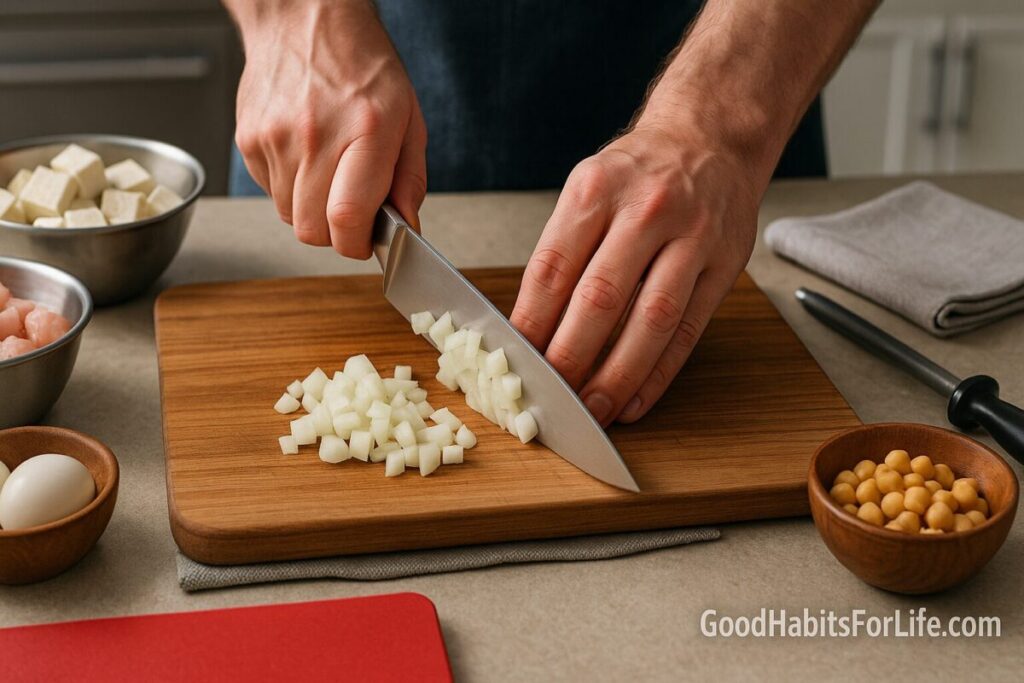
Knife Basics: Grip, Dice & Speed (Safely): Protein-Forward Plan (2025)
Knife Basics: Grip, Dice & Speed (Safely) — Protein Plan
Table of Contents
🧭 What & Why
-
Knife skills = faster, safer, tastier. A proper grip and consistent dice reduce injury risk and deliver even cooking and better texture.
-
Protein-forward cooking gets easier. When chicken, paneer/tofu, eggs, and legumes are prepped efficiently, it’s simple to hit daily protein targets while keeping meals quick and affordable.
-
Evidence notes: Safe food handling and separation (raw vs ready-to-eat) reduce cross-contamination risk; sharp, well-maintained knives are safer to use than dull ones; adults typically need ~0.8 g protein/kg/day (general RDA) with higher needs for some groups. See References.
🛡️ Outcomes you’ll get
-
A reliable pinch grip, claw guide hand, and board setup that keeps fingers safe.
-
A mental model for dice sizes so your food cooks predictably.
-
A 15-minute protein prep you can repeat weekly.
⚠️ If you’re new or returning after a long break, emphasize safety & control before speed.
🧼 Safety Foundations
-
Board stability: Lay a damp, wrung-out towel under your cutting board.
-
Separation: Use dedicated boards/knives (or strict cleaning/sanitizing) for raw meat/seafood vs produce/ready-to-eat.
-
Clean, rinse, sanitize: After handling raw foods, wash with hot soapy water, rinse, then sanitize (per label) and air-dry.
-
Storage: Chill perishable diced foods within 2 hours (≤1 hour if ≥32 °C/90 °F).
-
First-aid basics: For minor cuts, apply pressure, clean, and dress; seek medical care for deep, gaping, or contaminated wounds.
🛠️ Essential Tools & Setup
-
Chef’s knife (20–23 cm / 8–9 in): Versatile, stable.
-
Paring knife (8–10 cm / 3–4 in): Peeling, small detail cuts.
-
Serrated knife: Bread/tomatoes.
-
Honing steel: Realigns the edge—use before each session (10 gentle strokes/side).
-
Sharpener or stone: Restores edge—schedule every few weeks or as needed.
-
Cut-resistant glove (ANSI/ISEA-rated): Optional but helpful for beginners.
-
Large, grippy board(s): One for raw proteins, one for produce; color-coded if possible.
-
Towel + bench scraper: Stability and easy transfer of diced ingredients.
-
Containers: Clear, labeled, airtight for mise en place.
Bench setup (left-to-right for right-handers; mirror for left-handers): clean produce → knife/board center → discard bowl → storage containers.
🧠 Knife Grips & Guide-Hand Technique
-
Pinch grip (dominant hand): Pinch the blade just ahead of the bolster with thumb + side of index finger; wrap remaining fingers around the handle. This gives control and reduces wrist fatigue.
-
Claw (guide hand): Curl fingertips under; knuckles forward act as a fence; thumb tucked.
-
Rock-chop motion: Tip contacts board; lift heel and roll forward in an arc; keep blade in contact to stabilize.
-
Push-cut: For dense veg (carrots, potatoes): tip lifts slightly; push forward and down in one motion.
-
Pull-cut: For delicate produce (mushrooms, herbs): draw knife toward you to reduce bruising.
Safety cues you can say out loud: “Knuckles forward, thumb tucked. Board steady. Eyes on blade.”
📏 Standard Cuts & Dice Sizes
Consistency improves texture and cook time. Aim for these common sizes:
| Cut | Metric | Imperial | Use cases |
|---|---|---|---|
| Brunoise | ~3 mm cubes | ~⅛ in | Garnishes, quick-saute veg |
| Small dice | ~6 mm | ~¼ in | Soups, stir-fries |
| Medium dice | ~13 mm | ~½ in | Roasting veg, chili |
| Large dice | ~19 mm | ~¾ in | Slow braises |
| Julienne | 3×3×50 mm | ⅛×⅛×2 in | Salads, stir-fries |
| Batonnet | 6×6×60 mm | ¼×¼×2.5 in | Fries, crudités |
| Chiffonade | thin ribbons | thin | Leafy herbs/greens |
Pro tip: Square edges first (create a flat “plank”), then slice into matchsticks (julienne), then cross-cut into dice. Your fingertips stay behind your knuckles the entire time.
✅ Quick Start: 10-Minute Skill Sprint
-
Stabilize board (damp towel), hone your knife (10 strokes/side).
-
Warm-up: 60 s of claw practice with a half onion—root on for stability.
-
Dice practice:
-
Peel and halve 1 onion; small dice one half, medium dice the other.
-
Cut 1 carrot into batonnets, then small dice half of them.
-
Chiffonade a small handful of spinach or basil.
-
-
Stop-check: Even cubes? Fingers safe? Any wobble? Re-stabilize and continue.
Keep scraps for stock; compost peels.
📅 The 7-Day Protein-Forward Starter Plan
Goal: Learn safe, efficient knife work while assembling quick meals that deliver ~30–40 g protein per serving.
-
Day 1 – Setup & Safety (15–20 min)
Wash boards/knives; label two containers RAW / READY. Practice pinch grip + claw with an onion and carrot.
Mini-prep: Small-dice 1 onion; chill. -
Day 2 – Egg Power (15 min)
Dice tomatoes + onions; chiffonade spinach. Cook egg bhurji or scramble (4 eggs = ~24–28 g protein) and fold in veg. Add a side of Greek yogurt (~10 g/100 g). -
Day 3 – Chickpea Crunch (15 min)
Medium-dice cucumber and peppers; mince herbs. Toss with 1 can chickpeas (~14–18 g protein), lemon, olive oil, salt. Add paneer cubes or feta to reach 30–40 g. -
Day 4 – Paneer/Tofu Stir-Fry (20 min)
Batonnet carrots, julienne peppers, small-dice onion. Sear 200 g paneer or extra-firm tofu (~32–40 g protein) and stir-fry with veg and sauce. -
Day 5 – Chicken (or Soy) Prep (20 min)
Separate raw board/knife. Medium-dice 300 g chicken breast (~66 g protein total). Cook thoroughly (≥74 °C/165 °F). Portion 150 g for dinner; chill remainder. -
Day 6 – Protein Bowls (15 min)
Build bowls: grain or salad base + protein (tofu/paneer/chicken/chickpeas) + diced veg + sauce. Target 30–40 g protein/bowl. -
Day 7 – Review & Sharpen (20–30 min)
Practice even small dice on 1 onion + 1 carrot; hone; sharpen if needed. Make a quick omelet with leftovers.
Weekly shopping template (protein-forward): eggs, paneer/tofu, chicken or additional legumes, Greek yogurt, chickpeas/lentils, onions, carrots, peppers, leafy greens, tomatoes, cucumbers, herbs, lemons.
⏱️ Speed—Safely: Drills & Checkpoints
-
Metronome drill (3×2 min):
-
Small dice onion; 2) Julienne pepper; 3) Chiffonade spinach. Count clean cubes, not total cuts.
-
-
Accuracy test: Place your diced veg into a measuring cup—less than 10% outliers (too big/small) = pass.
-
Grip audit every minute: Pinch at blade, thumb opposite index, wrist neutral.
-
Stop rule: Any wobble, wet handle, drifting eyes, or crowding—pause, wipe, reset.
👥 Audience Variations
-
Students: Start with paring knife + chef’s knife, a single medium board, and a cut-resistant glove for your guide hand. Batch-prep chickpeas, eggs, and tofu (budget-friendly).
-
Parents: Color-code boards; keep a “no-hands on board” rule for kids; involve them in washing herbs and spinning greens, not knife work.
-
Professionals: Time your sets; sharpen on a workday schedule (e.g., every 2–3 weeks); pre-label containers by dice size for consistent cook times.
-
Seniors: Prioritize lighter knives, non-slip mats, and a slightly taller board height to reduce back/shoulder strain.
-
Teens (supervision): Practice with soft produce (zucchini, mushrooms) first; glove + claw mandatory.
⚠️ Mistakes & Myths to Avoid
-
Myth: “Dull knives are safer.” → False. Dull blades slip; sharp + controlled is safer.
-
Mistake: Fingers splayed on the guide hand → switch to claw.
-
Mistake: Cutting on glass/stone → quickly dulls the edge; use wood or quality plastic.
-
Myth: “Honing = sharpening.” → Honing realigns; sharpening removes metal to recreate an edge.
-
Mistake: Same board/knife for raw chicken and salad → cross-contamination risk; separate or fully sanitize in between.
-
Mistake: Chasing speed too soon → earn speed with accuracy first.
💬 Real-Life Scripts & Mini-Routines
-
Start session mantra (5 s): “Board stable, blade sharp, claw up.”
-
Transfer cleanly: “Tip down, scrape with spine” (use bench scraper or the spine of the knife, not the edge).
-
Onion small-dice script: Trim → halve → peel → horizontal cuts (2–3) → vertical cuts → cross-cut → finish with claw.
-
Protein-Forward 15 (mix-and-match bowls):
-
Small-dice ½ onion, medium-dice 1 cucumber & 1 pepper, chiffonade 1 handful spinach.
-
Combine with 200 g tofu/paneer or 150 g cooked chicken + ½ can chickpeas.
-
Add lemon + yogurt or tahini sauce. Yield: 1–2 servings, 30–40 g protein/serving.
-
🧰 Tools, Apps & Resources
-
Hardware: Honing steel; 1000/3000 or 1000/6000 water stone; color-coded boards; ANSI/ISEA-rated cut-resistant glove.
-
Apps:
-
Cronometer/FoodData Central for nutrition checks.
-
Timer/metronome app for drills.
-
-
Pros & cons quick take: Stones give the best edge (learning curve), pull-through sharpeners are easy (can remove more metal), gloves add confidence (don’t replace technique).
📌 Key Takeaways
-
Stabilize the board, pinch grip + claw, eyes on the blade.
-
Hone every session, sharpen on a schedule.
-
Learn standard dice sizes to cook evenly.
-
Use separate boards/knives for raw proteins vs produce.
-
Build a repeatable Protein-Forward 15 for effortless 30–40 g protein meals.
-
Speed comes from accuracy + rhythm, not rushing.
❓ FAQs
1) What’s the safest knife for beginners?
A 20 cm (8 in) chef’s knife offers stability and control. Pair it with a paring knife and consider a cut-resistant glove for your guide hand.
2) How often should I sharpen?
Hone before each session; sharpen when the knife drags or fails a paper-slice or tomato-skin test—often every 3–8 weeks depending on use and board material.
3) Is there a correct way to hold food while chopping?
Yes—the claw: fingertips curled under, knuckles forward as a fence, thumb tucked.
4) What are common dice sizes I should memorize?
Brunoise ~3 mm, small 6 mm, medium 13 mm, large 19 mm; julienne 3×3×50 mm, batonnet 6×6×60 mm, chiffonade for greens.
5) Do cut-resistant gloves really help?
They reduce cut severity but don’t replace technique. Look for ANSI/ISEA-rated gloves that fit snugly.
6) How do I avoid tears with onions?
Use a sharp knife, chill the onion briefly, and work near ventilation; the biggest factor is reducing cell damage with a sharp, clean cut.
7) What’s a simple daily protein target?
A general guideline is ~0.8 g/kg/day for adults (health permitting). Many people benefit from 20–40 g per meal; personalize with a clinician/dietitian.
8) How do I keep herbs bright and not bruised?
Dry thoroughly, then chiffonade with a quick pull-cut; add at the end of cooking.
9) Is honing the same as sharpening?
No. Honing realigns the edge; sharpening removes metal to recreate it. You need both over time.
10) How should I store knives?
On a magnetic strip or in a block/sheath—never loose in a drawer (edge damage + injury risk).
📚 References
-
Centers for Disease Control and Prevention (CDC). Food Safety: Clean, Separate, Cook, Chill. https://www.cdc.gov/foodsafety/keep-food-safe.html
-
USDA Food Safety and Inspection Service (FSIS). Cutting Boards and Food Safety. https://www.fsis.usda.gov/food-safety/safe-food-handling-and-preparation/food-safety-basics/cutting-boards-and-food-safety
-
FoodSafety.gov. Safe Minimum Internal Temperatures. https://www.foodsafety.gov/food-safety-charts/safe-minimum-cooking-temperature
-
Harvard T.H. Chan School of Public Health. The Nutrition Source: Protein. https://www.hsph.harvard.edu/nutritionsource/what-should-you-eat/protein/
-
World Health Organization (WHO). Protein and amino acid requirements in human nutrition (TRS 935). https://www.who.int/publications/i/item/WHO-TRS-935
-
NCBI Bookshelf. Dietary Reference Intakes for Energy, Carbohydrate, Fat, Protein, and Amino Acids. https://www.ncbi.nlm.nih.gov/books/
-
USDA. FoodData Central. https://fdc.nal.usda.gov/
-
University of Nebraska–Lincoln Extension. Knife Safety in the Kitchen. https://food.unl.edu/
-
University of Maine Cooperative Extension. Kitchen Knife Safety. https://extension.umaine.edu/
-
UC Davis Safety Services. Knife Safety. https://safetyservices.ucdavis.edu/
-
International Safety Equipment Association (ISEA). ANSI/ISEA 105 – Hand Protection. https://www.safetyequipment.org/standard/ansiisea-105/
-
Mayo Clinic. Cuts and scrapes: First aid. https://www.mayoclinic.org/first-aid/first-aid-cuts/basics/art-20056711
Disclaimer
This article is for general education only and is not a substitute for personalized medical or dietary advice.