
Unit Price Math: Compare Sizes Without Stress: Protein-Forward Plan (2025)
Unit Price Math (2025): Protein-Forward Grocery Plan
Table of Contents
🧭 What & Why
Unit price is the cost per standard amount (e.g., ₹/100 g, $/kg, €/L). It lets you compare different pack sizes and brands fairly, cutting through promo hype and “shrinkflation.” Many countries encourage or require clear unit prices (e.g., the EU’s Price Indication Directive; UK CMA guidance; Australia’s ACCC consumer pages), though exact formats vary by retailer and region. EUR-Lex+1GOV.UKaccc.gov.au
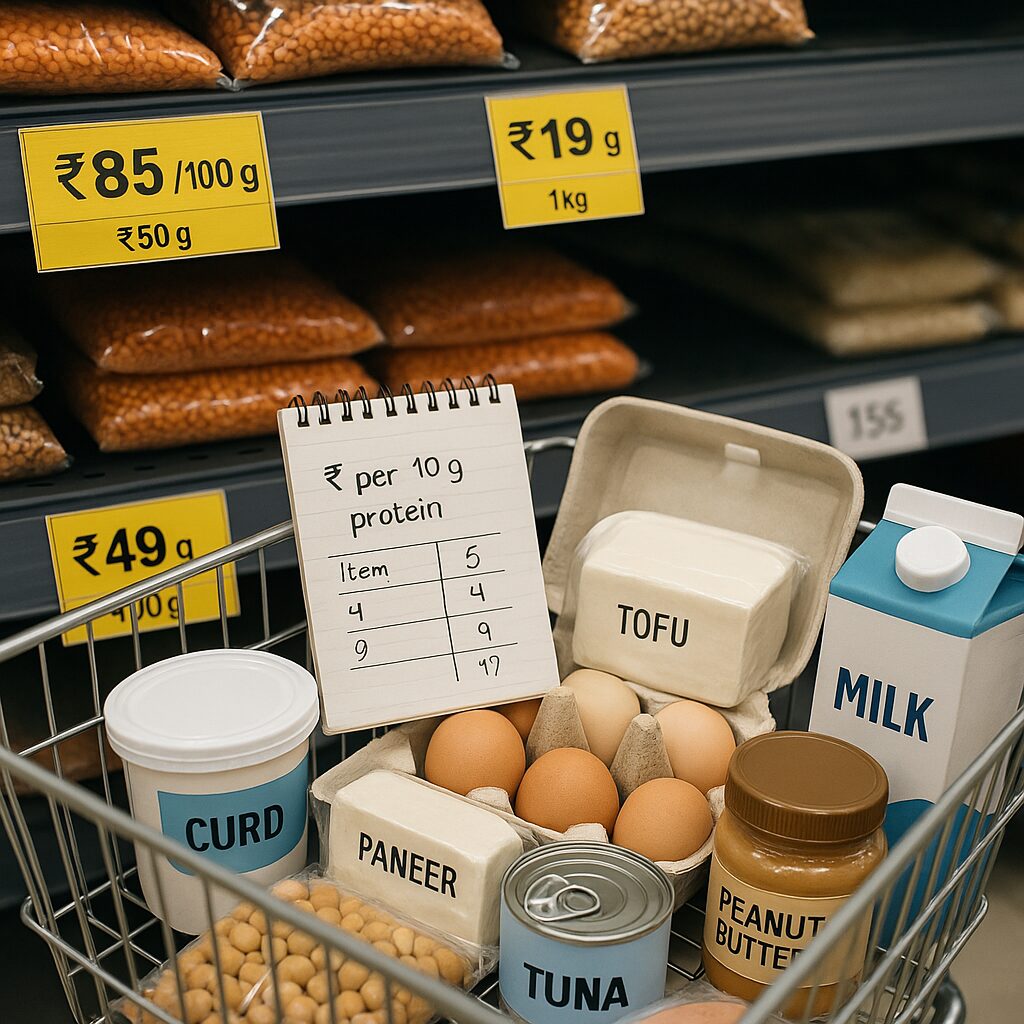
For a protein-forward cart, pair unit price with protein density (grams of protein per 100 g/ml) so you’re buying the lowest cost per 10 g protein rather than just the lowest price per pack. Nutrition databases like USDA FoodData Central make this easy. fdc.nal.usda.gov
Typical daily needs for healthy adults start around 0.8 g protein/kg body weight, with room to adjust by life stage and activity. When budgets are tight and prices volatile, using unit price + protein density helps you meet needs more affordably. NCBIwww.heart.orgFAOHome
✅ Quick Start: Your 10-Minute Aisle Routine
Goal: Choose the best value per 10 g protein—fast.
-
Pick 2–3 options in a category (e.g., eggs, yogurt, tofu).
-
Find the unit price on the shelf tag. If the base units differ, convert so all are per 100 g or per 100 ml (multiply/divide as needed). GOV.UK
-
Grab protein density from the label (per 100 g/ml) or check USDA FoodData Central. fdc.nal.usda.gov
-
Compute “Cost per 10 g protein”:
Cost/10 g protein=Unit price (per 100 g)Protein (g) per 100 g×10\text{Cost/10 g protein} = \frac{\text{Unit price (per 100 g)}}{\text{Protein (g) per 100 g}} \times 10
-
Buy the lowest cost/10 g that meets your taste/diet needs.
-
Note waste factors (bones, marinade, drained weight); adjust if relevant (see Techniques).
-
Snap a photo of the shelf tag for next time—build a mini price book.
🗓️ 30-60-90 Protein-Forward Habit Plan
Days 1–30 — Starter
-
Make one weekly protein comparison (e.g., eggs vs. tofu vs. yogurt).
-
Log three results in your notes: item, unit price, protein per 100 g, cost per 10 g protein.
-
Swap one item to the better-value option.
Days 31–60 — Builder
-
Expand to two categories (e.g., beans/legumes; chicken/fish).
-
Start a price-book (notes or sheet). Track best unit prices by store.
-
Batch-cook a budget protein base (e.g., lentils or shredded chicken) each week.
Days 61–90 — Automatic
-
Set thresholds (e.g., “buy Greek yogurt ≤ ₹0.35 per 10 g protein”).
-
Use store apps or photos to spot deals quickly.
-
Review once a month; update thresholds if inflation shifts. Global diet costs move—your thresholds should, too. FAOHomeWorld Bank
🛠️ Techniques & Frameworks (with examples)
1) The Protein-Forward Formula
-
Step A: Standardize unit price to per 100 g/ml.
-
Step B: Look up protein/100 g (label or USDA FDC).
-
Step C: Compute cost per 10 g protein (formula above). fdc.nal.usda.gov
Example (illustrative numbers):
Eggs: unit price ₹8 per 100 g; protein ≈ 12.6 g/100 g → ₹(8 ÷ 12.6) × 10 ≈ ₹6.35 / 10 g
Firm tofu: ₹9 per 100 g; protein ≈ 17 g/100 g → ₹(9 ÷ 17) × 10 ≈ ₹5.29 / 10 g
Greek yogurt: ₹6 per 100 g; protein ≈ 10 g/100 g → ₹6.00 / 10 g
Choose tofu here if taste/diet fits.
(Protein values vary by brand; check labels or FDC entries.) fdc.nal.usda.gov
2) Adjust for Edible Portion
Bone-in chicken or water-packed products may inflate the apparent value. Use edible yield (e.g., 70–75% for some cuts) to refine comparisons. If pack shows drained weight, convert your unit price to per drained 100 g before comparing. (Retailers are encouraged to present clear, legible unit pricing, but practices vary.) NISTGOV.UK
3) Same Base, Every Time
If one tag shows per kg and another per 100 g, convert to the same base to avoid errors. In the EU/UK/Australia, regulators highlight the need for clear and consistent unit indications so shoppers can compare fairly. EUR-LexGOV.UKaccc.gov.au
4) Beware “Discount Illusions”
Some promos aren’t better than everyday unit prices; recent guidance stresses clarity on prior price when promotions are announced. Check the unit price—not just a percent-off badge. EUR-Lex
5) How Much Protein Should I Target?
Start with 0.8 g/kg/day (e.g., 60 g/day at 75 kg), then personalize with your clinician/dietitian. Spreading protein through the day improves practicality and satiety. NCBI
👥 Audience Variations
-
Students / Busy Pros: Pre-portion budget proteins (boiled eggs, Greek yogurt cups, tofu cubes). Use cost/10 g protein to pick quick snacks.
-
Families: Compare bulk vs. two smaller packs; sometimes smaller packs win after waste is considered.
-
Seniors: Prioritize easy-to-chew proteins (yogurt, soft tofu, legumes) and check per-serving cost vs. waste; protein needs may be similar or higher depending on health—confirm with a professional. ACL Administration for Community Living
-
Fitness-Focused: If higher protein targets, price check per 25–30 g protein (one serving). Whole foods often beat specialty products on value.
-
Plant-Forward: Beans, lentils, tofu, and dairy often deliver competitive ₹ per 10 g protein; confirm with your local unit prices and protein densities. fdc.nal.usda.gov
⚠️ Mistakes & Myths to Avoid
-
“Bigger is always cheaper.” Not true—compare unit price; smaller may win. GOV.UK
-
“All unit prices use the same base.” They don’t—convert to the same base to compare. EUR-Lex
-
“Promos guarantee value.” Promotions must reference a prior price correctly; still, the best check is unit price. EUR-Lex
-
“Protein amount is the same across brands.” Protein densities vary widely (e.g., yogurts, tofu, sausages). Verify on labels or FoodData Central. fdc.nal.usda.gov
💬 Real-Life Examples & Scripts
Aisle Script (to yourself):
“Same base? Yes—both per 100 g. Protein per 100 g? Brand A yogurt: 7 g; Brand B: 10 g. Unit prices: ₹5 vs. ₹6. Cost/10 g → A: ₹(5 ÷ 7)×10 ≈ ₹7.14; B: ₹(6 ÷ 10)×10 = ₹6.00. Pick B.”
Butcher Counter:
“Is there a boneless option? What’s the price per kg after trimming? If the bone-in yield is ~70%, that changes my comparison.”
Canned Fish:
“Label shows drained weight 120 g. Tag is ₹240 per 185 g net. Convert to ₹ per 100 g drained: (₹240 ÷ 120)×100 = ₹200 per 100 g drained.”
Weekly Review:
“Eggs were ₹6.40/10 g protein last week; tofu ₹5.20/10 g. If eggs drop below ₹5.80, switch.”
🧰 Tools, Apps & Resources
-
USDA FoodData Central (FDC) — definitive nutrient database for protein/100 g lookups. fdc.nal.usda.gov
-
MyFoodData — fast nutrition comparisons (built from USDA data). My Food Data
-
Regulator Guides on Unit Pricing — UK CMA explainer & research; EU Price Indication Directive summary; NIST best-practice guide; ACCC consumer page. Competition and Markets AuthorityGOV.UKEUR-LexNIST+1accc.gov.au
-
Calculator / Notes / Photos — your price-book; update monthly as food prices shift globally. FAOHome
🧾 Key Takeaways
-
Always compare unit price on the same base. GOV.UK
-
Make it protein-forward by computing cost per 10 g protein from labels/FDC. fdc.nal.usda.gov
-
Account for edible yield and drained weight. GOV.UK
-
Set buy thresholds and keep a price-book as prices move. FAOHome
❓ FAQs
1) What if two items use different unit bases (per kg vs. per 100 g)?
Convert to the same base (e.g., divide per-kg price by 10 to get per-100 g) before comparing. EUR-Lex
2) How do I handle items with water, sauce, or bones?
Use drained weight or edible yield to adjust your unit price; then compute cost per 10 g protein. GOV.UK
3) How much protein do most adults need?
A practical baseline is 0.8 g/kg/day; discuss personal targets with a clinician, especially for athletes, older adults, or specific conditions. NCBI
4) Is more protein always better?
Not necessarily. Focus on your personal target and overall diet quality; many adults already meet or exceed baseline needs. www.heart.orgCDC Blogs
5) Are plant proteins cheaper per 10 g protein?
Often yes (beans, lentils, tofu), but check local unit prices and protein densities; results vary by region and brand. fdc.nal.usda.gov
6) Why do some promos still feel expensive?
Promo rules differ by region, and displays can be inconsistent. Unit price cuts through this—use it to judge value. GOV.UK
📚 References
-
UK Competition & Markets Authority (CMA). Unit pricing: consumer guide & research. (2023–2024). https://www.gov.uk/cma-cases/unit-pricing and https://www.gov.uk/government/publications/unit-pricing-analysis-and-consumer-research/summary-of-consumer-research-and-unit-pricing-analysis GOV.UK+1
-
European Commission / EUR-Lex. Directive 98/6/EC on price indication & 2019/2161 amendment (price reductions). https://eur-lex.europa.eu/eli/dir/1998/6/oj/eng and summary https://eur-lex.europa.eu/EN/legal-content/summary/price-indications-on-consumer-products.html EUR-Lex+1
-
NIST. Unit Pricing Best Practices (SP 1181) & Uniform Unit Pricing tools. https://www.nist.gov/system/files/documents/2017/04/28/SP1181-Unit-Pricing-Guide.pdf and program page. NIST+1
-
ACCC (Australia). Unit prices for groceries — consumer guidance. https://www.accc.gov.au/consumers/pricing/unit-prices-for-groceries accc.gov.au
-
USDA FoodData Central — nutrient data hub for protein per 100 g/ml. https://fdc.nal.usda.gov/ fdc.nal.usda.gov
-
MyFoodData — USDA-based comparisons (e.g., tofu vs. beef; chickpeas). https://tools.myfooddata.com/ My Food Data+1
-
American Heart Association. Protein: What’s Enough? (2024). https://www.heart.org/en/healthy-living/healthy-eating/eat-smart/nutrition-basics/protein-and-heart-health www.heart.org
-
National Academies / NCBI. Dietary Reference Intakes — Protein (0.8 g/kg/day baseline). https://www.ncbi.nlm.nih.gov/books/NBK208874/ and DRI tables. NCBI
-
FAO & World Bank. Cost and affordability of a healthy diet (2024–2025 updates). https://www.fao.org/3/cd1254en/online/state-food-security-and-nutrition-2024/cost-affordability-healthy-diet.html and methodology brief. FAOHomefiles-faostat.fao.org
-
Harvard T.H. Chan School of Public Health. Protein — The Nutrition Source. https://nutritionsource.hsph.harvard.edu/what-should-you-eat/protein/ The Nutrition Source
⚖️ Disclaimer
This guide is educational and not a substitute for personalized nutrition or medical advice. Consult a qualified professional for individual recommendations.