
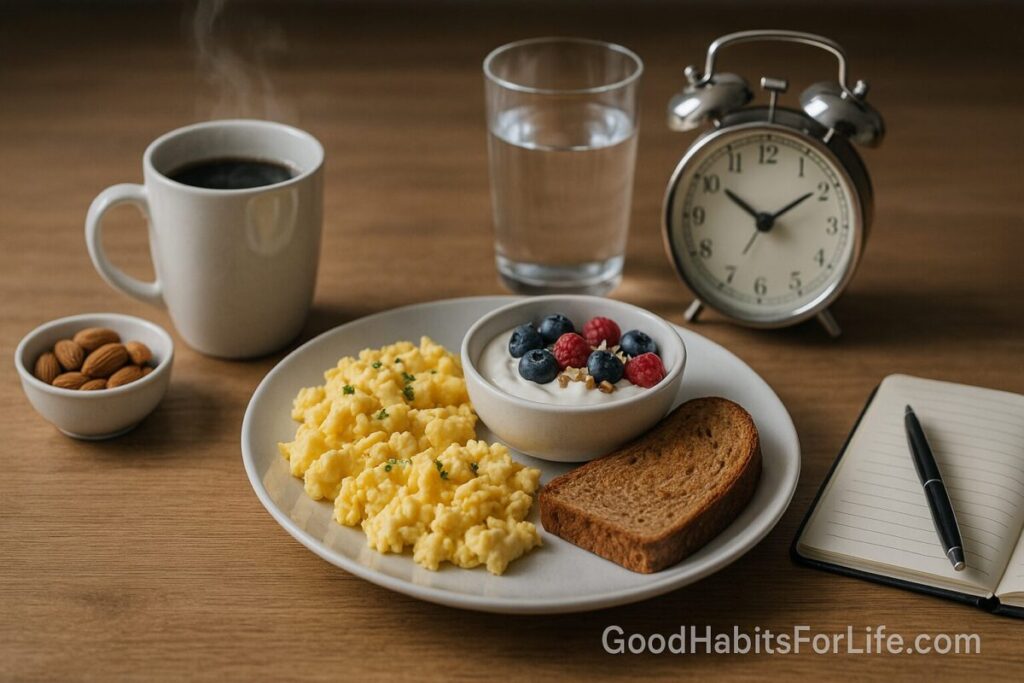
Caffeine & Food: Timing for Calm Energy: Protein-Forward Plan (2025)
Caffeine & Food Timing for Calm Energy (Protein Plan)
Table of Contents
🧭 What This Guide Covers & Why It Works
You’ll learn a simple, research-aligned way to use caffeine with food to avoid spikes and crashes. We’ll combine:
-
Caffeine science: how it blocks adenosine, its half-life, and sleep effects.
-
Meal timing: why a protein-forward meal (20–30 g) early in the day steadies energy and appetite.
-
Practical windows: when to drink, how much, and when to stop.
The result: calm focus, fewer jitters, better sleep, and more consistent productivity.
🧠 How Caffeine Works (and what food changes)
-
What caffeine does: It blocks adenosine receptors, reducing perceived fatigue. Peak blood levels usually occur 30–60 minutes after intake; half-life averages 3–7 hours (varies by genetics, medications, pregnancy, and smoking status).
-
With vs without food: Food can slow the rate of caffeine absorption (later, smoother peak) without meaningfully reducing overall uptake—useful if you’re sensitive to jitters or stomach upset.
-
Cortisol & wake-up: Your body naturally spikes cortisol ~30–45 minutes after waking. Some people feel steadier delaying coffee until after water + breakfast; others do fine with coffee at breakfast. Treat it as an experiment.
-
Sleep: Late-day caffeine reduces sleep time and quality—even when taken 6 hours before bed for many people.
⏱️ Timing Windows for Calm Energy
Morning (0–2 h after waking)
-
Hydrate first (250–500 ml water).
-
Eat a protein-forward meal (see below).
-
Coffee/tea after or with food. If jitter-prone, wait 30–60 min post-meal.
Mid-morning focus block
-
If needed, a second, smaller dose. Avoid stacking large boluses. Try 1 espresso (~60–80 mg) or 200–250 ml coffee (~80–120 mg).
Early afternoon pick-up
-
Optional micro-dose (e.g., green/black tea 30–60 mg or half-cup coffee).
-
Cut-off: last caffeine 6–8 hours before bed (earlier if sensitive).
Evening
-
Choose decaf or herbal. Protect sleep to protect tomorrow’s energy.
🍳 Protein-Forward Breakfast Blueprint (with examples)
Target: 20–30 g protein, steady carbs, and some healthy fat.
Why protein? It improves satiety, helps glycemic control, and stabilizes energy and cravings through the morning.
Easy builds (mix & match):
-
Greek yogurt bowl: 200 g Greek yogurt + nuts/seeds + berries (≈20–25 g protein).
-
Egg scramble: 2–3 eggs + cottage cheese + veggies + whole-grain toast (≈25–30 g).
-
Tofu bhurji wrap: Firm tofu + onions/tomatoes + whole-wheat roti (≈20–25 g).
-
Oats + whey: 60 g oats cooked in milk + 1 scoop whey/isolate (≈30 g).
-
Dal-cheela + curd: Lentil pancakes + 150 g curd (≈20–25 g).
Iron absorption note: Coffee/tea polyphenols reduce non-heme iron absorption. If you rely on plant-based or iron-fortified foods, separate coffee/tea from iron-rich meals or iron supplements by ~1–2 hours.
⚖️ Doses & Personalization (safe limits, special cases)
-
Most healthy adults: keep to ≤400 mg/day total caffeine.
-
Pregnant or trying to conceive: ≤200 mg/day.
-
Per-dose for performance/focus: many respond well to 1–3 mg/kg (e.g., 70–210 mg for a 70 kg adult). Start low.
-
Slower metabolism: pregnancy, certain medications (e.g., oral contraceptives), and genetics prolong half-life—stop earlier in the day.
-
Faster metabolism: smokers often clear caffeine faster (still respect sleep cut-offs).
-
Medical conditions/meds: If you have anxiety disorders, GERD, arrhythmias, or take stimulants or certain antibiotics, talk to your clinician about caffeine.
Typical caffeine amounts (approx.):
-
Brewed coffee 240 ml: 80–120 mg
-
Espresso 30–60 ml: 60–100 mg
-
Black tea 240 ml: 40–70 mg
-
Green tea 240 ml: 25–45 mg
-
Energy drinks 250 ml: 80–160 mg
-
Cola 330 ml: 30–50 mg
-
Dark chocolate 40 g: 20–40 mg
-
Decaf coffee 240 ml: 2–5 mg
🚦 Quick Start: Do-This-Today Checklist
-
Set a cut-off: last caffeine ≥8 hours before bedtime for the first week.
-
Hydrate on waking (250–500 ml).
-
Eat a 20–30 g protein breakfast.
-
Have coffee/tea with or after food.
-
Budget: cap at 300–400 mg (or ≤200 mg if pregnant).
-
Track reactions (jitteriness, focus, sleep). Adjust dose/timing tomorrow.
📅 7-Day “Calm Energy” Plan
Day 1–2:
-
Breakfast: 25 g protein. Coffee after breakfast (≈80–120 mg).
-
Optional tea at 13:00 (30–60 mg). Cut-off set to bedtime minus 8 h.
Day 3–4:
-
Keep breakfast protein. Try smaller, split doses (e.g., 60–80 mg twice).
-
Add 1–2 min breath-downshift before caffeine to check if you truly need it.
Day 5:
-
Tea day (natural L-theanine) for smoother focus.
-
Move any second dose 30 min earlier; protect sleep.
Day 6:
-
Performance day: if a big task, try ~2 mg/kg with food mid-morning.
-
No afternoon caffeine.
Day 7:
-
Deload: decaf or herbal only. Evaluate sleep, mood, and productivity.
-
Set your personalized routine for next week.
🛠️ Techniques & Frameworks
-
Caffeine Budgeting: Decide your daily cap; pre-allocate doses on your calendar.
-
Meal-First Rule: Water → protein-forward meal → caffeine.
-
1-In-1-Out: If you add a shot later, drop the afternoon tea.
-
Tea for Tension: Choose green/black tea when anxious; L-theanine may reduce perceived jitters.
-
Iron-Smart Spacing: Keep coffee/tea ~1–2 h away from iron-rich meals/supplements.
-
Sleep Guardrails: Keep a standing “no caffeine after 14:00–16:00” (adjust for bedtime).
👥 Audience Variations
-
Students/Teens: Emphasize sleep; single morning dose + optional light early-afternoon tea. Avoid energy drink stacking.
-
Professionals: Split doses (mid-morning + early afternoon); use meeting blocks as reminders.
-
Parents: Eat first (you’ll be less jittery on a rushed morning). Keep an herbal fallback for evenings.
-
Seniors: Greater sensitivity common—use smaller doses and an earlier cut-off.
-
Athletes: For training/competition, trial 1–3 mg/kg 60 min pre-event with food; never try new strategies on race day.
⚠️ Mistakes & Myths to Avoid
-
Myth: “Empty-stomach coffee is always bad.” Some tolerate it fine, but it can worsen jitters/reflux—test with food first.
-
Mistake: Chasing dips with big afternoon doses. Use a micro-dose or switch to tea.
-
Mistake: Ignoring iron. Plant-forward eaters: separate coffee/tea from iron.
-
Myth: “Decaf is caffeine-free.” It still has a little caffeine.
-
Mistake: Last-minute evening coffee “to push through.” It often steals tomorrow’s energy.
💬 Real-Life Examples & Scripts
-
Café order (steady): “Small latte and Greek yogurt cup.” (Protein + moderate caffeine.)
-
Office routine: Water → egg wrap → 200 ml coffee at 10:00 → green tea at 14:00 → herbal after 17:00.
-
Study day: Oats + whey at 08:00 → 1 espresso at 09:30 → stop by 14:00.
-
Iron-smart lunch: Spinach dal + lemon. Have coffee at 11:00 and 15:30, not with lunch.
🔧 Tools & Resources
-
Timer/reminder apps (phone/desktop) for cut-off alarms.
-
Simple food scale to learn protein portions (a week of practice is enough).
-
Sleep tracker (any wearable/app) to see your caffeine-sleep relationship.
-
Notebook or notes app for a 1-week caffeine log (time, dose, effect, sleep).
✅ Key Takeaways
-
Pair caffeine with a protein-forward meal to steady absorption and mood.
-
Use mid-morning and early-afternoon windows; stop 6–8 h before bed.
-
Keep within safe daily limits (≤400 mg; ≤200 mg in pregnancy).
-
Protect iron absorption by spacing coffee/tea from iron-rich meals/supplements.
-
Iterate a personal plan with the 7-day routine and cut-off alarms.
❓ FAQs
1) Is coffee on an empty stomach harmful?
Not universally, but many people feel jittery or get reflux. Try water + breakfast first, then coffee.
2) What if I’m very sensitive to caffeine?
Start with tea or half-caf, take it with food, and set an earlier cut-off (e.g., before 13:00).
3) Can protein shakes replace breakfast?
Yes—if they deliver 20–30 g protein and some carbs/fiber. Pair with fruit or oats.
4) How close to workouts should I take caffeine?
Many feel benefits ~60 min pre-workout at 1–3 mg/kg, with food. Test on training days first.
5) Does decaf still affect sleep?
It can in very sensitive people (it contains a small amount of caffeine). Keep decaf earlier if needed.
6) Is tea “calmer” than coffee?
Tea typically has less caffeine per cup and contains L-theanine, which may promote a smoother alertness.
7) How do I estimate my daily intake?
Log each drink and use typical caffeine values (see above). Keep a weekly average ≤400 mg (≤200 mg if pregnant).
8) Do milk or sugar change absorption?
They can slightly change the rate and overall meal glycemia. Focus on protein + fiber and moderate sugars.
📚 References
-
U.S. FDA. Spilling the Beans: How Much Caffeine Is Too Much? https://www.fda.gov/
-
EFSA Panel on Nutrition. Scientific Opinion on the safety of caffeine (2015). https://efsa.europa.eu/
-
Drake C et al. Caffeine effects on sleep taken 0, 3, or 6 hours prior to bedtime. J Clin Sleep Med. 2013. https://pubmed.ncbi.nlm.nih.gov/24235903/
-
NCBI Bookshelf (StatPearls). Caffeine—pharmacology & kinetics. https://www.ncbi.nlm.nih.gov/books/
-
ACOG. Moderate Caffeine Consumption During Pregnancy. https://www.acog.org/
-
NIH ODS. Iron — Fact Sheet for Health Professionals (coffee/tea and non-heme iron). https://ods.od.nih.gov/
-
Clow A et al. The cortisol awakening response (CAR): a review. Int J Psychophysiol. 2004 / Fries E et al., 2009. https://pubmed.ncbi.nlm.nih.gov/
-
Haskell CF et al. The effects of L-theanine, caffeine and their combination on cognition and mood. Nutr Neurosci. 2008/2010. https://pubmed.ncbi.nlm.nih.gov/
-
Leidy HJ et al. Beneficial effects of a higher-protein breakfast on appetite and reward-driven eating. Am J Clin Nutr. 2013. https://pubmed.ncbi.nlm.nih.gov/
-
International Society of Sports Nutrition. Position Stand: Caffeine and Performance (2021). https://jissn.biomedcentral.com/
⚖️ Disclaimer
This guide is for general education and is not medical advice; consult your healthcare professional if you have medical conditions, are pregnant, or take medications.