
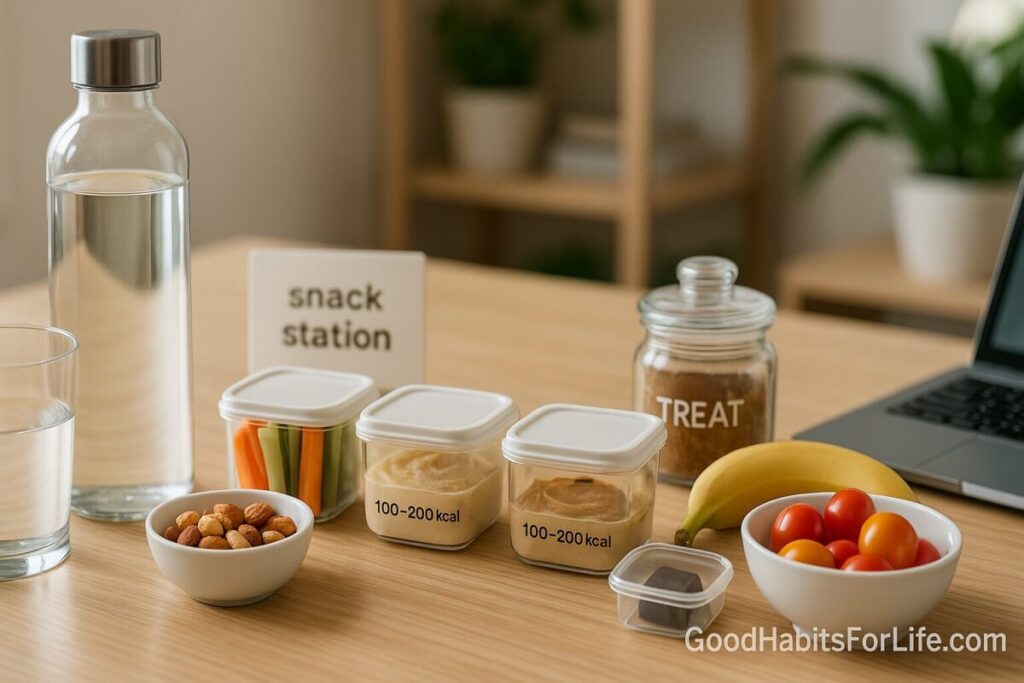
Office Snacking: Cues, Containers & Better Defaults
Office Snacking: Cues, Containers & Better Defaults
Table of Contents
🧭 What This Guide Covers & Why It Works
Office snacking isn’t just hunger—it’s also cues (seeing food), containers (how much is available at hand), and defaults (the easy option when you’re busy). Rather than relying on sheer willpower, you’ll redesign your environment so the simplest choice aligns with your goals.
Why this works
-
Portion & package size drive intake. When food is served or packaged in larger amounts, people unintentionally eat more. Reducing package/plate size and pre-portioning lowers energy intake.
-
Defaults nudge behavior. The item that’s easiest to access (front of the cupboard, on the desk, auto-replenished) becomes the frequent choice.
-
Mindful & intuitive cues (checking hunger, slowing down) reduce autopilot snacking and improve satisfaction without strict rules.
You’ll build a desk setup and micro-routines that:
-
keep nutrient-dense options visible and treats planned,
-
pre-portion snacks (100–200 kcal; ~420–840 kJ),
-
set hydration and fruit/protein as default choices.
✅ Quick Start: Fix Today in 20 Minutes
-
Hydration default (5 min). Put a filled 600–1,000 ml bottle (20–34 fl oz) on your desk. Make water/unsweetened tea the first sip before snacks.
-
Desk audit (5 min). Remove open bags/bulk sweets from your desk. Keep only one ready snack in sight.
-
Right-size containers (5 min). Portion nuts/trail mix into 30 g (≈1 oz) snap-locks; crackers into 25–30 g; hummus 2 tbsp (≈30 g).
-
Pre-decide defaults (5 min). Pick two everyday snacks you’ll reach for first (e.g., apple + peanut butter; yogurt + seeds) and place them at eye level in your fridge/drawer.
Snack ideas (mix & match)
-
Fruit (apple, banana, berries) + 1 tbsp nut butter (15 g)
-
Plain yogurt (150–170 g) + seeds (10 g)
-
Hummus (30 g) + carrots/cucumber (150 g)
-
Roasted chana/chickpeas (25–30 g) or nuts (20–30 g)
-
Whole-grain crackers (25 g) + cheese (20–30 g)
🗓️ 7-Day Starter Plan (Desk + Pantry Reset)
Day 1 – Measure your baseline.
List everything you usually snack on at work for one day; note times and triggers (boredom, meetings, stress).
Day 2 – Clear & contain.
Move all bulk sweets to a closed cupboard two steps away. Set small containers: 5–7 “grab packs” (100–200 kcal each).
Day 3 – Default drinks.
Stock water, soda water, unsweetened tea/coffee. Make sugar-sweetened drinks opt-in only (not on the desk).
Day 4 – Front-row fiber + protein.
Place fruit, yogurt, boiled eggs, paneer/cottage cheese, or roasted chickpeas at the front of the fridge/drawer.
Day 5 – Cue swap.
Replace candy bowl with a fruit bowl. Add a sticky note: “Hungry, Thirsty, or Tired?” (H-T-T check).
Day 6 – Meeting snacks policy (personal).
Bring your own pre-portioned snack to long meetings. Sit away from the pastry tray; plate once and step back.
Day 7 – Review & adjust.
Keep what worked, change one thing that didn’t, and restock containers for the week.
🧠 The Science: Cues, Portion Size & Defaults
-
Portion/pack size effect: Larger packages and dishes lead to greater selection and consumption—even without increased hunger. Reducing package or tableware size can meaningfully cut intake.
-
Choice architecture: Making healthier items more visible/accessible (eye level, first on the table) increases selection rates in cafeterias and offices. Defaults (e.g., “water included”) guide choices without removing options.
-
Processing level matters: Ultra-processed snacks are engineered for palatability and convenience; trials show they can increase energy intake and weight when eaten ad libitum compared with minimally processed foods.
-
Mindful eating: Brief check-ins (hunger/fullness scale, pausing between bites) reduce “mindless” grazing and improve dietary quality.
🛠️ Techniques & Frameworks
The “3-Bin Desk System”
-
Bin A (Front): Ready-to-eat fruit/veg and protein (today’s defaults).
-
Bin B (Middle): Pre-portioned nuts, chickpeas, whole-grain crackers.
-
Bin C (Back/Closed): Treats you enjoy—also pre-portioned. Out of sight.
If-Then Plans (implementation intentions)
-
If it’s <12:00 and I’m peckish, then I’ll drink 250 ml water and wait 10 minutes.
-
If there’s cake in the break room, then I’ll split a slice with a colleague or save a portion for 16:00.
Right-Size Containers (guide)
-
Nuts/trail mix: 20–30 g
-
Roasted chickpeas: 25–30 g
-
Yogurt: 150–170 g
-
Cheese: 20–30 g
-
Hummus: 30 g with 150 g vegetables
-
Whole-grain crackers: 25–30 g
The “HTT” Check (Hungry-Thirsty-Tired)
-
Hungry? Eat a protein+fiber snack.
-
Thirsty? 250 ml water first.
-
Tired? 3-minute walk, 10 breaths, then reassess.
Make Water the Default
-
Bottle on desk (600–1,000 ml), refill at lunch.
-
Offer water/tea first at meetings; sweetened drinks only by request.
Placement & Visibility
-
Fruit bowl in sight; sweets in opaque containers or a cupboard.
-
Place your “default” snack at eye level in the office fridge.
👥 Audience Variations
-
Students/Interns: Keep budget snacks (bananas, yogurt cups, roasted chana) in portions; avoid studying with open family-size bags.
-
Remote/WFH: Apply the same 3-bin system to your kitchen shelf; keep the “treat bin” in a high cupboard.
-
Shift Workers: Add a savory protein default (eggs, paneer/tofu, lentil soup) to curb 02:00 sugar spikes; set refills before shift starts.
-
Managers/HR: Make water the meeting default; move pastries away from the doorway; offer fruit + nuts alongside treats.
⚠️ Mistakes & Myths to Avoid
-
Myth: “Smaller plates don’t matter.”
Reality: While not a magic bullet, reducing portion/package sizes lowers intake on average. -
Mistake: Banning favorite foods.
Fix: Plan treats and pre-portion; restriction often backfires. -
Mistake: Logging every calorie forever.
Fix: Use short “awareness sprints” (1–2 weeks) to recalibrate, then rely on cues and environment. -
Myth: “Healthy snacks must be expensive.”
Reality: Fruit, boiled eggs, yogurt, roasted legumes are affordable, portable, and filling.
💬 Real-Life Examples & Scripts
-
Slack to team before a meeting:
“I’m setting water and fruit as the first option for today’s sync. Pastries are there too—help yourself after you’ve grabbed something hydrating.” -
At the break room:
“That looks great—I’ll take a small piece now and save the rest for later.” -
Self-prompt on your monitor:
“Default: water + fruit. Treats are planned, not banned.”
🔧 Tools, Apps & Resources
-
Containers: 120–250 ml snap-locks or silicone snack bags for right-size portions.
-
Timer apps: 10-minute pause before snacking; gentle notifications.
-
Food awareness apps: Use for a 7–14 day sprint to learn true portions; then switch off.
-
Reusable bottle: 600–1,000 ml with volume markers to hit 1.5–2.0 L/day (approx. 50–68 fl oz).
📌 Key Takeaways
-
Design beats discipline: shrink packages, move food, set defaults.
-
Keep protein + fiber handy; make water the first step.
-
Use pre-portioned containers and a 3-bin system at your desk.
-
Plan treats—don’t fight them all day.
-
Review weekly; restock containers every Sunday or Monday.
❓FAQs
1) What’s a good calorie target for a snack?
Most people do well with 100–200 kcal (≈420–840 kJ), higher if very active or if meals are far apart.
2) Are nuts “too high-calorie” for work?
In small portions (20–30 g), nuts are filling and nutrient-dense. Pre-portion to avoid grazing from the bag.
3) Is fruit bad because of sugar?
Whole fruit comes with fiber, water, and micronutrients. It’s not comparable to sugary drinks or sweets.
4) I drink a lot of sweet tea/coffee at work—what’s the fix?
Shift the default: water first; then tea/coffee unsweetened or with less sugar. Keep syrups/sugar as an opt-in.
5) What if my office always has pastries?
Plate once, step away, and add protein (yogurt, cheese, eggs) to feel satisfied. Consider splitting a portion.
6) How do I stop snacking when stressed?
Use the HTT check. If tired or stressed, try a 3-minute walk, 10 deep breaths, or a quick chat before eating.
7) Do smaller bowls really change intake?
They help on average, especially combined with pre-portioned packs and out-of-sight storage.
8) Is calorie counting necessary?
Not long-term. Do a short awareness sprint to learn portions, then rely on cues and your environment design.
📚 References
-
Cochrane Review: Portion, package or tableware size for changing selection and consumption of food (Hollands et al.). https://www.cochranelibrary.com/cdsr/doi/10.1002/14651858.CD011045.pub2/full
-
CDC Workplace Health: Nutrition—guidance and resources for worksites. https://www.cdc.gov/workplacehealthpromotion/health-strategies/nutrition/index.html
-
WHO: Healthy diet—dietary patterns and recommendations. https://www.who.int/news-room/fact-sheets/detail/healthy-diet
-
Harvard T.H. Chan School of Public Health—The Nutrition Source: Snacking. https://www.hsph.harvard.edu/nutritionsource/snacking
-
Hall et al., 2019. Ultra-Processed Diets Cause Excess Calorie Intake and Weight Gain (randomized controlled trial). Cell Metabolism. https://www.cell.com/cell-metabolism/fulltext/S1550-4131(19)30248-7
-
Cadario R, Chandon P., 2020. Which Healthy Eating Nudges Work Best? Meta-analysis of field experiments. Marketing Science. https://doi.org/10.1287/mksc.2019.1198
-
Harvard Health Publishing—Mindful eating overview and techniques. https://www.health.harvard.edu/staying-healthy/mindful-eating
-
American Heart Association—Added Sugars recommendations. https://www.heart.org/en/healthy-living/healthy-eating/eat-smart/sugar/added-sugars
-
UK Government / Public Health England—Food and Drink in the Workplace & catering guidelines. https://www.gov.uk/government/publications/healthy-workplace-food-and-drink
-
NIH NIDDK—Changing eating behaviors for better health (mindful strategies). https://www.niddk.nih.gov/health-information/weight-management/healthy-eating-physical-activity
Disclaimer: This article is general information only and not a substitute for personal medical or nutrition advice.